ECU CADILLAC ESCALADE 2008 3.G Workshop Manual
[x] Cancel search | Manufacturer: CADILLAC, Model Year: 2008, Model line: ESCALADE, Model: CADILLAC ESCALADE 2008 3.GPages: 490, PDF Size: 2.65 MB
Page 298 of 490
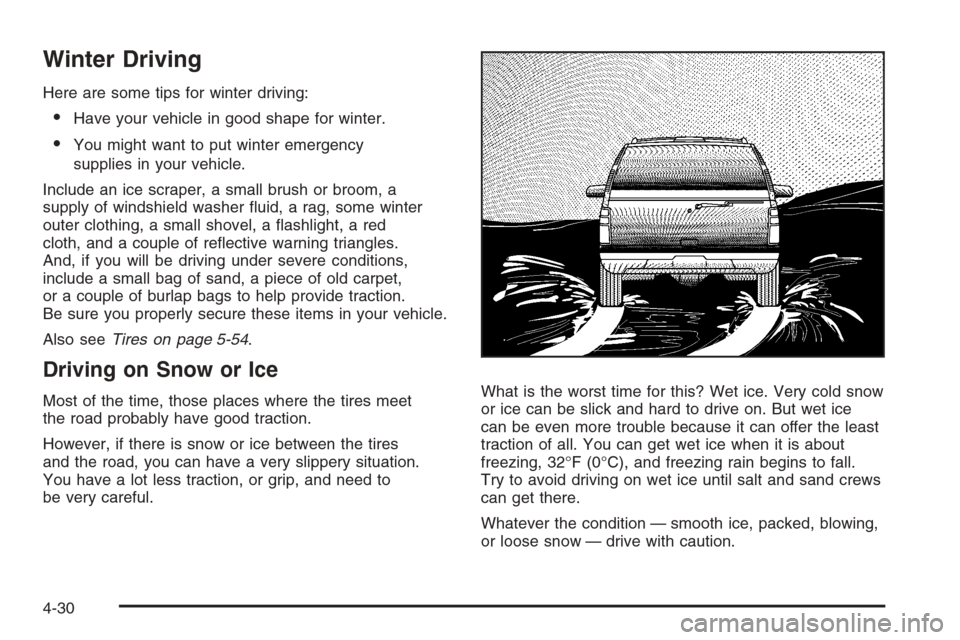
Winter Driving
Here are some tips for winter driving:
Have your vehicle in good shape for winter.
You might want to put winter emergency
supplies in your vehicle.
Include an ice scraper, a small brush or broom, a
supply of windshield washer uid, a rag, some winter
outer clothing, a small shovel, a ashlight, a red
cloth, and a couple of reective warning triangles.
And, if you will be driving under severe conditions,
include a small bag of sand, a piece of old carpet,
or a couple of burlap bags to help provide traction.
Be sure you properly secure these items in your vehicle.
Also seeTires on page 5-54.
Driving on Snow or Ice
Most of the time, those places where the tires meet
the road probably have good traction.
However, if there is snow or ice between the tires
and the road, you can have a very slippery situation.
You have a lot less traction, or grip, and need to
be very careful.What is the worst time for this? Wet ice. Very cold snow
or ice can be slick and hard to drive on. But wet ice
can be even more trouble because it can offer the least
traction of all. You can get wet ice when it is about
freezing, 32°F (0°C), and freezing rain begins to fall.
Try to avoid driving on wet ice until salt and sand crews
can get there.
Whatever the condition — smooth ice, packed, blowing,
or loose snow — drive with caution.
4-30
Page 308 of 490
Using heavier suspension components to get
added durability might not change your weight
ratings. Ask your dealer to help you load
your vehicle the right way.
If you put things inside your vehicle — like
suitcases, tools, packages, or anything
else — they will go as fast as the vehicle
goes. If you have to stop or turn quickly,
or if there is a crash, they will keep going.
{CAUTION:
Things you put inside your vehicle can
strike and injure people in a sudden stop
or turn, or in a crash.
Put things in the cargo area of your
vehicle. Try to spread the weight
evenly.
Never stack heavier things, like
suitcases, inside the vehicle so that
some of them are above the tops
of the seats.
CAUTION: (Continued)
CAUTION: (Continued)
Do not leave an unsecured child
restraint in your vehicle.
When you carry something inside the
vehicle, secure it whenever you can.
Do not leave a seat folded down
unless you need to.
There is also important loading information for
off-road driving in this manual. See “Loading Your
Vehicle for Off-Road Driving” underOff-Road
Driving on page 4-12.
Add-On Equipment
When you carry removable items, you may need to
put a limit on how many people you can carry inside
your vehicle. Be sure to weigh your vehicle before
you buy and install the new equipment.
Notice:Overloading your vehicle may cause
damage. Repairs would not be covered by your
warranty. Do not overload your vehicle.
Remember not to exceed the Gross Axle Weight
Rating (GAWR) of the front or rear axle.
4-40
Page 311 of 490
Dolly Towing
Two-Wheel-Drive Vehicles
(Rear Wheels Off the Ground)
Notice:If you tow a two-wheel-drive vehicle with
the rear wheels on the ground, the transmission
could be damaged. The repairs would not be
covered by your warranty. Never tow your vehicle
with the rear wheels on the ground.
Two-wheel-drive vehicles should not be towed with
the rear wheels on the ground. Two-wheel-drive
transmissions have no provisions for internal
lubrication while being towed.
Two-wheel-drive vehicles can be towed on a dolly
with the front wheels on the ground provided that
the wheels are straight.
Use the following procedure to dolly tow your vehicle:
1. Drive the vehicle up onto the tow dolly.
2. Shift the transmission to PARK (P).
3. Turn the engine off, but leave the ignition on.
4. Firmly set the parking brake.
5. Securely attach the vehicle being towed to the
tow dolly.
6. Release the parking brake only after the vehicle
being towed is rmly attached to the towing vehicle.
Autoride®
The Autoride®feature provides improved vehicle
ride and handling under a variety of passenger and
loading conditions.
The system is fully automatic and uses a computer
controller to continuously monitor vehicle speed,
wheel to body position, lift/dive and steering position
of the vehicle. The controller then sends signals to each
shock absorber to independently adjust the damping
level to provide the optimum vehicle ride.
Autoride
®also interacts with the tow/haul mode that,
when activated, will provide additional control of
the shock absorbers. This additional control results
in better ride and handling characteristics when
the vehicle is loaded or towing a trailer. See “Tow/Haul
Mode” underTowing a Trailer on page 4-44for more
information.
4-43
Page 315 of 490
Weight of the Trailer
How heavy can a trailer safely be?
It depends on how you plan to use your rig. For example,
speed, altitude, road grades, outside temperature and
how much your vehicle is used to pull a trailer are all
important. It can also depend on any special equipment
that you have on your vehicle, and the amount of tongue
weight the vehicle can carry. See “Weight of the Trailer
Tongue” later in this section for more information.Maximum trailer weight is calculated assuming only the
driver is in the tow vehicle and it has all the required
trailering equipment. The weight of additional optional
equipment, passengers and cargo in the tow vehicle
must be subtracted from the maximum trailer weight.
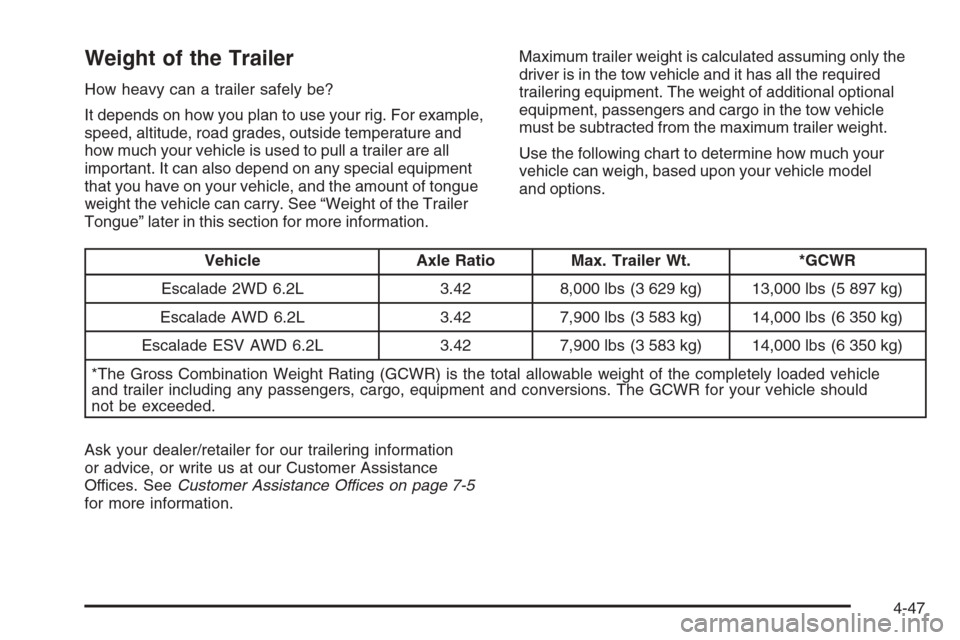
Use the following chart to determine how much your
vehicle can weigh, based upon your vehicle model
and options.
Vehicle Axle Ratio Max. Trailer Wt. *GCWR
Escalade 2WD 6.2L 3.42 8,000 lbs (3 629 kg) 13,000 lbs (5 897 kg)
Escalade AWD 6.2L 3.42 7,900 lbs (3 583 kg) 14,000 lbs (6 350 kg)
Escalade ESV AWD 6.2L 3.42 7,900 lbs (3 583 kg) 14,000 lbs (6 350 kg)
*The Gross Combination Weight Rating (GCWR) is the total allowable weight of the completely loaded vehicle
and trailer including any passengers, cargo, equipment and conversions. The GCWR for your vehicle should
not be exceeded.
Ask your dealer/retailer for our trailering information
or advice, or write us at our Customer Assistance
Offices. SeeCustomer Assistance Offices on page 7-5
for more information.
4-47
Page 321 of 490
Towing a trailer requires a certain amount of experience.
Before setting out for the open road, you’ll want to
get to know your rig. Acquaint yourself with the feel
of handling and braking with the added weight of
the trailer. And always keep in mind that the vehicle
you are driving is now a good deal longer and not
nearly as responsive as your vehicle is by itself.
Before you start, check all trailer hitch parts and
attachments, safety chains, electrical connector, lamps,
tires and mirror adjustment. If the trailer has electric
brakes, start your vehicle and trailer moving and
then apply the trailer brake controller by hand to be
sure the brakes are working. This lets you check your
electrical connection at the same time.
During your trip, check occasionally to be sure that
the load is secure, and that the lamps and any trailer
brakes are still working.
Following Distance
Stay at least twice as far behind the vehicle ahead
as you would when driving your vehicle without a
trailer. This can help you avoid situations that require
heavy braking and sudden turns.
Passing
You’ll need more passing distance up ahead when
you’re towing a trailer. And, because you’re a good
deal longer, you’ll need to go much farther beyond the
passed vehicle before you can return to your lane.
Backing Up
Hold the bottom of the steering wheel with one hand.
Then, to move the trailer to the left, just move that hand
to the left. To move the trailer to the right, move your
hand to the right. Always back up slowly and, if possible,
have someone guide you.
Making Turns
Notice:Making very sharp turns while trailering
could cause the trailer to come in contact with
the vehicle. Your vehicle could be damaged.
Avoid making very sharp turns while trailering.
When you’re turning with a trailer, make wider turns than
normal. Do this so your trailer won’t strike soft shoulders,
curbs, road signs, trees or other objects. Avoid jerky
or sudden maneuvers. Signal well in advance.
4-53
Page 350 of 490
Coolant Surge Tank Pressure Cap
Notice:If the pressure cap is not tightly installed,
coolant loss and possible engine damage may
occur. Be sure the cap is properly and tightly
secured.
The coolant surge tank pressure cap must be fully
installed on the coolant surge tank. SeeEngine
Compartment Overview on page 5-12for more
information on location.
Engine Overheating
You will nd a coolant temperature gage on your
vehicle’s instrument panel. SeeEngine Coolant
Temperature Gage on page 3-42.
In addition, the messages ENGINE OVERHEATED
STOP ENGINE, ENGINE OVERHEATED IDLE
ENGINE, or ENGINE POWER IS REDUCED could
appear in the Driver Information Center (DIC) on
the instrument panel. SeeDIC Warnings and
Messages on page 3-52.
If Steam Is Coming From Your Engine
{CAUTION:
Steam from an overheated engine can burn
you badly, even if you just open the hood.
Stay away from the engine if you see or hear
steam coming from it. Turn it off and get
everyone away from the vehicle until it cools
down. Wait until there is no sign of steam or
coolant before you open the hood.
If you keep driving when the vehicles engine
is overheated, the liquids in it can catch re.
You or others could be badly burned. Stop
your engine if it overheats, and get out of the
vehicle until the engine is cool.
SeeOverheated Engine Protection Operating
Mode on page 5-28for information on driving
to a safe place in an emergency.
Notice:If your engine catches re because you keep
driving with no coolant, your vehicle can be badly
damaged. The costly repairs would not be covered by
your warranty. SeeOverheated Engine Protection
Operating Mode on page 5-28for information on
driving to a safe place in an emergency.
5-26
Page 392 of 490
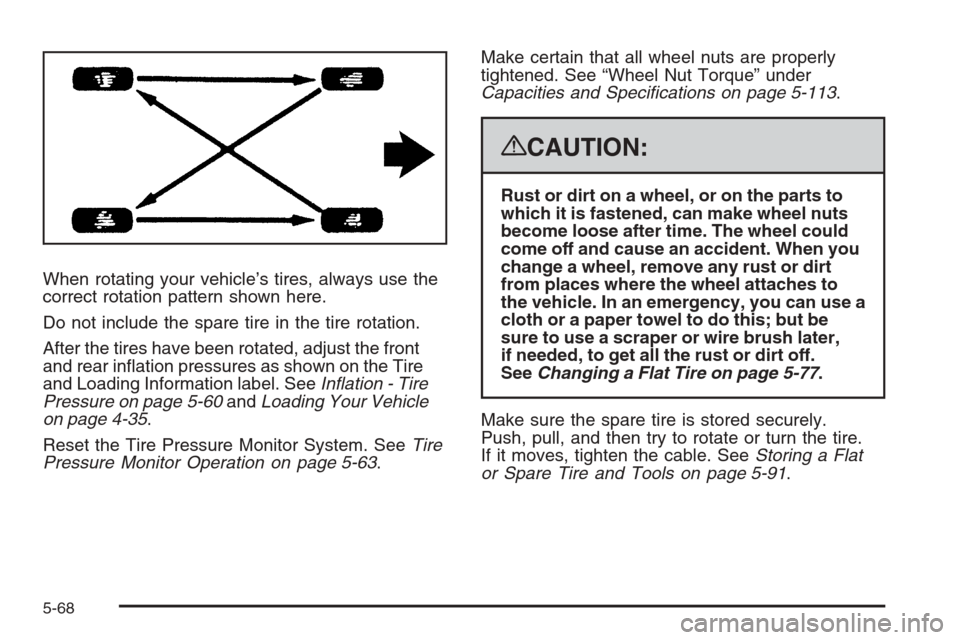
When rotating your vehicle’s tires, always use the
correct rotation pattern shown here.
Do not include the spare tire in the tire rotation.
After the tires have been rotated, adjust the front
and rear ination pressures as shown on the Tire
and Loading Information label. SeeInflation - Tire
Pressure on page 5-60andLoading Your Vehicle
on page 4-35.
Reset the Tire Pressure Monitor System. SeeTire
Pressure Monitor Operation on page 5-63.Make certain that all wheel nuts are properly
tightened. See “Wheel Nut Torque” under
Capacities and Specifications on page 5-113.
{CAUTION:
Rust or dirt on a wheel, or on the parts to
which it is fastened, can make wheel nuts
become loose after time. The wheel could
come off and cause an accident. When you
change a wheel, remove any rust or dirt
from places where the wheel attaches to
the vehicle. In an emergency, you can use a
cloth or a paper towel to do this; but be
sure to use a scraper or wire brush later,
if needed, to get all the rust or dirt off.
SeeChanging a Flat Tire on page 5-77.
Make sure the spare tire is stored securely.
Push, pull, and then try to rotate or turn the tire.
If it moves, tighten the cable. SeeStoring a Flat
or Spare Tire and Tools on page 5-91.
5-68
Page 413 of 490
5. If the spare does not lower, turn the wrench
counterclockwise until approximately 6 inches
(15 cm) of cable is exposed.
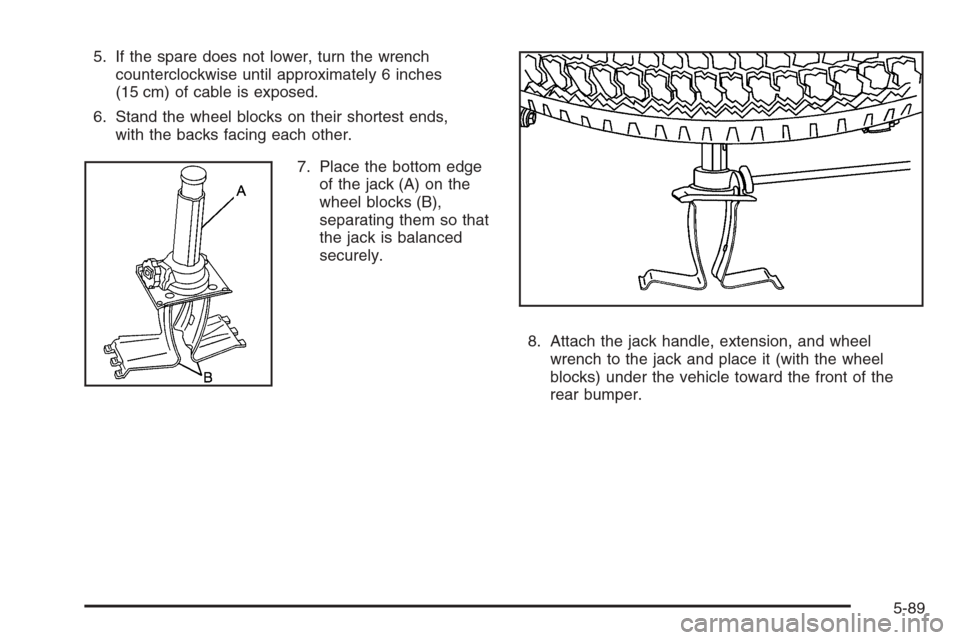
6. Stand the wheel blocks on their shortest ends,
with the backs facing each other.
7. Place the bottom edge
of the jack (A) on the
wheel blocks (B),
separating them so that
the jack is balanced
securely.
8. Attach the jack handle, extension, and wheel
wrench to the jack and place it (with the wheel
blocks) under the vehicle toward the front of the
rear bumper.
5-89
Page 418 of 490
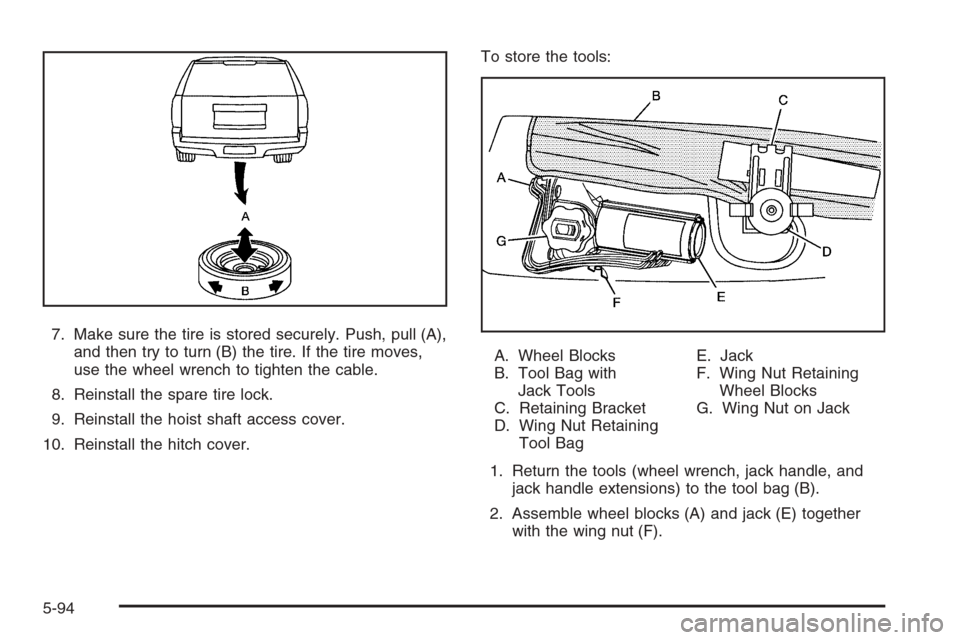
7. Make sure the tire is stored securely. Push, pull (A),
and then try to turn (B) the tire. If the tire moves,
use the wheel wrench to tighten the cable.
8. Reinstall the spare tire lock.
9. Reinstall the hoist shaft access cover.
10. Reinstall the hitch cover.To store the tools:
A. Wheel Blocks
B. Tool Bag with
Jack Tools
C. Retaining Bracket
D. Wing Nut Retaining
Tool BagE. Jack
F. Wing Nut Retaining
Wheel Blocks
G. Wing Nut on Jack
1. Return the tools (wheel wrench, jack handle, and
jack handle extensions) to the tool bag (B).
2. Assemble wheel blocks (A) and jack (E) together
with the wing nut (F).
5-94
Page 419 of 490
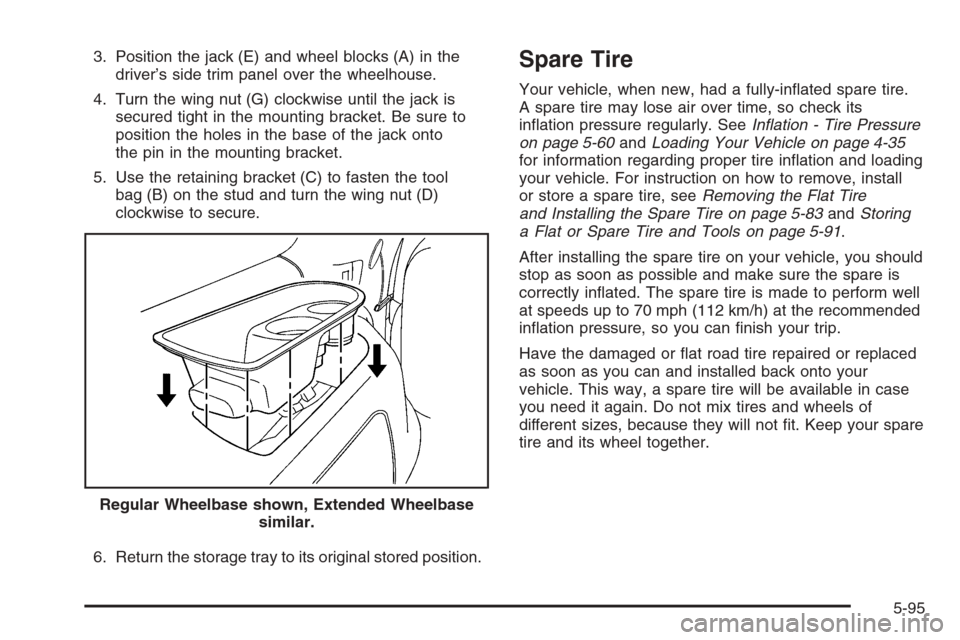
3. Position the jack (E) and wheel blocks (A) in the
driver’s side trim panel over the wheelhouse.
4. Turn the wing nut (G) clockwise until the jack is
secured tight in the mounting bracket. Be sure to
position the holes in the base of the jack onto
the pin in the mounting bracket.
5. Use the retaining bracket (C) to fasten the tool
bag (B) on the stud and turn the wing nut (D)
clockwise to secure.
6. Return the storage tray to its original stored position.Spare Tire
Your vehicle, when new, had a fully-inated spare tire.
A spare tire may lose air over time, so check its
ination pressure regularly. SeeInflation - Tire Pressure
on page 5-60andLoading Your Vehicle on page 4-35
for information regarding proper tire ination and loading
your vehicle. For instruction on how to remove, install
or store a spare tire, seeRemoving the Flat Tire
and Installing the Spare Tire on page 5-83andStoring
a Flat or Spare Tire and Tools on page 5-91.
After installing the spare tire on your vehicle, you should
stop as soon as possible and make sure the spare is
correctly inated. The spare tire is made to perform well
at speeds up to 70 mph (112 km/h) at the recommended
ination pressure, so you can nish your trip.
Have the damaged or at road tire repaired or replaced
as soon as you can and installed back onto your
vehicle. This way, a spare tire will be available in case
you need it again. Do not mix tires and wheels of
different sizes, because they will not t. Keep your spare
tire and its wheel together.
Regular Wheelbase shown, Extended Wheelbase
similar.
5-95