roof CADILLAC ESCALADE 2010 3.G User Guide
[x] Cancel search | Manufacturer: CADILLAC, Model Year: 2010, Model line: ESCALADE, Model: CADILLAC ESCALADE 2010 3.GPages: 616, PDF Size: 39.41 MB
Page 122 of 616
different vehicle. Any object, such as an aftermarketseat heater or a comfort enhancing pad or device,installed under or on top of the seat fabric, couldalso interfere with the operation of the passengersensing system. This could either prevent properdeployment of the passenger airbag(s) or preventthe passenger sensing system from properly turningoff the passenger airbag(s). SeePassenger SensingSystem on page 2!84.
If you have any questions, call CustomerAssistance. The phone numbers and addresses forCustomer Assistance are in Step Two of theCustomer Satisfaction Procedure in this manual.SeeCustomer Satisfaction Procedure on page 9!2.
If the vehicle has rollover roof-rail airbags, seeDifferent Size Tires and Wheelson page 7!75foradditional important information.
Q: Because I have a disability, I have to get myvehicle modified. How can I find out whether thiswill affect my airbag system?
A:If you have questions, call Customer Assistance.The phone numbers and addresses for CustomerAssistance are in Step Two of the CustomerSatisfaction Procedure in this manual. SeeCustomer Satisfaction Procedure on page 9!2.
In addition, your dealer/retailer and the service manualhave information about the location of the airbagsensors, sensing and diagnostic module andairbag wiring.
2-90
Page 126 of 616
Section 3 Features and Controls
Mirrors. . . . . . . . . . . . . . . . . . . . . . . . . . . . . . . . . . . . . . . . . . . . 3-43Manual Rearview Mirror . . . . . . . . . . . . . . . . . . . . . . . . 3-43Automatic Dimming Rearview Mirror . . . . . . . . . . . 3-43Outside Power Foldaway Mirrors . . . . . . . . . . . . . . 3-43Park Tilt Mirrors . . . . . . . . . . . . . . . . . . . . . . . . . . . . . . . . 3-44Outside Convex Mirror . . . . . . . . . . . . . . . . . . . . . . . . . 3-45Outside Heated Mirrors . . . . . . . . . . . . . . . . . . . . . . . . 3-45
Object Detection Systems. . . . . . . . . . . . . . . . . . . . . . . 3-46Ultrasonic Rear Parking Assist (URPA) . . . . . . . . 3-46Side Blind Zone Alert (SBZA) . . . . . . . . . . . . . . . . . . 3-48Rear Vision Camera (RVC) . . . . . . . . . . . . . . . . . . . . 3-51
Universal Home Remote System. . . . . . . . . . . . . . . . 3-55Universal Home Remote System Operation(With Three Round LED) . . . . . . . . . . . . . . . . . . . . 3-55
Storage Areas. . . . . . . . . . . . . . . . . . . . . . . . . . . . . . . . . . . . 3-62Glove Box . . . . . . . . . . . . . . . . . . . . . . . . . . . . . . . . . . . . . 3-62Cupholders . . . . . . . . . . . . . . . . . . . . . . . . . . . . . . . . . . . . 3-62Center Console Storage . . . . . . . . . . . . . . . . . . . . . . 3-64Assist Handles . . . . . . . . . . . . . . . . . . . . . . . . . . . . . . . . . 3-64Garment Hooks . . . . . . . . . . . . . . . . . . . . . . . . . . . . . . . . 3-64Roof Rack System . . . . . . . . . . . . . . . . . . . . . . . . . . . . . 3-64Rear Storage Area . . . . . . . . . . . . . . . . . . . . . . . . . . . . . 3-66Rear Seat Armrest . . . . . . . . . . . . . . . . . . . . . . . . . . . . . 3-66
Sunroof. . . . . . . . . . . . . . . . . . . . . . . . . . . . . . . . . . . . . . . . . . . 3-66
3-2
Page 152 of 616
C (ON/RUN) :This position can be used to operate theelectrical accessories and to display some instrumentpanel cluster warning and indicator lights. The switchstays in this position when the engine is running.The transmission is also unlocked in this position onautomatic transmission vehicles.
If you leave the key in the ACC/ACCESSORY orON/RUN position with the engine off, the batterycould be drained. You may not be able to start thevehicle if the battery is allowed to drain for an extendedperiod of time.
D (START) :This is the position that starts the engine.When the engine starts, release the key. The ignitionswitch returns to ON/RUN for driving.
A warning tone will sound when the driver door isopened, the ignition is in ACC/ACCESSORY orLOCK/OFF and the key is in the ignition.
Retained Accessory Power (RAP)
The following vehicle accessories can be used for up to10 minutes after the engine is turned off:
.Audio System
.Power Windows
.OnStar®System (if equipped)
.Sunroof (if equipped)
These features work when the key is in ON/RUN orACC/ACCESSORY. Once the key is turned fromON/RUN to LOCK/OFF, the windows and sunroofcontinue to work up to 10 minutes until any door isopened. The radio continues to work for up to10 minutes or until the driver door is opened.
3-28
Page 188 of 616
Center Console Storage
A console compartment is located between thebucket seats.
The console has both an upper and lower storage binaccessed by lifting up on the latches located at the frontof the console lid.
The console may have an accessory power outletinside. SeeAccessory Power Outlet(s) on page 4!19.
The rear of the console also has a cupholder thatswings down for the rear seat passengers to use.
Assist Handles
Assist handles located above the rear passenger doorscan be used when getting out of the vehicle. Pull thehandles downward to use them.
Garment Hooks
There are garment hooks located on the assist handles.
Roof Rack System
{WARNING:
If something is carried on top of the vehicle that is
longer or wider than the roof rack—like paneling,
plywood, or a mattress—the wind can catch it
while the vehicle is being driven. The item being
carried could be violently torn off, and this could
cause a collision, and damage the vehicle. Never
carry something longer or wider than the roof rack
on top of the vehicle unless using a GM Certified
accessory carrier.
For vehicles with a roof rack, the rack can be used toload items. For roof racks that do not have crossrailsincluded, GM Certified crossrails can be purchased asan accessory. See your dealer/retailer for additionalinformation.
For vehicles with crossrails, they can be movedback and forth to help secure cargo. To adjust them,turn the knob located at each end of the crossrailcounterclockwise until the crossrail can move freely.To secure the crossrail, turn the knob located at eachend of the crossrail clockwise until tightened. Tie theload to the siderails or siderail supports.
3-64
Page 189 of 616
Notice:Loading cargo on the roof rack that weighsmore than 91 kg (200 lbs) or hangs over the rear orsides of the vehicle may damage the vehicle. Loadcargo so that it rests evenly between the crossrails,making sure to fasten cargo securely.
To prevent damage or loss of cargo when driving,check to make sure crossrails and cargo are securelyfastened. Loading cargo on the roof rack will make thevehicle’s center of gravity higher. Avoid high speeds,sudden starts, sharp turns, sudden braking or abruptmaneuvers, otherwise it may result in loss of control.If driving for a long distance, on rough roads, or at highspeeds, occasionally stop the vehicle to make sure thecargo remains in its place.
Do not exceed the maximum vehicle capacity whenloading the vehicle. For more information on vehiclecapacity and loading, seeLoading the Vehicleonpage 6!32.
To prevent damage or loss of cargo, check now andthen to make sure the luggage and cargo are stillsecurely fastened.
Be sure the cargo is properly loaded.
.If small heavy objects are placed on the roof, placethe load in the area over the rear wheels (behindthe rear side door on extended models). If needed,cut a piece of 3/8 inch plywood to fit inside thecrossrails and siderails to spread the load.If plywood is used, tie it to the siderail supports.
.Tie the load to the crossrails or the siderailsupports. Use the crossrails only to keep theload from sliding. To move the crossrails, pull outon the latch release handle at each end. Slide thecrossrail to the desired position balancing the forceside to side. Push the release handle back into thelatched position and slide the crossrail back andforth slightly to be sure the latch snaps securelyinto place.
.If needed to carry long items, move the crossrailsas far apart as they will go. Tie the load to thecrossrails and the siderails or siderail supports.Also tie the load to the bumpers. Do not tie theload so tightly that the crossrails or siderailsare damaged.
.After moving a crossrail, be sure it is securelylocked into the siderail.
A Center High-Mounted Stoplamp (CHMSL) is locatedabove the glass or above the rear load doors.
If items are loaded on the roof of the vehicle, careshould be taken not to block or damage theCHMSL unit.
3-65
Page 190 of 616
Rear Storage Area
For vehicles with a rear storage area, it is located inthe rear cargo area of the vehicle on the driver's sidetrim panel.
Turn the knobs and swing the storage door to accessthe storage compartment. The door can be removed.
Rear Seat Armrest
For vehicle with an armrest/storage compartmentlocated by the second row seat, pull the loop at the topof the armrest out to lower the armrest.
Push the button on the front of the armrest and pull thetop up to open the compartment.
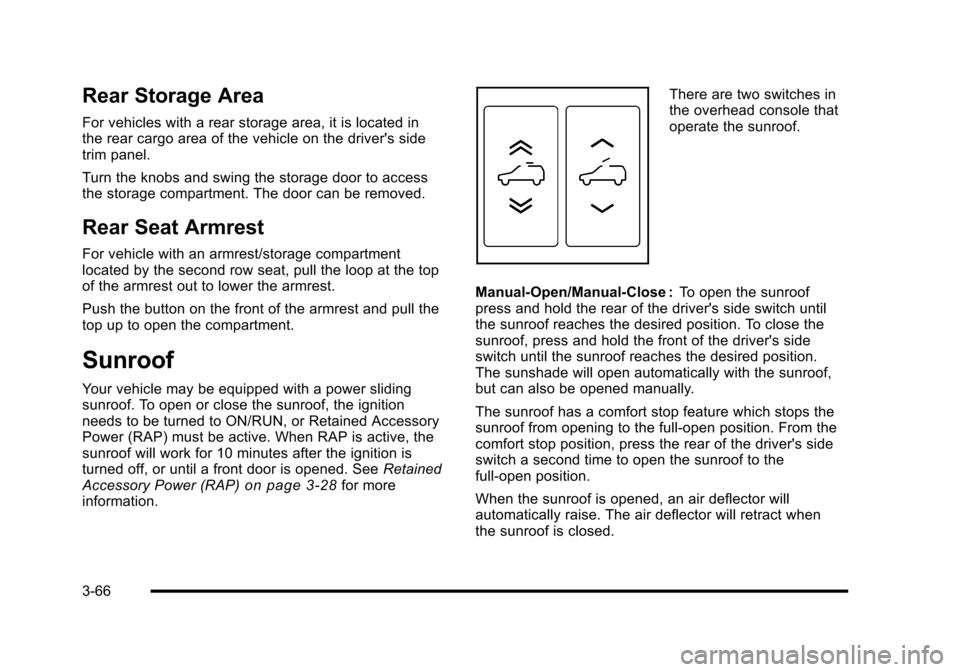
Sunroof
Your vehicle may be equipped with a power slidingsunroof. To open or close the sunroof, the ignitionneeds to be turned to ON/RUN, or Retained AccessoryPower (RAP) must be active. When RAP is active, thesunroof will work for 10 minutes after the ignition isturned off, or until a front door is opened. SeeRetainedAccessory Power (RAP)on page 3!28for moreinformation.
There are two switches inthe overhead console thatoperate the sunroof.
Manual-Open/Manual-Close :To open the sunroofpress and hold the rear of the driver's side switch untilthe sunroof reaches the desired position. To close thesunroof, press and hold the front of the driver's sideswitch until the sunroof reaches the desired position.The sunshade will open automatically with the sunroof,but can also be opened manually.
The sunroof has a comfort stop feature which stops thesunroof from opening to the full-open position. From thecomfort stop position, press the rear of the driver's sideswitch a second time to open the sunroof to thefull-open position.
When the sunroof is opened, an air deflector willautomatically raise. The air deflector will retract whenthe sunroof is closed.
3-66
Page 191 of 616
Express-Open/Express-Close :To express-open thesunroof, fully press and release the rear of the driver'sside switch. The sunroof will open automatically. To stopthe sunroof partway, press the switch a second time.To express-close the sunroof, fully press and releasethe front of the driver's side switch. The sunroof willclose automatically. To stop the sunroof partway, pressthe switch a second time. The sunshade will openautomatically with the sunroof, but can also beopened manually.
The sunroof has a comfort stop feature which stops thesunroof from opening to the full-open position. From thecomfort stop position, press the rear of the driver's sideswitch a second time to open the sunroof to thefull-open position.
When the sunroof is opened, an air deflector willautomatically raise. The air deflector will retract whenthe sunroof is closed.
Vent :The sunroof has an express-vent open feature.From the closed position, press the rear of thepassenger's side switch to vent the sunroof. To stopthe sunroof partway, press the switch a second time.To close the sunroof, press and hold the front of thepassenger's side switch. To stop the sunroof partway,release the switch.
Anti-Pinch Feature :If an object is in the path of thesunroof while it is closing, the anti-pinch feature willdetect the object and stop the sunroof from closing atthe point of the obstruction. The sunroof will then openhalfway, and the air deflector will raise. To close thesunroof once it has re-opened, refer to the“Express-Close”or“Manual-Close”functions describedpreviously. If the sunroof is in the vent position, andthere is an object in the path of the sunroof when itclosing, the anti-pinch feature will detect the object andstop the sunroof. To close the sunroof once it hasre-opened, refer to the“Manual-Close”or“Express-Close”functions described previously.
Do not keep the sunroof open for long periods of timewhile the vehicle is not in use. Debris can collect in thetracks, damage the sunroof operation and plug thewater draining system.
3-67
Page 240 of 616
Compass Calibration
The compass can be manually calibrated. Only calibratethe compass in a magnetically clean and safe location,such as an open parking lot, where driving the vehiclein circles is not a danger. It is suggested to calibrateaway from tall buildings, utility wires, manhole covers,or other industrial structures, if possible.
If CAL should ever appear in the DIC display, thecompass should be calibrated.
If the DIC display does not show a heading, forexample, N for North, or the heading does not changeafter making turns, there may be a strong magnetic fieldinterfering with the compass. Such interference may becaused by a magnetic CB or cell phone antenna mount,a magnetic emergency light, magnetic note pad holder,or any other magnetic item. Turn off the vehicle, movethe magnetic item, then turn on the vehicle and calibratethe compass.
To calibrate the compass, use the following procedure:
Compass Calibration Procedure
1. Before calibrating the compass, make sure thecompass zone is set to the variance zone in whichthe vehicle is located. See“Compass Variance(Zone) Procedure”earlier in this section.
Do not operate any switches such as window,sunroof, climate controls, seats, etc. during thecalibration procedure.
2. Press the vehicle information button until
PRESSVTO CALIBRATE COMPASS displays.
3. Press the set/reset button to start the compasscalibration.
4. The DIC will display CALIBRATING: DRIVE INCIRCLES. Drive the vehicle in tight circles at lessthan 5 mph (8 km/h) to complete the calibration.The DIC will display CALIBRATION COMPLETEfor a few seconds when the calibration is complete.The DIC display will then return to theprevious menu.
DIC Warnings and Messages
Messages are displayed on the DIC to notify the driverthat the status of the vehicle has changed and thatsome action may be needed by the driver to correct thecondition. Multiple messages may appear one afteranother.
Some messages may not require immediate action, butyou can press any of the DIC buttons on the instrumentpanel to acknowledge that you received the messagesand to clear them from the display.
Some messages cannot be cleared from the DICdisplay because they are more urgent. Thesemessages require action before they can be cleared.
4-48
Page 300 of 616
Cellular Phone Usage
Cellular phone usage may cause interference with thevehicle's radio. This interference may occur whenmaking or receiving phone calls, charging the phone'sbattery, or simply having the phone on. Thisinterference causes an increased level of static whilelistening to the radio. If static is received while listeningto the radio, unplug the cellular phone and turn it off.
Rear Side Window Antenna
The AM-FM antenna is located in the passenger rearside windows. Make sure the inside surfaces of the rearside windows are not scratched and that the lines onthe glass are not damaged. If the inside surfaces aredamaged, they could interfere with radio reception.
If a cellular telephone antenna needs to be attached tothe glass, make sure that the grid lines for the AM-FMantenna are not damaged. There is enough spacebetween the grid lines to attach a cellular telephoneantenna without interfering with radio reception.
Notice:Using a razor blade or sharp object to clearthe inside of the rear side windows may affect radioreception or damage the rear side window antenna.Repairs would not be covered by the warranty. Donot clear the inside of the rear side windows withsharp objects.
Notice:Do not apply aftermarket glass tinting withmetallic film. The metallic film in some tintingmaterials will interfere with or distort the incomingradio reception. Any damage caused to the antennadue to metallic tinting materials will not be coveredby the warranty.
XM™Satellite Radio Antenna
System
The XM Satellite Radio antenna is located on the roof ofthe vehicle. Keep the antenna clear of obstructions forclear radio reception.
If the vehicle has a sunroof, the performance of theXM system may be affected if the sunroof is open.
4-108
Page 358 of 616
.Vehicle is traveling at high speed.
.Vehicle changes directions more than once,or when the vehicle is turning on a turn table in aparking lot.
.Vehicle is entering and/or exiting a parking lot ora garage.
.GPS signal is not received.
.Roof carrier is installed on the vehicle.
.Vehicle is being driven with tire chains.
.Tires are replaced.
.Tire pressure for the tires is incorrect.
.Tires are worn.
.First time the map DVD is inserted.
.Battery is disconnected for several days.
.Vehicle is driving in heavy traffic where driving is atlow speeds, and the vehicle is stopped and startedrepeatedly.
See your dealer/retailer if other problems occur.
Problems with Route Guidance
Inappropriate route guidance may occur under one ormore of the following conditions:
.You have not turned onto the road indicated.
.Route guidance may not be available when usingautomatic rerouting for the next right or left turn.
.The route may not be changed when usingautomatic rerouting.
.There is no route guidance when turning at anintersection.
.Plural names of places may be announcedoccasionally.
.It may take a long time to operate automaticrerouting during high-speed driving.
.Automatic rerouting may display a route returningto the set stopover if you are heading for adestination without passing through a set stopover.
.The route prohibits the entry of a vehicle due to aregulation by time or season or any otherregulation which may be given.
5-58