seats CADILLAC ESCALADE 2010 3.G Owner's Manual
[x] Cancel search | Manufacturer: CADILLAC, Model Year: 2010, Model line: ESCALADE, Model: CADILLAC ESCALADE 2010 3.GPages: 616, PDF Size: 39.41 MB
Page 58 of 616
Safety Belts
Safety Belts: They Are for Everyone
This section of the manual describes how to use safetybelts properly. It also describes some things not to dowith safety belts.
{WARNING:
Do not let anyone ride where a safety belt cannot
be worn properly. In a crash, if you or your
passenger(s) are not wearing safety belts, the
injuries can be much worse. You can hit things
inside the vehicle harder or be ejected from the
vehicle. You and your passenger(s) can be
seriously injured or killed. In the same crash, you
might not be, if you are buckled up. Always fasten
your safety belt, and check that your passenger(s)
are restrained properly too.
{WARNING:
It is extremely dangerous to ride in a cargo area,
inside or outside of a vehicle. In a collision,
people riding in these areas are more likely to be
seriously injured or killed. Do not allow people to
ride in any area of your vehicle that is not
equipped with seats and safety belts. Be sure
everyone in your vehicle is in a seat and using a
safety belt properly.
This vehicle has indicators as a reminder to buckle thesafety belts. SeeSafety Belt Reminderson page 4!29for additional information.
In most states and in all Canadian provinces, the lawrequires wearing safety belts. Here is why:
You never know if you will be in a crash. If you do havea crash, you do not know if it will be a serious one.
A few crashes are mild, and some crashes can be soserious that even buckled up, a person would notsurvive. But most crashes are in between. In many ofthem, people who buckle up can survive and sometimeswalk away. Without safety belts, they could have beenbadly hurt or killed.
2-26
Page 71 of 616
Lap-Shoulder Belt
All seating positions in the vehicle have a lap-shoulderbelt except for the center front passenger position,if equipped, which has a lap belt. SeeLap Beltonpage 2!47for more information.
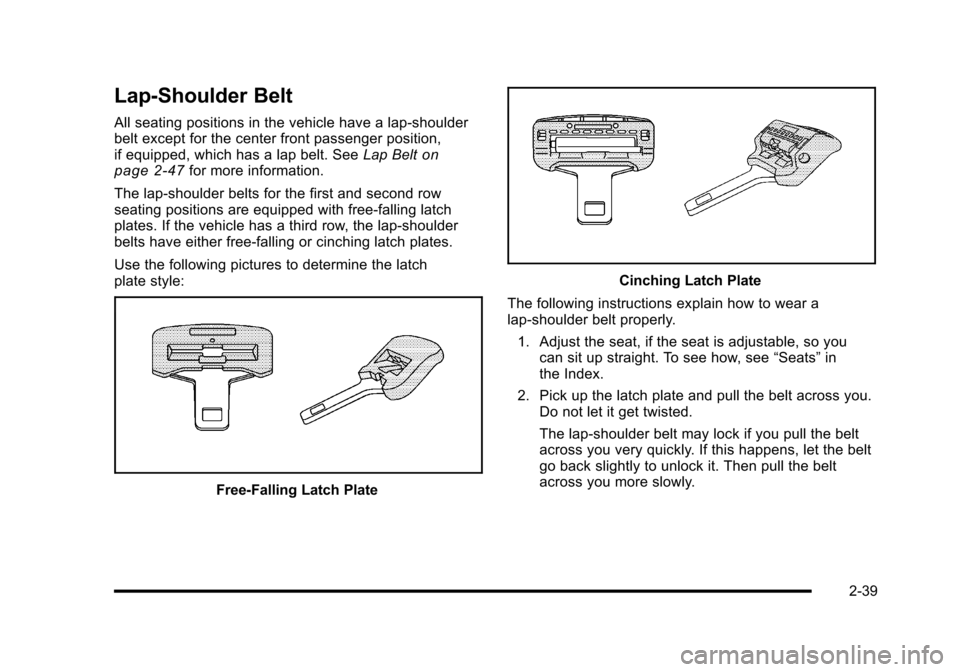
The lap!shoulder belts for the first and second rowseating positions are equipped with free!falling latchplates. If the vehicle has a third row, the lap!shoulderbelts have either free!falling or cinching latch plates.
Use the following pictures to determine the latchplate style:
Free-Falling Latch Plate
Cinching Latch Plate
The following instructions explain how to wear alap-shoulder belt properly.
1. Adjust the seat, if the seat is adjustable, so youcan sit up straight. To see how, see“Seats”inthe Index.
2. Pick up the latch plate and pull the belt across you.Do not let it get twisted.
The lap-shoulder belt may lock if you pull the beltacross you very quickly. If this happens, let the beltgo back slightly to unlock it. Then pull the beltacross you more slowly.
2-39
Page 75 of 616
The adjuster can be moved up just by pushing up onthe shoulder belt guide.
After the adjuster is set to the desired position, try tomove it down without squeezing the buttons to makesure it has locked into position.
Safety Belt Pretensioners
This vehicle has safety belt pretensioners forfront outboard occupants. Although the safety beltpretensioners cannot be seen, they are part of thesafety belt assembly. They can help tighten the safetybelts during the early stages of a moderate to severefrontal, near frontal, or rear crash if the thresholdconditions for pretensioner activation are met.And, if the vehicle has side impact airbags, safety beltpretensioners can help tighten the safety belts in a sidecrash or a rollover event.
Pretensioners work only once. If the pretensionersactivate in a crash, they will need to be replaced, andprobably other new parts for the vehicle's safety beltsystem. SeeReplacing Restraint System Parts After aCrash on page 2!92.
Rear Safety Belt Comfort Guides
This vehicle may have rear shoulder belt comfortguides. If not, they are available through yourdealer/retailer. The guides may provide added safetybelt comfort for older children who have outgrownbooster seats and for some adults. When installed andproperly adjusted, the comfort guide positions the beltaway from the neck and head.
2-43
Page 80 of 616
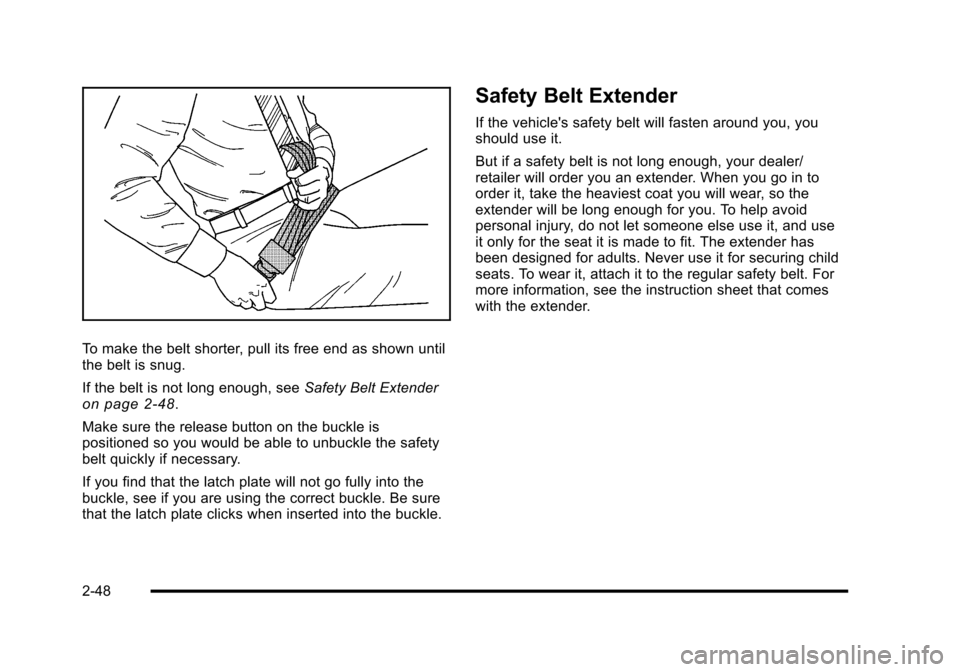
To make the belt shorter, pull its free end as shown untilthe belt is snug.
If the belt is not long enough, seeSafety Belt Extenderon page 2!48.
Make sure the release button on the buckle ispositioned so you would be able to unbuckle the safetybelt quickly if necessary.
If you find that the latch plate will not go fully into thebuckle, see if you are using the correct buckle. Be surethat the latch plate clicks when inserted into the buckle.
Safety Belt Extender
If the vehicle's safety belt will fasten around you, youshould use it.
But if a safety belt is not long enough, your dealer/retailer will order you an extender. When you go in toorder it, take the heaviest coat you will wear, so theextender will be long enough for you. To help avoidpersonal injury, do not let someone else use it, and useit only for the seat it is made to fit. The extender hasbeen designed for adults. Never use it for securing childseats. To wear it, attach it to the regular safety belt. Formore information, see the instruction sheet that comeswith the extender.
2-48
Page 81 of 616
Child Restraints
Older Children
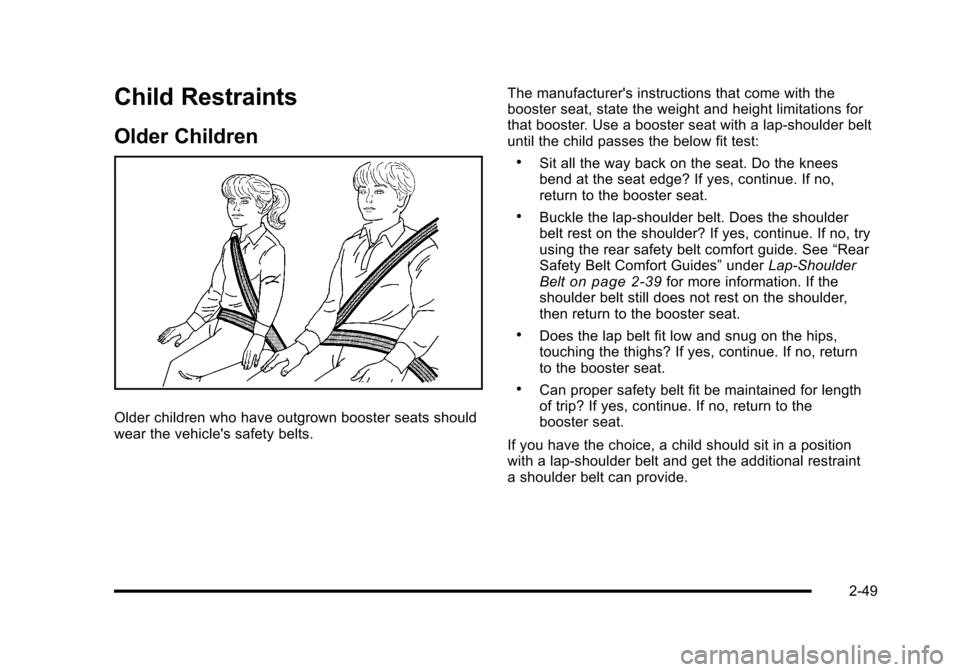
Older children who have outgrown booster seats shouldwear the vehicle's safety belts.
The manufacturer's instructions that come with thebooster seat, state the weight and height limitations forthat booster. Use a booster seat with a lap-shoulder beltuntil the child passes the below fit test:
.Sit all the way back on the seat. Do the kneesbend at the seat edge? If yes, continue. If no,return to the booster seat.
.Buckle the lap-shoulder belt. Does the shoulderbelt rest on the shoulder? If yes, continue. If no, tryusing the rear safety belt comfort guide. See“RearSafety Belt Comfort Guides”underLap-ShoulderBelton page 2!39for more information. If theshoulder belt still does not rest on the shoulder,then return to the booster seat.
.Does the lap belt fit low and snug on the hips,touching the thighs? If yes, continue. If no, returnto the booster seat.
.Can proper safety belt fit be maintained for lengthof trip? If yes, continue. If no, return to thebooster seat.
If you have the choice, a child should sit in a positionwith a lap-shoulder belt and get the additional restrainta shoulder belt can provide.
2-49
Page 88 of 616
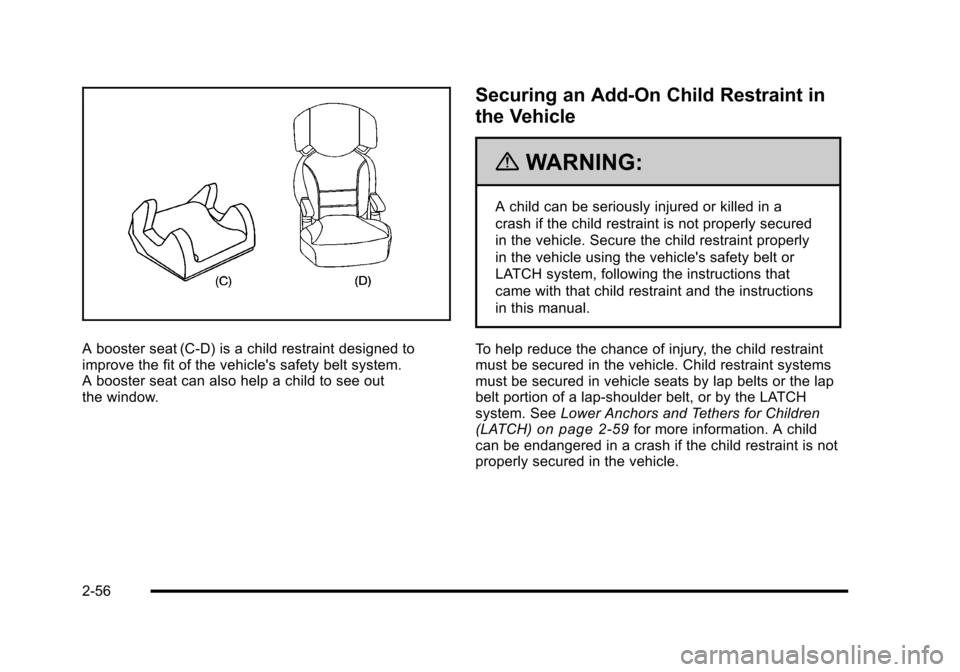
A booster seat (C-D) is a child restraint designed toimprove the fit of the vehicle's safety belt system.A booster seat can also help a child to see outthe window.
Securing an Add-On Child Restraint in
the Vehicle
{WARNING:
A child can be seriously injured or killed in a
crash if the child restraint is not properly secured
in the vehicle. Secure the child restraint properly
in the vehicle using the vehicle's safety belt or
LATCH system, following the instructions that
came with that child restraint and the instructions
in this manual.
To help reduce the chance of injury, the child restraintmust be secured in the vehicle. Child restraint systemsmust be secured in vehicle seats by lap belts or the lapbelt portion of a lap-shoulder belt, or by the LATCHsystem. SeeLower Anchors and Tethers for Children(LATCH)on page 2!59for more information. A childcan be endangered in a crash if the child restraint is notproperly secured in the vehicle.
2-56
Page 94 of 616
For models with a three passenger third row seat, seethe information following for installing a child restraintwith a top tether in the third row, if your vehicle has one.Never install two top tethers using the same top tetheranchor.
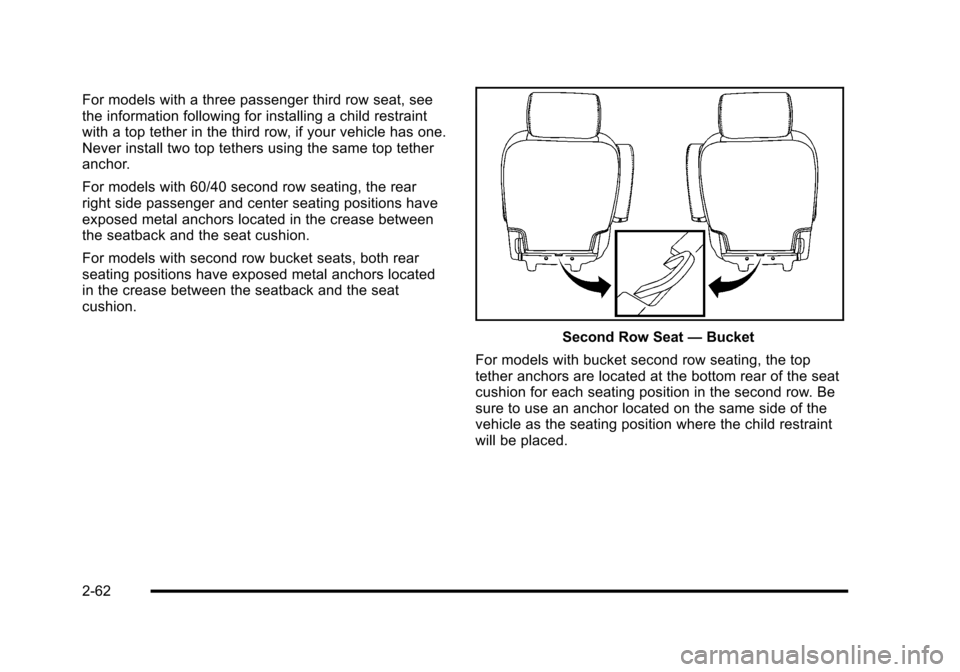
For models with 60/40 second row seating, the rearright side passenger and center seating positions haveexposed metal anchors located in the crease betweenthe seatback and the seat cushion.
For models with second row bucket seats, both rearseating positions have exposed metal anchors locatedin the crease between the seatback and the seatcushion.
Second Row Seat—Bucket
For models with bucket second row seating, the toptether anchors are located at the bottom rear of the seatcushion for each seating position in the second row. Besure to use an anchor located on the same side of thevehicle as the seating position where the child restraintwill be placed.
2-62
Page 121 of 616

Servicing Your Airbag-Equipped
Vehicle
Airbags affect how the vehicle should be serviced.There are parts of the airbag system in several placesaround the vehicle. Your dealer/retailer and the servicemanual have information about servicing the vehicleand the airbag system. To purchase a service manual,seeService Publications Ordering Informationonpage 9!17.
{WARNING:
For up to 10 seconds after the ignition is turned off
and the battery is disconnected, an airbag can still
inflate during improper service. You can be injured
if you are close to an airbag when it inflates. Avoid
yellow connectors. They are probably part of the
airbag system. Be sure to follow proper service
procedures, and make sure the person performing
work for you is qualified to do so.
Adding Equipment to Your
Airbag-Equipped Vehicle
Q: Is there anything I might add to or change aboutthe vehicle that could keep the airbags fromworking properly?
A:Yes. If you add things that change the vehicle'sframe, bumper system, height, front end or sidesheet metal, they may keep the airbag system fromworking properly. Changing or moving any parts ofthe front seats, safety belts, the airbag sensing anddiagnostic module, steering wheel, instrument panel,roof-rail airbag modules, ceiling headliner or pillargarnish trim, overhead console, front sensors, sideimpact sensors, rollover sensor module, or airbagwiring can affect the operation of the airbag system.
In addition, the vehicle may have a passengersensing system for the right front passengerposition, which includes sensors that are part of thepassenger seat. The passenger sensing systemmay not operate properly if the original seat trim isreplaced with non-GM covers, upholstery or trim,or with GM covers, upholstery or trim designed for a
2-89
Page 131 of 616

To replace the battery:
1. Separate the transmitter with a flat, thin objectinserted into the notch, located above themetal base.
2. Remove the old battery. Do not use a metal object.
3. Insert the new battery, positive side facing up.Replace with a CR2032 or equivalent battery.
4. Snap the transmitter back together.
Remote Vehicle Start
This feature allows you to start the engine from outsideof the vehicle. It may also start up the vehicle's heatingor air conditioning systems and rear window defogger.Normal operation of the system will return after the keyis turned to the ON/RUN position.
During a remote start, the climate control system willdefault to a heating or cooling mode depending on theoutside temperatures.
During a remote start, if your vehicle has an automaticclimate control system and heated seats, the heatedseats will turn on during colder outside temperaturesand will shut off when the key is turned to ON/RUN.If your vehicle does not have an automatic climatecontrol system, during remote start, you will need tomanually turn the heated seats on and off. SeeHeatedand Cooled Seatso n p a g e 2!5for additionalinformation.
Laws in some communities may restrict the use ofremote starters. For example, some laws may require aperson using the remote start to have the vehicle inview when doing so. Check local regulations for anyrequirements on remote starting of vehicles.
Do not use the remote start feature if your vehicle is lowon fuel. Your vehicle may run out of fuel.
3-7
Page 188 of 616
Center Console Storage
A console compartment is located between thebucket seats.
The console has both an upper and lower storage binaccessed by lifting up on the latches located at the frontof the console lid.
The console may have an accessory power outletinside. SeeAccessory Power Outlet(s) on page 4!19.
The rear of the console also has a cupholder thatswings down for the rear seat passengers to use.
Assist Handles
Assist handles located above the rear passenger doorscan be used when getting out of the vehicle. Pull thehandles downward to use them.
Garment Hooks
There are garment hooks located on the assist handles.
Roof Rack System
{WARNING:
If something is carried on top of the vehicle that is
longer or wider than the roof rack—like paneling,
plywood, or a mattress—the wind can catch it
while the vehicle is being driven. The item being
carried could be violently torn off, and this could
cause a collision, and damage the vehicle. Never
carry something longer or wider than the roof rack
on top of the vehicle unless using a GM Certified
accessory carrier.
For vehicles with a roof rack, the rack can be used toload items. For roof racks that do not have crossrailsincluded, GM Certified crossrails can be purchased asan accessory. See your dealer/retailer for additionalinformation.
For vehicles with crossrails, they can be movedback and forth to help secure cargo. To adjust them,turn the knob located at each end of the crossrailcounterclockwise until the crossrail can move freely.To secure the crossrail, turn the knob located at eachend of the crossrail clockwise until tightened. Tie theload to the siderails or siderail supports.
3-64