change wheel CADILLAC ESCALADE 2012 3.G User Guide
[x] Cancel search | Manufacturer: CADILLAC, Model Year: 2012, Model line: ESCALADE, Model: CADILLAC ESCALADE 2012 3.GPages: 538, PDF Size: 7.59 MB
Page 334 of 538
Black plate (34,1)Cadillac Escalade/Escalade ESV Owner Manual - 2012
9-34 Driving and Operating
Drive Systems
All-Wheel Drive
If the vehicle has this feature,
engine power is sent to all four
wheels when extra traction is
needed. This is like four-wheel
drive, but there is no separate lever
or switch to engage or disengage
the front axle. It is fully automatic,
and adjusts itself as needed for road
conditions.
If the vehicle is a hybrid, see
“Four-Wheel Drive”in the hybrid
supplement.
Brakes
Antilock Brake
System (ABS)
This vehicle has the Antilock Brake
System (ABS), an advanced
electronic braking system that helps
prevent a braking skid.
When the engine is started and the
vehicle begins to drive away, ABS
checks itself. A momentary motor or
clicking noise might be heard while
this test is going on, and it might
even be noticed that the brake
pedal moves a little. This is normal.
If there is a problem with ABS, this
warning light stays on. See Antilock
Brake System (ABS) Warning Light
on page 5‑19. If driving safely on a wet road and it
becomes necessary to slam on the
brakes and continue braking to
avoid a sudden obstacle, a
computer senses that the wheels
are slowing down. If one of the
wheels is about to stop rolling, the
computer will separately work the
brakes at each wheel.
ABS can change the brake pressure
to each wheel, as required, faster
than any driver could. This can help
the driver steer around the obstacle
while braking hard.
As the brakes are applied, the
computer keeps receiving updates
on wheel speed and controls
braking pressure accordingly.
Remember: ABS does not change
the time needed to get a foot up to
the brake pedal or always decrease
stopping distance. If you get too
close to the vehicle in front of you,
there will not be enough time to
apply the brakes if that vehicle
Page 341 of 538
Black plate (41,1)Cadillac Escalade/Escalade ESV Owner Manual - 2012
Driving and Operating 9-41
Cruise Control
{WARNING
Cruise control can be dangerous
where you cannot drive safely at
a steady speed. So, do not use
the cruise control on winding
roads or in heavy traffic.
Cruise control can be dangerous
on slippery roads. On such roads,
fast changes in tire traction can
cause excessive wheel slip, and
you could lose control. Do not use
cruise control on slippery roads.
With cruise control, a speed of
about 40 km/h (25 mph) or more can
be maintained without keeping your
foot on the accelerator. Cruise
control does not work at speeds
below about 40 km/h (25 mph).
When the brakes are applied, cruise
control is turned off. This vehicle has a Hydra‐Matic 6‐
speed automatic transmission, see
Grade Braking under
Tow/Haul
Mode on page 9‑33 for an
explanation of how cruise control
interacts with the Range Selection
Mode, tow/haul and grade braking
systems.
This vehicle has StabiliTrak and
when the system begins to limit
wheel spin, the cruise control will
automatically disengage. See
StabiliTrak
®System on page 9‑37.
When road conditions allow the
cruise control to be safely used
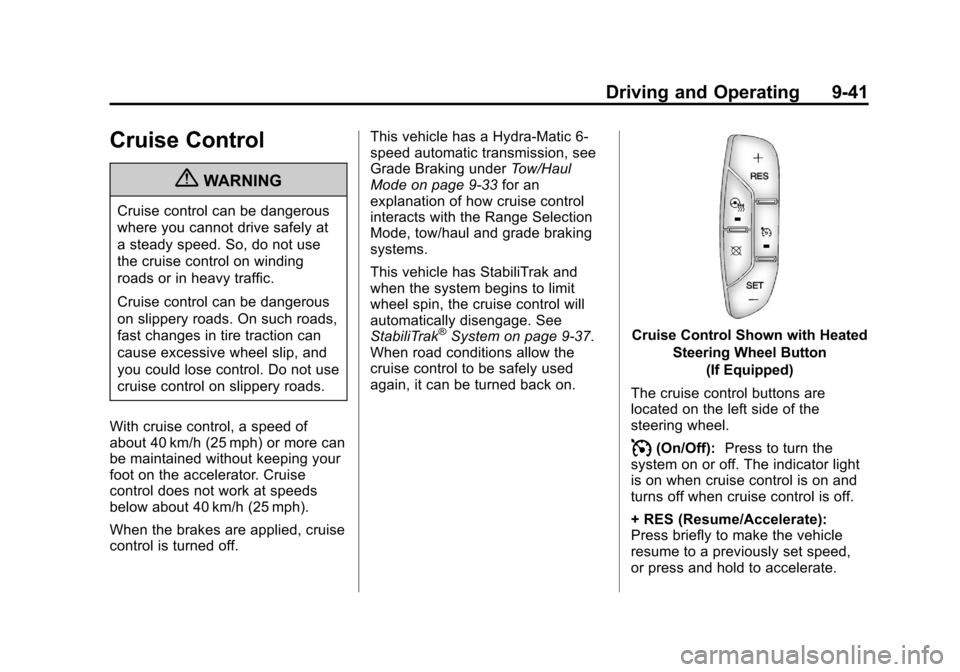
again, it can be turned back on.Cruise Control Shown with Heated
Steering Wheel Button(If Equipped)
The cruise control buttons are
located on the left side of the
steering wheel.
I(On/Off): Press to turn the
system on or off. The indicator light
is on when cruise control is on and
turns off when cruise control is off.
+ RES (Resume/Accelerate):
Press briefly to make the vehicle
resume to a previously set speed,
or press and hold to accelerate.
Page 392 of 538
Black plate (24,1)Cadillac Escalade/Escalade ESV Owner Manual - 2012
10-24 Vehicle Care
Brakes
This vehicle has disc brakes. Disc
brake pads have built-in wear
indicators that make a high-pitched
warning sound when the brake pads
are worn and new pads are needed.
The sound can come and go or be
heard all the time the vehicle is
moving, except when applying the
brake pedal firmly.
{WARNING
The brake wear warning sound
means that soon the brakes will
not work well. That could lead to
a crash. When the brake wear
warning sound is heard, have the
vehicle serviced.
Notice: Continuing to drive with
worn-out brake pads could result
in costly brake repair. Some driving conditions or climates
can cause a brake squeal when the
brakes are first applied or lightly
applied. This does not mean
something is wrong with the brakes.
Properly torqued wheel nuts are
necessary to help prevent brake
pulsation. When tires are rotated,
inspect brake pads for wear and
evenly tighten wheel nuts in the
proper sequence to torque
specifications in
Capacities and
Specifications on page 12‑2.
Brake linings should always be
replaced as complete axle sets.
Brake Pedal Travel
See your dealer if the brake pedal
does not return to normal height,
or if there is a rapid increase in
pedal travel. This could be a sign
that brake service might be
required.
Brake Adjustment
Every time the brakes are applied,
with or without the vehicle moving,
the brakes adjust for wear.
Replacing Brake System Parts
The braking system on a vehicle is
complex. Its many parts have to be
of top quality and work well together
if the vehicle is to have really good
braking. The vehicle was designed
and tested with top-quality brake
parts. When parts of the braking
system are replaced, be sure to get
new, approved replacement parts.
If this is not done, the brakes might
not work properly. For example,
installing disc brake pads that are
wrong for the vehicle, can change
the balance between the front and
rear brakes —for the worse. The
braking performance expected can
change in many other ways if the
wrong replacement brake parts are
installed.
Page 427 of 538
Black plate (59,1)Cadillac Escalade/Escalade ESV Owner Manual - 2012
Vehicle Care 10-59
SeeTire Pressure on
page 10‑52 andVehicle Load
Limits on page 9‑15.
Reset the Tire Pressure Monitor
System. See Tire Pressure
Monitor Operation on
page 10‑55.
Check that all wheel nuts are
properly tightened. See “Wheel
Nut Torque” underCapacities
and Specifications on
page 12‑2.
{WARNING
Rust or dirt on a wheel, or on the
parts to which it is fastened, can
make wheel nuts become loose
after time. The wheel could come
off and cause an accident. When
changing a wheel, remove any
rust or dirt from places where the
wheel attaches to the vehicle. In
an emergency, a cloth or a paper
(Continued)
WARNING (Continued)
towel can be used; however, use
a scraper or wire brush later to
remove all rust or dirt.
Lightly coat the center of the
wheel hub with wheel bearing
grease after a wheel change or
tire rotation to prevent corrosion
or rust build-up. Do not get
grease on the flat wheel
mounting surface or on the
wheel nuts or bolts.
When It Is Time for New
Tires
Factors, such as maintenance,
temperatures, driving speeds,
vehicle loading, and road conditions
affect the wear rate of the tires.
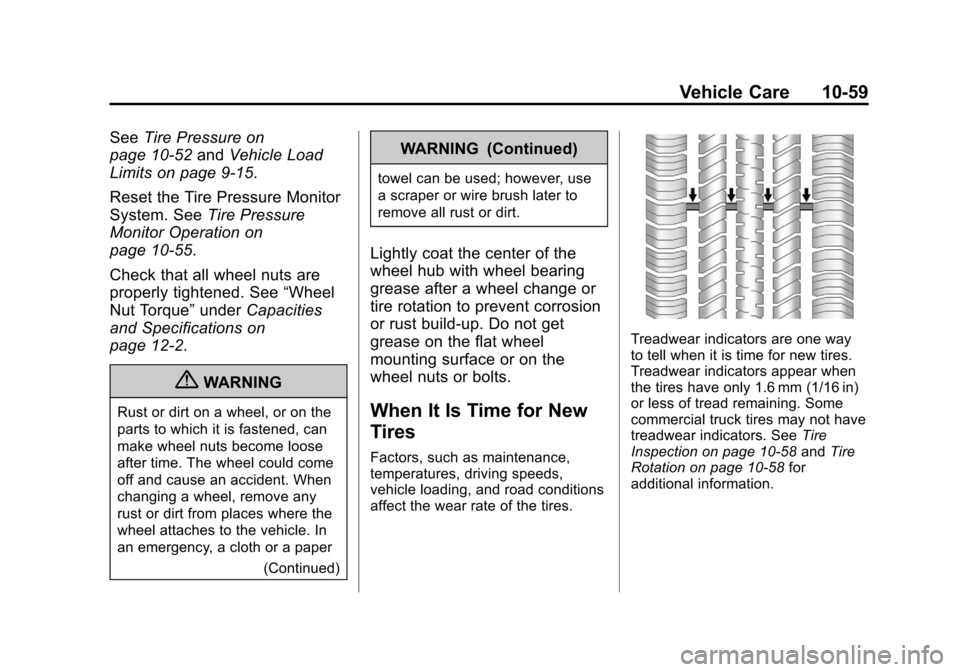
Treadwear indicators are one way
to tell when it is time for new tires.
Treadwear indicators appear when
the tires have only 1.6 mm (1/16 in)
or less of tread remaining. Some
commercial truck tires may not have
treadwear indicators. See Tire
Inspection on page 10‑58 andTire
Rotation on page 10‑58 for
additional information.
Page 434 of 538
Black plate (66,1)Cadillac Escalade/Escalade ESV Owner Manual - 2012
10-66 Vehicle Care
{WARNING
Lifting a vehicle and getting
under it to do maintenance or
repairs is dangerous without the
appropriate safety equipment and
training. If a jack is provided with
the vehicle, it is designed only for
changing a flat tire. If it is used for
anything else, you or others could
be badly injured or killed if the
vehicle slips off the jack. If a jack
is provided with the vehicle, only
use it for changing a flat tire.
If a tire goes flat, avoid further tire
and wheel damage by driving slowly
to a level place, well off the road,
if possible. Turn on the hazard
warning flashers. See Hazard
Warning Flashers on page 6‑7.
{WARNING
Changing a tire can be
dangerous. The vehicle can slip
off the jack and roll over or fall
causing injury or death. Find a
level place to change the tire. To
help prevent the vehicle from
moving:
1. Set the parking brake firmly.
2. Put an automatic transmission in P (Park)
or a manual transmission in
1 (First) or R (Reverse).
3. Turn off the engine and do not restart while the vehicle
is raised.
(Continued)
WARNING (Continued)
4. Do not allow passengers toremain in the vehicle.
5. Place wheel blocks on both sides of the tire at the
opposite corner of the tire
being changed.
This vehicle may come with a jack
and spare tire or a tire sealant and
compressor kit. To use the jacking
equipment to change a spare tire
safely, follow the instructions
below. Then see Tire Changing on
page 10‑74. To use the tire sealant
and compressor kit, see Tire
Sealant and Compressor Kit on
page 10‑67.
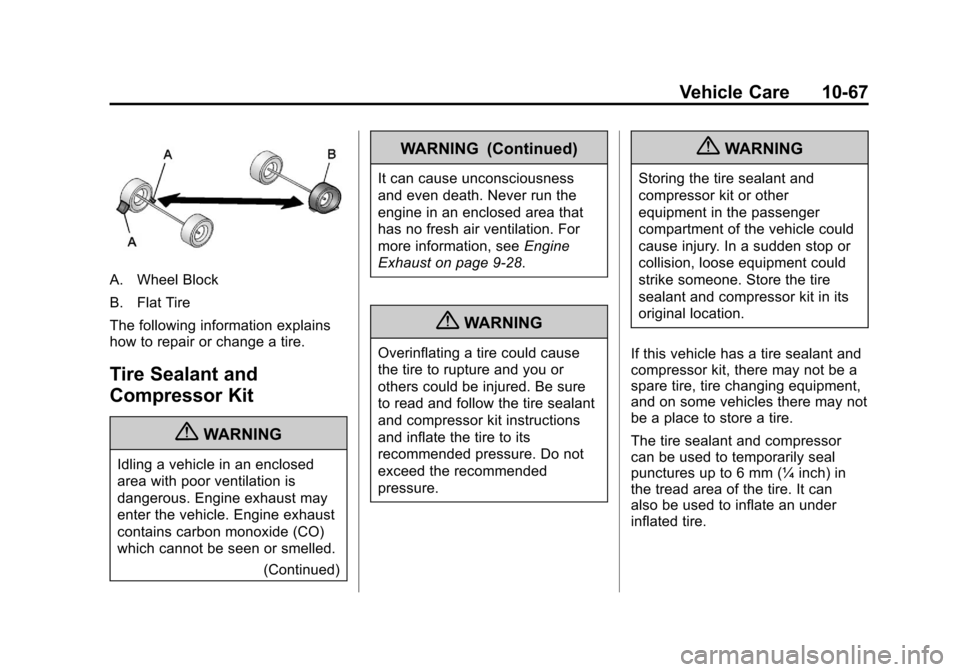
When the vehicle has a flat tire (B),
use the following example as a
guide to assist you in the placement
of wheel blocks (A).
Page 435 of 538
Black plate (67,1)Cadillac Escalade/Escalade ESV Owner Manual - 2012
Vehicle Care 10-67
A. Wheel Block
B. Flat Tire
The following information explains
how to repair or change a tire.
Tire Sealant and
Compressor Kit
{WARNING
Idling a vehicle in an enclosed
area with poor ventilation is
dangerous. Engine exhaust may
enter the vehicle. Engine exhaust
contains carbon monoxide (CO)
which cannot be seen or smelled.(Continued)
WARNING (Continued)
It can cause unconsciousness
and even death. Never run the
engine in an enclosed area that
has no fresh air ventilation. For
more information, seeEngine
Exhaust on page 9‑28.
{WARNING
Overinflating a tire could cause
the tire to rupture and you or
others could be injured. Be sure
to read and follow the tire sealant
and compressor kit instructions
and inflate the tire to its
recommended pressure. Do not
exceed the recommended
pressure.
{WARNING
Storing the tire sealant and
compressor kit or other
equipment in the passenger
compartment of the vehicle could
cause injury. In a sudden stop or
collision, loose equipment could
strike someone. Store the tire
sealant and compressor kit in its
original location.
If this vehicle has a tire sealant and
compressor kit, there may not be a
spare tire, tire changing equipment,
and on some vehicles there may not
be a place to store a tire.
The tire sealant and compressor
can be used to temporarily seal
punctures up to 6 mm (¼ inch) in
the tread area of the tire. It can
also be used to inflate an under
inflated tire.
Page 442 of 538
Black plate (74,1)Cadillac Escalade/Escalade ESV Owner Manual - 2012
10-74 Vehicle Care
Storing the Tire Sealant
and Compressor Kit
The tire sealant and compressor kit
is located under the storage tray on
the driver side trim panel (over the
rear wheelhouse).
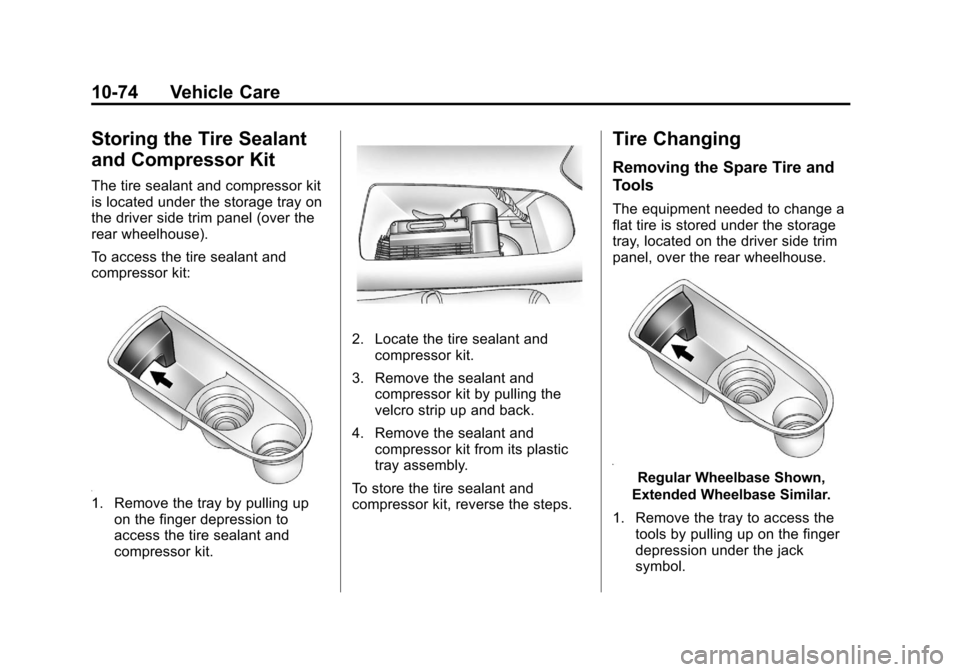
To access the tire sealant and
compressor kit:
1. Remove the tray by pulling upon the finger depression to
access the tire sealant and
compressor kit.
2. Locate the tire sealant andcompressor kit.
3. Remove the sealant and compressor kit by pulling the
velcro strip up and back.
4. Remove the sealant and compressor kit from its plastic
tray assembly.
To store the tire sealant and
compressor kit, reverse the steps.
Tire Changing
Removing the Spare Tire and
Tools
The equipment needed to change a
flat tire is stored under the storage
tray, located on the driver side trim
panel, over the rear wheelhouse.
Regular Wheelbase Shown,
Extended Wheelbase Similar.
1. Remove the tray to access the tools by pulling up on the finger
depression under the jack
symbol.
Page 492 of 538

Black plate (2,1)Cadillac Escalade/Escalade ESV Owner Manual - 2012
12-2 Technical Data
Vehicle Data
Capacities and Specifications
The following approximate capacities are given in metric and English conversions. SeeRecommended Fluids and
Lubricants on page 11‑13 for more information.
Application Capacities
Metric English
Air Conditioning Refrigerant For the air conditioning system refrigerant charge
amount, see the refrigerant label located under the hood. See your dealer for more information.
Cooling System 16.7 L 17.6 qt
Engine Oil with Filter 5.7 L† 6.0 qt†
Fuel Tank Regular 98.4 L 26.0 gal
Extended 119.2 L 31.5 gal
Transmission Fluid (Pan Removal and Replacement) 5.7 L 6.0 qt
Transfer Case Fluid 1.4 L 1.5 qt
Wheel Nut Torque 190 Y140 lb ft
All capacities are approximate. When adding, be sure to fill to the approximate level, as recommended in this
manual. Recheck fluid after filling.
†Oil filter should be changed at every oil change.
Page 502 of 538
Black plate (8,1)Cadillac Escalade/Escalade ESV Owner Manual - 2012
13-8 Customer Information
GM Mobility
Reimbursement Program
(U.S. and Canada)
This program is available to
qualified applicants for cost
reimbursement of eligible
aftermarket adaptive equipment
required for the vehicle, such as
hand controls or a wheelchair/
scooter lift for the vehicle.
For more information on the limited
offer, visit www.gmmobility.com or
call the GM Mobility Assistance
Center at 1-800-323-9935. Text
Telephone (TTY) users, call
1-800-833-9935.General Motors of Canada also
has a Mobility Program. Call
1-800-GM-DRIVE (463-7483)
for details. TTY users call
1-800-263-3830.
Roadside Service (U.S.
and Canada)
In the United States or Canada, call
1-800-882-1112.
Text Telephone (TTY), U.S. only,
call
1-888-889-2438.
Service is available 24 hours a day,
365 days a year.
Calling for Service
When calling Roadside Service,
have the following information
ready:
.Your name, home address, and
home telephone number.
.Telephone number of your
location.
.Location of the vehicle.
.Model, year, color, and license
plate number of the vehicle.
.Odometer reading, Vehicle
Identification Number (VIN), and
delivery date of the vehicle.
.Description of the problem.
Coverage
Services are provided up to
5 years/160 000 km (100,000 mi),
whichever comes first.
In the U.S., anyone driving the
vehicle is covered. In Canada, a
person driving the vehicle without
permission from the owner is not
covered.
Roadside Service is not a part of
the New Vehicle Limited Warranty.
Cadillac and General Motors of
Canada Limited reserve the right to
make any changes or discontinue
the Roadside Service program at
any time without notification.
Page 529 of 538

Black plate (5,1)Cadillac Escalade/Escalade ESV Owner Manual - 2012
INDEX i-5
Fuel . . . . . . . . . . . . . . . . . . . . . . . . . . . 9-51Additives . . . . . . . . . . . . . . . . . . . . . 9-52
E85 (85% Ethanol) . . . . . . . . . . . 9-53
Filling a Portable Fuel
Container . . . . . . . . . . . . . . . . . . . 9-56
Filling the Tank . . . . . . . . . . . . . . . 9-54
Fuels in Foreign Countries . . . . 9-52
Gasoline Specifications . . . . . . . 9-52
Gauge . . . . . . . . . . . . . . . . . . . . . . . . 5-12
Management, Active . . . . . . . . . . 9-27
Recommended . . . . . . . . . . . . . . . 9-51
Requirements, California . . . . . 9-52
System Messages . . . . . . . . . . . . 5-33
Fuel Economy Driving . . . . . . . . . . . . . . . . . . . . . . . . 1-22
Full-Size Spare Tire . . . . . . . . . . 10-87
Fuses
Engine CompartmentFuse Block . . . . . . . . . . . . . . . . 10-39
Fuses and Circuit Breakers . . . . . . . . . . . . . . . . . . 10-38
Instrument Panel Fuse Block . . . . . . . . . . . . . . . . . . . . . . 10-43G
Garage Door Opener . . . . . . . . . . 5-46Programming . . . . . . . . . . . . . . . . . 5-46
Gasoline Specifications . . . . . . . . . . . . . . . . . 9-52
Gauges Engine Coolant
Temperature . . . . . . . . . . . . . . . . 5-13
Fuel . . . . . . . . . . . . . . . . . . . . . . . . . . 5-12
Odometer . . . . . . . . . . . . . . . . . . . . . 5-12
Speedometer . . . . . . . . . . . . . . . . . 5-12
Tachometer . . . . . . . . . . . . . . . . . . . 5-12
Trip Odometer . . . . . . . . . . . . . . . . 5-12
Warning Lights and Indicators . . . . . . . . . . . . . . . . . . . 5-10
General Information
Service and Maintenance . . . . . 11-1
Towing . . . . . . . . . . . . . . . . . . . . . . . . 9-57
Vehicle Care . . . . . . . . . . . . . . . . . . 10-2
Glass Replacement . . . . . . . . . . . 10-32
Global Positioning
System (GPS) . . . . . . . . . . . . . . . . 7-94
Glove Box . . . . . . . . . . . . . . . . . . . . . . 4-1
GM Mobility Reimbursement Program . . . . . . . . . . . . . . . . . . . . . . 13-8
H
Hazard Warning Flashers . . . . . . . 6-7
Head Restraints . . . . . . . . . . . . . . . . 3-2
Headlamps
Aiming . . . . . . . . . . . . . . . . . . . . . . 10-33
Automatic . . . . . . . . . . . . . . . . . . . . . . 6-6
Bulb Replacement . . . . . . . . . . 10-35
Daytime RunningLamps (DRL) . . . . . . . . . . . . . . . . . 6-5
Flash-to-Pass . . . . . . . . . . . . . . . . . . 6-5
High Intensity Discharge (HID) Lighting . . . . . . . . . . . . . 10-35
High-Beam On Light . . . . . . . . . . 5-23
High/Low Beam Changer . . . . . . 6-5
Lamps On Reminder . . . . . . . . . 5-23
Heated
Rear Seats . . . . . . . . . . . . . . . . . . . . 3-8
Steering Wheel . . . . . . . . . . . . . . . . 5-4
Heated and Ventilated Front Seats . . . . . . . . . . . . . . . . . . . . . . . . . 3-7
Heated Mirrors . . . . . . . . . . . . . . . . . 2-17
Heater Engine . . . . . . . . . . . . . . . . . . . . . . . . 9-24
High-Beam On Light . . . . . . . . . . . 5-23
High-Speed Operation . . . . . . . . 10-53