trailer CADILLAC ESCALADE 2012 3.G Owner's Guide
[x] Cancel search | Manufacturer: CADILLAC, Model Year: 2012, Model line: ESCALADE, Model: CADILLAC ESCALADE 2012 3.GPages: 538, PDF Size: 7.59 MB
Page 389 of 538

Black plate (21,1)Cadillac Escalade/Escalade ESV Owner Manual - 2012
Vehicle Care 10-21
.Idles for long periods in traffic.
.Tows a trailer. SeeTrailer
Towing on page 9‑61.
If the ENGINE OVERHEATED
STOP ENGINE or the ENGINE
OVERHEATED IDLE ENGINE
message appears with no sign of
steam, try this for a minute or so:
If the overheat warning is displayed
with no sign of steam:
1. Turn the air conditioning off.
2. Turn the heater on to the highest temperature and to the highest
fan speed. Open the windows as
necessary.
3. In heavy traffic, let the engine idle in N (Neutral) while stopped.
If it is safe to do so, pull off
the road, shift to P (Park)
or N (Neutral) and let the
engine idle.
If the temperature overheat gauge
is no longer in the overheat zone
or an overheat warning no longer
displays, the vehicle can be driven. Continue to drive the vehicle slowly
for about 10 minutes. Keep a safe
vehicle distance from the vehicle in
front. If the warning does not come
back on, continue to drive normally.
If the warning continues, pull
over, stop, and park the vehicle
right away.
If there is no sign of steam, idle
the engine for five minutes while
parked. If the warning is still
displayed, turn off the engine until it
cools down. Also, see
“Overheated
Engine Protection Operating Mode”
later in this section.
Overheated Engine
Protection
Operating Mode
If an overheated engine condition
exists and the ENGINE POWER IS
REDUCED message is displayed,
an overheat protection mode which
alternates firing groups of cylinders
helps prevent engine damage. In this mode, a loss in power and
engine performance will be noticed.
This operating mode allows the
vehicle to be driven to a safe place
in an emergency. Driving extended
distances and/or towing a trailer in
the overheat protection mode
should be avoided.
Notice:
After driving in the
overheated engine protection
operating mode, to avoid engine
damage, allow the engine to cool
before attempting any repair.
The engine oil will be severely
degraded. Repair the cause of
coolant loss, change the oil and
reset the oil life system. See
Engine Oil on page 10‑7.
Page 390 of 538
Black plate (22,1)Cadillac Escalade/Escalade ESV Owner Manual - 2012
10-22 Vehicle Care
Engine Fan
The vehicle has electric cooling
fans. The fans spinning at low
speed during most everyday driving
might be heard. The fans can turn
off if no cooling is required. Under
heavy vehicle loading, trailer towing,
and/or high outside temperatures,
or if operating the air conditioning
system, the fans can change to high
speed and an increase in fan noise
might be heard. This is normal and
indicates that the cooling system
is functioning properly. The fans
change to low speed when
additional cooling is no longer
required.
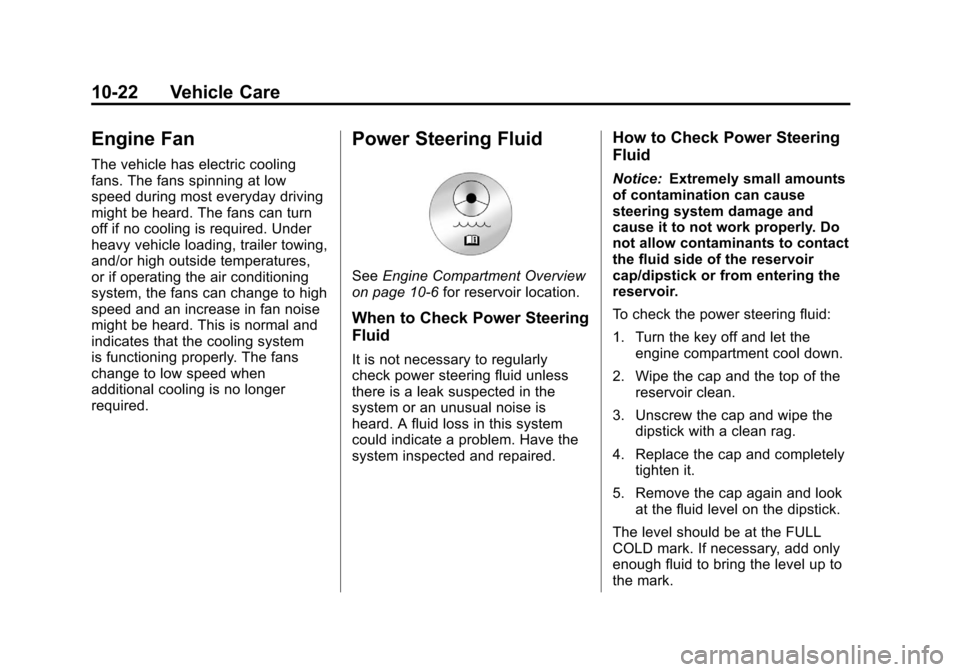
Power Steering Fluid
SeeEngine Compartment Overview
on page 10‑6 for reservoir location.
When to Check Power Steering
Fluid
It is not necessary to regularly
check power steering fluid unless
there is a leak suspected in the
system or an unusual noise is
heard. A fluid loss in this system
could indicate a problem. Have the
system inspected and repaired.
How to Check Power Steering
Fluid
Notice:Extremely small amounts
of contamination can cause
steering system damage and
cause it to not work properly. Do
not allow contaminants to contact
the fluid side of the reservoir
cap/dipstick or from entering the
reservoir.
To check the power steering fluid:
1. Turn the key off and let the engine compartment cool down.
2. Wipe the cap and the top of the reservoir clean.
3. Unscrew the cap and wipe the dipstick with a clean rag.
4. Replace the cap and completely tighten it.
5. Remove the cap again and look at the fluid level on the dipstick.
The level should be at the FULL
COLD mark. If necessary, add only
enough fluid to bring the level up to
the mark.
Page 409 of 538

Black plate (41,1)Cadillac Escalade/Escalade ESV Owner Manual - 2012
Vehicle Care 10-41
The vehicle may not be equipped
with all of the fuses, relays, and
features shown.Fuses Usage
1 Right Trailer Stop/
Turn Lamp
2 Electronic Stability
Suspension Control,
Automatic Level Control
Exhaust
3 Left Trailer Stop/
Turn Lamp
4 Engine Controls
5 Engine Control Module,
Throttle Control
6 Trailer Brake Controller
7 Front Washer
8 Oxygen Sensors
9 Antilock Brakes System 2
10 Trailer Back-up Lamps
11 Driver Side Low-Beam
Headlamp Fuses Usage
12 Engine Control Module
(Battery)
13 Fuel Injectors, Ignition
Coils (Right Side)
14 Transmission Control
Module (Battery)
15 Vehicle Back-up Lamps
16 Passenger Side
Low-Beam Headlamp
17 Air Conditioning
Compressor
18 Oxygen Sensors
19 Transmission Controls
(Ignition)
20 Fuel Pump
21 Fuel System Control
Module
22 Headlamp Washer
23 Rear Windshield Washer
24 Fuel Injectors, Ignition
Coils (Left Side) Fuses Usage
25 Trailer Parking Lamps
26 Driver Side Parking
Lamps
27 Passenger Side Parking
Lamps
28 Fog Lamps
29 Horn
30 Passenger Side
High-Beam Headlamp
31 Daytime Running Lamps
(DRL) (If Equipped)
32 Driver Side High-Beam
Headlamp
33 Daytime Running Lamps 2
(If Equipped)
34 Sunroof
35 Key Ignition System, Theft
Deterrent System
36 Windshield Wiper
37 SEO B2 Upfitter Usage
(Battery)
Page 410 of 538

Black plate (42,1)Cadillac Escalade/Escalade ESV Owner Manual - 2012
10-42 Vehicle Care
FusesUsage
38 Electric Adjustable Pedals
39 Climate Controls (Battery)
40 Airbag System (Ignition)
41 Amplifier
42 Audio System
43 Miscellaneous (Ignition),
Cruise Control
44 Liftgate Release
45 Airbag System (Battery)
46 Instrument Panel Cluster
47 Not Used
48 Auxiliary Climate Control
(Ignition)
49 Center High-Mounted
Stoplamp (CHMSL)
50 Rear Defogger
51 Heated Mirrors Fuses
Usage
52 SEO B1 Upfitter Usage
(Battery)
53 Cigarette Lighter, Auxiliary
Power Outlet
54 Automatic Level Control
Compressor Relay
55 Climate Controls (Ignition)
56 Engine Control Module,
Secondary Fuel Pump
(Ignition)
J-Case Fuses Usage
57 Cooling Fan 1
58 Automatic Level
Control Compressor
59 Heavy Duty Antilock
Braking System
60 Cooling Fan 2 J-Case
Fuses Usage
61 Antilock Brake
System 1
62 Starter
63 Stud 2 (Trailer
Brakes)
64 Left Bussed Electrical
Center 1
65 Electric Running
Boards
66 Not Used
67 Transfer Case
68 Stud 1 (Trailer
Connector Battery
Power)
69 Mid-Bussed Electrical
Center 1
70 Climate Control
Blower
Page 461 of 538
Black plate (93,1)Cadillac Escalade/Escalade ESV Owner Manual - 2012
Vehicle Care 10-93
Towing
Towing the Vehicle
Notice:To avoid damage, the
disabled vehicle should be
towed with all four wheels off
the ground. Care must be taken
with vehicles that have low
ground clearance and/or special
equipment. Always flatbed on a
car carrier.
Consult your dealer or a
professional towing service if the
disabled vehicle must be towed.
See Roadside Service (U.S. and
Canada) on page 13‑8 orRoadside
Service (Mexico) on page 13‑10.
To tow the vehicle behind another
vehicle for recreational purposes,
such as behind a motor home, see
“Recreational Vehicle Towing” in this
section.
Recreational Vehicle
Towing
If the vehicle is a hybrid, see
the hybrid supplement for more
information.
Recreational vehicle towing
means towing the vehicle behind
another vehicle –such as behind
a motorhome. The two most
common types of recreational
vehicle towing are known as “dinghy
towing” (towing the vehicle with all
four wheels on the ground) and
“dolly towing” (towing the vehicle
with two wheels on the ground and
two wheels up on a device known
as a “dolly”). Here are some important things to
consider before recreational vehicle
towing:.What is the towing capacity
of the towing vehicle? Be
sure to read the tow
vehicle manufacturer's
recommendations.
.What is the distance that will be
travelled? Some vehicles have
restrictions on how far and how
long they can tow.
.Is the proper towing equipment
going to be used? See your
dealer or trailering professional
for additional advice and
equipment recommendations.
.Is the vehicle ready to be
towed? Just as preparing the
vehicle for a long trip, make sure
the vehicle is prepared to be
towed.
Page 474 of 538
Black plate (2,1)Cadillac Escalade/Escalade ESV Owner Manual - 2012
11-2 Service and Maintenance
Your dealer recognizes the
importance of providing
competitively priced maintenance
and repair services. With trained
technicians, the dealer is the place
for routine maintenance such as oil
changes and tire rotations and
additional maintenance items like
tires, brakes, batteries, and wiper
blades.
Notice:Damage caused by
improper maintenance can lead
to costly repairs and may not be
covered by the vehicle warranty.
Maintenance intervals, checks,
inspections, recommended fluids,
and lubricants are important to
keep the vehicle in good working
condition.
The Tire Rotation and Required
Services are the responsibility of the
vehicle owner. It is recommended to
have your dealer perform these
services every 12 000 km/7,500 mi. Proper vehicle maintenance helps to
keep the vehicle in good working
condition, improves fuel economy,
and reduces vehicle emissions.
Because of the way people use
vehicles, maintenance needs
vary. There may need to be
more frequent checks and
services. The Additional Required
Services
‐Normal are for
vehicles that:
.Carry passengers and cargo
within recommended limits on
the Tire and Loading Information
label. See Vehicle Load Limits
on page 9‑15.
.Are driven on reasonable road
surfaces within legal driving
limits.
.Use the recommended fuel.
See Recommended Fuel on
page 9‑51. Refer to the information in the
Maintenance Schedule Additional
Required Services
‐Normal chart.
The Additional Required
Services ‐Severe are for
vehicles that are:
.Mainly driven in hilly or
mountainous terrain.
.Frequently towing a trailer.
.Used for high speed or
competitive driving.
.Used for taxi, police, or delivery
service.
Refer to the information in the
Maintenance Schedule Additional
Required Services ‐Severe chart.
Page 507 of 538
Black plate (13,1)Cadillac Escalade/Escalade ESV Owner Manual - 2012
Customer Information 13-13
Services Not Included in Roadside
Assistance
Roadside Assistance does not
cover or reimburse services for the
following:
.Events caused by fraud or bad
faith by the driver.
.Vehicle immobilization
situations due to a major force
or unforeseen circumstances,
such as natural phenomena
of an extraordinary nature,
earthquakes, volcanic eruptions,
and other cyclonic storms.
.Vehicle immobilization situations
arising from car accidents
caused by the driver of the
vehicle or third parties. This
means any occurrence that
causes physical injury to the
occupants and/or the vehicle
caused by external forces.
.Acts of terrorism, riot or uproar,
armed forces or police actions
which prevent timely delivery of
assistance services.
.Food service, beverages,
telephone calls, or other extra
costs. Accommodation costs
apply only to Mexico per the
terms and conditions of the
Roadside Assistance program.
.Any damage to the vehicle
without intent, derived from the
services provided.
.Cost of towing a trailer when
choosing a Cadillac dealer that
is nearest to the temporary
storage facility for the disabled
vehicle.
.Cost of all maneuvers required
to access the vehicle when it is
not available to be towed.
.Cost of fuel provided.
Routine vehicle repair costs are
not covered by the Roadside
Assistance program. For more
information, see your new vehicle
warranty. Contacting Roadside Assistance
Roadside Assistance services are
of no cost to you and available
24 hours a day, 365 days a year.
Costs are only incurred in situations
that exceed the limits of the
program, some of which are listed
previously in this section.
To contact Roadside Assistance by
phone, use the following numbers:
Mexico
01-800-466-0805
United States
1-866-466-8906
Canada
1-800-268-6800
E-mail
[email protected]
Cadillac reserves the right to make
any changes or discontinue the
Roadside Assistance program at
any time without notification.
Page 537 of 538

Black plate (13,1)Cadillac Escalade/Escalade ESV Owner Manual - 2012
INDEX i-13
Towing (cont'd)Trailer . . . . . . . . . . . . . . . . . . . . . . . . 9-61
Trailer Sway Control (TSC) . . . 9-68
Vehicle . . . . . . . . . . . . . . . . . . . . . 10-93
Traction Control System (TCS)/StabiliTrak
®Light . . . . . . . . . . . . 5-21
Road Sensing Suspension . . . 9-39
Trailer
Sway Control (TSC) . . . . . . . . . . 9-68
Trailer Towing . . . . . . . . . . . . . . . . . 9-61
Transmission Automatic . . . . . . . . . . . . . . . . . . . . . 9-29
Fluid, Automatic . . . . . . . . . . . . .10-11
Messages . . . . . . . . . . . . . . . . . . . . 5-37
Transportation Program, Courtesy . . . . . . . . . . . . . . . . . . . . 13-14
Trip Odometer . . . . . . . . . . . . . . . . . 5-12
Turn and Lane-Change
Signals . . . . . . . . . . . . . . . . . . . . . . . . 6-7
U
Ultrasonic Parking Assist . . . . . . 9-43
Uniform Tire QualityGrading . . . . . . . . . . . . . . . . . . . . . 10-62
Universal Remote System . . . . . 5-46 Operation . . . . . . . . . . . . . . . . . . . . . 5-51
Programming . . . . . . . . . . . . . . . . . 5-46
Updates Map Data . . . . . . . . . . . . . . . . . . . . . 7-96
Using This Manual . . . . . . . . . . . . . . . . iv
V
Vehicle Canadian Owners . . . . . . . . . . . . . . . iii
Control . . . . . . . . . . . . . . . . . . . . . . . . 9-3
IdentificationNumber (VIN) . . . . . . . . . . . . . . . 12-1
Load Limits . . . . . . . . . . . . . . . . . . . 9-15
Messages . . . . . . . . . . . . . . . . . . . . 5-29
Personalization . . . . . . . . . . . . . . . 5-38
Positioning . . . . . . . . . . . . . . . . . . . 7-95
Reminder Messages . . . . . . . . . . 5-37 Vehicle (cont'd)
Remote Start . . . . . . . . . . . . . . . . . . 2-5
Security . . . . . . . . . . . . . . . . . . . . . . 2-13
Towing . . . . . . . . . . . . . . . . . . . . . . 10-93
Vehicle Care Storing the Tire Sealantand Compressor Kit . . . . . . . 10-74
Tire Pressure . . . . . . . . . . . . . . . 10-52
Vehicle Identification
Service Parts IdentificationLabel . . . . . . . . . . . . . . . . . . . . . . . . 12-1
Ventilation, Air . . . . . . . . . . . . . . . . . . 8-7
Visors . . . . . . . . . . . . . . . . . . . . . . . . . 2-22
Voice Recognition . . . . . . . . . . . . . 7-97
W
Warning Brake System Light . . . . . . . . . . . 5-18
Warning Lights, Gauges, and Indicators . . . . . . . . . . . . . . . . 5-10
Warnings . . . . . . . . . . . . . . . . . . . . . . . . . iv Cautions and Danger . . . . . . . . . . . .iv
Hazard Flashers . . . . . . . . . . . . . . . 6-7