tire size CADILLAC ESCALADE 2022 User Guide
[x] Cancel search | Manufacturer: CADILLAC, Model Year: 2022, Model line: ESCALADE, Model: CADILLAC ESCALADE 2022Pages: 508, PDF Size: 9.18 MB
Page 410 of 508
Cadillac Escalade Owner Manual (GMNA-Localizing-U.S./Canada/Mexico-
15567102) - 2022 - CRC - 11/17/21
VEHICLE CARE 409
Tire Pressure
Tires need the correct amount of
air pressure to operate effectively.
{Warning
Neither tire underinflation nor
overinflation is good.
Underinflated tires, or tires that
do not have enough air, can
result in:
.Tire overloading and
overheating, which could lead
to a blowout.
.Premature or irregular wear.
.Poor handling.
.Reduced fuel economy.
Overinflated tires, or tires that
have too much air, can result in:
.Unusual wear.
.Poor handling.
.Rough ride.
.Needless damage from road
hazards. The Tire and Loading Information
label on the vehicle indicates the
original equipment tires and the
correct cold tire inflation
pressures. The recommended
pressure is the minimum air
pressure needed to support the
vehicle's maximum load carrying
capacity.
For additional information
regarding how much weight the
vehicle can carry, and an example
of the Tire and Loading
Information label, see
Vehicle Load
Limits 0241. How the vehicle is
loaded affects vehicle handling
and ride comfort. Never load the
vehicle with more weight than it
was designed to carry. When to Check
Check the pressure of the tires
once a month or more.
Do not forget the spare tire, if the
vehicle has one. See
Full-Size Spare
Tire 0435 for additional
information.
How to Check
Use a good quality pocket-type
gauge to check tire pressure.
Proper tire inflation cannot be
determined by looking at the tire.
Check the tire inflation pressure
when the tires are cold, meaning
the vehicle has not been driven for
at least three hours or no more
than 1.6 km (1 mi).
Remove the valve cap from the
tire valve stem. Press the tire
gauge firmly onto the valve to get
a pressure measurement. If the
cold tire inflation pressure
matches the recommended
pressure on the Tire and Loading
Information label, no further
Page 411 of 508

Cadillac Escalade Owner Manual (GMNA-Localizing-U.S./Canada/Mexico-
15567102) - 2022 - CRC - 11/17/21
410 VEHICLE CARE
adjustment is necessary. If the
inflation pressure is low, add air
until the recommended pressure is
reached. If the inflation pressure
is high, press on the metal stem in
the center of the tire valve to
release air.
Re-check the tire pressure with
the tire gauge.
Put the valve caps back on the
valve stems to keep out dirt and
moisture. Use only valve caps
designed for the vehicle by GM.
TPMS sensors could be damaged
and would not be covered by the
vehicle warranty.Tire Pressure for
High-Speed Operation
{Warning
Driving at high speeds, 160 km/h
(100 mph) or higher, puts additional
strain on tires. Sustained
high-speed driving causes excessive
heat buildup and can cause sudden
tire failure. This could cause a
crash, and you or others could be
killed. Some high-speed rated tires
require inflation pressure
adjustment for high-speed
operation. When speed limits and
road conditions allow the vehicle to
be driven at high speeds, make sure
the tires are rated for high-speed
operation, are in excellent
condition, and are set to the correct
cold tire inflation pressure for the
vehicle load.Vehicles with tire sizes listed in the
High Speed Operation Inflation
Pressures table require inflation
pressure adjustment when driving the
vehicle at speeds of 160 km/h
(100 mph) or higher. Set the cold tire
inflation pressure to the
corresponding value in the table for
the tire size on the vehicle.
Page 412 of 508

Cadillac Escalade Owner Manual (GMNA-Localizing-U.S./Canada/Mexico-
15567102) - 2022 - CRC - 11/17/21
VEHICLE CARE 411
High Speed Operation Inf lation Pressures
Tire Size Cold Inf lation Pressure kPa (psi)
275/50R22 111H 270 kPa (39 psi)
Return the tires to the recommended
cold tire inflation pressure when
high-speed driving has ended. See
Vehicle Load Limits 0241 and
Tire Pressure 0409.
Tire Pressure Monitor
System
The Tire Pressure Monitor System
(TPMS) uses radio and sensor
technology to check tire pressure
levels. The TPMS sensors monitor the
air pressure in your tires and transmit
tire pressure readings to a receiver
located in the vehicle.
Each tire, including the spare (if
provided), should be checked monthly
when cold and inflated to the
inflation pressure recommended by
the vehicle manufacturer on the
vehicle placard or tire inflation
pressure label. (If your vehicle has
tires of a different size than the size indicated on the vehicle placard or tire
inflation pressure label, you should
determine the proper tire inflation
pressure for those tires.)
As an added safety feature, your
vehicle has been equipped with a tire
pressure monitoring system (TPMS)
that illuminates a low tire pressure
telltale when one or more of your tires
is significantly under-inflated.
Accordingly, when the low tire
pressure telltale illuminates, you
should stop and check your tires as
soon as possible, and inflate them to
the proper pressure. Driving on a
significantly under-inflated tire causes
the tire to overheat and can lead to
tire failure. Under-inflation also
reduces fuel efficiency and tire tread
life, and may affect the vehicle's
handling and stopping ability.
Please note that the TPMS is not a
substitute for proper tire maintenance,
and it is the driver's responsibility to
maintain correct tire pressure, even if
under-inflation has not reached the
level to trigger illumination of the
TPMS low tire pressure telltale.
Your vehicle has also been equipped
with a TPMS malfunction indicator to
indicate when the system is not
operating properly. The TPMS
malfunction indicator is combined
with the low tire pressure telltale.
When the system detects a
malfunction, the telltale will flash for
approximately one minute and then
remain continuously illuminated. This
sequence will continue upon
subsequent vehicle start-ups as long
as the malfunction exists.
When the malfunction indicator is
illuminated, the system may not be
able to detect or signal low tire
Page 413 of 508
Cadillac Escalade Owner Manual (GMNA-Localizing-U.S./Canada/Mexico-
15567102) - 2022 - CRC - 11/17/21
412 VEHICLE CARE
pressure as intended. TPMS
malfunctions may occur for a variety
of reasons, including the installation
of replacement or alternate tires or
wheels on the vehicle that prevent the
TPMS from functioning properly.
Always check the TPMS malfunction
telltale after replacing one or more
tires or wheels on your vehicle to
ensure that the replacement or
alternate tires and wheels allow the
TPMS to continue to function
properly.
SeeTire Pressure Monitor Operation
0 412.
See Radio Frequency Statement 0481.
Tire Pressure Monitor
Operation
This vehicle may have a Tire Pressure
Monitor System (TPMS). The TPMS is
designed to warn the driver when a
low tire pressure condition exists.
TPMS sensors are mounted onto each
tire and wheel assembly, excluding the
spare tire and wheel assembly. The
TPMS sensors monitor the air pressure in the tires and transmit the
tire pressure readings to a receiver
located in the vehicle.
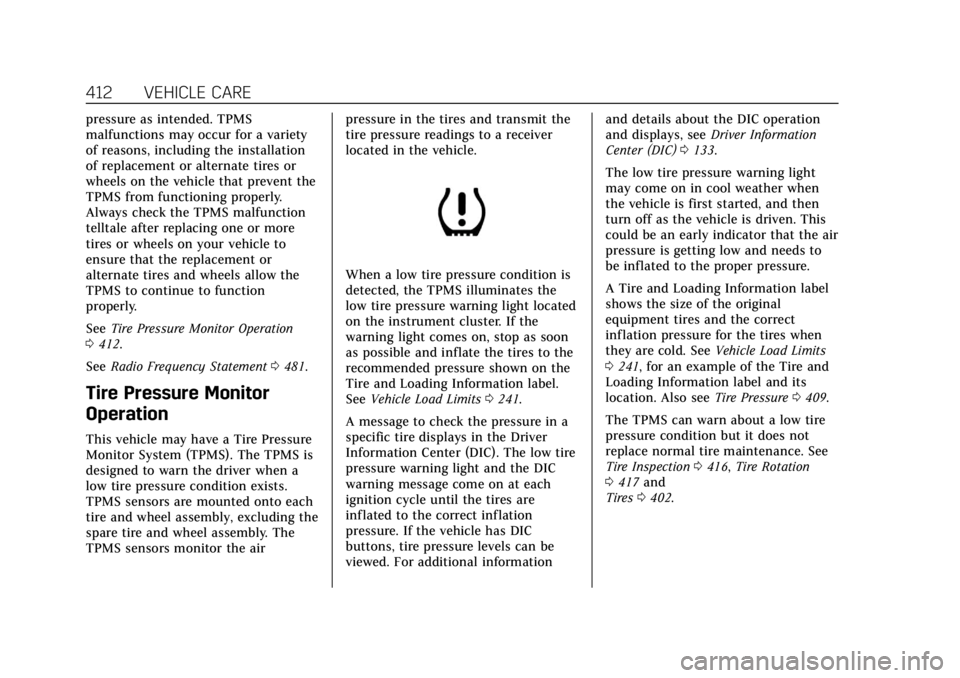
When a low tire pressure condition is
detected, the TPMS illuminates the
low tire pressure warning light located
on the instrument cluster. If the
warning light comes on, stop as soon
as possible and inflate the tires to the
recommended pressure shown on the
Tire and Loading Information label.
See
Vehicle Load Limits 0241.
A message to check the pressure in a
specific tire displays in the Driver
Information Center (DIC). The low tire
pressure warning light and the DIC
warning message come on at each
ignition cycle until the tires are
inflated to the correct inflation
pressure. If the vehicle has DIC
buttons, tire pressure levels can be
viewed. For additional information and details about the DIC operation
and displays, see
Driver Information
Center (DIC) 0133.
The low tire pressure warning light
may come on in cool weather when
the vehicle is first started, and then
turn off as the vehicle is driven. This
could be an early indicator that the air
pressure is getting low and needs to
be inflated to the proper pressure.
A Tire and Loading Information label
shows the size of the original
equipment tires and the correct
inflation pressure for the tires when
they are cold. See Vehicle Load Limits
0 241, for an example of the Tire and
Loading Information label and its
location. Also see Tire Pressure0409.
The TPMS can warn about a low tire
pressure condition but it does not
replace normal tire maintenance. See
Tire Inspection 0416, Tire Rotation
0 417 and
Tires 0402.
Page 416 of 508

Cadillac Escalade Owner Manual (GMNA-Localizing-U.S./Canada/Mexico-
15567102) - 2022 - CRC - 11/17/21
VEHICLE CARE 415
Trailer Tire Pressure Monitoring
Operation
If equipped, the Trailer Tire Pressure
Monitoring System (TTPMS) is
designed to monitor the pressure of
the trailer tires and warn the driver
when a low pressure condition exists.
TTPMS sensors for four tires are
provided. The system can
accommodate a trailer with up to six
tires if additional sensors are
purchased from the dealer. Also, the
system can be paired with up to five
individual trailers.
Prior to use, the vehicle must learn
the sensors by following the learning
process. SeeTrailering App 0355.
Contact your trailer service center or
tire service center to have the
pressure sensors installed inside the
trailer tires. The technician should
insert the sensor stem through the
hole in the trailer wheel. When the
sensor is correctly positioned, the nut
on the sensor stem should be
tightened to 8 Y(6 lb ft). When
mounting the trailer tire onto the
trailer wheel be careful not to damage
the sensor.
The Trailering App can be used to
view the tire pressures after the
recommended trailer tire pressures
have been entered. Refer to the trailer tire placard on the trailer or the trailer
tire sidewall for the recommended tire
pressure.
The system is compatible with trailer
tires that have placard pressure values
from 103 - 689 kpa (15 - 100 psi). The
hole in the wheel for the tire stem
must be 11.43 mm (0.453 in) in
diameter. Use of the pressure sensors
on a wheel with a different stem hole
size could result in loss of air from
the tire.
If a low trailer tire pressure condition
is detected, the TTPMS displays a
warning message on the DIC. If the
warning message is displayed, stop as
soon as possible and inflate the tires
to the recommended pressure shown
on the tire placard on the trailer.
In addition, the TTPMS monitors the
temperature of the trailer tires. If the
system detects a high temperature on
one or more of the trailer tires, a
warning message will be displayed on
the DIC. If this warning message is
displayed, stop as soon as possible,
and inspect the overheated trailer tire.
Page 417 of 508

Cadillac Escalade Owner Manual (GMNA-Localizing-U.S./Canada/Mexico-
15567102) - 2022 - CRC - 11/17/21
416 VEHICLE CARE
Common causes for high trailer tire
temperature are underinflation,
overloading, or tire damage.
TTPMS Malfunction Message
The TTPMS will not function properly
if one or more of the trailer tire
sensors are missing or inoperable.
If the system detects a malfunction, a
DIC message indicates that the system
requires service. Some of the
conditions that can cause the service
message to occur are:
.One of the trailer tires has been
replaced with the spare tire which
does not have a learned TTPMS
sensor. The DIC message should
turn off after the pressure sensor is
installed in the tire, and the
learning process is performed
successfully. See "TTPMS Sensor
Learning Process" underTrailering
App 0355.
.The TTPMS sensor learning process
was not done or not completed
successfully. The DIC message
should go off after successfully
completing the sensor learning process. See "TTPMS Sensor
Learning Process" under
Trailering
App 0355.
.One or more TTPMS sensors are
missing or damaged. The DIC
message should go off when the
TTPMS sensors are installed and
the sensor learning process is
performed successfully. See "TTPMS
Sensor Learning Process" under
Trailering App 0355.
.Operating electronic devices or
being near facilities using radio
wave frequencies similar to the
TTPMS could cause interference to
the TTPMS which could cause loss
of signal reception from the sensor.
.If the system does not receive the
signal from an individual sensor, an
error message may not occur until
the vehicle has been driver for a
period of time.
If the TTPMS is not functioning
properly, it cannot detect or signal a
low tire condition. See your dealer for
service if the DIC message comes on
and stays on when the trailer tire
pressures have been checked and
determined to be correct.
Tire Inspection
We recommend that the tires,
including the spare tire, if the
vehicle has one, be inspected for
signs of wear or damage at least
once a month.
Replace the tire if:
.The indicators at three or more
places around the tire can
be seen.
.There is cord or fabric showing
through the tire's rubber.
.The tread or sidewall is cracked,
cut, or snagged deep enough to
show cord or fabric.
.The tire has a bump, bulge,
or split.
.The tire has a puncture, cut,
or other damage that cannot be
repaired well because of the size
or location of the damage.
Page 420 of 508
Cadillac Escalade Owner Manual (GMNA-Localizing-U.S./Canada/Mexico-
15567102) - 2022 - CRC - 11/17/21
VEHICLE CARE 419
month, remove the tires or raise the
vehicle to reduce the weight from the
tires.
Buying New Tires
GM has developed and matched
specific tires for the vehicle. The
original equipment tires installed
were designed to meet General
Motors Tire Performance Criteria
Specification (TPC Spec) system
rating. When replacement tires are
needed, GM strongly recommends
buying tires with the same TPC
Spec rating.
GM's exclusive TPC Spec system
considers over a dozen critical
specifications that impact the
overall performance of the vehicle,
including brake system
performance, ride and handling,
traction control, and tire pressure
monitoring performance. GM's
TPC Spec number is molded onto
the tire's sidewall near the tire
size. If the tires have an all-season
tread design, the TPC Specnumber will be followed by MS for
mud and snow. See
Tire Sidewall
Labeling 0404 for additional
information.
GM recommends replacing worn
tires in complete sets of four.
Uniform tread depth on all tires
will help to maintain the
performance of the vehicle.
Braking and handling performance
may be adversely affected if all the
tires are not replaced at the same
time. If proper rotation and
maintenance have been done, all
four tires should wear out at
about the same time. However,
if it is necessary to replace only
one axle set of worn tires, place
the new tires on the rear axle. See
Tire Rotation 0417.
{Warning
Tires could explode during
improper service. Attempting to
mount or dismount a tire could
cause injury or death. Only your
(Continued)
Warning (Continued)
dealer or authorized tire service
center should mount or
dismount the tires.
{Warning
Mixing tires of different sizes
(other than those originally
installed on the vehicle), brands,
tread patterns, or types may
cause loss of vehicle control,
resulting in a crash or other
vehicle damage. Use the correct
size, brand, and type of tire on
all wheels.
{Warning
Using bias-ply tires on the
vehicle may cause the wheel rim
flanges to develop cracks after
many miles of driving. A tire
and/or wheel could fail suddenly
(Continued)
Page 421 of 508
Cadillac Escalade Owner Manual (GMNA-Localizing-U.S./Canada/Mexico-
15567102) - 2022 - CRC - 11/17/21
420 VEHICLE CARE
Warning (Continued)
and cause a crash. Use only
radial-ply tires with the wheels
on the vehicle.
Winter tires with the same speed
rating as the original equipment
tires may not be available for H, V,
W, Y and ZR speed rated tires.
Never exceed the winter tires’
maximum speed capability when
using winter tires with a lower
speed rating.
If the vehicle tires must be
replaced with a tire that does not
have a TPC Spec number, make
sure they are the same size, load
range, speed rating, and
construction (radial) as the
original tires.
The Tire and Loading Information
label indicates the original
equipment tires on the vehicle.
See Vehicle Load Limits 0241.Different Size Tires and
Wheels
If wheels or tires are installed that are
a different size than the original
equipment wheels and tires, vehicle
performance, including its braking,
ride and handling characteristics,
stability, and resistance to rollover
may be affected. If the vehicle has
electronic systems such as antilock
brakes, rollover airbags, traction
control, electronic stability control,
or All-Wheel Drive, the performance
of these systems can also be affected.
{Warning
If different sized wheels are used,
there may not be an acceptable
level of performance and safety if
tires not recommended for those
wheels are selected. This increases
the chance of a crash and serious
injury. Only use GM specific wheel
and tire systems developed for the
vehicle, and have them properly
installed by a GM certified
technician. See
Buying New Tires 0419 and
Accessories and Modifications 0369.
Uniform Tire Quality
Grading
The following information relates
to the system developed by the
United States National Highway
Traffic Safety Administration
(NHTSA), which grades tires by
treadwear, traction, and
temperature performance. This
applies only to vehicles sold in the
United States. The grades are
molded on the sidewalls of most
passenger car tires. The Uniform
Tire Quality Grading (UTQG)
system does not apply to deep
tread, winter tires, compact spare
tires, tires with nominal rim
diameters of 10 to 12 inches
(25 to 30 cm), or to some
limited-production tires.
While the tires available on
General Motors passenger cars
and light trucks may vary with
respect to these grades, they must
Page 424 of 508
Cadillac Escalade Owner Manual (GMNA-Localizing-U.S./Canada/Mexico-
15567102) - 2022 - CRC - 11/17/21
VEHICLE CARE 423
Warning (Continued)
amount of clearance can cause
damage to the brakes, suspension,
or other vehicle parts. The area
damaged by the tire chains could
cause loss of control and a crash.
Use another type of traction device
only if its manufacturer
recommends it for the vehicle's tire
size combination and road
conditions. Follow that
manufacturer's instructions. To
avoid vehicle damage, drive slowly
and readjust or remove the traction
device if it contacts the vehicle. Do
not spin the wheels. If traction
devices are used, install them on
the rear tires.
If a Tire Goes Flat
It is unusual for a tire to blow out
while driving, especially if the tires are
maintained properly. If air goes out of
a tire, it is much more likely to leak
out slowly. But if there ever is a
blowout, here are a few tips about
what to expect and what to do:If a front tire fails, the flat tire creates
a drag that pulls the vehicle toward
that side. Take your foot off the
accelerator pedal and grip the steering
wheel firmly. Steer to maintain lane
position, and then gently brake to a
stop, well off the road, if possible.
A rear blowout, particularly on a
curve, acts much like a skid and may
require the same correction as used in
a skid. Stop pressing the accelerator
pedal and steer to straighten the
vehicle. It may be very bumpy and
noisy. Gently brake to a stop, well off
the road, if possible.
{Warning
Driving on a flat tire will cause
permanent damage to the tire.
Re-inflating a tire after it has been
driven on while severely
underinflated or flat may cause a
blowout and a serious crash. Never
attempt to re-inflate a tire that has
been driven on while severely
underinflated or flat. Have your
(Continued)
Warning (Continued)
dealer or an authorized tire service
center repair or replace the flat tire
as soon as possible.
{Warning
Lifting a vehicle and getting under
it to do maintenance or repairs is
dangerous without the appropriate
safety equipment and training. If a
jack is provided with the vehicle, it
is designed only for changing a flat
tire. If it is used for anything else,
you or others could be badly injured
or killed if the vehicle slips off the
jack. If a jack is provided with the
vehicle, only use it for changing a
flat tire.
If a tire goes flat, avoid further tire
and wheel damage by driving slowly
to a level place, well off the road,
if possible. Turn on the hazard
warning flashers. See Hazard Warning
Flashers 0155.
Page 433 of 508

Cadillac Escalade Owner Manual (GMNA-Localizing-U.S./Canada/Mexico-
15567102) - 2022 - CRC - 11/17/21
432 VEHICLE CARE
Warning (Continued)
damage if the hoist cable fails or if
the tire comes loose. Make sure the
tire is stored securely before
driving.
Caution
Always store the spare tire or flat
tire with the valve stem pointed up.
Stowing a tire with the valve stem
pointed down could result in
damage to the wheel.
Caution
The tire hoist is designed to be
raised and lowered with tension on
the cable. If the hoist must be
raised or lowered without a tire
attached, do so only by hand, and
at a slow pace, to avoid damaging
the mechanism. Do not use power
tools.
{Warning
An improperly stored spare tire
could come loose and cause a crash.
To avoid personal injury or property
damage, always store the spare tire
when the vehicle is parked on a
level surface.
If the vehicle has 275/60R20 or
275/50R22 size tires, the flat tire must
be stored inside of the vehicle using
the flat tire secure strap inside the
glove box. See “Storing a Flat Tire
Inside of the Vehicle ”later in this
section.
If the vehicle has 265/65R18 or
275/55R20 size tires, store the flat tire
under the rear of the vehicle in the
spare tire carrier. Refer to the
following graphics and instructions:
1. Hoist Assembly
2. Hoist Shaft
3. Hoist Shaft Access Cover/Hole
4. Jack Handle Extension
5. Wheel Wrench
6. Spare Tire Lock
7. Hoist End of Extension Tool
8. Hoist Shaft Access Hole
9. Spare Tire (Valve Stem Pointed Up)
10.Tire/Wheel Retainer
11.Hoist Cable
1. Put the tire (9) on the ground at the rear of the vehicle with the
valve stem pointed up, and to
the rear.