sport mode CADILLAC ESCALADE 2022 Owners Manual
[x] Cancel search | Manufacturer: CADILLAC, Model Year: 2022, Model line: ESCALADE, Model: CADILLAC ESCALADE 2022Pages: 508, PDF Size: 9.18 MB
Page 130 of 508

Cadillac Escalade Owner Manual (GMNA-Localizing-U.S./Canada/Mexico-
15567102) - 2022 - CRC - 11/18/21
INSTRUMENTS AND CONTROLS 129
The light flashes when the TCS and/or
the StabiliTrak/ESC system is actively
working.
SeeTraction Control/Electronic Stability
Control 0265.
Engine Coolant
Temperature Warning Light
This light comes on briefly while
starting the vehicle.
If it does not, have the vehicle
serviced by your dealer. If the system
is working normally the indicator light
goes off.
Caution
The engine coolant temperature
warning light indicates that the
vehicle has overheated. Driving with
this light on can damage the engine
(Continued)
Caution (Continued)
and it may not be covered by the
vehicle warranty. SeeEngine
Overheating 0381.
The engine coolant temperature
warning light comes on when the
engine has overheated.
If this happens, pull over and turn off
the engine as soon as possible. See
Engine Overheating 0381.
Driver Mode Control Light
This light comes on when Sport Mode
is selected.
This light comes on when Snow Mode
is selected.
This light comes on when Terrain
Mode is selected.
This light comes on when Off-Road
Mode is selected.
This light comes on when the Tow/
Haul Mode is selected.
Page 268 of 508

Cadillac Escalade Owner Manual (GMNA-Localizing-U.S./Canada/Mexico-
15567102) - 2022 - CRC - 11/17/21
DRIVING AND OPERATING 267
Traction and Stability Menu
To turn off TCS, select or touch the
Traction virtual button on the screen.
The traction off light
idisplays in
the instrument cluster. See Traction
Off Light 0128.
If TCS is limiting wheel spin when
disabled, the system will not turn off
until the wheels stop spinning.
To turn TCS back on, select or touch
the Traction virtual button on the
screen. The traction off light
i
displayed in the instrument cluster
will turn off. To turn StabiliTrak/ESC off, first turn
off TCS to enable the Stability virtual
button on the screen, then select or
touch the Stability virtual button. The
StabiliTrak/ESC off light
gwill display
in the instrument cluster. See
StabiliTrak OFF Light 0128.
To turn StabiliTrak/ESC back on,
select or touch the Stability virtual
button on the screen. StabiliTrak/ESC
will turn on, but TCS will remain off.
TCS cannot be on when StabiliTrak/
ESC is off. If both systems are turned
off, selecting or touching the Traction
virtual button will turn both systems
back on.
StabiliTrak/ESC will automatically
turn on if the vehicle exceeds 56 km/h
(35 mph) and cannot be turned off
again until speed is reduced. Traction
control will remain off. Vehicles
equipped with the four corner air
suspension re-enable StabiliTrak/ESC
at 32 km/h (20 mph). The vehicle has a Trailer Sway Control
(TSC) feature and a Hill Start Assist
(HSA) feature. See
Trailer Sway Control
(TSC) 0354 or
Hill Start Assist (HSA) 0264.
Adding accessories can affect the
vehicle performance. See Accessories
and Modifications 0369.
Driver Mode Control
Driver Mode Control (DMC) allows the
driver to adjust the overall driving
experience to better suit preference by
adjusting multiple subsystems
simultaneously. Drive mode
availability and affected vehicle
subsystems are dependent upon
vehicle trim level, region, and optional
features.
Tour will be the default mode at every
ignition cycle. A unique and persistent
indicator will be displayed in the
instrument cluster for each mode.
Depending on trim level, Tour mode,
Sport mode, Snow/Ice mode, Off-Road
mode, Tow/Haul mode, Terrain mode,
and My mode may be available.
Page 269 of 508
Cadillac Escalade Owner Manual (GMNA-Localizing-U.S./Canada/Mexico-
15567102) - 2022 - CRC - 11/17/21
268 DRIVING AND OPERATING
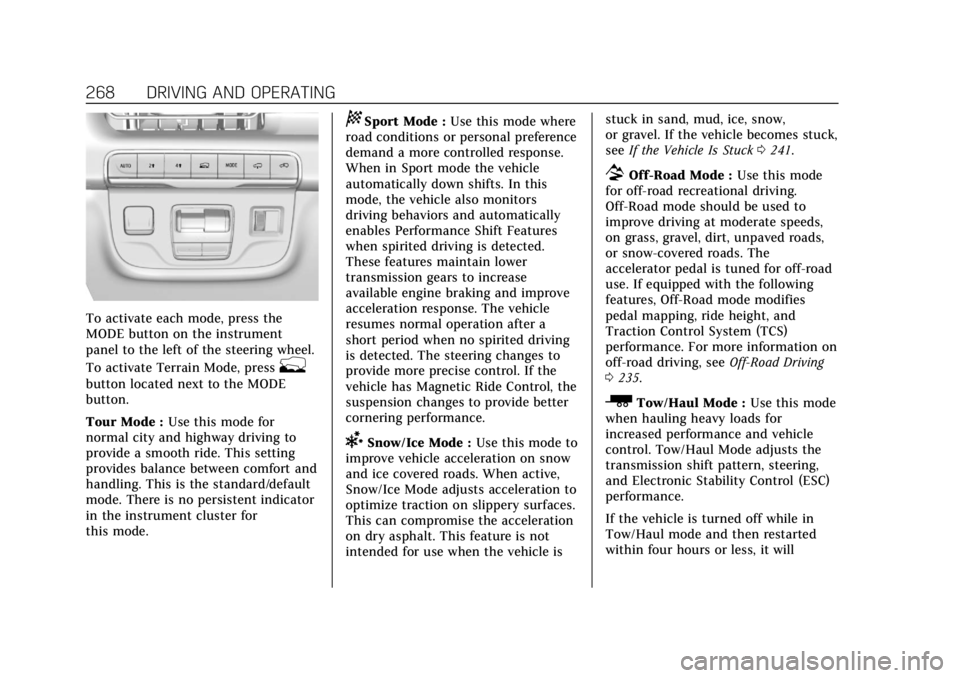
To activate each mode, press the
MODE button on the instrument
panel to the left of the steering wheel.
To activate Terrain Mode, press
g
button located next to the MODE
button.
Tour Mode :Use this mode for
normal city and highway driving to
provide a smooth ride. This setting
provides balance between comfort and
handling. This is the standard/default
mode. There is no persistent indicator
in the instrument cluster for
this mode.
8Sport Mode : Use this mode where
road conditions or personal preference
demand a more controlled response.
When in Sport mode the vehicle
automatically down shifts. In this
mode, the vehicle also monitors
driving behaviors and automatically
enables Performance Shift Features
when spirited driving is detected.
These features maintain lower
transmission gears to increase
available engine braking and improve
acceleration response. The vehicle
resumes normal operation after a
short period when no spirited driving
is detected. The steering changes to
provide more precise control. If the
vehicle has Magnetic Ride Control, the
suspension changes to provide better
cornering performance.
6Snow/Ice Mode : Use this mode to
improve vehicle acceleration on snow
and ice covered roads. When active,
Snow/Ice Mode adjusts acceleration to
optimize traction on slippery surfaces.
This can compromise the acceleration
on dry asphalt. This feature is not
intended for use when the vehicle is stuck in sand, mud, ice, snow,
or gravel. If the vehicle becomes stuck,
see
If the Vehicle Is Stuck 0241.
7Off-Road Mode : Use this mode
for off-road recreational driving.
Off-Road mode should be used to
improve driving at moderate speeds,
on grass, gravel, dirt, unpaved roads,
or snow-covered roads. The
accelerator pedal is tuned for off-road
use. If equipped with the following
features, Off-Road mode modifies
pedal mapping, ride height, and
Traction Control System (TCS)
performance. For more information on
off-road driving, see Off-Road Driving
0 235.
_Tow/Haul Mode : Use this mode
when hauling heavy loads for
increased performance and vehicle
control. Tow/Haul Mode adjusts the
transmission shift pattern, steering,
and Electronic Stability Control (ESC)
performance.
If the vehicle is turned off while in
Tow/Haul mode and then restarted
within four hours or less, it will
Page 408 of 508

Cadillac Escalade Owner Manual (GMNA-Localizing-U.S./Canada/Mexico-
15567102) - 2022 - CRC - 11/17/21
VEHICLE CARE 407
DOT Markings:A code molded
into the sidewall of a tire
signifying that the tire is in
compliance with the U.S.
Department of Transportation
(DOT) Motor Vehicle Safety
Standards. The DOT code includes
the Tire Identification Number
(TIN), an alphanumeric designator
which can also identify the tire
manufacturer, production plant,
brand, and date of production.
GVWR
:Gross Vehicle Weight
Rating. See Vehicle Load Limits
0 241.
GAWR FRT
:Gross Axle Weight
Rating for the front axle. See
Vehicle Load Limits 0241.
GAWR RR
:Gross Axle Weight
Rating for the rear axle. See
Vehicle Load Limits 0241. Intended Outboard Sidewall
:
The side of an asymmetrical tire
that must always face outward
when mounted on a vehicle.
Kilopascal (kPa)
:The metric unit
for air pressure.
Light Truck (LT-Metric) Tire
:A
tire used on light duty trucks and
some multipurpose passenger
vehicles.
Load Index
:An assigned number
ranging from 1 to 279 that
corresponds to the load carrying
capacity of a tire.
Maximum Inf lation Pressure
:
The maximum air pressure to
which a cold tire can be inflated.
The maximum air pressure is
molded onto the sidewall.
Maximum Load Rating
:The load
rating for a tire at the maximum
permissible inflation pressure for
that tire. Maximum Loaded Vehicle
Weight
:The sum of curb weight,
accessory weight, vehicle capacity
weight, and production options
weight.
Normal Occupant Weight
:The
number of occupants a vehicle is
designed to seat multiplied by
68 kg (150 lb). See Vehicle Load
Limits 0241.
Occupant Distribution
:
Designated seating positions.
Outward Facing Sidewall
:The
side of an asymmetrical tire that
has a particular side that faces
outward when mounted on a
vehicle. The side of the tire that
contains a whitewall, bears white
lettering, or bears manufacturer,
brand, and/or model name
molding that is higher or deeper
than the same moldings on the
other sidewall of the tire.
Page 441 of 508

Cadillac Escalade Owner Manual (GMNA-Localizing-U.S./Canada/Mexico-
15567102) - 2022 - CRC - 11/17/21
440 VEHICLE CARE
Contact a professional towing service
if the disabled vehicle must be
transported. GM recommends a
flatbed tow truck to transport a
disabled vehicle. Use ramps to help
reduce approach angles, if necessary.
If equipped, a tow eye may be located
near the spare tire or emergency jack.
Do not use the tow eye to pull the
vehicle from the snow, mud, sand,
or ditch. Tow eye threads may have
right or left-hand threads. Use caution
when installing or removing the
tow eye.
The vehicle must be in N (Neutral)
and the electric parking brake must be
released when loading the vehicle
onto a flatbed tow truck.
.If the vehicle is equipped with car
wash mode and has 12-volt battery
power, refer to“Car Wash Mode ”
under Automatic Transmission 0252
to place the vehicle in N (Neutral).
.If the 12-volt battery is dead and/or
the engine will not start, the vehicle
will not move. Try to jump start the vehicle. Refer to
Jump Starting -
North America 0436 and if the
jump start is successful, retry the
“Car Wash Mode ”procedure.
.If jump starting is unsuccessful, the
vehicle will not move. Tire skates or
dollies must be used under the
non-rolling tires to prevent vehicle
damage.
Front Attachment Points
The vehicle is equipped with specific
attachment points to be used to pull
the vehicle onto a flatbed car carrier
from a flat road surface. Do not use
these attachment points to pull the
vehicle from snow, mud or sand.
Recreational Vehicle
Towing
Recreational vehicle towing means
towing the vehicle behind another
vehicle, such as a motor home. The
two most common types of
recreational vehicle towing are dinghy
and dolly towing. Dinghy towing is
towing the vehicle with all four wheels
on the ground. Dolly towing is towing
the vehicle with two wheels on the
ground and two wheels on a dolly.
Follow the tow vehicle manufacturer’s
instructions. See your dealer or
trailering professional for additional
advice and equipment
recommendations.
Here are some important things to
consider before recreational vehicle
towing:
.Before towing the vehicle, become
familiar with the local laws that
apply to recreational vehicle towing.
These laws may vary by region.
.What is the towing capacity of the
towing vehicle? Be sure to read the
tow vehicle manufacturer's
recommendations.