ECO mode CADILLAC ESCALADE ESV 2007 2.G User Guide
[x] Cancel search | Manufacturer: CADILLAC, Model Year: 2007, Model line: ESCALADE ESV, Model: CADILLAC ESCALADE ESV 2007 2.GPages: 574, PDF Size: 2.89 MB
Page 161 of 574
Compass Variance
The mirror is set in zone eight upon leaving the
factory. It will be necessary to adjust the compass
to compensate for compass variance if the
vehicle is outside of zone eight. Under certain
circumstances, as during a long distance
cross-country trip, it will be necessary to adjust for
compass variance. Compass variance is the
difference between earth’s magnetic north and true
geographic north. If not adjusted to account for
compass variance, the compass could give
false readings.
To adjust for compass variance, do the following:
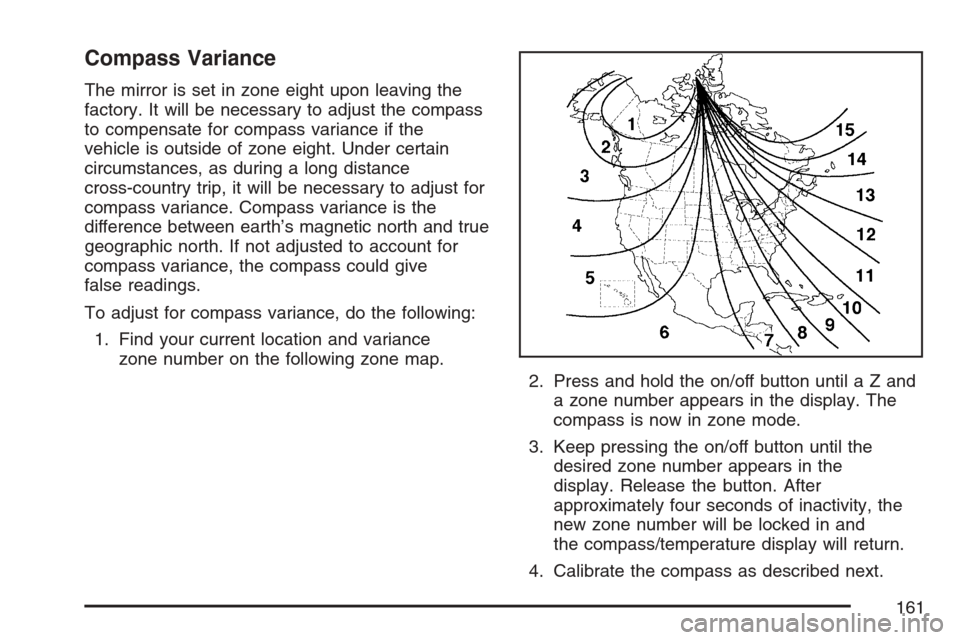
1. Find your current location and variance
zone number on the following zone map.
2. Press and hold the on/off button untilaZand
a zone number appears in the display. The
compass is now in zone mode.
3. Keep pressing the on/off button until the
desired zone number appears in the
display. Release the button. After
approximately four seconds of inactivity, the
new zone number will be locked in and
the compass/temperature display will return.
4. Calibrate the compass as described next.
161
Page 169 of 574
Universal Home Remote System
Operation (With Three Round LED)
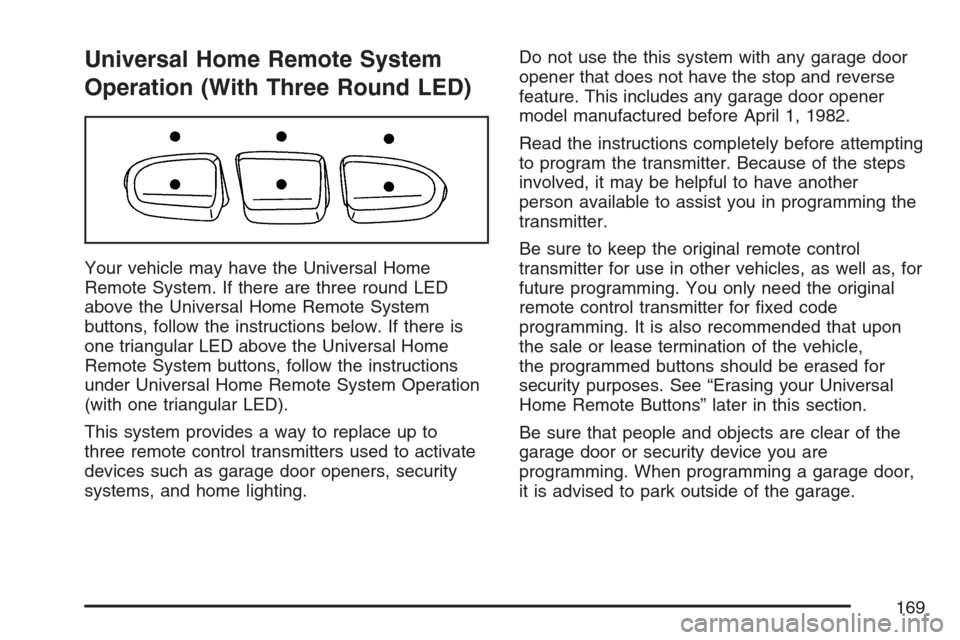
Your vehicle may have the Universal Home
Remote System. If there are three round LED
above the Universal Home Remote System
buttons, follow the instructions below. If there is
one triangular LED above the Universal Home
Remote System buttons, follow the instructions
under Universal Home Remote System Operation
(with one triangular LED).
This system provides a way to replace up to
three remote control transmitters used to activate
devices such as garage door openers, security
systems, and home lighting.Do not use the this system with any garage door
opener that does not have the stop and reverse
feature. This includes any garage door opener
model manufactured before April 1, 1982.
Read the instructions completely before attempting
to program the transmitter. Because of the steps
involved, it may be helpful to have another
person available to assist you in programming the
transmitter.
Be sure to keep the original remote control
transmitter for use in other vehicles, as well as, for
future programming. You only need the original
remote control transmitter for xed code
programming. It is also recommended that upon
the sale or lease termination of the vehicle,
the programmed buttons should be erased for
security purposes. See “Erasing your Universal
Home Remote Buttons” later in this section.
Be sure that people and objects are clear of the
garage door or security device you are
programming. When programming a garage door,
it is advised to park outside of the garage.
169
Page 174 of 574
Reprogramming Universal Home
Remote Buttons
You can reprogram any of the three buttons by
repeating the instructions.
Erasing Universal Home Remote
Buttons
You should erase the programmed buttons when
you sell the vehicle or terminate your lease.
To erase either rolling code or xed code on the
Universal Home Remote device, do the following:
1. Press and hold the two outside buttons at
the same time for approximately 20 seconds,
until the indicator lights, located directly
above the buttons, begin to blink rapidly.
2. Once the indicator lights begin to blink,
release both buttons. The codes from all
button will be erased.
For additional information on Universal Home
Remote, seeCustomer Assistance Offices
on page 544.
Universal Home Remote System
Operation (With One Triangular LED)
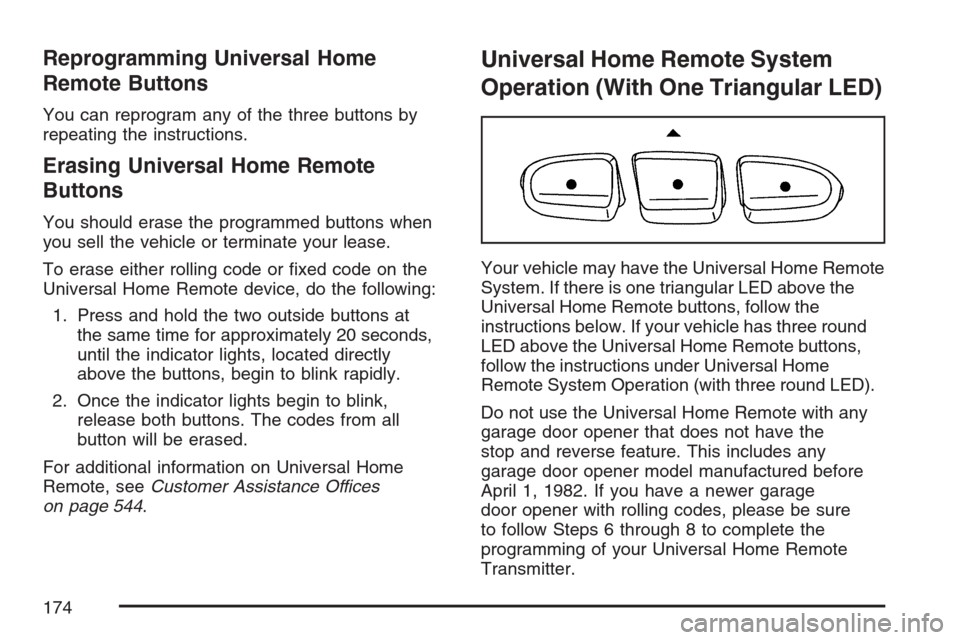
Your vehicle may have the Universal Home Remote
System. If there is one triangular LED above the
Universal Home Remote buttons, follow the
instructions below. If your vehicle has three round
LED above the Universal Home Remote buttons,
follow the instructions under Universal Home
Remote System Operation (with three round LED).
Do not use the Universal Home Remote with any
garage door opener that does not have the
stop and reverse feature. This includes any
garage door opener model manufactured before
April 1, 1982. If you have a newer garage
door opener with rolling codes, please be sure
to follow Steps 6 through 8 to complete the
programming of your Universal Home Remote
Transmitter.
174
Page 177 of 574
Gate Operator and Canadian
Programming
Canadian radio-frequency laws require transmitter
signals to time out or quit after several seconds
of transmission. This may not be long enough
for Universal Home Remote to pick up the signal
during programming. Similarly, some U.S. gate
operators are manufactured to time out in
the same manner.
If you live in Canada, or you are having difficulty
programming a gate operator or garage door
opener by using the “Programming Universal
Home Remote” procedures, regardless of where
you live, replace Step 3 under “Programming
Universal Home Remote” with the following:
Continue to press and hold the Universal Home
Remote button while you press and release every
two seconds (cycle) the hand-held transmitter
button until the frequency signal has been
successfully accepted by the Universal Home
Remote. The Universal Home Remote indicator
light will ash slowly at rst and then rapidly.
Proceed with Step 4 under “Programming
Universal Home Remote” to complete.
Using Universal Home Remote
Press and hold the appropriate Universal Home
Remote button for at least half of a second.
The indicator light will come on while the signal is
being transmitted.
Erasing Universal Home Remote
Buttons
To erase programming from the three Universal
Home Remote buttons do the following:
1. Press and hold down the two outside buttons
until the indicator light begins to ash, after
20 seconds. Do not hold the two outside
buttons for longer than 30 seconds.
2. Release both buttons.
The Universal Home Remote is now in the training
(learning) mode and can be programmed at any
time beginning with Step 2 under “Programming
Universal Home Remote” shown earlier in
this section.
Individual buttons cannot be erased, but they can
be reprogrammed. See “Reprogramming a
Single Universal Home Remote Button” following
this section.
177
Page 196 of 574
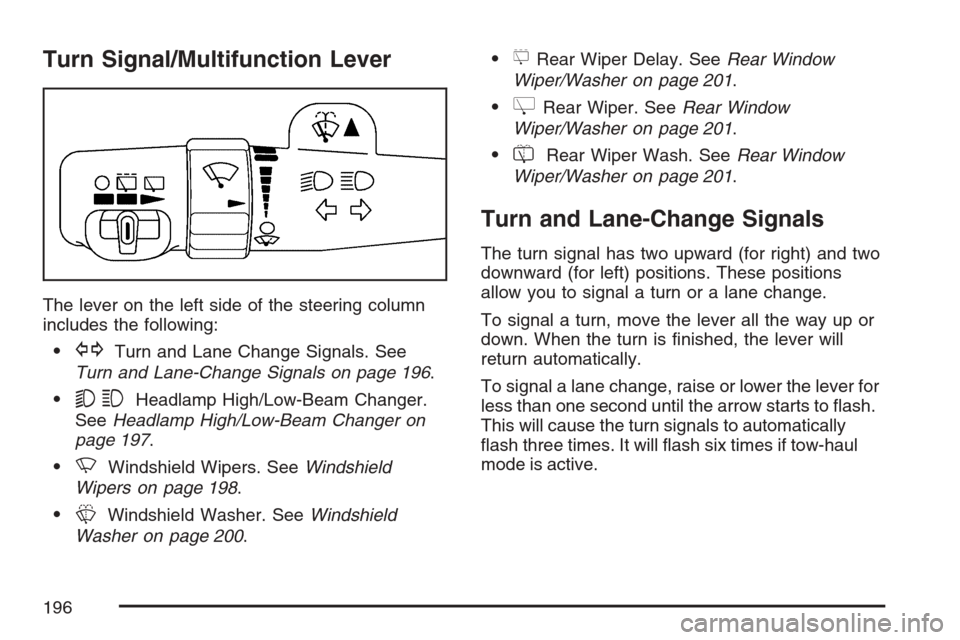
Turn Signal/Multifunction Lever
The lever on the left side of the steering column
includes the following:
GTurn and Lane Change Signals. See
Turn and Lane-Change Signals on page 196.
53Headlamp High/Low-Beam Changer.
SeeHeadlamp High/Low-Beam Changer on
page 197.
NWindshield Wipers. SeeWindshield
Wipers on page 198.
LWindshield Washer. SeeWindshield
Washer on page 200.
5Rear Wiper Delay. SeeRear Window
Wiper/Washer on page 201.
ZRear Wiper. SeeRear Window
Wiper/Washer on page 201.
=Rear Wiper Wash. SeeRear Window
Wiper/Washer on page 201.
Turn and Lane-Change Signals
The turn signal has two upward (for right) and two
downward (for left) positions. These positions
allow you to signal a turn or a lane change.
To signal a turn, move the lever all the way up or
down. When the turn is nished, the lever will
return automatically.
To signal a lane change, raise or lower the lever for
less than one second until the arrow starts to ash.
This will cause the turn signals to automatically
ash three times. It will ash six times if tow-haul
mode is active.
196
Page 199 of 574
Rainsense™ II Wipers
Your vehicle has Rainsense™ II windshield
wipers. These wipers automatically turn on when
a sensor, mounted next to the inside rearview
mirror, detects moisture on the windshield. When
active, these wipers are able to detect moisture
on the windshield and automatically turn on
the wipers.
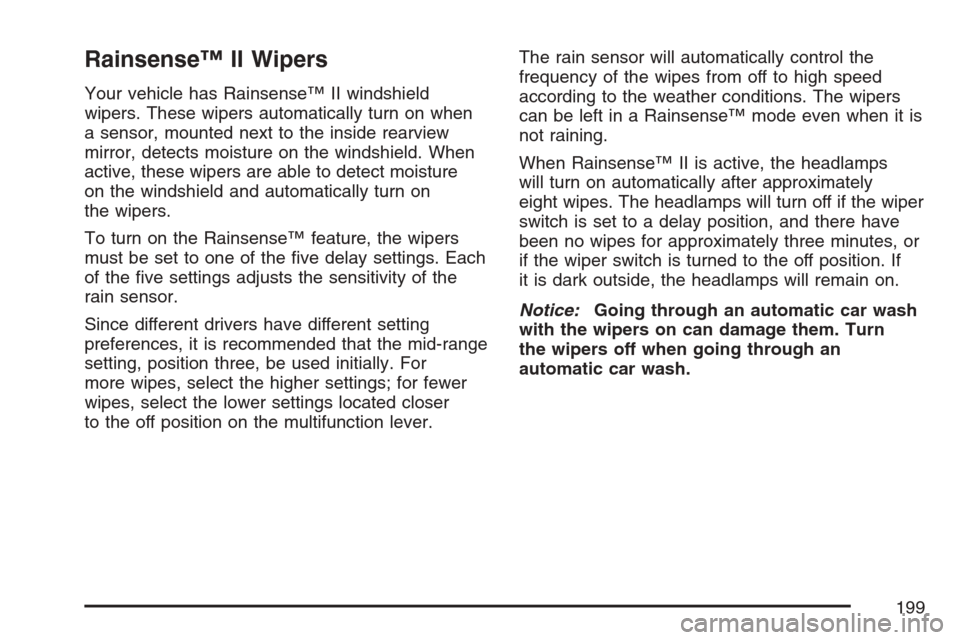
To turn on the Rainsense™ feature, the wipers
must be set to one of the ve delay settings. Each
of the ve settings adjusts the sensitivity of the
rain sensor.
Since different drivers have different setting
preferences, it is recommended that the mid-range
setting, position three, be used initially. For
more wipes, select the higher settings; for fewer
wipes, select the lower settings located closer
to the off position on the multifunction lever.The rain sensor will automatically control the
frequency of the wipes from off to high speed
according to the weather conditions. The wipers
can be left in a Rainsense™ mode even when it is
not raining.
When Rainsense™ II is active, the headlamps
will turn on automatically after approximately
eight wipes. The headlamps will turn off if the wiper
switch is set to a delay position, and there have
been no wipes for approximately three minutes, or
if the wiper switch is turned to the off position. If
it is dark outside, the headlamps will remain on.
Notice:Going through an automatic car wash
with the wipers on can damage them. Turn
the wipers off when going through an
automatic car wash.
199
Page 221 of 574

Turn the knob counterclockwise or clockwise to
lower or increase the cabin temperature. The
display will show the temperature setting
decreasing or increasing.
Set the passenger’s temperature setting to match
the driver’s temperature setting by pressing the
passenger power knob.
Automatic Operation
AUTO (Automatic):When automatic operation
is active the system will control the inside
temperature, the air delivery, and the fan speed.
Use the steps below to place the entire system in
automatic mode:
1. Press the AUTO button.
When AUTO is selected, the display will
change to show the current temperature(s)
and AUTO come on the display. The current
delivery mode and fan speed will also be
displayed for approximately ve seconds.When AUTO is selected, the air conditioning
operation and air inlet will be automatically
controlled. The air conditioning compressor will
run when the outside temperature is over
about 40°F (4°C). The air inlet will normally be
set to outside air. If it is hot outside, the air
inlet may automatically switch to recirculate
inside air to help quickly cool down your
vehicle. The light on the button will come on
in recirculation.
2. Set the driver’s and passenger’s temperature.
To nd your comfort setting, start with a 74°F
(23°C) temperature setting and allow about
20 minutes for the system to regulate. Use the
driver’s or passenger’s temperature buttons to
adjust the temperature setting as necessary.
If you choose the temperature setting of 60°F
(15°C), the system will remain at the maximum
cooling setting. If you choose the temperature
setting of 90°F (32°C), the system will remain at
the maximum heat setting. Choosing either
maximum setting will not cause the vehicle to
heat or cool any faster.
221
Page 223 of 574
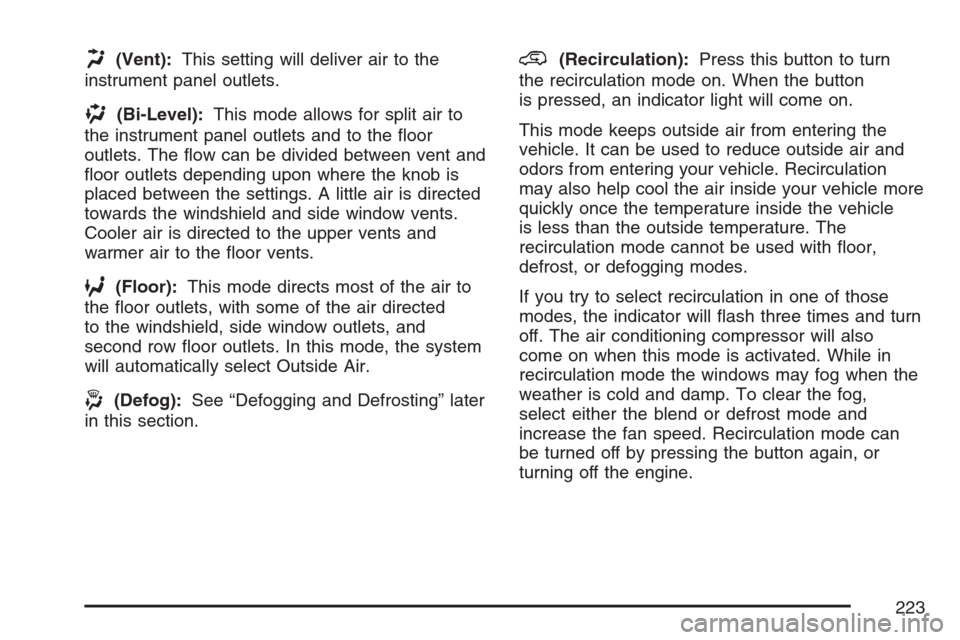
H(Vent):This setting will deliver air to the
instrument panel outlets.
)(Bi-Level):This mode allows for split air to
the instrument panel outlets and to the oor
outlets. The ow can be divided between vent and
oor outlets depending upon where the knob is
placed between the settings. A little air is directed
towards the windshield and side window vents.
Cooler air is directed to the upper vents and
warmer air to the oor vents.
6(Floor):This mode directs most of the air to
the oor outlets, with some of the air directed
to the windshield, side window outlets, and
second row oor outlets. In this mode, the system
will automatically select Outside Air.
-(Defog):See “Defogging and Defrosting” later
in this section.
@(Recirculation):Press this button to turn
the recirculation mode on. When the button
is pressed, an indicator light will come on.
This mode keeps outside air from entering the
vehicle. It can be used to reduce outside air and
odors from entering your vehicle. Recirculation
may also help cool the air inside your vehicle more
quickly once the temperature inside the vehicle
is less than the outside temperature. The
recirculation mode cannot be used with oor,
defrost, or defogging modes.
If you try to select recirculation in one of those
modes, the indicator will ash three times and turn
off. The air conditioning compressor will also
come on when this mode is activated. While in
recirculation mode the windows may fog when the
weather is cold and damp. To clear the fog,
select either the blend or defrost mode and
increase the fan speed. Recirculation mode can
be turned off by pressing the button again, or
turning off the engine.
223
Page 249 of 574
If a low or high tire pressure condition is detected
by the system while driving, a message advising
you to check the pressure in a specic tire
will appear in the display. SeeInation - Tire
Pressure on page 460andDIC Warnings
and Messages on page 250for more information.
If the tire pressure display shows dashes
instead of a value, there may be a problem with
your vehicle. If this consistently occurs, see
your dealer for service.
Relearn Tire Positions
If your vehicle has a Tire Pressure Monitor (TPM)
system, after rotating the tires or after replacing
a tire or sensor, the system must re-learn the
tire positions. To re-learn the tire positions, see
Tire Pressure Monitor System on page 462.
SeeTire Inspection and Rotation on page 467and
DIC Warnings and Messages on page 250for
more information.
Relearn Remote Key
This display allows you to match remote keyless
entry transmitters to your vehicle. To match a
remote keyless entry transmitter to your vehicle,
do the following:
1. Press the vehicle information button until
PRESS
VTO RELEARN REMOTE KEY
displays.
2. Press the set/reset button until REMOTE KEY
LEARNING ACTIVE is displayed.
3. Press and hold the lock and unlock buttons
on the rst transmitter at the same time for
approximately 15 seconds.
A chime will sound indicating that the
transmitter is matched.
4. To match additional transmitters at this time,
repeat Step 3.
Each vehicle can have a maximum of
eight transmitters matched to it.
5. To exit the programming mode, you must
cycle the key to LOCK.
Blank Display
This display shows no information.
249
Page 252 of 574
ENGINE OIL LOW ADD OIL
If your vehicle has an oil level sensor and the oil
level in the vehicle is low, this message will
display. Check the oil level and correct it as
necessary. You may need to let the vehicle cool
or warm up and cycle the ignition to be sure
this message will clear.
This message will clear itself after 10 seconds,
until the next ignition cycle. SeeEngine Oil
on page 407for additional information.
ENGINE OVERHEATED IDLE ENGINE
Notice:If you drive your vehicle while the
engine is overheating, severe engine damage
may occur. If an overheat warning appears
on the instrument panel cluster and/or
DIC, stop the vehicle as soon as possible.
SeeEngine Overheating on page 422for more
information.
This message will display when the engine coolant
temperature is too hot. Stop and allow the
vehicle to idle until it cools down. SeeEngine
Coolant Temperature Gage on page 238.SeeOverheated Engine Protection Operating
Mode on page 424for information on driving to a
safe place in an emergency.
ENGINE OVERHEATED STOP ENGINE
Notice:If you drive your vehicle while the
engine is overheating, severe engine damage
may occur. If an overheat warning appears
on the instrument panel cluster and/or
DIC, stop the vehicle as soon as possible.
SeeEngine Overheating on page 422for more
information.
If the engine cooling system reaches unsafe
temperatures for operation, this message will
display and a chime will sound. Stop and turn off
the vehicle as soon as it is safe to do so to avoid
severe damage. This message will clear when the
engine has cooled to a safe operating temperature.
252