automatic transmission CADILLAC ESCALADE ESV 2009 User Guide
[x] Cancel search | Manufacturer: CADILLAC, Model Year: 2009, Model line: ESCALADE ESV, Model: CADILLAC ESCALADE ESV 2009Pages: 602, PDF Size: 5.18 MB
Page 141 of 602
Running the Vehicle While Parked It is better not to park with the engine running. But if you
ever have to, here are some things to know.
{ CAUTION: Idling a vehicle in an enclosed area with poor
ventilation is dangerous. Engine exhaust may
enter the vehicle. Engine exhaust contains Carbon
Monoxide (CO) which cannot be seen or smelled.
It can cause unconsciousness and even death.
Never run the engine in an enclosed area that has
no fresh air ventilation. For more information, see
Engine Exhaust on page 2-38 .{ CAUTION: It can be dangerous to get out of the vehicle
if the automatic transmission shift lever is not
fully in P (Park) with the parking brake rmly set.
The vehicle can roll. Do not leave the vehicle
when the engine is running unless you have to.
If you have left the engine running, the vehicle can
move suddenly. You or others could be injured.
To be sure the vehicle will not move, even when
you are on fairly level ground, always set the
parking brake and move the shift lever to P (Park).
Follow the proper steps to be sure the vehicle will not
move. See Shifting Into Park on page 2-36 .
If parking on a hill and pulling a trailer, see Towing a
Trailer on page 5-44 .
2-39
Page 173 of 602
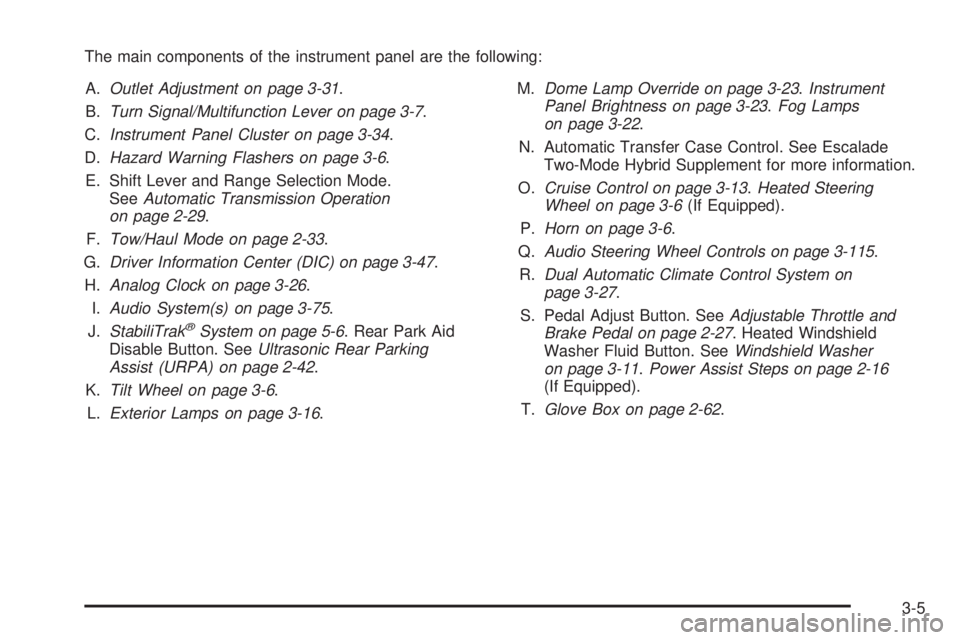
The main components of the instrument panel are the following:
A. Outlet Adjustment on page 3-31 .
B. Turn Signal/Multifunction Lever on page 3-7 .
C. Instrument Panel Cluster on page 3-34 .
D. Hazard Warning Flashers on page 3-6 .
E. Shift Lever and Range Selection Mode.
See Automatic Transmission Operation
on page 2-29 .
F. Tow/Haul Mode on page 2-33 .
G. Driver Information Center (DIC) on page 3-47 .
H. Analog Clock on page 3-26 .
I. Audio System(s) on page 3-75 .
J. StabiliTrak ®
System on page 5-6 . Rear Park Aid
Disable Button. See Ultrasonic Rear Parking
Assist (URPA) on page 2-42 .
K. Tilt Wheel on page 3-6 .
L. Exterior Lamps on page 3-16 . M. Dome Lamp Override on page 3-23 . Instrument
Panel Brightness on page 3-23 . Fog Lamps
on page 3-22 .
N. Automatic Transfer Case Control. See Escalade
Two-Mode Hybrid Supplement for more information.
O. Cruise Control on page 3-13 . Heated Steering
Wheel on page 3-6 (If Equipped).
P. Horn on page 3-6 .
Q. Audio Steering Wheel Controls on page 3-115 .
R. Dual Automatic Climate Control System on
page 3-27 .
S. Pedal Adjust Button. See Adjustable Throttle and
Brake Pedal on page 2-27 . Heated Windshield
Washer Fluid Button. See Windshield Washer
on page 3-11 . Power Assist Steps on page 2-16
(If Equipped).
T. Glove Box on page 2-62 .
3-5
Page 181 of 602
Cruise Control
{ CAUTION: Cruise control can be dangerous where you cannot
drive safely at a steady speed. So, do not use the
cruise control on winding roads or in heavy traffic.
Cruise control can be dangerous on slippery roads.
On such roads, fast changes in tire traction can
cause excessive wheel slip, and you could lose
control. Do not use cruise control on slippery roads.
With cruise control, a speed of about 25 mph (40 km/h)
or more can be maintained without keeping your foot
on the accelerator. Cruise control does not work
at speeds below about 25 mph (40 km/h). When the brakes are applied, cruise control is turned off.
For vehicles with an Allison ®
or Hydra-Matic 6-speed
automatic transmission, see “Grade Braking and Cruise
Grade Braking (Allison Transmission) under Tow/Haul
Mode on page 2-33 for an explanation of how cruise
control interacts with the Range Selection Mode,
tow/haul and grade braking systems.
If the vehicle has StabiliTrak ®
, and the system begins
to limit wheel spin, cruise control will automatically
disengage. See StabiliTrak ®
System on page 5-6 .
When road conditions allow the cruise control to
be safely used again, it can be turned back on.
3-13
Page 189 of 602

Headlamps on Reminder If a door is open, a reminder chime will sound when
the headlamps or parking lamps are manually turned on
and the key is out of the ignition. To turn off the chime,
turn the headlamp switch to off or AUTO and then back
on, or close and re-open the door. In the AUTO mode,
the headlamps turn off once the ignition is in LOCK/OFF
or may remain on until the headlamp delay ends
(if enabled in the DIC). See “Exit Lighting” under
DIC Vehicle Customization on page 3-65 .
Daytime Running Lamps (DRL) Daytime Running Lamps (DRL) can make it easier
for others to see the front of your vehicle during the day.
Fully functional daytime running lamps are required
on all vehicles rst sold in Canada.
The DRL system will come on when the following
conditions are met:
The ignition is on.
The exterior lamps control is in AUTO.
The transmission is not in P (Park).
The light sensor determines it is daytime.
When the DRL are on, only the DRL lamps will be on.
The taillamps, sidemarker, instrument panel lights,
and other lamps will not be on. When it begins to get dark, the automatic headlamp
system will switch from DRL to the headlamps.
To turn off the DRL lamps, turn the exterior
lamps control to the OFF position and then release.
For vehicles rst sold in Canada, the transmission must
be in the P (Park) position, before the DRL lamps can
be turned off.
Automatic Headlamp System When it is dark enough outside, the automatic headlamp
system turns on the headlamps at the normal brightness,
along with the taillamps, sidemarker, parking lamps,
and the instrument panel lights. The radio lights will
also be dim.
To turn off the automatic headlamp system, turn the
exterior lamps switch to the off position and then release
it. For vehicles rst sold in Canada, the transmission
must be in the P (Park) position, before the automatic
headlamp system can be turned off.
The vehicle has a light sensor located on the top of the
instrument panel in the defroster grille that regulates
when the automatic headlamps turn on. Do not cover
the sensor or the headlamps will come on whenever
the ignition is on.
The system may also turn on the headlamps when
driving through a parking garage, heavy overcast
weather, or a tunnel. This is normal.
3-21
Page 218 of 602
Average Economy Press the trip/fuel button until AVERAGE ECONOMY
displays. This display shows the approximate average
miles per gallon (mpg) or liters per 100 kilometers
(L/100 km). This number is calculated based on the
number of mpg (L/100 km) recorded since the last
time this menu item was reset. To reset AVERAGE
ECONOMY, press and hold the set/reset button.
Fuel Used Press the trip/fuel button until FUEL USED displays.
This display shows the number of gallons (gal) or
liters (L) of fuel used since the last reset of this menu
item. To reset the fuel used information, press and hold
the set/reset button while FUEL USED is displayed.
Timer Press the trip/fuel button until TIMER displays.
This display can be used as a timer.
To start the timer, press the set/reset button while
TIMER is displayed. The display will show the amount
of time that has passed since the timer was last reset,
not including time the ignition is off. Time will continue to be counted as long as the ignition is on, even if another
display is being shown on the DIC. The timer will record
up to 99 hours, 59 minutes and 59 seconds (99:59:59)
after which the display will return to zero.
To stop the timer, press the set/reset button briey while
TIMER is displayed.
To reset the timer to zero, press and hold the set/reset
button while TIMER is displayed.
Transmission Temperature Press the trip/fuel button until TRANS TEMP displays.
This display shows the temperature of the automatic
transmission uid in either degrees Fahrenheit (°F)
or degrees Celsius (°C).
Average Vehicle Speed Press the trip/fuel button until AVERAGE SPEED
displays. This display shows the average speed in
miles per hour (MPH) or kilometers per hour (km/h).
Blank Display This display shows no information.
3-50
Page 384 of 602

It is recommended to leave the system on for normal
driving conditions, but it may be necessary to turn the
system off if the vehicle is stuck in sand, mud, ice or
snow, and you want to “rock” the vehicle to attempt to
free it. It may also be necessary to turn off the system
when driving in extreme off-road conditions where high
wheel spin is required. See If Your Vehicle is Stuck in
Sand, Mud, Ice, or Snow on page 5-31 .
Traction Control Operation The traction control system is part of the StabiliTrak
system. Traction control limits wheel spin by reducing
engine power to the wheels (engine speed management)
and by applying brakes to each individual wheel
(brake-traction control) as necessary.
The traction control system is enabled automatically
when the vehicle is started. It will activate and the
StabiliTrak light will ash if it senses that any of the
wheels are spinning or beginning to lose traction
while driving. If traction control is turned off, only the
brake-traction control portion of traction control will work.
The engine speed management will be disabled. In this
mode, engine power is not reduced automatically and the
driven wheels can spin more freely. This can cause the
brake-traction control to activate constantly. Notice: If the wheel(s) of one axle is allowed
to spin excessively while the StabiliTrak, ABS and
brake warning lights and any relevant DIC messages
are displayed, the transfer case could be damaged.
The repairs would not be covered by the vehicle
warranty. Reduce engine power and do not spin
the wheel(s) excessively while these lights and
messages are displayed.
The traction control system may activate on dry or
rough roads or under conditions such as heavy
acceleration while turning or abrupt upshifts/downshifts
of the transmission. When this happens, a reduction in
acceleration may be noticed, or a noise or vibration may
be heard. This is normal.
If cruise control is being used when the system activates,
the StabiliTrak light will ash and cruise control will
automatically disengage. Cruise control may be
reengaged when road conditions allow. See Cruise
Control on page 3-13 .
StabiliTrak may also turn off automatically if it determines
that a problem exists with the system. If the problem does
not clear itself after restarting the vehicle, see your
dealer/retailer for service.
5-8
Page 419 of 602

Two-wheel-drive vehicles should not be towed with
the rear wheels on the ground. Two-wheel-drive
transmissions have no provisions for internal lubrication
while being towed.
Dolly Towing (Rear Wheels Off the Ground)
Use the following procedure to dinghy tow a
two-wheel-drive vehicle from the rear:
1. Attach the dolly to the tow vehicle following the
dolly manufacturer’s instructions.
2. Drive the rear wheels onto the dolly.
3. Firmly set the parking brake. See Parking Brake on
page 2-34 . 4. Put the transmission in P (Park).
5. Secure the vehicle to the dolly following the
manufacturer’s instructions.
6. Use an adequate clamping device designed for
towing to ensure that the front wheels are locked
into the straight position.
7. Turn the ignition to LOCK/OFF.
Level Control
Automatic Level Control The automatic level control rear suspension is available
on light-duty vehicles and comes as a part of the
Autoride ®
suspension, if equipped.
This type of level control is fully automatic and will provide
a better leveled riding position as well as better handling
under a variety of passenger and loading conditions. An
air compressor connected to the rear shocks will raise or
lower the rear of the vehicle to maintain proper vehicle
height. The system is activated when the ignition key is
turned to ON/RUN and will automatically adjust vehicle
height thereafter. The system may exhaust (lower vehicle
height) for up to ten minutes after the ignition key has
been turned off. You may hear the air compressor
operating when the height is being adjusted.
If a weight-distributing hitch is being used, it is
recommended to allow the shocks to inate, thereby
leveling the vehicle prior to adjusting the hitch.
5-43
Page 432 of 602

Maintenance When Trailer Towing The vehicle needs service more often when pulling a
trailer. See this manual’s Maintenance Schedule or Index
for more information. Things that are especially important
in trailer operation are automatic transmission uid,
engine oil, axle lubricant, belts, cooling system and brake
system. It is a good idea to inspect these before and
during the trip.
Check periodically to see that all hitch nuts and bolts
are tight.
Trailer Wiring Harness Heavy-Duty Trailer Wiring Package
The vehicle is equipped with the seven-wire trailer
towing harness. This harness with a seven-pin universal
heavy-duty trailer connector is attached to the rear
bumper beam. It is located next to the integrated trailer
hitch. The seven-wire harness contains the following trailer
circuits:
Yellow: Left Stop/Turn Signal
Dark Green: Right Stop/Turn Signal
Brown: Taillamps
White: Ground
Light Green: Back-up Lamps
Red w/ Black Stripe: Battery Feed*
Dark Blue: Trailer Brake*
*The fuses for these two circuits are installed in the
underhood electrical center, but the circuits are
not connected. They should be installed by your dealer
or a qualied service center.
If charging a remote (non-vehicle) battery, press the
Tow/Haul mode button, if equipped, located at the end of
the shift lever. This will boost the vehicle system voltage
and properly charge the battery. If the trailer is too light
for Tow/Haul mode, or the vehicle is not equipped with
Tow/Haul, turn on the headlamps as a second way to
boost the vehicle system and charge the battery.
5-56
Page 435 of 602
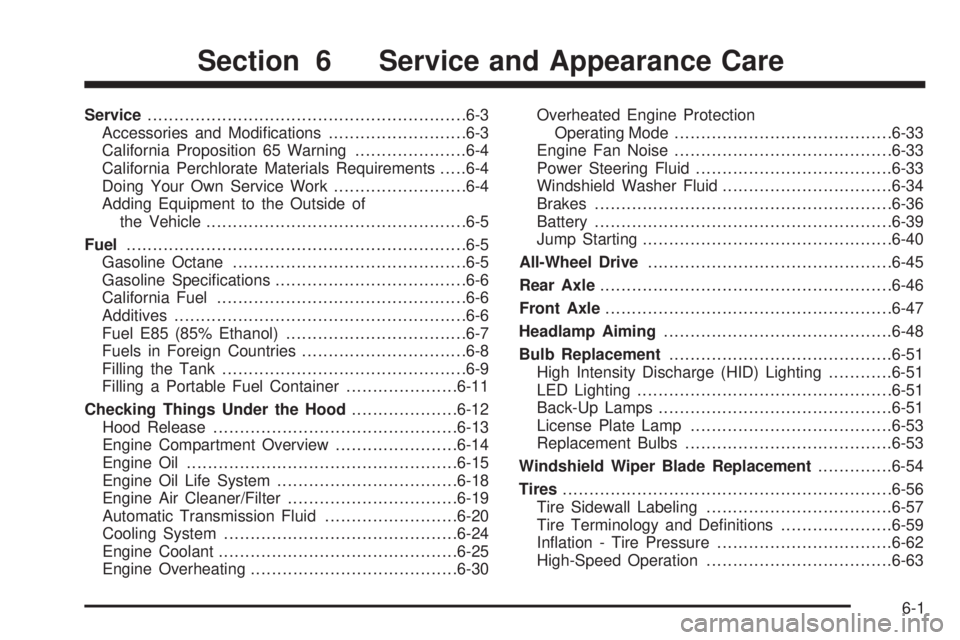
Service ........................................................... .6-3
Accessories and Modications ......................... .6-3
California Proposition 65 Warning .................... .6-4
California Perchlorate Materials Requirements .... .6-4
Doing Your Own Service Work ........................ .6-4
Adding Equipment to the Outside of
the Vehicle ................................................ .6-5
Fuel ............................................................... .6-5
Gasoline Octane ........................................... .6-5
Gasoline Specications ................................... .6-6
California Fuel .............................................. .6-6
Additives ...................................................... .6-6
Fuel E85 (85% Ethanol) ................................. .6-7
Fuels in Foreign Countries .............................. .6-8
Filling the Tank ............................................. .6-9
Filling a Portable Fuel Container .................... .6-11
Checking Things Under the Hood ................... .6-12
Hood Release ............................................. .6-13
Engine Compartment Overview ...................... .6-14
Engine Oil .................................................. .6-15
Engine Oil Life System ................................. .6-18
Engine Air Cleaner/Filter ............................... .6-19
Automatic Transmission Fluid ........................ .6-20
Cooling System ........................................... .6-24
Engine Coolant ............................................ .6-25
Engine Overheating ...................................... .6-30 Overheated Engine Protection
Operating Mode ........................................ .6-33
Engine Fan Noise ........................................ .6-33
Power Steering Fluid .................................... .6-33
Windshield Washer Fluid ............................... .6-34
Brakes ....................................................... .6-36
Battery ....................................................... .6-39
Jump Starting .............................................. .6-40
All-Wheel Drive ............................................. .6-45
Rear Axle ...................................................... .6-46
Front
Axle ..................................................... .6-47
Headlamp Aiming .......................................... .6-48
Bulb Replacement ......................................... .6-51
High Intensity Discharge (HID) Lighting ........... .6-51
LED Lighting ............................................... .6-51
Back-Up Lamps ........................................... .6-51
License Plate Lamp ..................................... .6-53
Replacement Bulbs ...................................... .6-53
Windshield Wiper Blade Replacement ............. .6-54
Tires ............................................................. .6-56
Tire Sidewall Labeling .................................. .6-57
Tire Terminology and Denitions .................... .6-59
Ination - Tire Pressure ................................ .6-62
High-Speed Operation .................................. .6-63Section 6 Service and Appearance Care
6-1
Page 449 of 602

A. Engine Air Cleaner/Filter on page 6-19 .
B. Coolant Surge Tank and Pressure Cap. See Cooling
System on page 6-24 .
C. Remote Positive (+) Terminal. See Jump Starting on
page 6-40 .
D. Battery on page 6-39 .
E. Engine Oil Fill Cap. See “When to Add Engine Oil”
under Engine Oil on page 6-15 .
F. Automatic Transmission Dipstick (Out of View).
See “Checking the Fluid Level” under Automatic
Transmission Fluid on page 6-20 .
G. Remote Negative ( − ) Terminal (GND) (Out of View).
See Jump Starting on page 6-40 .
H. Engine Oil Dipstick (Out of View). See “Checking
Engine Oil” under Engine Oil on page 6-15 .
I. Engine Cooling Fan (Out of View). See Cooling
System on page 6-24 .
J. Power Steering Fluid Reservoir (Out of View).
See Power Steering Fluid on page 6-33 .
K. Brake Master Cylinder Reservoir. See “Brake Fluid”
under Brakes on page 6-36 . L. Underhood Fuse Block on page 6-109 .
M. Windshield Washer Fluid Reservoir. See “Adding
Washer Fluid” under Windshield Washer Fluid
on page 6-34 .
Engine Oil
Checking Engine Oil It is a good idea to check the engine oil level at each
fuel ll. In order to get an accurate reading, the oil must
be warm and the vehicle must be on level ground.
The engine oil dipstick handle is a yellow loop.
See Engine Compartment Overview on page 6-14
for the location of the engine oil dipstick.
1. Turn off the engine and give the oil several minutes
to drain back into the oil pan. If this is not done, the
oil dipstick might not show the actual level.
2. Pull out the dipstick and clean it with a paper towel
or cloth, then push it back in all the way. Remove it
again, keeping the tip down, and check the level.
6-15