coolant temperature CADILLAC ESCALADE ESV 2009 User Guide
[x] Cancel search | Manufacturer: CADILLAC, Model Year: 2009, Model line: ESCALADE ESV, Model: CADILLAC ESCALADE ESV 2009Pages: 602, PDF Size: 5.18 MB
Page 460 of 602
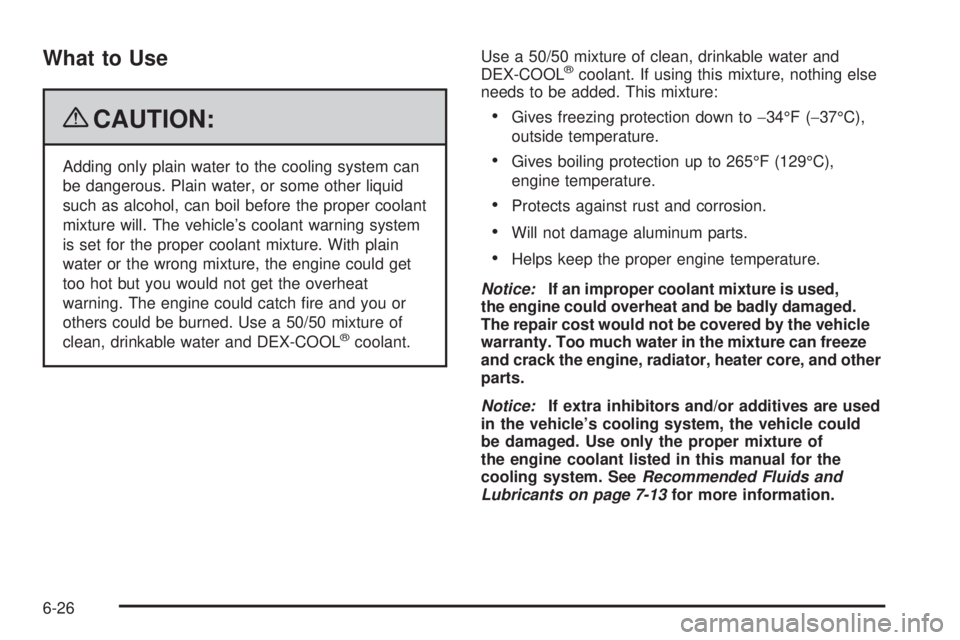
What to Use
{ CAUTION: Adding only plain water to the cooling system can
be dangerous. Plain water, or some other liquid
such as alcohol, can boil before the proper coolant
mixture will. The vehicle’s coolant warning system
is set for the proper coolant mixture. With plain
water or the wrong mixture, the engine could get
too hot but you would not get the overheat
warning. The engine could catch re and you or
others could be burned. Use a 50/50 mixture of
clean, drinkable water and DEX-COOL ®
coolant. Use a 50/50 mixture of clean, drinkable water and
DEX-COOL ®
coolant. If using this mixture, nothing else
needs to be added. This mixture:
Gives freezing protection down to − 34°F ( − 37°C),
outside temperature.
Gives boiling protection up to 265°F (129°C),
engine temperature.
Protects against rust and corrosion.
Will not damage aluminum parts.
Helps keep the proper engine temperature.
Notice: If an improper coolant mixture is used,
the engine could overheat and be badly damaged.
The repair cost would not be covered by the vehicle
warranty. Too much water in the mixture can freeze
and crack the engine, radiator, heater core, and other
parts.
Notice: If extra inhibitors and/or additives are used
in the vehicle’s cooling system, the vehicle could
be damaged. Use only the proper mixture of
the engine coolant listed in this manual for the
cooling system. See Recommended Fluids and
Lubricants on page 7-13 for more information.
6-26
Page 464 of 602

4. With the coolant surge tank pressure cap off, start
the engine and let it run until you can feel the upper
radiator hose getting hot. Watch out for the engine
cooling fan.
By this time, the coolant level inside the coolant
surge tank may be lower. If the level is lower, add
more of the proper mixture to the coolant surge tank
until the level reaches the FULL COLD mark. 5. Replace the pressure cap. Be sure the pressure
cap is hand-tight and fully seated.
6. Verify coolant level after engine is shut off and the
coolant is cold. If necessary, repeat coolant ll
procedure Steps 1 through 6.
Notice: If the pressure cap is not tightly installed,
coolant loss and possible engine damage may occur.
Be sure the cap is properly and tightly secured.
Engine Overheating The vehicle has several indicators to warn of engine
overheating.
There is a coolant temperature gage on your vehicle’s
instrument panel. See Engine Coolant Temperature
Gage on page 3-41 .
In addition, ENGINE OVERHEATED STOP ENGINE,
ENGINE OVERHEATED IDLE ENGINE, and a ENGINE
POWER IS REDUCED message comes on in the
Driver Information Center (DIC) on the instrument panel.
See DIC Warnings and Messages on page 3-56 .
6-30
Page 466 of 602

If No Steam Is Coming From The
Engine Compartment The ENGINE OVERHEATED STOP ENGINE or the
ENGINE OVERHEATED IDLE ENGINE message, along
with a low coolant condition, can indicate a serious
problem.
If you get an engine overheat warning, but see or
hear no steam, the problem may not be too serious.
Sometimes the engine can get a little too hot when you:
Climb a long hill on a hot day.
Stop after high-speed driving.
Idle for long periods in traffic.
Tow a trailer. See Towing a Trailer on page 5-44 .
If you get the ENGINE OVERHEATED STOP ENGINE or
the ENGINE OVERHEATED IDLE ENGINE message
with no sign of steam, try this for a minute or so:
If the overheat warning is displayed with no sign of
steam:
1. Turn the air conditioning off.
2. Turn the heater on to the highest temperature and
to the highest fan speed. Open the windows as
necessary. 3. In heavy traffic, let the engine idle in N (Neutral)
while stopped. If it is safe to do so, pull off the
road, shift to P (Park) or N (Neutral) and let
the engine idle.
If the temperature overheat gage is no longer in the
overheat zone or an overheat warning no longer displays,
the vehicle can be driven. Continue to drive the vehicle
slow for about 10 minutes. Keep a safe vehicle distance
from the car in front of you. If the warning does not come
back on, continue to drive normally.
If the warning continues, pull over, stop, and park the
vehicle right away.
If there is no sign of steam, idle the engine for
ve minutes while parked. If the warning is still
displayed, turn off the engine until it cools down.
Also, see “Overheated Engine Protection Operating
Mode” later in this section.
6-32
Page 467 of 602

Overheated Engine Protection
Operating Mode If an overheated engine condition exists and the
ENGINE POWER IS REDUCED message is displayed,
an overheat protection mode which alternates ring
groups of cylinders helps prevent engine damage.
In this mode, you will notice a loss in power and engine
performance. This operating mode allows the vehicle
to be driven to a safe place in an emergency. Driving
extended miles (km) and/or towing a trailer in the
overheat protection mode should be avoided.
Notice: After driving in the overheated engine
protection operating mode, to avoid engine damage,
allow the engine to cool before attempting any repair.
The engine oil will be severely degraded. Repair the
cause of coolant loss, change the oil and reset the oil
life system. See Engine Oil on page 6-15 .Engine Fan Noise The vehicle has electric cooling fans. You might hear
the fans spinning at low speed during most everyday
driving. The fans can turn off if no cooling is required.
Under heavy vehicle loading, trailer towing, and/or
high outside temperatures, or if you are operating the
air conditioning system, the fans can change to
high speed and you might hear an increase in fan noise.
This is normal and indicates that the cooling system
is functioning properly. The fans change to low speed
when additional cooling is no longer required.
Power Steering Fluid See Engine Compartment
Overview on page 6-14 for
reservoir location.
6-33
Page 557 of 602
(f) Lubricate all key lock cylinders, hood latch assembly,
secondary latch, pivots, spring anchor, release pawl, rear
compartment hinges, outer tailgate handle pivot points,
latch bolt, fuel door hinge, and folding seat hardware.
More frequent lubrication may be required when exposed
to a corrosive environment. Applying silicone grease on
weatherstrips with a clean cloth will make them last
longer, seal better, and not stick or squeak.
(g) Inspect system. Check all fuel and vapor lines
and hoses for proper hook-up, routing, and condition.
Check that the purge valve works properly, if equipped.
Replace as needed.
(h) Change automatic transmission fluid and filter if the
vehicle is mainly driven under one or more of these
conditions:
In heavy city traffic where the outside temperature
regularly reaches 90°F (32°C) or higher.
In hilly or mountainous terrain.
When doing frequent trailer towing.
Uses such as found in taxi, police, or delivery
service.
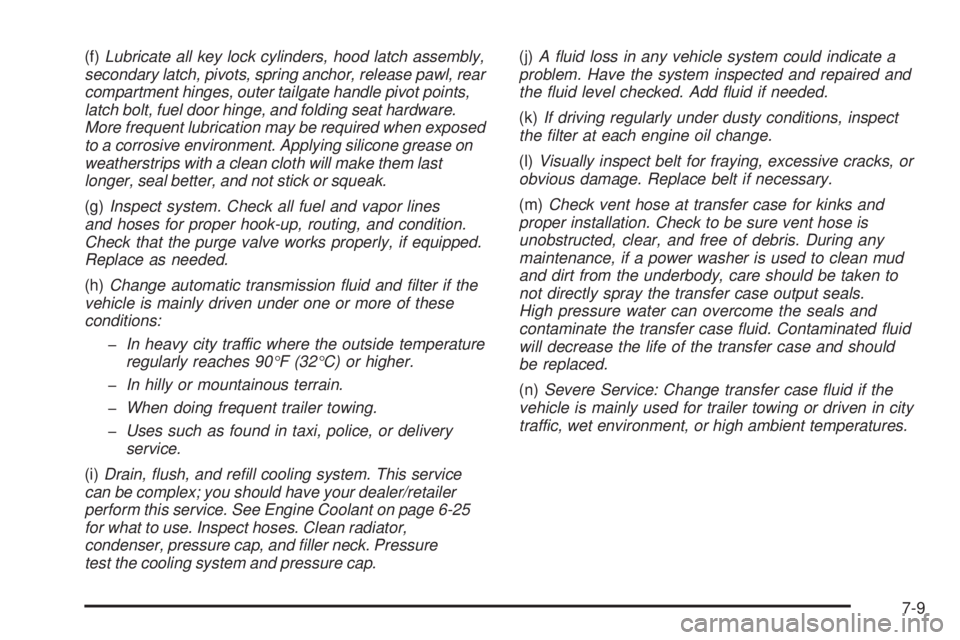
(i) Drain, flush, and refill cooling system. This service
can be complex; you should have your dealer/retailer
perform this service. See Engine Coolant on page 6-25
for what to use. Inspect hoses. Clean radiator,
condenser, pressure cap, and filler neck. Pressure
test the cooling system and pressure cap. (j) A fluid loss in any vehicle system could indicate a
problem. Have the system inspected and repaired and
the fluid level checked. Add fluid if needed.
(k) If driving regularly under dusty conditions, inspect
the filter at each engine oil change.
(l) Visually inspect belt for fraying, excessive cracks, or
obvious damage. Replace belt if necessary.
(m) Check vent hose at transfer case for kinks and
proper installation. Check to be sure vent hose is
unobstructed, clear, and free of debris. During any
maintenance, if a power washer is used to clean mud
and dirt from the underbody, care should be taken to
not directly spray the transfer case output seals.
High pressure water can overcome the seals and
contaminate the transfer case fluid. Contaminated fluid
will decrease the life of the transfer case and should
be replaced.
(n) Severe Service: Change transfer case fluid if the
vehicle is mainly used for trailer towing or driven in city
traffic, wet environment, or high ambient temperatures.
7-9
Page 590 of 602

Cleaning (cont.)
Weatherstrips ............................................ 6-100
Windshield, Backglass, and Wiper Blades ...... 6-102
Wood Panels ............................................ 6-100
Climate Control System
Outlet Adjustment ........................................ 3-31
Rear Air Conditioning and Heating System,
Electronic ................................................ 3-32
Climate Control Systems
Dual Automatic ............................................ 3-27
Clock ............................................................ 3-26
Collision Damage Repair .................................. 8-12
Compass ....................................................... 3-53
Content Theft-Deterrent .................................... 2-21
Control of a Vehicle .......................................... 5-3
Coolant
Engine ....................................................... 6-25
Engine Temperature Gage ............................ 3-41
Cooled Seats ................................................... 1-6
Cooling System .............................................. 6-24
Courtesy Transportation Program ...................... 8-10
Cruise Control ................................................ 3-13
Light .......................................................... 3-46
Cupholders .................................................... 2-62 Customer Assistance ......................................... 8-6
Offices ......................................................... 8-6
Text Telephone (TTY) Users ........................... 8-6
Customer Information
Service Publications Ordering Information ........ 8-15
Customer Satisfaction Procedure ........................ 8-2
D Damage Repair, Collision ................................. 8-12
Data Recorders
Event ......................................................... 8-17
Database Coverage Explanations ...................... 4-62
Daytime Running Lamps (DRL) ......................... 3-21
Defensive Driving ............................................. 5-2
Delayed Locking ............................................. 2-10
DIC Compass ................................................. 3-53
Doing Your Own Service Work ........................... 6-4
Dome Lamp Override ...................................... 3-23
Dome Lamps ................................................. 3-23
Door
Delayed Locking .......................................... 2-10
Locks ........................................................ 2-10
Power Locks ............................................... 2-10
Programmable Automatic Door Locks ............. 2-11
Rear Door Security Locks ............................. 2-11
4
Page 591 of 602
Drive Systems
All-Wheel Drive ........................................... 6-45
Driver Information Center (DIC) ......................... 3-47
DIC Operation and Displays .......................... 3-48
DIC Vehicle Customization ............................ 3-65
DIC Warnings and Messages ........................ 3-56
Driving
At Night ..................................................... 5-25
Before a Long Trip ...................................... 5-27
Better Fuel Economy ..................................... 5-2
Defensive ..................................................... 5-2
Drunk .......................................................... 5-3
Highway Hypnosis ....................................... 5-27
Hill and Mountain Roads .............................. 5-28
In Rain and on Wet Roads ........................... 5-26
Loss of Control ........................................... 5-12
Off-Road .................................................... 5-13
Off-Road Recovery ...................................... 5-11
Recovery Hooks .......................................... 5-32
Rocking Your Vehicle to Get it Out ................. 5-32
Winter ........................................................ 5-29
Dual Automatic Climate Control System ............. 3-27
DVD
Rear Seat Entertainment System ........... 3-87, 3-97E E85 Fuel ......................................................... 6-7
EDR ............................................................. 8-16
Electrical Equipment
Add-On Equipment ..................................... 6-105
Electrical System
Center Instrument Panel Fuse Block ............. 6-108
Fuses and Circuit Breakers ......................... 6-106
Instrument Panel Fuse Block ....................... 6-106
Power Windows and Other Power Options .... 6-105
Underhood Fuse Block ............................... 6-109
Windshield Wiper Fuses ............................. 6-105
Electronic Immobilizer
PASS-Key ®
III+ ........................................... 2-22
Electronic Immobilizer Operation
PASS-Key ®
III+ ........................................... 2-23
Engine
Air Cleaner/Filter ......................................... 6-19
Check and Service Engine Soon Lamp ........... 3-42
Compartment Overview ................................ 6-14
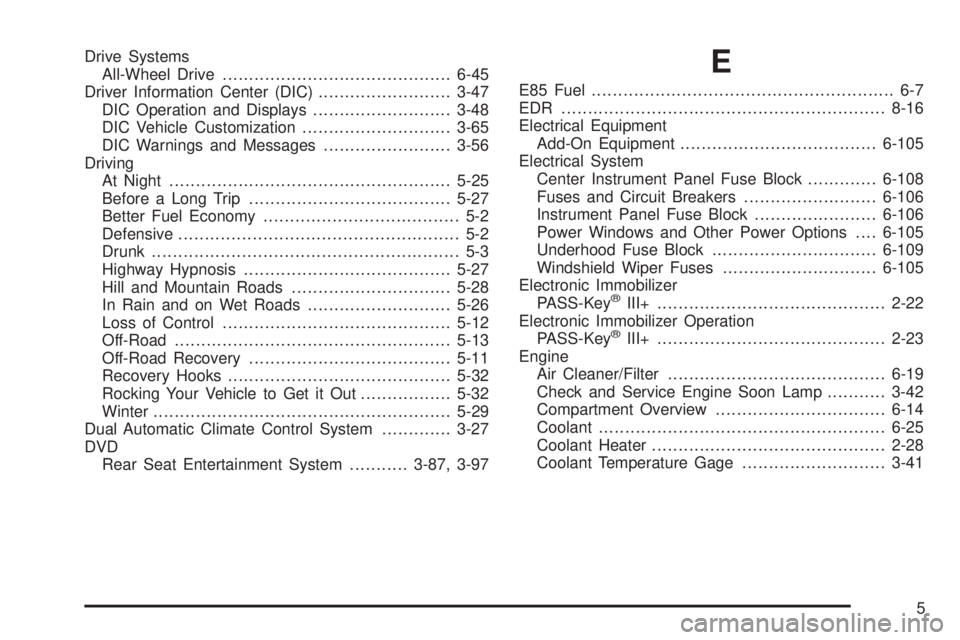
Coolant ...................................................... 6-25
Coolant Heater ............................................ 2-28
Coolant Temperature Gage ........................... 3-41
5
Page 593 of 602
GGages
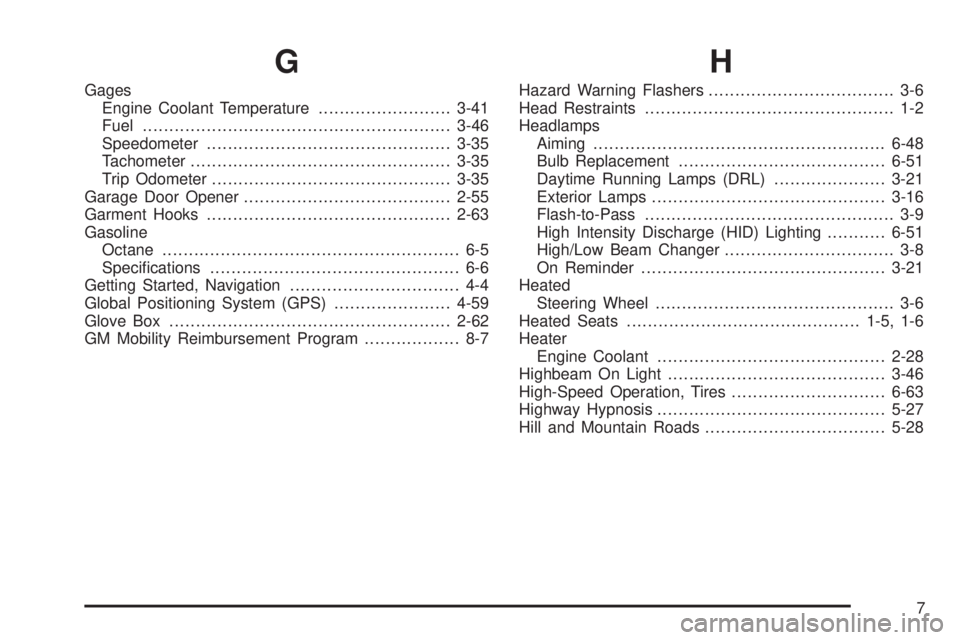
Engine Coolant Temperature ......................... 3-41
Fuel .......................................................... 3-46
Speedometer .............................................. 3-35
Tachometer ................................................. 3-35
Trip Odometer ............................................. 3-35
Garage Door Opener ....................................... 2-55
Garment Hooks .............................................. 2-63
Gasoline
Octane ........................................................ 6-5
Specications ............................................... 6-6
Getting Started, Navigation ................................ 4-4
Global Positioning System (GPS) ...................... 4-59
Glove Box ..................................................... 2-62
GM Mobility Reimbursement Program .................. 8-7
H Hazard Warning Flashers ................................... 3-6
Head Restraints ............................................... 1-2
Headlamps
Aiming ....................................................... 6-48
Bulb Replacement ....................................... 6-51
Daytime Running Lamps (DRL) ..................... 3-21
Exterior Lamps ............................................ 3-16
Flash-to-Pass ............................................... 3-9
High Intensity Discharge (HID) Lighting ........... 6-51
High/Low Beam Changer ................................ 3-8
On Reminder .............................................. 3-21
Heated
Steering Wheel ............................................. 3-6
Heated Seats ............................................ 1-5, 1-6
Heater
Engine Coolant ........................................... 2-28
Highbeam On Light ......................................... 3-46
High-Speed Operation, Tires ............................. 6-63
Highway Hypnosis ........................................... 5-27
Hill and Mountain Roads .................................. 5-28
7