maintenance CADILLAC ESCALADE ESV 2009 User Guide
[x] Cancel search | Manufacturer: CADILLAC, Model Year: 2009, Model line: ESCALADE ESV, Model: CADILLAC ESCALADE ESV 2009Pages: 602, PDF Size: 5.18 MB
Page 436 of 602
Tire Pressure Monitor System ........................ .6-64
Tire Pressure Monitor Operation .................... .6-65
Tire Inspection and Rotation .......................... .6-69
When It Is Time for New Tires ...................... .6-70
Buying New Tires ........................................ .6-71
Different Size Tires and Wheels ..................... .6-73
Uniform Tire Quality Grading ......................... .6-73
Wheel Alignment and Tire Balance ................. .6-75
Wheel Replacement ..................................... .6-75
Tire Chains ................................................. .6-76
If a Tire Goes Flat ....................................... .6-77
Changing a Flat Tire .................................... .6-78
Removing the Spare Tire and Tools ............... .6-79
Removing the Flat Tire and Installing the
Spare Tire ............................................... .6-84
Secondary Latch System .............................. .6-89
Storing a Flat or Spare Tire and Tools ........... .6-92
Spare Tire .................................................. .6-96
Appearance Care ........................................... .6-96
Interior Cleaning .......................................... .6-96
Fabric/Carpet .............................................. .6-98
Leather ...................................................... .6-98
Instrument Panel, Vinyl, and Other
Plastic Surfaces ....................................... .6-99
Wood Panels ............................................. .6-100
Speaker Covers ......................................... .6-100 Care of Safety Belts ................................... .6-100
Weatherstrips ............................................ .6-100
Washing Your Vehicle ................................. .6-100
Cleaning Exterior Lamps/Lenses ................... .6-101
Finish Care ............................................... .6-101
Windshield, Backglass, and Wiper Blades ...... .6-102
Aluminum or Chrome-Plated Wheels
and Trim ............................................... .6-102
Tires ........................................................ .6-103
Sheet Metal Damage .................................. .6-103
Finish
Damage .......................................... .6-103
Underbody Maintenance .............................. .6-104
Chemical Paint Spotting .............................. .6-104
Vehicle Identication .................................... .6-104
Vehicle Identication Number (VIN) ............... .6-104
Service Parts Identication Label .................. .6-105
Electrical System ......................................... .6-105
Add-On Electrical Equipment ........................ .6-105
Windshield Wiper Fuses .............................. .6-105
Power Windows and Other Power Options ..... .6-105
Fuses and Circuit Breakers ......................... .6-106
Instrument Panel Fuse Block ....................... .6-106
Center Instrument Panel Fuse Block ............. .6-108
Underhood Fuse Block ............................... .6-109
Capacities and Specications ....................... .6-113Section 6 Service and Appearance Care
6-2
Page 438 of 602

California Proposition 65 Warning Most motor vehicles, including this one, contain and/or
emit chemicals known to the State of California to
cause cancer and birth defects or other reproductive
harm. Engine exhaust, many parts and systems
(including some inside the vehicle), many uids, and
some component wear by-products contain and/or emit
these chemicals.
California Perchlorate Materials
Requirements Certain types of automotive applications, such as
airbag initiators, seat belt pretensioners, and lithium
batteries contained in remote keyless transmitters,
may contain perchlorate materials. Special handling
may be necessary. For additional information, see
www.dtsc.ca.gov/hazardouswaste/perchlorate. Doing Your Own Service Work If this vehicle is a Two-mode Hybrid, see the Two-mode
Hybrid manual for more information.
{ CAUTION: You can be injured and the vehicle could be
damaged if you try to do service work on a vehicle
without knowing enough about it.
Be sure you have sufficient knowledge,
experience, the proper replacement parts,
and tools before attempting any vehicle
maintenance task.
Be sure to use the proper nuts, bolts, and
other fasteners. English and metric fasteners
can be easily confused. If the wrong fasteners
are used, parts can later break or fall off.
You could be hurt.
If doing some of your own service work, use the proper
service manual. It tells you much more about how to
service the vehicle than this manual can. To order
the proper service manual, see Service Publications
Ordering Information on page 8-15 .
6-4
Page 439 of 602

This vehicle has an airbag system. Before attempting
to do your own service work, see Servicing Your
Airbag-Equipped Vehicle on page 1-93 .
Keep a record with all parts receipts and list the
mileage and the date of any service work performed.
See Maintenance Record on page 7-17 .
Adding Equipment to the Outside of
the Vehicle Things added to the outside of the vehicle can affect the
airow around it. This can cause wind noise and can
affect fuel economy and windshield washer performance.
Check with your dealer/retailer before adding equipment
to the outside of the vehicle.
Fuel Use of the recommended fuel is an important part of
the proper maintenance of this vehicle. To help keep the
engine clean and maintain optimum vehicle performance,
we recommend the use of gasoline advertised as
TOP TIER Detergent Gasoline.
The 8th digit of the Vehicle Identication Number (VIN)
shows the code letter or number that identies the
vehicle’s engine. The VIN is at the top left of the
instrument panel. See Vehicle Identification Number
(VIN) on page 6-104 . If the vehicle has the 6.2L V8 engine (VIN Code 2),
you can use either unleaded gasoline or ethanol fuel
containing up to 85% ethanol (E85); also see Fuel E85
(85% Ethanol) on page 6-7 . In all other engines, use only
unleaded gasoline. See Gasoline Octane on page 6-5 .
Gasoline Octane If the vehicle has the 6.0L V8 engine (VIN Code 5),
use regular unleaded gasoline with a posted octane
rating of 87 or higher. If the octane rating is less than 87,
you might notice an audible knocking noise when you
drive, commonly referred to as spark knock. If this occurs,
use a gasoline rated at 87 octane or higher as soon as
possible. If you are using gasoline rated at 87 octane or
higher and you hear heavy knocking, the engine needs
service.
If the vehicle has the 6.2L V8 engine (VIN Code 2),
use premium unleaded gasoline with a posted octane
rating of 91 or higher. You can also use regular unleaded
gasoline rated at 87 octane or higher, but the vehicle’s
acceleration could be slightly reduced, and you might
notice a slight audible knocking noise, commonly referred
to as spark knock. If the octane is less than 87, you might
notice a heavy knocking noise when you drive. If this
occurs, use a gasoline rated at 87 octane or higher as
soon as possible. Otherwise, you could damage the
engine. If you are using gasoline rated at 87 octane or
higher and you hear heavy knocking, the engine needs
service.
6-5
Page 453 of 602
If the CHANGE ENGINE OIL SOON message comes
back on when the vehicle is started, the Engine Oil Life
System has not reset. Repeat the procedure.
What to Do with Used Oil Used engine oil contains certain elements that can be
unhealthy for your skin and could even cause cancer.
Do not let used oil stay on your skin for very long. Clean
your skin and nails with soap and water, or a good
hand cleaner. Wash or properly dispose of clothing or
rags containing used engine oil. See the manufacturer’s
warnings about the use and disposal of oil products.
Used oil can be a threat to the environment. If you
change your own oil, be sure to drain all the oil from the
lter before disposal. Never dispose of oil by putting it
in the trash, pouring it on the ground, into sewers, or into
streams or bodies of water. Recycle it by taking it to a
place that collects used oil.
Engine Air Cleaner/Filter See Engine Compartment Overview on page 6-14 for
the location of the engine air cleaner/lter.
Inspect the air cleaner/lter at the Maintenance II
intervals and replace it at the rst oil change after each
50,000 mile (80 000 km) interval. See Scheduled
Maintenance on page 7-4 for more information. If driving
on dusty/dirty conditions, inspect the lter at each engine
oil change. How to Inspect the Engine Air
Cleaner/Filter To inspect the air cleaner/lter, remove the engine air
cleaner/lter from the vehicle by following Steps 1
through 6. When the engine air cleaner/lter is removed,
lightly shake it to release loose dust and dirt. If the
engine air cleaner/lter remains caked with dirt, a new
lter is required.
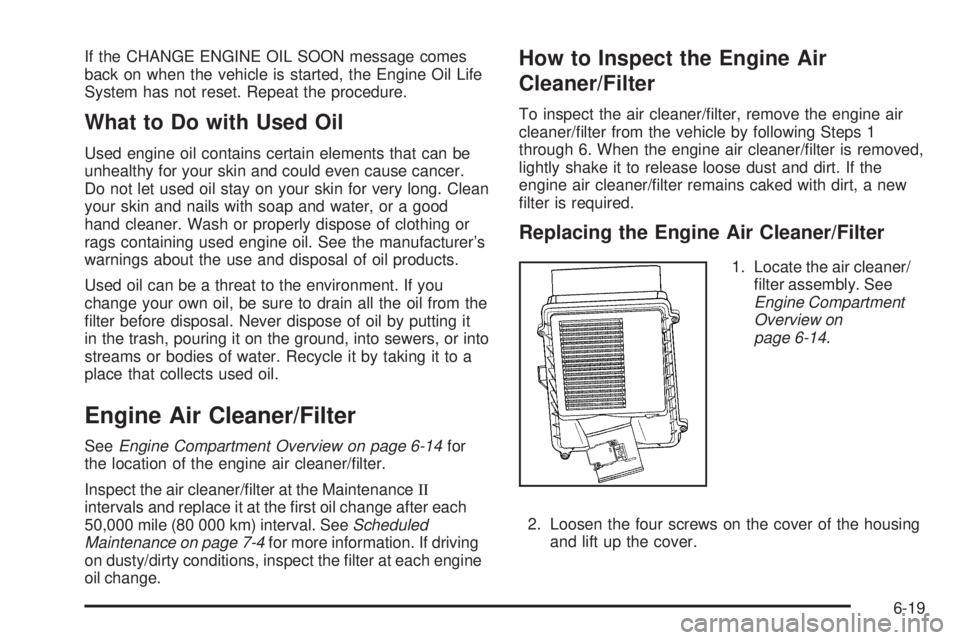
Replacing the Engine Air Cleaner/Filter 1. Locate the air cleaner/
lter assembly. See
Engine Compartment
Overview on
page 6-14 .
2. Loosen the four screws on the cover of the housing
and lift up the cover.
6-19
Page 455 of 602

Notice: Use of the incorrect automatic transmission
uid may damage the vehicle, and the damages
may not be covered by the vehicle’s warranty.
Always use the automatic transmission uid listed in
Recommended Fluids and Lubricants on page 7-13 .
Change the uid and lter at the intervals listed in the
Maintenance Schedule. See Scheduled Maintenance on
page 7-4 . Be sure to use the transmission uid listed
in Recommended Fluids and Lubricants on page 7-13 .
How to Check Automatic Transmission
Fluid Notice: Too much or too little uid can damage your
transmission. Too much can mean that some of the
uid could come out and fall on hot engine parts or
exhaust system parts, starting a re. Too little uid
could cause the transmission to overheat. Be sure
to get an accurate reading if you check your
transmission uid. Before checking the uid level, prepare the vehicle as
follows:
1. Start the engine and park the vehicle on a level
surface. Keep the engine running.
2. Apply the parking brake and place the shift lever in
P (Park).
3. With your foot on the brake pedal, move the shift
lever through each gear range, pausing for about
three seconds in each range. Then, move the
shift lever back to P (Park).
4. Allow the engine to idle (500 – 800 rpm) for at least
one minute. Slowly release the brake pedal.
5. Keep the engine running and press the Trip/Fuel
button or trip odometer reset stem until TRANS
TEMP (Transmission Temperature) displays on the
Driver Information Center (DIC).
6. Using the TRANS TEMP reading, determine and
perform the appropriate check procedure. If the
TRANS TEMP reading is not within the required
temperature ranges, allow the vehicle to cool,
or operate the vehicle until the appropriate
transmission uid temperature is reached.
6-21
Page 471 of 602

{ CAUTION: If too much brake uid is added, it can spill on
the engine and burn, if the engine is hot enough.
You or others could be burned, and the vehicle
could be damaged. Add brake uid only when
work is done on the brake hydraulic system.
See “Checking Brake Fluid” in this section.
When the brake uid falls to a low level, the brake
warning light comes on. See Brake System Warning
Light on page 3-39 .
Refer to the Maintenance Schedule to determine when
to check the brake uid. See Scheduled Maintenance
on page 7-4 . Checking Brake Fluid Check brake uid by looking at the brake uid reservoir.
See Engine Compartment Overview on page 6-14 .
The uid level should be
above MIN. If it is not,
have the brake hydraulic
system checked to
see if there is a leak.
After work is done on the brake hydraulic system,
make sure the level is above the MIN but not over the
MAX mark.
6-37
Page 473 of 602
Properly torqued wheel nuts are necessary to help
prevent brake pulsation. When tires are rotated, inspect
brake pads for wear and evenly tighten wheel nuts in
the proper sequence to torque specications in
Capacities and Specifications on page 6-113 .
Brake linings should always be replaced as complete
axle sets.
Brake Pedal Travel See your dealer/retailer if the brake pedal does not
return to normal height, or if there is a rapid increase in
pedal travel. This could be a sign that brake service
might be required.
Brake Adjustment Every brake stop, the disc brakes adjust for wear.
Replacing Brake System Parts The braking system on a vehicle is complex. Its many
parts have to be of top quality and work well together if
the vehicle is to have really good braking. The vehicle
was designed and tested with top-quality brake parts. When parts of the braking system are replaced — for
example, when the brake linings wear down and new
ones are installed — be sure to get new approved
replacement parts. If this is not done, the brakes might
not work properly. For example, if someone puts in brake
linings that are wrong for the vehicle, the balance
between the front and rear brakes can change — for the
worse. The braking performance expected can change in
many other ways if the wrong replacement brake parts
are installed.
Battery If the vehicle is a Two-mode Hybrid, see the Two-mode
Hybrid manual for more information.
This vehicle has a maintenance free battery. When it is
time for a new battery, see your dealer/retailer for
one that has the replacement number shown on the
original battery’s label. See Engine Compartment
Overview on page 6-14 for battery location.
Warning: Battery posts, terminals, and related
accessories contain lead and lead compounds,
chemicals known to the State of California to cause
cancer and reproductive harm. Wash hands after
handling.
6-39
Page 479 of 602
To disconnect the jumper cables from both vehicles do
the following:
1. Disconnect the black negative ( − ) cable from the
vehicle that had the bad battery.
2. Disconnect the black negative ( − ) cable from the
vehicle with the good battery.
3. Disconnect the red positive (+) cable from the
vehicle with the good battery.
4. Disconnect the red positive (+) cable from the other
vehicle.
5. Return the remote positive (+) terminal cover, if the
vehicle has one, to its original position.
All-Wheel Drive Transfer Case If your vehicle is equipped with All-Wheel Drive, be
sure to perform the lubricant checks described in this
section. There are two additional systems that need
lubrication.
When to Check Lubricant Refer to the Maintenance Schedule to determine
how often to check the lubricant. See Scheduled
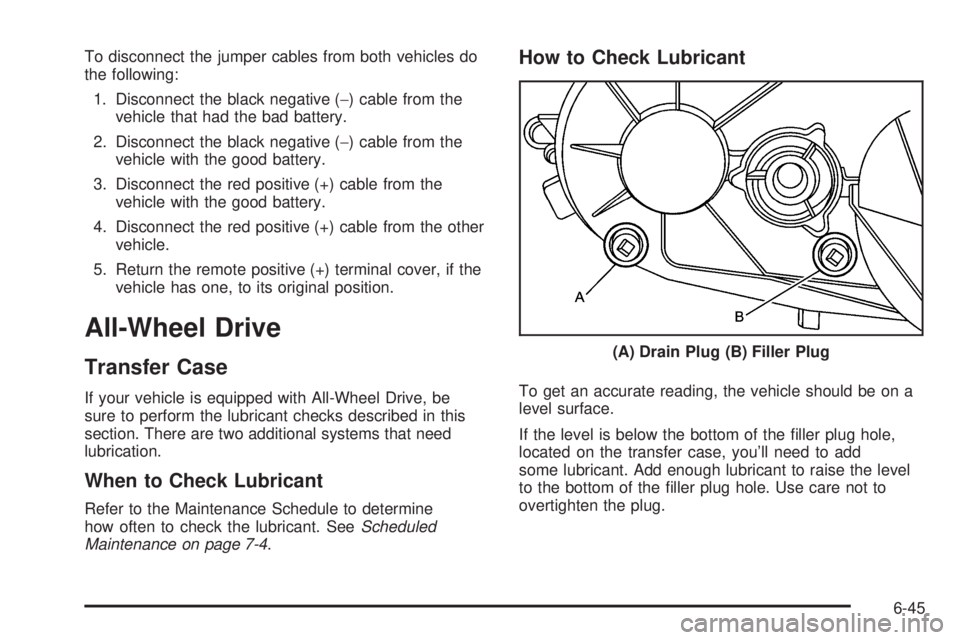
Maintenance on page 7-4 . How to Check Lubricant
To get an accurate reading, the vehicle should be on a
level surface.
If the level is below the bottom of the ller plug hole,
located on the transfer case, you’ll need to add
some lubricant. Add enough lubricant to raise the level
to the bottom of the ller plug hole. Use care not to
overtighten the plug. (A) Drain Plug (B) Filler Plug
6-45
Page 480 of 602
What to Use Refer to the Maintenance Schedule to determine what
kind of lubricant to use. See Recommended Fluids
and Lubricants on page 7-13 .
Rear Axle When to Check Lubricant It is not necessary to regularly check rear axle uid
unless you suspect there is a leak or you hear an
unusual noise. A uid loss could indicate a problem.
Have it inspected and repaired.
All axle assemblies are lled by volume of uid during
production. They are not lled to reach a certain level.
When checking the uid level on any axle, variations in
the readings can be caused by factory ll differences
between the minimum and the maximum uid volume.
Also, if a vehicle has just been driven before checking
the uid level, it may appear lower than normal because
uid has traveled out along the axle tubes and has not
drained back to the sump area. Therefore, a reading
taken ve minutes after the vehicle has been driven will
appear to have a lower uid level than a vehicle that has
been stationary for an hour or two. Remember that the
rear axle assembly must be supported to get a true
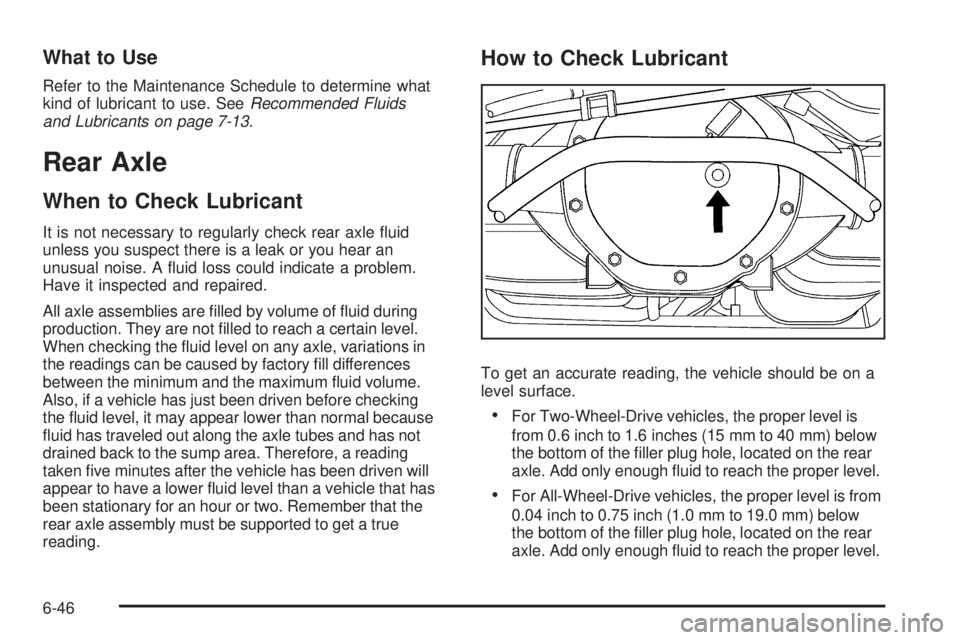
reading. How to Check Lubricant
To get an accurate reading, the vehicle should be on a
level surface.
For Two-Wheel-Drive vehicles, the proper level is
from 0.6 inch to 1.6 inches (15 mm to 40 mm) below
the bottom of the ller plug hole, located on the rear
axle. Add only enough uid to reach the proper level.
For All-Wheel-Drive vehicles, the proper level is from
0.04 inch to 0.75 inch (1.0 mm to 19.0 mm) below
the bottom of the ller plug hole, located on the rear
axle. Add only enough uid to reach the proper level.
6-46
Page 481 of 602
What to Use Refer to the Maintenance Schedule to determine what
kind of lubricant to use. See Recommended Fluids
and Lubricants on page 7-13 .
Front Axle When to Check and Change Lubricant It is not necessary to regularly check front axle uid
unless you suspect there is a leak or you hear an
unusual noise. A uid loss could indicate a problem.
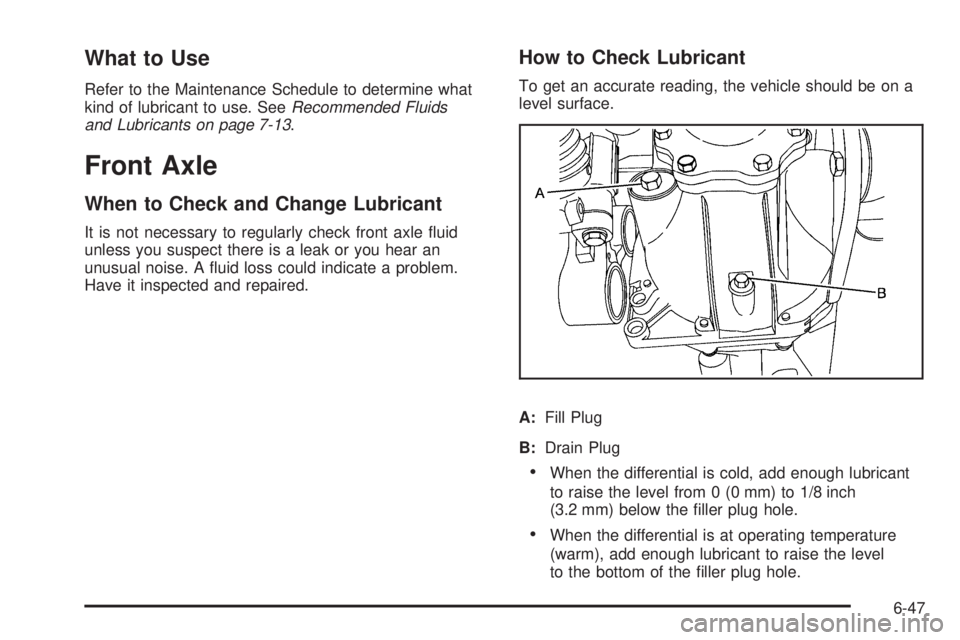
Have it inspected and repaired. How to Check Lubricant To get an accurate reading, the vehicle should be on a
level surface.
A: Fill Plug
B: Drain Plug
When the differential is cold, add enough lubricant
to raise the level from 0 (0 mm) to 1/8 inch
(3.2 mm) below the ller plug hole.
When the differential is at operating temperature
(warm), add enough lubricant to raise the level
to the bottom of the ller plug hole.
6-47