warning CADILLAC ESCALADE ESV 2009 Service Manual
[x] Cancel search | Manufacturer: CADILLAC, Model Year: 2009, Model line: ESCALADE ESV, Model: CADILLAC ESCALADE ESV 2009Pages: 602, PDF Size: 5.18 MB
Page 389 of 602

While driving on a surface with reduced traction, try
your best to avoid sudden steering, acceleration, or
braking, including reducing vehicle speed by shifting to
a lower gear. Any sudden changes could cause the tires
to slide. You may not realize the surface is slippery until
the vehicle is skidding. Learn to recognize warning
clues — such as enough water, ice, or packed snow on
the road to make a mirrored surface — and slow down
when you have any doubt.
Remember: Any Antilock Brake System (ABS) helps
avoid only the braking skid.
Off-Road Driving Vehicles with all-wheel drive can be used for off-road
driving. Vehicles without all-wheel drive and vehicles
with 22-inch tire/wheel assemblies should not be driven
off-road except on a level, solid surface.
Many of the vehicle design features that help make the
vehicle more responsive on paved roads during poor
weather conditions also help make it better suited for
off-road use than conventional passenger vehicles.
The vehicle does not have features usually thought to
be necessary for extended or severe off-road use such
as special underbody shielding and transfer case low
gear range. The airbag system is designed to work properly under
a wide range of conditions, including off-road usage.
Always wear your safety belt and observe safe driving
speeds, especially on rough terrain.
Drinking and driving can be very dangerous on any road
and this is certainly true for off-road driving. At the very
time you need special alertness and driving skills, your
reexes, perceptions, and judgment can be affected
by even a small amount of alcohol. You could have a
serious — or even fatal — accident if you drink and drive
or ride with a driver who has been drinking.
Off-roading can be great fun but has some denite
hazards. The greatest of these is the terrain itself. When
off-road driving, traffic lanes are not marked, curves are
not banked, and there are no road signs. Surfaces can be
slippery, rough, uphill, or downhill.
Avoid sharp turns and abrupt maneuvers. Failure to
operate the vehicle correctly off-road could result in loss
of vehicle control or vehicle rollover.
Off-roading involves some new skills. That is why it is
very important that you read these driving tips and
suggestions to help make off-road driving safer
and more enjoyable.
5-13
Page 402 of 602
Driving in Rain and on Wet Roads Rain and wet roads can reduce vehicle traction
and affect your ability to stop and accelerate. Always
drive slower in these types of driving conditions
and avoid driving through large puddles and
deep-standing or owing water.
{ CAUTION: Wet brakes can cause crashes. They might not
work as well in a quick stop and could cause
pulling to one side. You could lose control of the
vehicle.
After driving through a large puddle of water or a
car/vehicle wash, lightly apply the brake pedal until
the brakes work normally.
Flowing or rushing water creates strong forces.
Driving through owing water could cause your
vehicle to be carried away. If this happens, you
and other vehicle occupants could drown. Do not
ignore police warnings and be very cautious about
trying to drive through owing water. Hydroplaning Hydroplaning is dangerous. Water can build up under
your vehicle’s tires so they actually ride on the water.
This can happen if the road is wet enough and you are
going fast enough. When your vehicle is hydroplaning, it
has little or no contact with the road.
There is no hard and fast rule about hydroplaning.
The best advice is to slow down when the road is wet.
Other Rainy Weather Tips Besides slowing down, other wet weather driving tips
include:
Allow extra following distance.
Pass with caution.
Keep windshield wiping equipment in good shape.
Keep the windshield washer uid reservoir lled.
Have good tires with proper tread depth. See Tires
on page 6-56 .
Turn off cruise control.
5-26
Page 406 of 602

Blizzard Conditions Being stuck in snow can be in a serious situation. Stay
with the vehicle unless there is help nearby. If possible,
use the Roadside Service on page 8-7 . To get help and
keep everyone in the vehicle safe:
Turn on the Hazard Warning Flashers on page 3-6 .
Tie a red cloth to an outside mirror.
{ CAUTION: Snow can trap engine exhaust under the vehicle.
This may cause exhaust gases to get inside.
Engine exhaust contains carbon monoxide (CO)
which cannot be seen or smelled. It can cause
unconsciousness and even death.
If the vehicle is stuck in the snow:
Clear away snow from around the base of
your vehicle, especially any that is blocking
the exhaust pipe.
Check again from time to time to be sure
snow does not collect there.
CAUTION: (Continued) CAUTION: (Continued)
Open a window about two inches (5 cm) on
the side of the vehicle that is away from the
wind to bring in fresh air.
Fully open the air outlets on or under the
instrument panel.
Adjust the Climate Control system to a setting
that circulates the air inside the vehicle and
set the fan speed to the highest setting.
See Climate Control System in the Index.
For more information about carbon monoxide, see
Engine Exhaust on page 2-38 .
Snow can trap exhaust gases under your vehicle.
This can cause deadly CO (carbon monoxide) gas
to get inside. CO could overcome you and kill you.
You cannot see it or smell it, so you might not
know it is in your vehicle. Clear away snow from
around the base of your vehicle, especially any
that is blocking the exhaust.
Run the engine for short periods only as needed to
keep warm, but be careful.
To save fuel, run the engine for only short periods as
needed to warm the vehicle and then shut the engine off
and close the window most of the way to save heat.
5-30
Page 430 of 602

Driving On Grades Reduce speed and shift to a lower gear before starting
down a long or steep downgrade. If the transmission is
not shifted down, the brakes might have to be used so
much that they would get hot and no longer work well.
Vehicles can tow in D (Drive). Shift the transmission to
a lower gear if the transmission shifts too often under
heavy loads and/or hilly conditions.
The tow/haul mode may be used if the transmission
shifts too often. See Tow/Haul Mode Light on page 3-46 .
When towing at high altitude on steep uphill grades,
consider the following: Engine coolant will boil at a lower
temperature than at normal altitudes. If the engine is
turned off immediately after towing at high altitude on
steep uphill grades, the vehicle may show signs similar to
engine overheating. To avoid this, let the engine run while
parked, preferably on level ground, with the transmission
in P (Park) for a few minutes before turning the engine
off. If the overheat warning comes on, see Engine
Overheating on page 6-30 . Parking on Hills
{ CAUTION: Parking the vehicle on a hill with the trailer
attached can be dangerous. If something goes
wrong, the rig could start to move. People can be
injured, and both the vehicle and the trailer can be
damaged. When possible, always park the rig on a
at surface.
If parking the rig on a hill:
1. Press the brake pedal, but do not shift into P (Park)
yet. Turn the wheels into the curb if facing downhill
or into traffic if facing uphill.
2. Have someone place chocks under the trailer
wheels.
3. When the wheel chocks are in place, release the
regular brakes until the chocks absorb the load.
4. Reapply the brake pedal. Then apply the parking
brake and shift into P (Park).
5. Release the brake pedal.
5-54
Page 435 of 602
Service ........................................................... .6-3
Accessories and Modications ......................... .6-3
California Proposition 65 Warning .................... .6-4
California Perchlorate Materials Requirements .... .6-4
Doing Your Own Service Work ........................ .6-4
Adding Equipment to the Outside of
the Vehicle ................................................ .6-5
Fuel ............................................................... .6-5
Gasoline Octane ........................................... .6-5
Gasoline Specications ................................... .6-6
California Fuel .............................................. .6-6
Additives ...................................................... .6-6
Fuel E85 (85% Ethanol) ................................. .6-7
Fuels in Foreign Countries .............................. .6-8
Filling the Tank ............................................. .6-9
Filling a Portable Fuel Container .................... .6-11
Checking Things Under the Hood ................... .6-12
Hood Release ............................................. .6-13
Engine Compartment Overview ...................... .6-14
Engine Oil .................................................. .6-15
Engine Oil Life System ................................. .6-18
Engine Air Cleaner/Filter ............................... .6-19
Automatic Transmission Fluid ........................ .6-20
Cooling System ........................................... .6-24
Engine Coolant ............................................ .6-25
Engine Overheating ...................................... .6-30 Overheated Engine Protection
Operating Mode ........................................ .6-33
Engine Fan Noise ........................................ .6-33
Power Steering Fluid .................................... .6-33
Windshield Washer Fluid ............................... .6-34
Brakes ....................................................... .6-36
Battery ....................................................... .6-39
Jump Starting .............................................. .6-40
All-Wheel Drive ............................................. .6-45
Rear Axle ...................................................... .6-46
Front
Axle ..................................................... .6-47
Headlamp Aiming .......................................... .6-48
Bulb Replacement ......................................... .6-51
High Intensity Discharge (HID) Lighting ........... .6-51
LED Lighting ............................................... .6-51
Back-Up Lamps ........................................... .6-51
License Plate Lamp ..................................... .6-53
Replacement Bulbs ...................................... .6-53
Windshield Wiper Blade Replacement ............. .6-54
Tires ............................................................. .6-56
Tire Sidewall Labeling .................................. .6-57
Tire Terminology and Denitions .................... .6-59
Ination - Tire Pressure ................................ .6-62
High-Speed Operation .................................. .6-63Section 6 Service and Appearance Care
6-1
Page 438 of 602

California Proposition 65 Warning Most motor vehicles, including this one, contain and/or
emit chemicals known to the State of California to
cause cancer and birth defects or other reproductive
harm. Engine exhaust, many parts and systems
(including some inside the vehicle), many uids, and
some component wear by-products contain and/or emit
these chemicals.
California Perchlorate Materials
Requirements Certain types of automotive applications, such as
airbag initiators, seat belt pretensioners, and lithium
batteries contained in remote keyless transmitters,
may contain perchlorate materials. Special handling
may be necessary. For additional information, see
www.dtsc.ca.gov/hazardouswaste/perchlorate. Doing Your Own Service Work If this vehicle is a Two-mode Hybrid, see the Two-mode
Hybrid manual for more information.
{ CAUTION: You can be injured and the vehicle could be
damaged if you try to do service work on a vehicle
without knowing enough about it.
Be sure you have sufficient knowledge,
experience, the proper replacement parts,
and tools before attempting any vehicle
maintenance task.
Be sure to use the proper nuts, bolts, and
other fasteners. English and metric fasteners
can be easily confused. If the wrong fasteners
are used, parts can later break or fall off.
You could be hurt.
If doing some of your own service work, use the proper
service manual. It tells you much more about how to
service the vehicle than this manual can. To order
the proper service manual, see Service Publications
Ordering Information on page 8-15 .
6-4
Page 452 of 602
Engine Oil Additives / Engine Oil
Flushes Do not add anything to the oil. The recommended oils
with the starburst symbol that meet GM standards are
all that is needed for good performance and engine
protection.
Engine oil system ushes are not recommended and
could cause engine damage not covered by the vehicle
warranty.
Engine Oil Life System
When to Change Engine Oil This vehicle has a computer system that indicates when
to change the engine oil and lter. This is based on
engine revolutions and engine temperature, and not on
mileage. Based on driving conditions, the mileage at
which an oil change is indicated can vary considerably.
For the oil life system to work properly, the system
must be reset every time the oil is changed.
When the system has calculated that oil life has been
diminished, it indicates that an oil change is necessary.
A CHANGE ENGINE OIL SOON message comes on.
See DIC Warnings and Messages on page 3-56 .
Change the oil as soon as possible within the next
600 miles (1 000 km). It is possible that, if driving under
the best conditions, the oil life system might not
indicate that an oil change is necessary for over a year. However, the engine oil and lter must be changed at
least once a year and at this time the system must
be reset. Your dealer/retailer has trained service people
who will perform this work using genuine parts and
reset the system. It is also important to check the oil
regularly and keep it at the proper level.
If the system is ever reset accidentally, the oil must be
changed at 3,000 miles (5 000 km) since the last oil
change. Remember to reset the oil life system whenever
the oil is changed.
How to Reset the Engine Oil Life
System The Engine Oil Life System calculates when to change
the engine oil and lter based on vehicle use. Whenever
the oil is changed, reset the system so it can calculate
when the next oil change is required. If a situation occurs
where the oil is changed prior to a CHANGE ENGINE OIL
SOON message being turned on, reset the system.
Always reset the engine oil life to 100% after every oil
change. It will not reset itself. To reset the Engine
Oil Life System:
1. Display the OIL LIFE REMAINING on the DIC.
2. Press and hold the SET/RESET button on the DIC
for more than ve seconds. The oil life will change
to 100%.
6-18
Page 453 of 602
If the CHANGE ENGINE OIL SOON message comes
back on when the vehicle is started, the Engine Oil Life
System has not reset. Repeat the procedure.
What to Do with Used Oil Used engine oil contains certain elements that can be
unhealthy for your skin and could even cause cancer.
Do not let used oil stay on your skin for very long. Clean
your skin and nails with soap and water, or a good
hand cleaner. Wash or properly dispose of clothing or
rags containing used engine oil. See the manufacturer’s
warnings about the use and disposal of oil products.
Used oil can be a threat to the environment. If you
change your own oil, be sure to drain all the oil from the
lter before disposal. Never dispose of oil by putting it
in the trash, pouring it on the ground, into sewers, or into
streams or bodies of water. Recycle it by taking it to a
place that collects used oil.
Engine Air Cleaner/Filter See Engine Compartment Overview on page 6-14 for
the location of the engine air cleaner/lter.
Inspect the air cleaner/lter at the Maintenance II
intervals and replace it at the rst oil change after each
50,000 mile (80 000 km) interval. See Scheduled
Maintenance on page 7-4 for more information. If driving
on dusty/dirty conditions, inspect the lter at each engine
oil change. How to Inspect the Engine Air
Cleaner/Filter To inspect the air cleaner/lter, remove the engine air
cleaner/lter from the vehicle by following Steps 1
through 6. When the engine air cleaner/lter is removed,
lightly shake it to release loose dust and dirt. If the
engine air cleaner/lter remains caked with dirt, a new
lter is required.
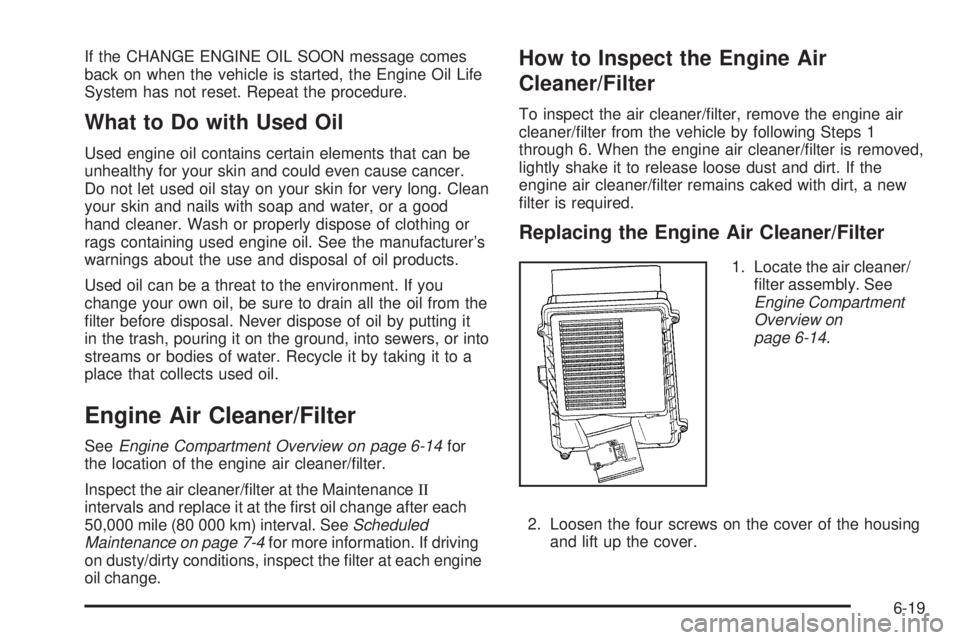
Replacing the Engine Air Cleaner/Filter 1. Locate the air cleaner/
lter assembly. See
Engine Compartment
Overview on
page 6-14 .
2. Loosen the four screws on the cover of the housing
and lift up the cover.
6-19
Page 460 of 602
What to Use
{ CAUTION: Adding only plain water to the cooling system can
be dangerous. Plain water, or some other liquid
such as alcohol, can boil before the proper coolant
mixture will. The vehicle’s coolant warning system
is set for the proper coolant mixture. With plain
water or the wrong mixture, the engine could get
too hot but you would not get the overheat
warning. The engine could catch re and you or
others could be burned. Use a 50/50 mixture of
clean, drinkable water and DEX-COOL ®
coolant. Use a 50/50 mixture of clean, drinkable water and
DEX-COOL ®
coolant. If using this mixture, nothing else
needs to be added. This mixture:
Gives freezing protection down to − 34°F ( − 37°C),
outside temperature.
Gives boiling protection up to 265°F (129°C),
engine temperature.
Protects against rust and corrosion.
Will not damage aluminum parts.
Helps keep the proper engine temperature.
Notice: If an improper coolant mixture is used,
the engine could overheat and be badly damaged.
The repair cost would not be covered by the vehicle
warranty. Too much water in the mixture can freeze
and crack the engine, radiator, heater core, and other
parts.
Notice: If extra inhibitors and/or additives are used
in the vehicle’s cooling system, the vehicle could
be damaged. Use only the proper mixture of
the engine coolant listed in this manual for the
cooling system. See Recommended Fluids and
Lubricants on page 7-13 for more information.
6-26
Page 464 of 602

4. With the coolant surge tank pressure cap off, start
the engine and let it run until you can feel the upper
radiator hose getting hot. Watch out for the engine
cooling fan.
By this time, the coolant level inside the coolant
surge tank may be lower. If the level is lower, add
more of the proper mixture to the coolant surge tank
until the level reaches the FULL COLD mark. 5. Replace the pressure cap. Be sure the pressure
cap is hand-tight and fully seated.
6. Verify coolant level after engine is shut off and the
coolant is cold. If necessary, repeat coolant ll
procedure Steps 1 through 6.
Notice: If the pressure cap is not tightly installed,
coolant loss and possible engine damage may occur.
Be sure the cap is properly and tightly secured.
Engine Overheating The vehicle has several indicators to warn of engine
overheating.
There is a coolant temperature gage on your vehicle’s
instrument panel. See Engine Coolant Temperature
Gage on page 3-41 .
In addition, ENGINE OVERHEATED STOP ENGINE,
ENGINE OVERHEATED IDLE ENGINE, and a ENGINE
POWER IS REDUCED message comes on in the
Driver Information Center (DIC) on the instrument panel.
See DIC Warnings and Messages on page 3-56 .
6-30