child lock CADILLAC ESCALADE ESV 2009 Owners Manual
[x] Cancel search | Manufacturer: CADILLAC, Model Year: 2009, Model line: ESCALADE ESV, Model: CADILLAC ESCALADE ESV 2009Pages: 602, PDF Size: 5.18 MB
Page 1 of 602
Seats and Restraint System ............................. 1-1
Head Restraints
......................................... 1-2
Front Seats
............................................... 1-3
Rear Seats
.............................................. 1-10
Safety Belts
............................................. 1-30
Child Restraints
....................................... 1-52
Airbag System
......................................... 1-79
Restraint System Check
............................ 1-95
Features and Controls ..................................... 2-1
Keys
........................................................ 2-3
Doors and Locks
...................................... 2-10
Windows
................................................. 2-17
Theft-Deterrent Systems
............................ 2-21
Starting and Operating Your Vehicle
........... 2-24
Mirrors
.................................................... 2-40
Object Detection Systems
.......................... 2-42
OnStar ®
System
...................................... 2-52
Universal Home Remote System
................ 2-55
Storage Areas
......................................... 2-62
Sunroof
.................................................. 2-65 Instrument Panel ............................................. 3-1
Instrument Panel Overview
.......................... 3-4
Climate Controls
...................................... 3-27
Warning Lights, Gages, and Indicators
........ 3-33
Driver Information Center (DIC)
.................. 3-47
Audio System(s)
....................................... 3-75
Navigation System .......................................... 4-1
Overview
.................................................. 4-2
Features and Controls
.............................. 4-13
Navigation Audio System
........................... 4-62
Voice Recognition
.................................... 4-86
Driving Your Vehicle ....................................... 5-1
Your Driving, the Road, and the Vehicle
....... 5-2
Towing
................................................... 5-40
Service and Appearance Care .......................... 6-1
Service
..................................................... 6-3
Fuel
......................................................... 6-5
Checking Things Under the Hood
............... 6-12
All-Wheel Drive
........................................ 6-45
Rear Axle
............................................... 6-462009 Cadillac Escalade/Escalade ESV Owner Manual
M
Page 5 of 602
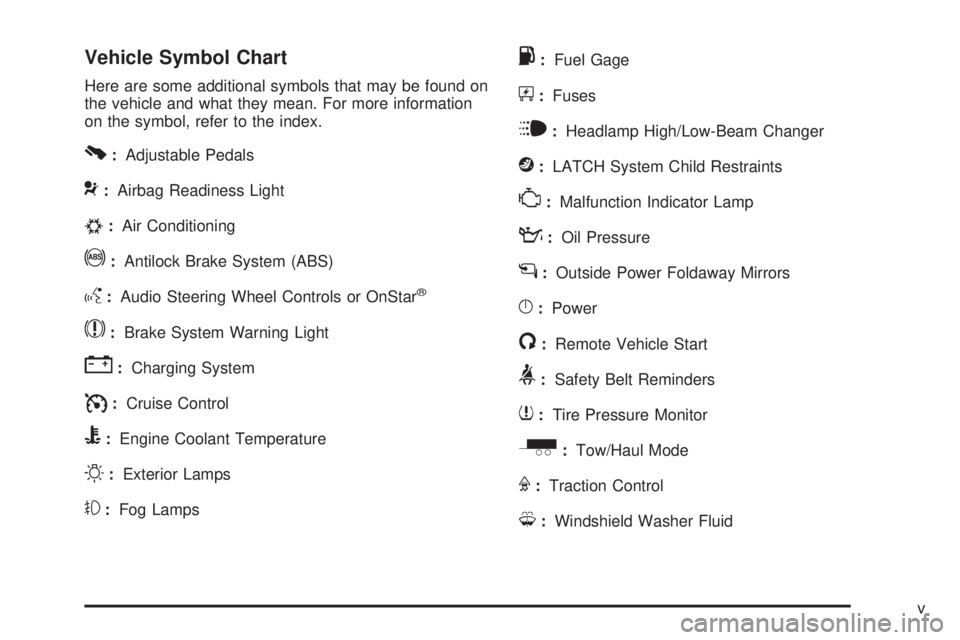
Vehicle Symbol Chart Here are some additional symbols that may be found on
the vehicle and what they mean. For more information
on the symbol, refer to the index.
0 : Adjustable Pedals
9 : Airbag Readiness Light
# : Air Conditioning
! : Antilock Brake System (ABS)
g : Audio Steering Wheel Controls or OnStar ®
$ : Brake System Warning Light
" : Charging System
I : Cruise Control
B : Engine Coolant Temperature
O : Exterior Lamps
# : Fog Lamps . : Fuel Gage
+ : Fuses
i : Headlamp High/Low-Beam Changer
j : LATCH System Child Restraints
* : Malfunction Indicator Lamp
: : Oil Pressure
g : Outside Power Foldaway Mirrors
} : Power
/ : Remote Vehicle Start
> : Safety Belt Reminders
7 : Tire Pressure Monitor
_ : Tow/Haul Mode
F : Traction Control
M : Windshield Washer Fluid
v
Page 41 of 602
How to Wear Safety Belts Properly This section is only for people of adult size.
Be aware that there are special things to know about
safety belts and children. And there are different
rules for smaller children and infants. If a child will be
riding in the vehicle, see Older Children on page 1-52 or
Infants and Young Children on page 1-55 . Follow
those rules for everyone’s protection.
It is very important for all occupants to buckle up.
Statistics show that unbelted people are hurt more often
in crashes than those who are wearing safety belts.
Occupants who are not buckled up can be thrown out of
the vehicle in a crash. And they can strike others in
the vehicle who are wearing safety belts.
First, before you or your passenger(s) wear a safety
belt, there is important information you should know.
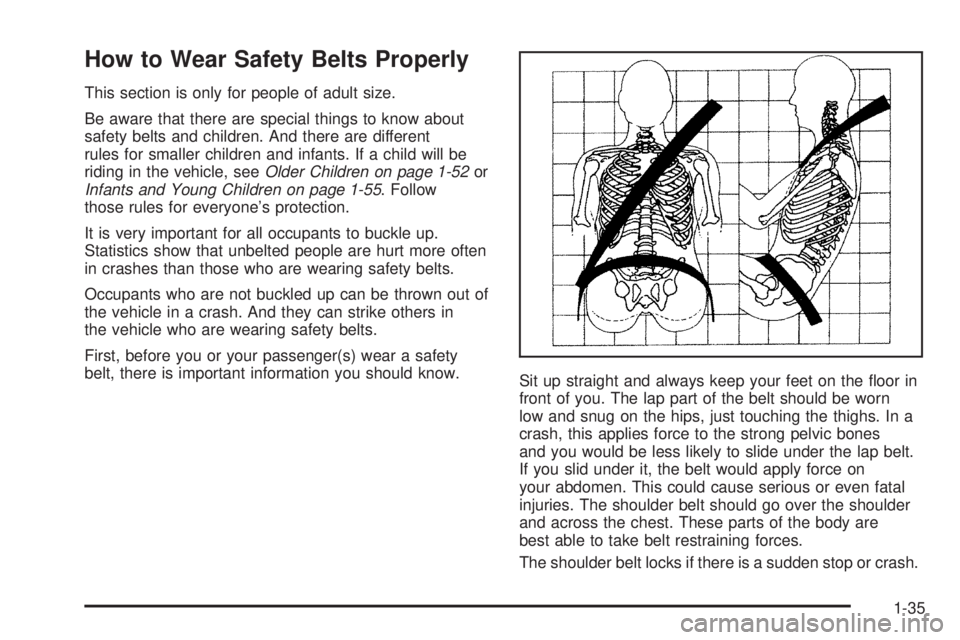
Sit up straight and always keep your feet on the oor in
front of you. The lap part of the belt should be worn
low and snug on the hips, just touching the thighs. In a
crash, this applies force to the strong pelvic bones
and you would be less likely to slide under the lap belt.
If you slid under it, the belt would apply force on
your abdomen. This could cause serious or even fatal
injuries. The shoulder belt should go over the shoulder
and across the chest. These parts of the body are
best able to take belt restraining forces.
The shoulder belt locks if there is a sudden stop or crash.
1-35
Page 49 of 602

Lap-Shoulder Belt All seating positions in the vehicle have a lap-shoulder
belt except for the center front passenger position, if
equipped, which has a lap belt. See Lap Belt on
page 1-50 for more information.
The lap-shoulder belts for the rst and second row
seating positions are equipped with free-falling latch
plates. If the vehicle has a third row, the lap-shoulder
belts have either free-falling or cinching latch plates.
Use the following pictures to determine the latch
plate style:
The following instructions explain how to wear a
lap-shoulder belt properly.
1. Adjust the seat, if the seat is adjustable, so you can
sit up straight. To see how, see “Seats” in the Index.
2. Pick up the latch plate and pull the belt across you.
Do not let it get twisted.
The lap-shoulder belt may lock if you pull the belt
across you very quickly. If this happens, let the belt
go back slightly to unlock it. Then pull the belt across
you more slowly.
If the shoulder portion of a passenger belt with a
free-falling latch plate is pulled out all the way, the
child restraint locking feature may be engaged.
If this happens, let the belt go back all the way and
start again.Free-Falling Latch Plate Cinching Latch Plate
1-43
Page 50 of 602
Engaging the child restraint locking feature in the
right front seating position may affect the passenger
sensing system. See Passenger Sensing System
on page 1-87 for more information.
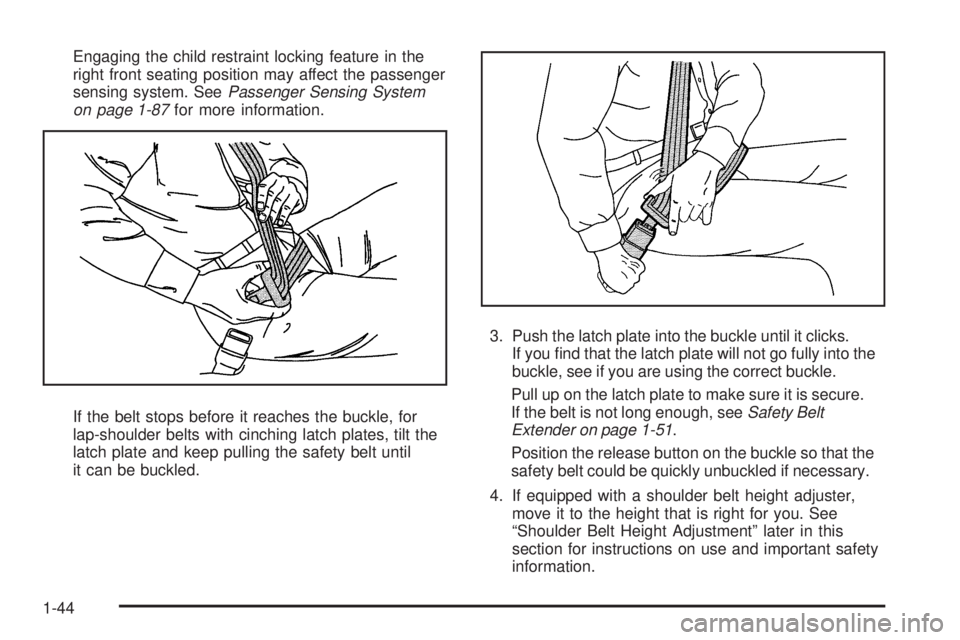
If the belt stops before it reaches the buckle, for
lap-shoulder belts with cinching latch plates, tilt the
latch plate and keep pulling the safety belt until
it can be buckled. 3. Push the latch plate into the buckle until it clicks.
If you nd that the latch plate will not go fully into the
buckle, see if you are using the correct buckle.
Pull up on the latch plate to make sure it is secure.
If the belt is not long enough, see Safety Belt
Extender on page 1-51 .
Position the release button on the buckle so that the
safety belt could be quickly unbuckled if necessary.
4. If equipped with a shoulder belt height adjuster,
move it to the height that is right for you. See
“Shoulder Belt Height Adjustment” later in this
section for instructions on use and important safety
information.
1-44
Page 74 of 602
According to accident statistics, children and infants are
safer when properly restrained in a child restraint
system or infant restraint system secured in a rear
seating position. See Where to Put the Restraint
on page 1-61 for additional information.
Securing a Child Restraint Designed for
the LATCH System
{ CAUTION: If a LATCH-type child restraint is not attached to
anchors, the child restraint will not be able to
protect the child correctly. In a crash, the child
could be seriously injured or killed. Install a
LATCH-type child restraint properly using the
anchors, or use the vehicle’s safety belts to secure
the restraint, following the instructions that came
with the child restraint and the instructions in this
manual. { CAUTION: Do not attach more than one child restraint to a
single anchor. Attaching more than one child
restraint to a single anchor could cause the anchor
or attachment to come loose or even break during
a crash. A child or others could be injured. To
reduce the risk of serious or fatal injuries during a
crash, attach only one child restraint per anchor.
{ CAUTION: Children can be seriously injured or strangled if a
shoulder belt is wrapped around their neck and
the safety belt continues to tighten. Buckle any
unused safety belts behind the child restraint so
children cannot reach them. Pull the shoulder belt
all the way out of the retractor to set the lock, if
your vehicle has one, after the child restraint has
been installed.
1-68
Page 80 of 602
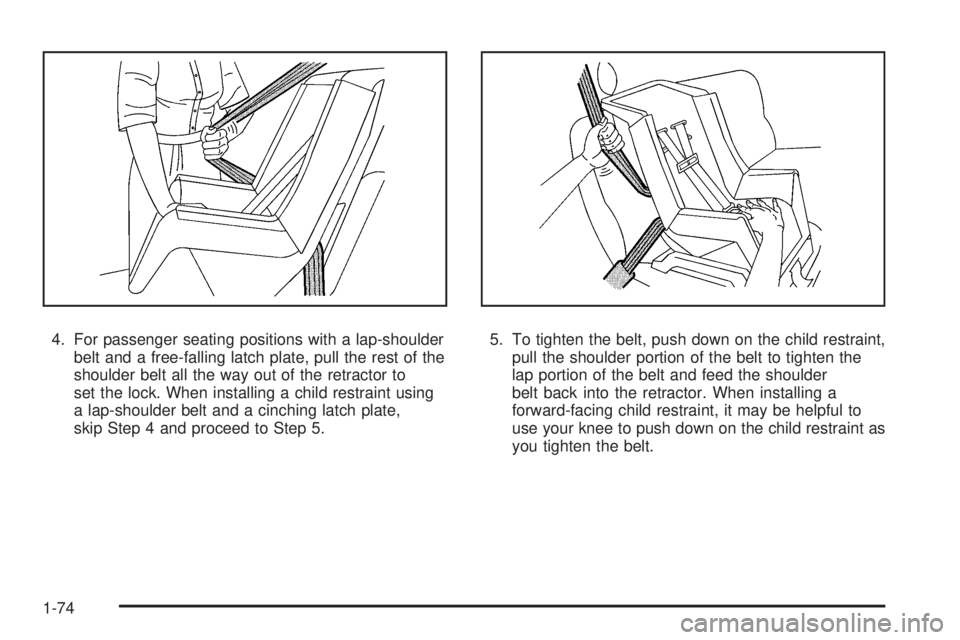
4. For passenger seating positions with a lap-shoulder
belt and a free-falling latch plate, pull the rest of the
shoulder belt all the way out of the retractor to
set the lock. When installing a child restraint using
a lap-shoulder belt and a cinching latch plate,
skip Step 4 and proceed to Step 5. 5. To tighten the belt, push down on the child restraint,
pull the shoulder portion of the belt to tighten the
lap portion of the belt and feed the shoulder
belt back into the retractor. When installing a
forward-facing child restraint, it may be helpful to
use your knee to push down on the child restraint as
you tighten the belt.
1-74
Page 84 of 602
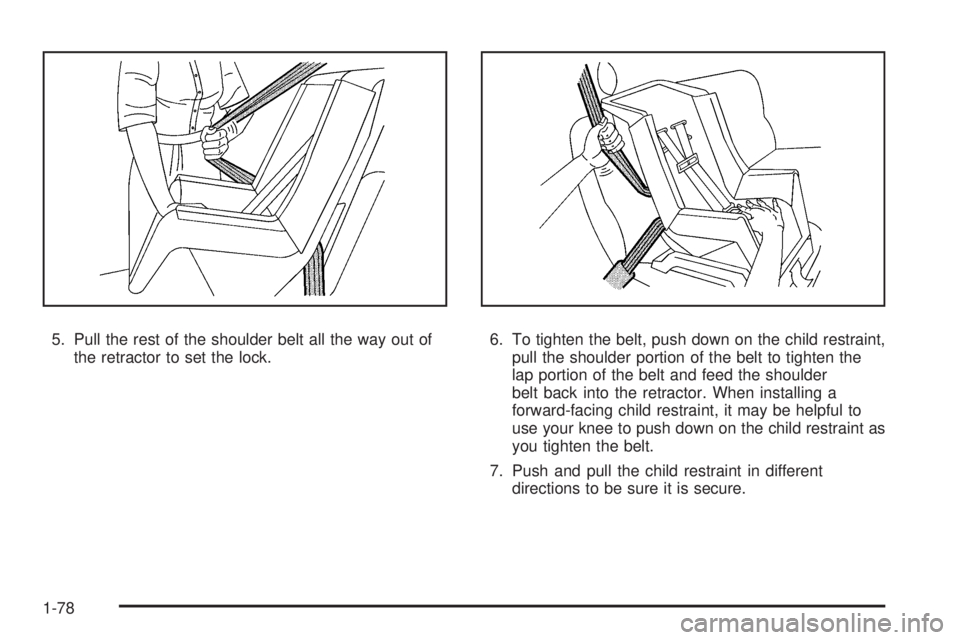
5. Pull the rest of the shoulder belt all the way out of
the retractor to set the lock. 6. To tighten the belt, push down on the child restraint,
pull the shoulder portion of the belt to tighten the
lap portion of the belt and feed the shoulder
belt back into the retractor. When installing a
forward-facing child restraint, it may be helpful to
use your knee to push down on the child restraint as
you tighten the belt.
7. Push and pull the child restraint in different
directions to be sure it is secure.
1-78
Page 98 of 602
Additional Factors Affecting System
Operation Safety belts help keep the passenger in position on the
seat during vehicle maneuvers and braking, which
helps the passenger sensing system maintain the
passenger airbag status. See “Safety Belts” and “Child
Restraints” in the Index for additional information
about the importance of proper restraint use.
If the shoulder portion of the belt is pulled out all the
way, the child restraint locking feature will be engaged.
This may unintentionally cause the passenger sensing
system to turn the airbag off for some adult size
occupants. If this happens, let the belt go back all the
way and start again.
A thick layer of additional material, such as a blanket or
cushion, or aftermarket equipment such as seat covers,
seat heaters, and seat massagers can affect how well the
passenger sensing system operates. We recommend
that you not use seat covers or other aftermarket
equipment except when approved by GM for your specic
vehicle. See Adding Equipment to Your Airbag-Equipped
Vehicle on page 1-94 for more information about
modications that can affect how the system operates. The on indicator may be lit if an object, such as a
briefcase, handbag, grocery bag, laptop or other
electronic device, is put on an unoccupied seat.
If this is not desired remove the object from the seat.
{ CAUTION: Stowing of articles under the passenger seat or
between the passenger seat cushion and seatback
may interfere with the proper operation of the
passenger sensing system.
1-92
Page 105 of 602
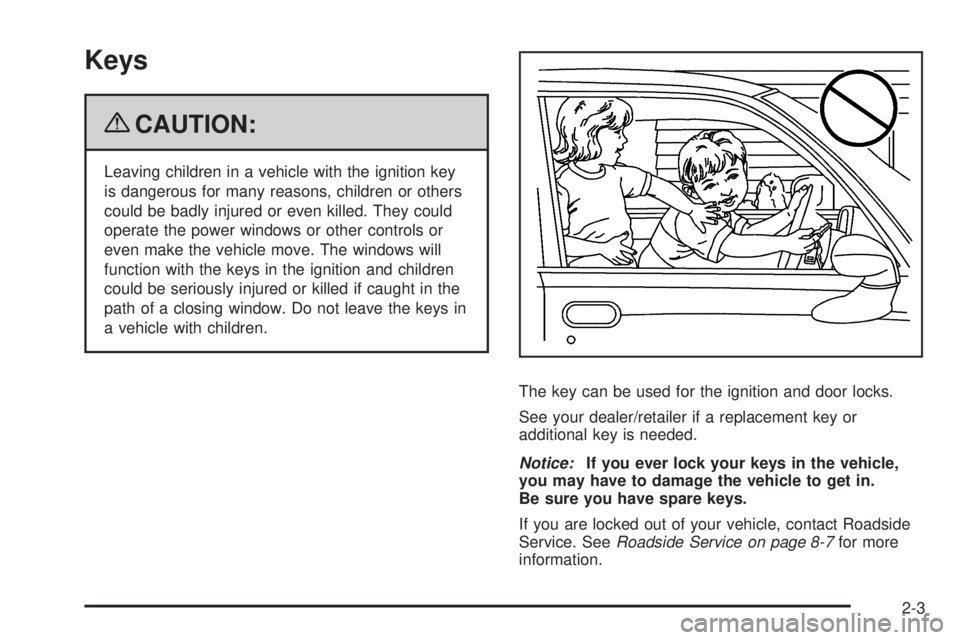
Keys
{ CAUTION: Leaving children in a vehicle with the ignition key
is dangerous for many reasons, children or others
could be badly injured or even killed. They could
operate the power windows or other controls or
even make the vehicle move. The windows will
function with the keys in the ignition and children
could be seriously injured or killed if caught in the
path of a closing window. Do not leave the keys in
a vehicle with children.
The key can be used for the ignition and door locks.
See your dealer/retailer if a replacement key or
additional key is needed.
Notice: If you ever lock your keys in the vehicle,
you may have to damage the vehicle to get in.
Be sure you have spare keys.
If you are locked out of your vehicle, contact Roadside
Service. See Roadside Service on page 8-7 for more
information.
2-3