airbag off CADILLAC ESCALADE ESV 2010 Owners Manual
[x] Cancel search | Manufacturer: CADILLAC, Model Year: 2010, Model line: ESCALADE ESV, Model: CADILLAC ESCALADE ESV 2010Pages: 620, PDF Size: 7.4 MB
Page 17 of 620
Black plate (11,1)Cadillac Escalade/Escalade ESV Owner Manual - 2010
Safety Belt
Refer to the following sections for important information
on how to use safety belts properly. .
Safety Belts: They Are for Everyone on page 2 ‑ 26 ..
How to Wear Safety Belts Properly on page 2 ‑ 30 ..
Lap-Shoulder Belt on page 2 ‑ 39 ..
Lower Anchors and Tethers for Children (LATCH)
on page 2 ‑ 59 . Sensing System for Passenger
Airbag The passenger sensing system, if equipped, will turn off
the right front passenger frontal airbag under certain
conditions. The driver airbags, seat ‐ mounted side
impact airbags, if equipped, and roof ‐ rail airbags are not
affected by this.
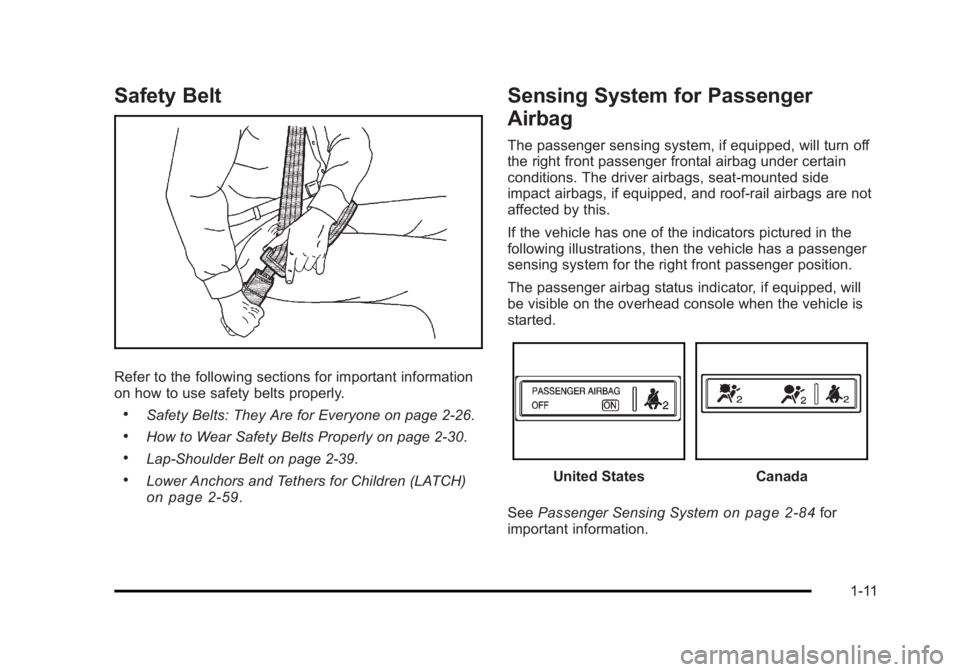
If the vehicle has one of the indicators pictured in the
following illustrations, then the vehicle has a passenger
sensing system for the right front passenger position.
The passenger airbag status indicator, if equipped, will
be visible on the overhead console when the vehicle is
started.
United States Canada
See Passenger Sensing System
on page 2 ‑ 84 for
important information.
1-11
Page 84 of 620
Black plate (52,1)Cadillac Escalade/Escalade ESV Owner Manual - 2010
Infants and Young Children Everyone in a vehicle needs protection! This includes
infants and all other children. Neither the distance
traveled nor the age and size of the traveler changes
the need, for everyone, to use safety restraints. In fact,
the law in every state in the United States and in every
Canadian province says children up to some age must
be restrained while in a vehicle.
{ WARNING: Children can be seriously injured or strangled if a
shoulder belt is wrapped around their neck and
the safety belt continues to tighten. Never leave
children unattended in a vehicle and never allow
children to play with the safety belts. Airbags plus lap ‐ shoulder belts offer protection for
adults and older children, but not for young children and
infants. Neither the vehicle's safety belt system nor its
airbag system is designed for them. Every time infants
and young children ride in vehicles, they should have
the protection provided by appropriate child restraints.
Children who are not restrained properly can strike
other people, or can be thrown out of the vehicle.
{ WARNING: Never do this.
Never hold an infant or a child while riding in a
vehicle. Due to crash forces, an infant or a child
will become so heavy it is not possible to hold it
during a crash. For example, in a crash at only
40 km/h (25 mph), a 5.5 kg (12 lb) infant will
suddenly become a 110 kg (240 lb) force on a
person's arms. An infant should be secured in an
appropriate restraint.
2-52
Page 90 of 620
Black plate (58,1)Cadillac Escalade/Escalade ESV Owner Manual - 2010
A label on your sun visor says, “ Never put a rear-facing
child seat in the front. ” This is because the risk to the
rear-facing child is so great, if the airbag deploys.
{ WARNING: A child in a rear-facing child restraint can be
seriously injured or killed if the right front
passenger airbag inflates. This is because the
back of the rear-facing child restraint would be
very close to the inflating airbag. A child in a
forward-facing child restraint can be seriously
injured or killed if the right front passenger airbag
inflates and the passenger seat is in a forward
position.
The vehicle may have a passenger sensing
system which is designed to turn off the right front
passenger frontal airbag under certain conditions.
(Continued)WARNING: (Continued) Even if the passenger sensing system,
if equipped, has turned off the right front
passenger frontal airbag, no system is fail-safe.
No one can guarantee that an airbag will not
deploy under some unusual circumstance, even
though it is turned off.
Secure rear-facing child restraints in a rear seat,
even if the airbag is off. If you secure a
forward-facing child restraint in the right front seat,
always move the front passenger seat as far back
as it will go. It is better to secure the child restraint
in a rear seat.
See Passenger Sensing System
on page 2 ‑ 84
for additional information.
2-58
Page 103 of 620
Black plate (71,1)Cadillac Escalade/Escalade ESV Owner Manual - 2010
Securing a Child Restraint in the
Right Front Seat Position This vehicle has airbags. A rear seat is a safer place to
secure a forward-facing child restraint. See Where to
Put the Restraint on page 2 ‑ 57 .
In addition, the vehicle may have a passenger sensing
system which is designed to turn off the right front
passenger frontal airbag under certain conditions. See
Passenger Sensing System on page 2 ‑ 84 and
Passenger Airbag Status Indicator
on page 4 ‑ 31 for
more information, including important safety information.
A label on the sun visor says, “ Never put a rear-facing
child seat in the front. ” This is because the risk to the
rear-facing child is so great, if the airbag deploys.
{ WARNING: A child in a rear-facing child restraint can be
seriously injured or killed if the right front
passenger airbag inflates. This is because the
back of the rear-facing child restraint would be
very close to the inflating airbag. A child in a
forward-facing child restraint can be seriously
(Continued)WARNING: (Continued) injured or killed if the right front passenger airbag
inflates and the passenger seat is in a forward
position.
The vehicle may have a passenger sensing
system which is designed to turn off the right front
passenger frontal airbag under certain conditions.
Even if the passenger sensing system,
if equipped, has turned off the right front
passenger frontal airbag, no system is fail-safe.
No one can guarantee that an airbag will not
deploy under some unusual circumstance, even
though it is turned off.
Secure rear-facing child restraints in a rear seat,
even if the airbag is off. If you secure a
forward-facing child restraint in the right front seat,
always move the front passenger seat as far back
as it will go. It is better to secure the child restraint
in a rear seat.
See Passenger Sensing System on page 2 ‑ 84
for additional information.
2-71
Page 106 of 620
Black plate (74,1)Cadillac Escalade/Escalade ESV Owner Manual - 2010
If the vehicle is equipped with the passenger sensing
system, and when the passenger sensing system has
turned off the right front passenger frontal airbag, the off
indicator in the passenger airbag status indicator should
light and stay lit when you start the vehicle. See
Passenger Airbag Status Indicator on page 4 ‑ 31 .
If a child restraint has been installed and the on
indicator is lit, see “ If the On Indicator is Lit for a Child
Restraint ” under Passenger Sensing System
on
page 2 ‑ 84 for more information.
To remove the child restraint, unbuckle the vehicle
safety belt and let it return to the stowed position.
Airbag System The vehicle has the following airbags: .
A frontal airbag for the driver. .
A frontal airbag for the right front passenger. .
A roof-rail airbag for the driver and passenger
directly behind the driver. .
A roof-rail airbag for the right front passenger and
the person seated directly behind that passenger. The vehicle may have the following airbags: .
A seat ‐ mounted side impact airbag for the driver. .
A seat ‐ mounted side impact airbag for the right
front passenger. .
If the vehicle has a third row seat, it will have a
third row roof-rail airbag.
All of the airbags in the vehicle will have the word
AIRBAG embossed in the trim or on an attached label
near the deployment opening.
For frontal airbags, the word AIRBAG will appear on the
middle part of the steering wheel for the driver and on
the instrument panel for the right front passenger.
With seat ‐ mounted side impact airbags, the word
AIRBAG will appear on the side of the seatback closest
to the door.
With roof-rail airbags, the word AIRBAG will appear
along the headliner or trim.
Airbags are designed to supplement the protection
provided by safety belts. Even though today's airbags
are also designed to help reduce the risk of injury from
the force of an inflating bag, all airbags must inflate very
quickly to do their job.
2-74
Page 108 of 620

Black plate (76,1)Cadillac Escalade/Escalade ESV Owner Manual - 2010
{ WARNING: Children who are up against, or very close to, any
airbag when it inflates can be seriously injured or
killed. Airbags plus lap-shoulder belts offer
protection for adults and older children, but not for
young children and infants. Neither the vehicle's
safety belt system nor its airbag system is
designed for them. Young children and infants
need the protection that a child restraint system
can provide. Always secure children properly in
your vehicle. To read how, see Older Children
on
page 2 ‑ 49
or Infants and Young Children on
page 2 ‑ 52 . There is an airbag
readiness light on the
instrument panel cluster,
which shows the airbag
symbol.
The system checks the airbag electrical system for
malfunctions. The light tells you if there is an electrical
problem. See Airbag Readiness Light on page 4 ‑ 30 for
more information.
2-76
Page 115 of 620

Black plate (83,1)Cadillac Escalade/Escalade ESV Owner Manual - 2010
The vehicle has a feature that may automatically unlock
the doors, turn on the interior lamps and hazard warning
flashers, and shut off the fuel system after the airbags
inflate. You can lock the doors, turn off the interior
lamps and hazard warning flashers by using the
controls for those features.
{ WARNING: A crash severe enough to inflate the airbags may
have also damaged important functions in the
vehicle, such as the fuel system, brake and
steering systems, etc. Even if the vehicle appears
to be drivable after a moderate crash, there may
be concealed damage that could make it difficult
to safely operate the vehicle.
Use caution if you should attempt to restart the
engine after a crash has occurred. In many crashes severe enough to inflate the airbag,
windshields are broken by vehicle deformation.
Additional windshield breakage may also occur from the
right front passenger airbag. .
Airbags are designed to inflate only once. After an
airbag inflates, you will need some new parts for
the airbag system. If you do not get them, the
airbag system will not be there to help protect you
in another crash. A new system will include airbag
modules and possibly other parts. The service
manual for your vehicle covers the need to replace
other parts. .
The vehicle has a crash sensing and diagnostic
module which records information after a crash.
See Vehicle Data Recording and Privacy on
page 9 ‑ 19 and Event Data Recorders on
page 9 ‑ 20
. .
Let only qualified technicians work on the airbag
systems. Improper service can mean that an
airbag system will not work properly. See your
dealer for service.
2-83
Page 116 of 620

Black plate (84,1)Cadillac Escalade/Escalade ESV Owner Manual - 2010
Passenger Sensing System If the vehicle has the passenger airbag status indicator
pictured in the following illustration, then the vehicle
has a passenger sensing system for the right front
passenger position. The passenger airbag status
indicator, if equipped, is visible on the overhead console
when the vehicle is started.
In addition, if the vehicle has a passenger sensing
system for the right front passenger position, the label
on the vehicle's sun visors refers to “ ADVANCED
AIRBAGS ” .
United States Canada
The words ON and OFF, or the symbol for on and off,
will be visible during the system check. If you are using
remote start, if equipped, to start the vehicle from a
distance, you may not see the system check. When the system check is complete, either the word
ON or OFF, or the symbol for on or off, will be visible.
See Passenger Airbag Status Indicator on page 4 ‑ 31 .
The passenger sensing system will turn off the right
front passenger frontal airbag under certain conditions.
The driver airbag, seat ‐ mounted side impact airbags
(if equipped) and the roof-rail airbags are not affected
by the passenger sensing system.
The passenger sensing system works with sensors that
are part of the right front passenger seat and safety
belt. The sensors are designed to detect the presence
of a properly-seated occupant and determine if the right
front passenger frontal airbag should be enabled (may
inflate) or not.
According to accident statistics, children are safer when
properly secured in a rear seat in the correct child
restraint for their weight and size.
We recommend that children be secured in a rear seat,
including: an infant or a child riding in a rear-facing child
restraint; a child riding in a forward-facing child seat; an
older child riding in a booster seat; and children, who
are large enough, using safety belts.
2-84
Page 117 of 620
Black plate (85,1)Cadillac Escalade/Escalade ESV Owner Manual - 2010
A label on the sun visor says, “ Never put a rear-facing
child seat in the front. ” This is because the risk to the
rear-facing child is so great, if the airbag deploys.
{ WARNING: A child in a rear-facing child restraint can be
seriously injured or killed if the right front
passenger airbag inflates. This is because the
back of the rear-facing child restraint would be
very close to the inflating airbag. A child in a
forward-facing child restraint can be seriously
injured or killed if the right front passenger airbag
inflates and the passenger seat is in a forward
position.
Even if the passenger sensing system has turned
off the right front passenger frontal airbag, no
system is fail-safe. No one can guarantee that an
airbag will not deploy under some unusual
circumstance, even though the airbag is
turned off.
(Continued)WARNING: (Continued) Secure rear-facing child restraints in a rear seat,
even if the airbag is off. If you secure a
forward-facing child restraint in the right front seat,
always move the front passenger seat as far back
as it will go. It is better to secure the child restraint
in a rear seat.
The passenger sensing system is designed to turn off
the right front passenger frontal airbag if: .
The right front passenger seat is unoccupied. .
The system determines an infant is present in a
child restraint. .
A right front passenger takes his/her weight off of
the seat for a period of time. .
Or, if there is a critical problem with the airbag
system or the passenger sensing system.
2-85
Page 118 of 620

Black plate (86,1)Cadillac Escalade/Escalade ESV Owner Manual - 2010
When the passenger sensing system has turned off the
right front passenger frontal airbag, the off indicator will
light and stay lit to remind you that the airbag is off. See
Passenger Airbag Status Indicator on page 4 ‑ 31 .
The passenger sensing system is designed to turn on
(may inflate) the right front passenger frontal airbag
anytime the system senses that a person of adult size is
sitting properly in the right front passenger seat.
When the passenger sensing system has allowed the
airbag to be enabled, the on indicator will light and stay
lit to remind you that the airbag is active.
For some children, including children in child restraints,
and for very small adults, the passenger sensing
system may or may not turn off the right front passenger
frontal airbag, depending upon the person's seating
posture and body build. Everyone in your vehicle who
has outgrown child restraints should wear a safety belt
properly — whether or not there is an airbag for that
person. { WARNING: If the airbag readiness light ever comes on and
stays on, it means that something may be wrong
with the airbag system. To help avoid injury to
yourself or others, have the vehicle serviced right
away. See Airbag Readiness Light
on page 4 ‑ 30
for more information, including important safety
information.
If the On Indicator is Lit for a Child
Restraint If a child restraint has been installed and the on
indicator is lit:
1. Turn the vehicle off.
2. Remove the child restraint from the vehicle.
3. Remove any additional items from the seat such as
blankets, cushions, seat covers, seat heaters,
or seat massagers.
4. Reinstall the child restraint following the directions
provided by the child restraint manufacturer and
refer to Securing a Child Restraint in the Right
Front Seat Position on page 2 ‑ 71 .
2-86