inflation pressure CADILLAC ESCALADE ESV 2010 Owners Manual
[x] Cancel search | Manufacturer: CADILLAC, Model Year: 2010, Model line: ESCALADE ESV, Model: CADILLAC ESCALADE ESV 2010Pages: 620, PDF Size: 7.4 MB
Page 227 of 620

Black plate (35,1)Cadillac Escalade/Escalade ESV Owner Manual - 2010
Engine Coolant Temperature Gauge This gauge shows the
engine coolant
temperature.
If the indicator on the gauge moves towards the shaded
area on the thermostat, it means that the engine coolant
has overheated. If the vehicle has been operating under
normal driving conditions, pull off the road, stop the
vehicle and turn off the engine as soon as possible.
See Engine Overheating on page 7 ‑ 34 .Tire Pressure Light For vehicles with a tire
pressure monitoring
system, this light comes
on briefly when the engine
is started. It provides
information about tire
pressures and the Tire
Pressure Monitoring
System.
When the Light is On Steady This indicates that one or more of the tires is
significantly underinflated.
A tire pressure message in the Driver Information
Center (DIC), can accompany the light. See Driver
Information Center (DIC)
on page 4 ‑ 41 for more
information. Stop and check the tires as soon as it is
safe to do so. If underinflated, inflate to the proper
pressure. See Inflation - Tire Pressure
on page 7 ‑ 65
for more information.
4-35
Page 238 of 620

Black plate (46,1)Cadillac Escalade/Escalade ESV Owner Manual - 2010
Tire Pressure On vehicles with the Tire Pressure Monitor System
(TPMS), the pressure for each tire can be viewed in the
DIC. The tire pressure will be shown in either pounds
per square inch (psi) or kilopascals (kPa). Press the
vehicle information button until the DIC displays FRONT
TIRES PSI (kPa) LEFT ## RIGHT ##. Press the vehicle
information button again until the DIC displays REAR
TIRES PSI (kPa) LEFT ## RIGHT ##.
If a low tire pressure condition is detected by the
system while driving, a message advising you to
add air to a specific tire will appear in the display.
See Inflation - Tire Pressure
on page 7 ‑ 65 and DIC
Warnings and Messages on page 4 ‑ 49 for more
information.
If the tire pressure display shows dashes instead of a
value, there may be a problem with your vehicle. If this
consistently occurs, see your dealer for service. Battery Voltage This display shows the current battery voltage. If the
voltage is in the normal range, the value will display. For
example, the display may read BATTERY VOLTAGE
13.2 VOLTS. If the voltage is low, the display will show
LOW. If the voltage is high, the display will show HIGH.
Your vehicle's charging system regulates voltage based
on the state of the battery. The battery voltage may
fluctuate when viewing this information on the DIC. This
is normal. See Charging System Light
on page 4 ‑ 32 for
more information. If there is a problem with the battery
charging system, the DIC will display a message. See
DIC Warnings and Messages on page 4 ‑ 49 .
Oil Pressure This display will show the oil pressure in either pounds
per square inch (psi) or kilopascals (kPa)
4-46
Page 249 of 620

Black plate (57,1)Cadillac Escalade/Escalade ESV Owner Manual - 2010
TIGHTEN GAS CAP This message may display along with the check engine
light on the instrument panel cluster if the vehicle's fuel
cap is not tightened properly. See Malfunction Indicator
Lamp
on page 4 ‑ 36 . Reinstall the fuel cap fully. See
Filling the Tank on page 7 ‑ 11 . The diagnostic system
can determine if the fuel cap has been left off or
improperly installed. A loose or missing fuel cap allows
fuel to evaporate into the atmosphere. A few driving
trips with the cap properly installed should turn this light
and message off.
TIRE LEARNING ACTIVE On vehicles with the Tire Pressure Monitor System
(TPMS), this message displays when the TPMS is
re-learning the tire positions on your vehicle. The tire
positions must be re-learned after rotating the tires or
after replacing a tire or sensor. See Tire Inspection and
Rotation on page 7 ‑ 71 , Tire Pressure Monitor System
on page 7 ‑ 67 , and Inflation - Tire Pressure on
page 7 ‑ 65
for more information. TIRE LOW ADD AIR TO TIRE On vehicles with the Tire Pressure Monitor System
(TPMS), this message displays when the pressure in
one or more of the vehicle's tires is low. This message
also displays LEFT FRONT, RIGHT FRONT, LEFT
REAR, or RIGHT REAR to indicate which tire needs to
be checked. The low tire pressure warning light will also
come on. See Tire Pressure Light
on page 4 ‑ 35 . You
can receive more than one tire pressure message at a
time. To read the other messages that may have been
sent at the same time, press the set/reset button. If a
tire pressure message appears on the DIC, stop as
soon as you can. Have the tire pressures checked and
set to those shown on the Tire Loading Information
label. See Tires
on page 7 ‑ 58 , Loading the Vehicle on
page 6 ‑ 32 , and Inflation - Tire Pressure on page 7 ‑ 65 .
The DIC also shows the tire pressure values. See DIC
Operation and Displays on page 4 ‑ 42 .
TRACTION CONTROL OFF If your vehicle has StabiliTrak, this message displays
when the Traction Control System (TCS) is turned off.
Adjust your driving accordingly. See StabiliTrak ®
System on page 6 ‑ 6 for more information.
4-57
Page 425 of 620

Black plate (33,1)Cadillac Escalade/Escalade ESV Owner Manual - 2010
The Tire and Loading Information label also
shows the size of the original equipment tires (C)
and the recommended cold tire inflation
pressures (D). For more information on tires and
inflation see Tires
on page 7 ‑ 58 and Inflation - Tire
Pressure
on page 7 ‑ 65 .
There is also important loading information on the
vehicle Certification/Tire label. It tells you the
Gross Vehicle Weight Rating (GVWR) and the
Gross Axle Weight Rating (GAWR) for the front
and rear axles. See “ Certification/Tire Label ” later
in this section.
Steps for Determining Correct Load Limit 1.
Locate the statement “ The combined weight
of occupants and cargo should never exceed
XXX kg or XXX lbs ” on your vehicle's placard.2.
Determine the combined weight of the driver
and passengers that will be riding in your
vehicle.
3.
Subtract the combined weight of the driver
and passengers from XXX kg or XXX lbs. 4.
The resulting figure equals the available
amount of cargo and luggage load capacity.
For example, if the “ XXX ” amount equals
1400 lbs and there will be five 150 lb
passengers in your vehicle, the amount of
available cargo and luggage load capacity is
650 lbs (1400 − 750 (5 x 150) = 650 lbs).5.
Determine the combined weight of luggage
and cargo being loaded on the vehicle. That
weight may not safely exceed the available
cargo and luggage load capacity calculated in
Step 4. 6.
If your vehicle will be towing a trailer, the load
from your trailer will be transferred to your
vehicle. Consult this manual to determine
how this reduces the available cargo and
luggage load capacity of your vehicle. See
Towing a Trailer
on page 6 ‑ 42 for important
information on towing a trailer, towing safety
rules and trailering tips.
6-33
Page 427 of 620

Black plate (35,1)Cadillac Escalade/Escalade ESV Owner Manual - 2010
Example 3
Item Description Total
A Vehicle Capacity
Weight for
Example 3 = 1,000 lbs
(453 kg)
B Subtract Occupant
Weight @ 200 lbs
(91 kg) × 5 = 1,000 lbs
(453 kg)
C Available Cargo
Weight = 0 lbs (0 kg)
Refer to your vehicle's tire and loading information
label for specific information about your vehicle's
capacity weight and seating positions. The combined weight of the driver, passengers,
and cargo should never exceed your vehicle's
capacity weight.
Certification/Tire Label
A vehicle specific Certification/Tire label is
attached to the rear edge of the driver's door.
The label shows the size of your vehicle's original
tires and the inflation pressures needed to obtain
the gross weight capacity of your vehicle. This is
called Gross Vehicle Weight Rating (GVWR).
The GVWR includes the weight of the vehicle,
all occupants, fuel, and cargo.
6-35
Page 438 of 620

Black plate (46,1)Cadillac Escalade/Escalade ESV Owner Manual - 2010
Trailering may be limited by the vehicle's ability to carry
tongue weight. Tongue or kingpin weight cannot cause
the vehicle to exceed the GVWR (Gross Vehicle Weight
Rating) or the RGAWR (Rear Gross Axle Weight
Rating). See “ Total Weight on the Vehicle's Tires ” later
in this section for more information.
After loading the trailer, weigh the trailer and then the
tongue, separately, to see if the weights are proper.
If they are not, adjustments might be made by moving
some items around in the trailer.
Total Weight on the Vehicle's Tires Be sure the vehicle's tires are inflated to the inflation
pressures found on the Certification label on the driver
door or see Loading the Vehicle
on page 6 ‑ 32 for more
information. Make sure not to exceed the GVWR limit
for the vehicle, or the RGAWR, with the tow vehicle and
trailer fully loaded for the trip including the weight of the
trailer tongue. If using a weight distributing hitch, make
sure not to exceed the RGAWR before applying the
weight distribution spring bars. Weight of the Trailering Combination It is important that the combination of the tow
vehicle and trailer does not exceed any of its weight
ratings — GCWR, GVWR, RGAWR, Trailer Weight
Rating or Tongue Weight. The only way to be sure it is
not exceeding any of these ratings is to weigh the tow
vehicle and trailer combination, fully loaded for the trip,
getting individual weights for each of these items.
Hitches The correct hitch equipment helps maintain combination
control. Most small-to-medium trailers can be towed
with a weight carrying hitch which simply features a
coupler latched to the hitch ball. Larger trailers may
require a weight distributing hitch that uses spring bars
to distribute the trailer tongue weight among the two
vehicle and trailer axles. See “ Weight of the Trailer
Tongue ” earlier in this section for rating limits with
various hitch types.
If a step-bumper hitch will be used, the bumper could
be damaged in sharp turns. Make sure there is ample
room when turning to avoid contact between the trailer
and the bumper.
Consider using sway controls with any trailer. Ask a
trailering professional about sway controls or refer to
the trailer manufacturer's recommendations and
instructions.
6-46
Page 450 of 620
Black plate (2,1)Cadillac Escalade/Escalade ESV Owner Manual - 2010
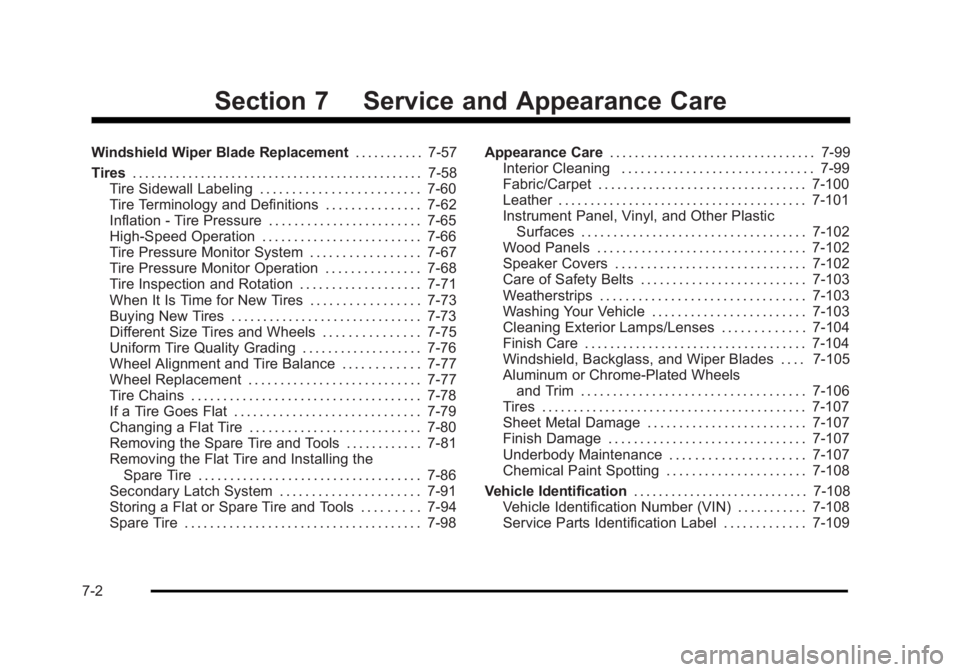
Section 7 Service and Appearance CareWindshield Wiper Blade Replacement . . . . . . . . . . . 7-57
Tires . . . . . . . . . . . . . . . . . . . . . . . . . . . . . . . . . . . . . . . . . . . . . . . 7-58
Tire Sidewall Labeling . . . . . . . . . . . . . . . . . . . . . . . . . 7-60
Tire Terminology and Definitions . . . . . . . . . . . . . . . 7-62
Inflation - Tire Pressure . . . . . . . . . . . . . . . . . . . . . . . . 7-65
High-Speed Operation . . . . . . . . . . . . . . . . . . . . . . . . . 7-66
Tire Pressure Monitor System . . . . . . . . . . . . . . . . . 7-67
Tire Pressure Monitor Operation . . . . . . . . . . . . . . . 7-68
Tire Inspection and Rotation . . . . . . . . . . . . . . . . . . . 7-71
When It Is Time for New Tires . . . . . . . . . . . . . . . . . 7-73
Buying New Tires . . . . . . . . . . . . . . . . . . . . . . . . . . . . . . 7-73
Different Size Tires and Wheels . . . . . . . . . . . . . . . 7-75
Uniform Tire Quality Grading . . . . . . . . . . . . . . . . . . . 7-76
Wheel Alignment and Tire Balance . . . . . . . . . . . . 7-77
Wheel Replacement . . . . . . . . . . . . . . . . . . . . . . . . . . . 7-77
Tire Chains . . . . . . . . . . . . . . . . . . . . . . . . . . . . . . . . . . . . 7-78
If a Tire Goes Flat . . . . . . . . . . . . . . . . . . . . . . . . . . . . . 7-79
Changing a Flat Tire . . . . . . . . . . . . . . . . . . . . . . . . . . . 7-80
Removing the Spare Tire and Tools . . . . . . . . . . . . 7-81
Removing the Flat Tire and Installing the
Spare Tire . . . . . . . . . . . . . . . . . . . . . . . . . . . . . . . . . . . 7-86
Secondary Latch System . . . . . . . . . . . . . . . . . . . . . . 7-91
Storing a Flat or Spare Tire and Tools . . . . . . . . . 7-94
Spare Tire . . . . . . . . . . . . . . . . . . . . . . . . . . . . . . . . . . . . . 7-98 Appearance Care . . . . . . . . . . . . . . . . . . . . . . . . . . . . . . . . . 7-99
Interior Cleaning . . . . . . . . . . . . . . . . . . . . . . . . . . . . . . 7-99
Fabric/Carpet . . . . . . . . . . . . . . . . . . . . . . . . . . . . . . . . . 7-100
Leather . . . . . . . . . . . . . . . . . . . . . . . . . . . . . . . . . . . . . . . 7-101
Instrument Panel, Vinyl, and Other Plastic
Surfaces . . . . . . . . . . . . . . . . . . . . . . . . . . . . . . . . . . . 7-102
Wood Panels . . . . . . . . . . . . . . . . . . . . . . . . . . . . . . . . . 7-102
Speaker Covers . . . . . . . . . . . . . . . . . . . . . . . . . . . . . . 7-102
Care of Safety Belts . . . . . . . . . . . . . . . . . . . . . . . . . . 7-103
Weatherstrips . . . . . . . . . . . . . . . . . . . . . . . . . . . . . . . . 7-103
Washing Your Vehicle . . . . . . . . . . . . . . . . . . . . . . . . 7-103
Cleaning Exterior Lamps/Lenses . . . . . . . . . . . . . 7-104
Finish Care . . . . . . . . . . . . . . . . . . . . . . . . . . . . . . . . . . . 7-104
Windshield, Backglass, and Wiper Blades . . . . 7-105
Aluminum or Chrome-Plated Wheels
and Trim . . . . . . . . . . . . . . . . . . . . . . . . . . . . . . . . . . . 7-106
Tires . . . . . . . . . . . . . . . . . . . . . . . . . . . . . . . . . . . . . . . . . . 7-107
Sheet Metal Damage . . . . . . . . . . . . . . . . . . . . . . . . . 7-107
Finish Damage . . . . . . . . . . . . . . . . . . . . . . . . . . . . . . . 7-107
Underbody Maintenance . . . . . . . . . . . . . . . . . . . . . 7-107
Chemical Paint Spotting . . . . . . . . . . . . . . . . . . . . . . 7-108
Vehicle Identification . . . . . . . . . . . . . . . . . . . . . . . . . . . . 7-108
Vehicle Identification Number (VIN) . . . . . . . . . . . 7-108
Service Parts Identification Label . . . . . . . . . . . . . 7-109
7-2
Page 507 of 620
Black plate (59,1)Cadillac Escalade/Escalade ESV Owner Manual - 2010
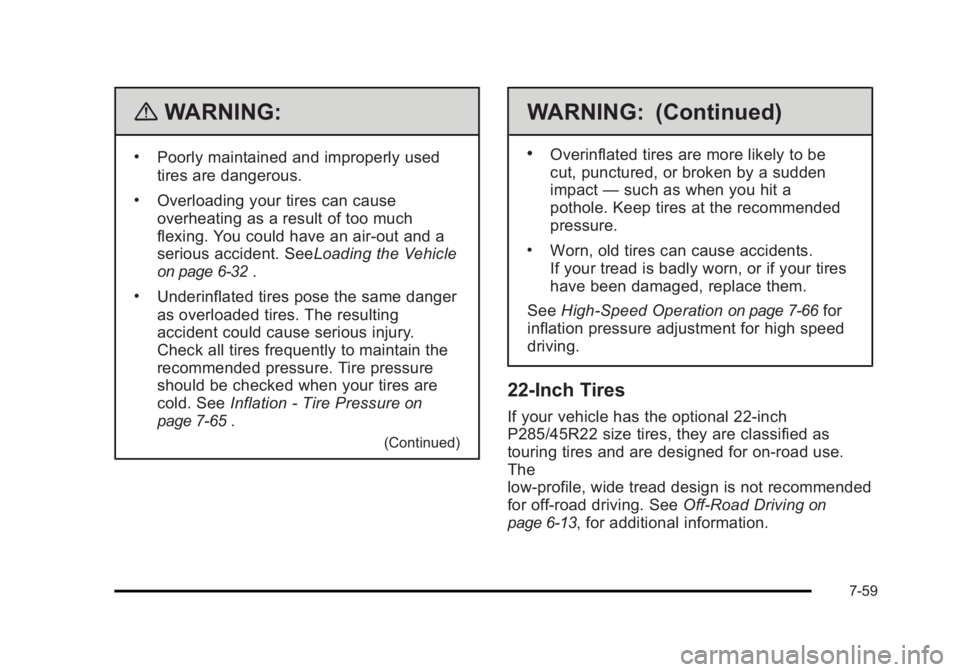
{ WARNING: .
Poorly maintained and improperly used
tires are dangerous. .
Overloading your tires can cause
overheating as a result of too much
flexing. You could have an air-out and a
serious accident. See Loading the Vehicle
on page 6 ‑ 32 ..
Underinflated tires pose the same danger
as overloaded tires. The resulting
accident could cause serious injury.
Check all tires frequently to maintain the
recommended pressure. Tire pressure
should be checked when your tires are
cold. See Inflation - Tire Pressure
on
page 7 ‑ 65
. (Continued)WARNING: (Continued) .
Overinflated tires are more likely to be
cut, punctured, or broken by a sudden
impact — such as when you hit a
pothole. Keep tires at the recommended
pressure. .
Worn, old tires can cause accidents.
If your tread is badly worn, or if your tires
have been damaged, replace them.
See High-Speed Operation
on page 7 ‑ 66 for
inflation pressure adjustment for high speed
driving.
22 ‐ Inch Tires If your vehicle has the optional 22 ‐ inch
P285/45R22 size tires, they are classified as
touring tires and are designed for on ‐ road use.
The
low ‐ profile, wide tread design is not recommended
for off ‐ road driving. See Off-Road Driving
on
page 6 ‑ 13
, for additional information.
7-59
Page 509 of 620

Black plate (61,1)Cadillac Escalade/Escalade ESV Owner Manual - 2010
(G) Maximum Cold Inflation Load Limit :
Maximum load that can be carried and the
maximum pressure needed to support that load.
For information on recommended tire pressure
see Inflation - Tire Pressure
on page 7 ‑ 65 and
Loading the Vehicle
on page 6 ‑ 32 .
Tire Size The following examples show the different parts of
a tire size.
Passenger (P ‐ Metric) Tire
(A) Passenger (P ‐ Metric) Tire :
The United States
version of a metric tire sizing system. The letter P
as the first character in the tire size means a
passenger vehicle tire engineered to standards
set by the U.S. Tire and Rim Association. (B) Tire Width :
The three ‐ digit number indicates
the tire section width in millimeters from sidewall
to sidewall.
(C) Aspect Ratio :
A two ‐ digit number that
indicates the tire height ‐ to ‐ width measurements.
For example, if the tire size aspect ratio is 75, as
shown in item C of the light truck (LT ‐ Metric) tire
illustration, it would mean that the tire's sidewall is
75% as high as it is wide.
(D) Construction Code :
A letter code is used to
indicate the type of ply construction in the tire.
The letter R means radial ply construction; the
letter D means diagonal or bias ply construction;
and the letter B means belted ‐ bias ply
construction.
(E) Rim Diameter :
Diameter of the wheel in
inches.
(F) Service Description :
These characters
represent the load index and speed rating of the
tire. The load index represents the load carry
capacity a tire is certified to carry. The speed
rating is the maximum speed a tire is certified to
carry a load.
7-61
Page 510 of 620

Black plate (62,1)Cadillac Escalade/Escalade ESV Owner Manual - 2010
Tire Terminology and Definitions Air Pressure :
The amount of air inside the tire
pressing outward on each square inch of the tire.
Air pressure is expressed in pounds per square
inch (psi) or kilopascal (kPa).
Accessory Weight :
This means the combined
weight of optional accessories. Some examples of
optional accessories are, automatic transmission,
power steering, power brakes, power windows,
power seats, and air conditioning.
Aspect Ratio :
The relationship of a tire's height to
its width.
Belt :
A rubber coated layer of cords that is
located between the plies and the tread. Cords
may be made from steel or other reinforcing
materials.
Bead :
The tire bead contains steel wires wrapped
by steel cords that hold the tire onto the rim.
Bias Ply Tire :
A pneumatic tire in which the plies
are laid at alternate angles less than 90 degrees
to the centerline of the tread. Cold Tire Pressure :
The amount of air pressure
in a tire, measured in pounds per square inch (psi)
or kilopascals (kPa) before a tire has built up heat
from driving. See Inflation - Tire Pressure
on
page 7 ‑ 65
.
Curb Weight :
The weight of a motor vehicle with
standard and optional equipment including the
maximum capacity of fuel, oil, and coolant, but
without passengers and cargo.
DOT Markings :
A code molded into the sidewall
of a tire signifying that the tire is in compliance
with the U.S. Department of Transportation (DOT)
motor vehicle safety standards. The DOT code
includes the Tire Identification Number (TIN), an
alphanumeric designator which can also identify
the tire manufacturer, production plant, brand, and
date of production.
GVWR :
Gross Vehicle Weight Rating.
See Loading the Vehicle
on page 6 ‑ 32 .
GAWR FRT :
Gross Axle Weight Rating for the
front axle. See Loading the Vehicle on page 6 ‑ 32 .
GAWR RR :
Gross Axle Weight Rating for the rear
axle. See Loading the Vehicle
on page 6 ‑ 32 .
7-62