change wheel CADILLAC ESCALADE ESV 2011 User Guide
[x] Cancel search | Manufacturer: CADILLAC, Model Year: 2011, Model line: ESCALADE ESV, Model: CADILLAC ESCALADE ESV 2011Pages: 548, PDF Size: 8.45 MB
Page 331 of 548
Black plate (11,1)Cadillac Escalade/Escalade ESV Owner Manual - 2011
Driving and Operating 9-11.
The vehicle has more bounce
when driving over obstacles. .
More braking distance is
needed, especially on an
unpaved surface.
{ WARNINGWhen you are driving off-road,
bouncing and quick changes in
direction can easily throw you
out of position. This could cause
you to lose control and crash.
So, whether you are driving
on or off the road, you and
your passengers should wear
safety belts. Scanning the Terrain Off-road driving can take you over
many different kinds of terrain. Be
familiar with the terrain and its many
different features.
Surface Conditions: Off-roading
surfaces can be hard-packed dirt,
gravel, rocks, grass, sand, mud,
snow, or ice. Each of these
surfaces affects the vehicle's
steering, acceleration, and braking
in different ways. Depending on the
surface, slipping, sliding, wheel
spinning, delayed acceleration,
poor traction, and longer braking
distances can occur. Surface Obstacles: Unseen or
hidden obstacles can be hazardous.
A rock, log, hole, rut, or bump can
startle you if you are not prepared
for them. Often these obstacles are
hidden by grass, bushes, snow,
or even the rise and fall of the
terrain itself.
Some things to consider: .
Is the path ahead clear? .
Will the surface texture change
abruptly up ahead? .
Does the travel take you uphill or
downhill? .
Will you have to stop suddenly
or change direction quickly?
Page 332 of 548

Black plate (12,1)Cadillac Escalade/Escalade ESV Owner Manual - 2011
9-12 Driving and Operating When driving over obstacles or
rough terrain, keep a firm grip on
the steering wheel. Ruts, troughs,
or other surface features can jerk
the wheel out of your hands.
When driving over bumps, rocks,
or other obstacles, the wheels can
leave the ground. If this happens,
even with one or two wheels, you
cannot control the vehicle as well or
at all.
Because you will be on an unpaved
surface, it is especially important to
avoid sudden acceleration, sudden
turns, or sudden braking.
Off-roading requires a different kind
of alertness from driving on paved
roads and highways. There are
no road signs, posted speed limits,
or signal lights. Use good judgment
about what is safe and what is not. Driving on Hills Off-road driving often takes you up,
down, or across a hill. Driving safely
on hills requires good judgment
and an understanding of what the
vehicle can and cannot do. There
are some hills that simply cannot be
driven, no matter how well built the
vehicle.
{ WARNINGMany hills are simply too steep
for any vehicle. If you drive up
them, you will stall. If you drive
down them, you cannot control
your speed. If you drive across
them, you will roll over. You could
be seriously injured or killed.
If you have any doubt about the
steepness, do not drive the hill. Approaching a Hill When you approach a hill, decide
if it is too steep to climb, descend,
or cross. Steepness can be hard
to judge. On a very small hill, for
example, there may be a smooth,
constant incline with only a small
change in elevation where you can
easily see all the way to the top.
On a large hill, the incline may get
steeper as you near the top, but you
might not see this because the crest
of the hill is hidden by bushes,
grass, or shrubs.
Consider this as you approach a hill: .
Is there a constant incline,
or does the hill get sharply
steeper in places? .
Is there good traction on the
hillside, or will the surface cause
tire slipping? .
Is there a straight path up or
down the hill so you will not
have to make turning
maneuvers?
Page 337 of 548
Black plate (17,1)Cadillac Escalade/Escalade ESV Owner Manual - 2011
Driving and Operating 9-17Driving in Mud, Sand, Snow,
or Ice When you drive in mud, snow,
or sand, the wheels do not get
good traction. Acceleration is not
as quick, turning is more difficult,
and braking distances are longer.
It is best to use a low gear when in
mud — the deeper the mud, the
lower the gear. In really deep mud,
keep the vehicle moving so it does
not get stuck.
When driving on sand, wheel
traction changes. On loosely packed
sand, such as on beaches or sand
dunes, the tires will tend to sink
into the sand. This affects steering,
accelerating, and braking. Drive at
a reduced speed and avoid sharp
turns or abrupt maneuvers. Hard packed snow and ice offer
the worst tire traction. On these
surfaces, it is very easy to lose
control. On wet ice, for example,
the traction is so poor that you will
have difficulty accelerating. And,
if the vehicle does get moving, poor
steering and difficult braking can
cause it to slide out of control.
{ WARNINGDriving on frozen lakes, ponds,
or rivers can be dangerous.
Underwater springs, currents
under the ice, or sudden thaws
can weaken the ice. Your vehicle
could fall through the ice and you
and your passengers could
drown. Drive your vehicle on
safe surfaces only. Driving in Water
{ WARNINGDriving through rushing water can
be dangerous. Deep water can
sweep your vehicle downstream
and you and your passengers
could drown. If it is only shallow
water, it can still wash away the
ground from under your tires, and
you could lose traction and roll
the vehicle over. Do not drive
through rushing water.
Heavy rain can mean flash flooding,
and flood waters demand extreme
caution.
Page 366 of 548
Black plate (46,1)Cadillac Escalade/Escalade ESV Owner Manual - 2011
9-46 Driving and Operating ABS can change the brake pressure
to each wheel, as required, faster
than any driver could. This can help
the driver steer around the obstacle
while braking hard.
As the brakes are applied, the
computer keeps receiving updates
on wheel speed and controls
braking pressure accordingly.
Remember: ABS does not change
the time needed to get a foot up to
the brake pedal or always decrease
stopping distance. If you get too
close to the vehicle in front of you,
there will not be enough time to
apply the brakes if that vehicle
suddenly slows or stops. Always
leave enough room up ahead to
stop, even with ABS.
Using ABS
Do not pump the brakes. Just hold
the brake pedal down firmly and let
ABS work. You might hear the ABS
pump or motor operating and feel
the brake pedal pulsate, but this is
normal. Braking in Emergencies ABS allows the driver to steer and
brake at the same time. In many
emergencies, steering can help
more than even the very best
braking.
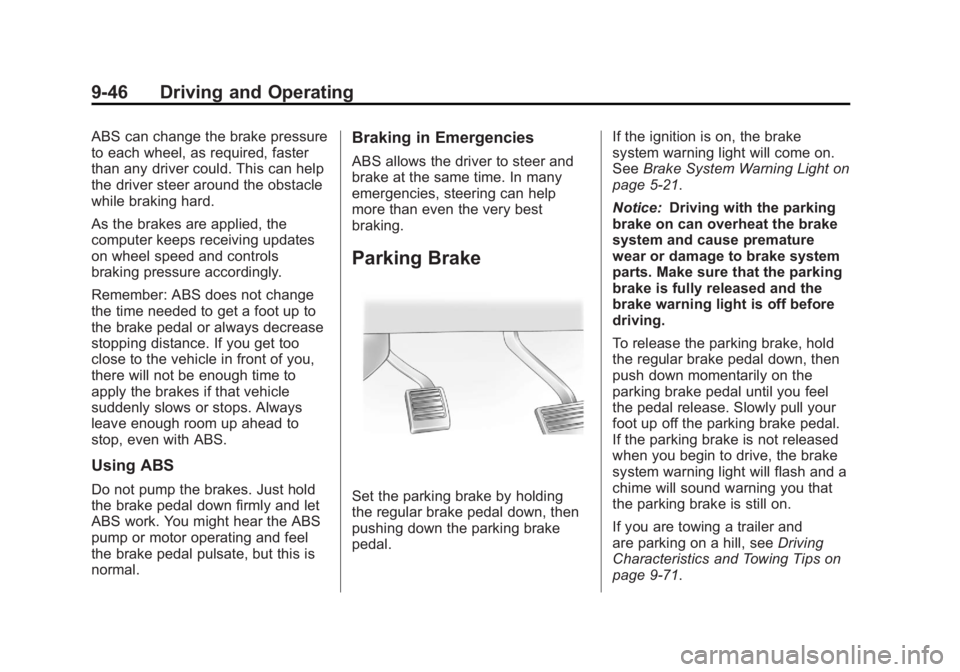
Parking Brake
Set the parking brake by holding
the regular brake pedal down, then
pushing down the parking brake
pedal. If the ignition is on, the brake
system warning light will come on.
See Brake System Warning Light on
page 5 ‑ 21 .
Notice: Driving with the parking
brake on can overheat the brake
system and cause premature
wear or damage to brake system
parts. Make sure that the parking
brake is fully released and the
brake warning light is off before
driving.
To release the parking brake, hold
the regular brake pedal down, then
push down momentarily on the
parking brake pedal until you feel
the pedal release. Slowly pull your
foot up off the parking brake pedal.
If the parking brake is not released
when you begin to drive, the brake
system warning light will flash and a
chime will sound warning you that
the parking brake is still on.
If you are towing a trailer and
are parking on a hill, see Driving
Characteristics and Towing Tips on
page 9 ‑ 71 .
Page 371 of 548
Black plate (51,1)Cadillac Escalade/Escalade ESV Owner Manual - 2011
Driving and Operating 9-51An air compressor connected to
the rear shocks will raise or lower
the rear of the vehicle to maintain
proper vehicle height. The system
is activated when the ignition
key is turned to ON/RUN and will
automatically adjust vehicle height
thereafter. The system may exhaust
(lower vehicle height) for up to
ten minutes after the ignition key
has been turned off. You may hear
the air compressor operating when
the height is being adjusted.
If a weight ‐ distributing hitch is being
used, it is recommended to allow
the shocks to inflate, thereby
leveling the vehicle prior to adjusting
the hitch. Cruise Control
{ WARNINGCruise control can be dangerous
where you cannot drive safely at
a steady speed. So, do not use
the cruise control on winding
roads or in heavy traffic.
Cruise control can be dangerous
on slippery roads. On such roads,
fast changes in tire traction can
cause excessive wheel slip, and
you could lose control. Do not use
cruise control on slippery roads.
With cruise control, a speed of
about 40 km/h (25 mph) or more can
be maintained without keeping your
foot on the accelerator. Cruise
control does not work at speeds
below about 40 km/h (25 mph). When the brakes are applied, cruise
control is turned off.
This vehicle has a Hydra ‐ Matic
6 ‐ speed automatic transmission,
see Grade Braking and Cruise
Grade Braking under Tow/Haul
Mode on page 9 ‑ 43 for an
explanation of how cruise control
interacts with the Range Selection
Mode, tow/haul and grade braking
systems.
This vehicle has StabiliTrak and
when the system begins to limit
wheel spin, the cruise control will
automatically disengage. See
StabiliTrak ®
System on page 9 ‑ 47 .
When road conditions allow the
cruise control to be safely used
again, it can be turned back on.
Page 427 of 548
Black plate (25,1)Cadillac Escalade/Escalade ESV Owner Manual - 2011
Vehicle Care 10-25
{ WARNINGThe brake wear warning sound
means that soon the brakes will
not work well. That could lead to
a crash. When the brake wear
warning sound is heard, have the
vehicle serviced.
Notice: Continuing to drive with
worn-out brake pads could result
in costly brake repair.
Some driving conditions or climates
can cause a brake squeal when
the brakes are first applied or
lightly applied. This does not mean
something is wrong with the brakes. Properly torqued wheel nuts are
necessary to help prevent brake
pulsation. When tires are rotated,
inspect brake pads for wear and
evenly tighten wheel nuts in
the proper sequence to torque
specifications in Capacities and
Specifications on page 12 ‑ 2 .
Brake linings should always be
replaced as complete axle sets.
Brake Pedal Travel See your dealer if the brake pedal
does not return to normal height,
or if there is a rapid increase in
pedal travel. This could be a
sign that brake service might be
required.
Brake Adjustment
Every time the brakes are applied,
with or without the vehicle moving,
the brakes adjust for wear. Replacing Brake System Parts The braking system on a vehicle is
complex. Its many parts have to be
of top quality and work well together
if the vehicle is to have really good
braking. The vehicle was designed
and tested with top-quality brake
parts. When parts of the braking
system are replaced, be sure to get
new, approved replacement parts.
If this is not done, the brakes might
not work properly. For example,
installing disc brake pads that are
wrong for the vehicle, can change
the balance between the front and
rear brakes — for the worse. The
braking performance expected can
change in many other ways if the
wrong replacement brake parts are
installed.
Page 462 of 548
Black plate (60,1)Cadillac Escalade/Escalade ESV Owner Manual - 2011
10-60 Vehicle Care Reset the Tire Pressure Monitor
System. See Tire Pressure
Monitor Operation on
page 10 ‑ 56 .
Make certain that all wheel nuts
are properly tightened. See
“ Wheel Nut Torque ” under
Capacities and Specifications on
page 12 ‑ 2 .
{ WARNINGRust or dirt on a wheel, or on the
parts to which it is fastened, can
make wheel nuts become loose
after time. The wheel could come
off and cause an accident. When
changing a wheel, remove any
rust or dirt from places where the
wheel attaches to the vehicle. In
an emergency, use a cloth or a
paper towel to do this; but be sure
to use a scraper or wire brush
later, if needed, to get all the rust
or dirt off. See If a Tire Goes Flat
on page 10 ‑ 66 . Lightly coat the center of the
wheel hub with wheel bearing
grease after a wheel change or
tire rotation to prevent corrosion
or rust build-up. Do not get
grease on the flat wheel
mounting surface or on the
wheel nuts or bolts.
When It Is Time for New
Tires Various factors, such as
maintenance, temperatures,
driving speeds, vehicle loading,
and road conditions influence
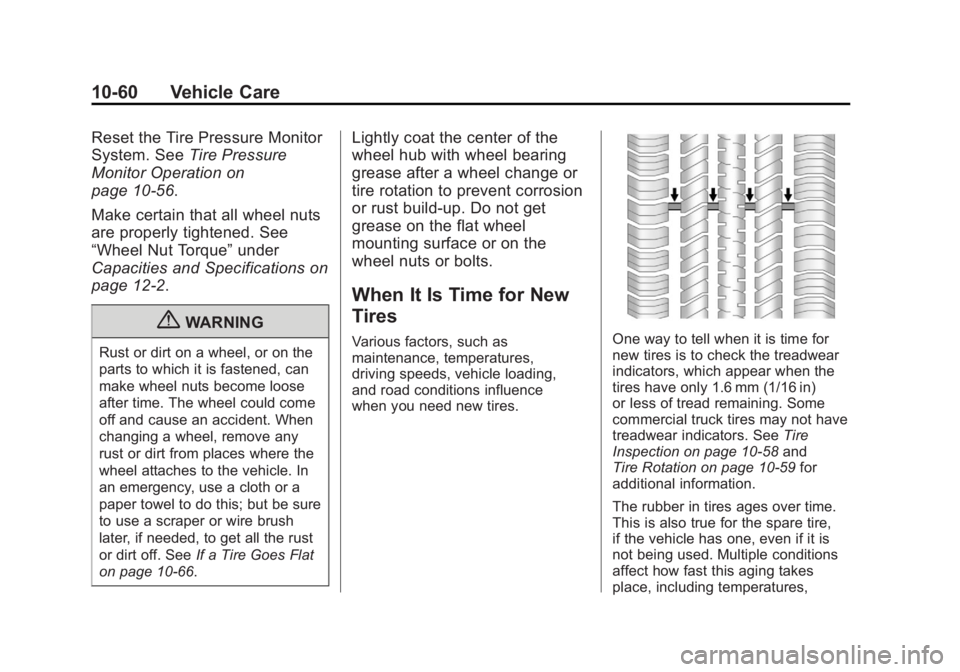
when you need new tires. One way to tell when it is time for
new tires is to check the treadwear
indicators, which appear when the
tires have only 1.6 mm (1/16 in)
or less of tread remaining. Some
commercial truck tires may not have
treadwear indicators. See Tire
Inspection on page 10 ‑ 58 and
Tire Rotation on page 10 ‑ 59 for
additional information.
The rubber in tires ages over time.
This is also true for the spare tire,
if the vehicle has one, even if it is
not being used. Multiple conditions
affect how fast this aging takes
place, including temperatures,
Page 469 of 548
Black plate (67,1)Cadillac Escalade/Escalade ESV Owner Manual - 2011
Vehicle Care 10-67
{ WARNINGLifting a vehicle and getting
under it to do maintenance or
repairs is dangerous without the
appropriate safety equipment and
training. If a jack is provided with
the vehicle, it is designed only for
changing a flat tire. If it is used for
anything else, you or others could
be badly injured or killed if the
vehicle slips off the jack. If a jack
is provided with the vehicle, only
use it for changing a flat tire.
If the vehicle is a hybrid, see the
hybrid supplement for more
information.
If a tire goes flat, avoid further tire
and wheel damage by driving slowly
to a level place, well off the road,
if possible. Turn on the hazard
warning flashers. See Hazard
Warning Flashers on page 6 ‑ 8 .{ WARNINGChanging a tire can be
dangerous. The vehicle can
slip off the jack and roll over or
fall on you or other people. You
and they could be badly injured or
even killed. Find a level place to
change your tire. To help prevent
the vehicle from moving:
1. Set the parking brake firmly.
2. Put an automatic
transmission shift lever in
P (Park), or shift a manual
transmission to 1 (First) or
R (Reverse).
3. Turn off the engine and do
not restart while the vehicle
is raised.
4. Do not allow passengers to
remain in the vehicle.
To be even more certain the
vehicle will not move, you should
put blocks at the front and rear of
(Continued) WARNING (Continued) the tire farthest away from the
one being changed. That would
be the tire on the other side, at
the opposite end of the vehicle.
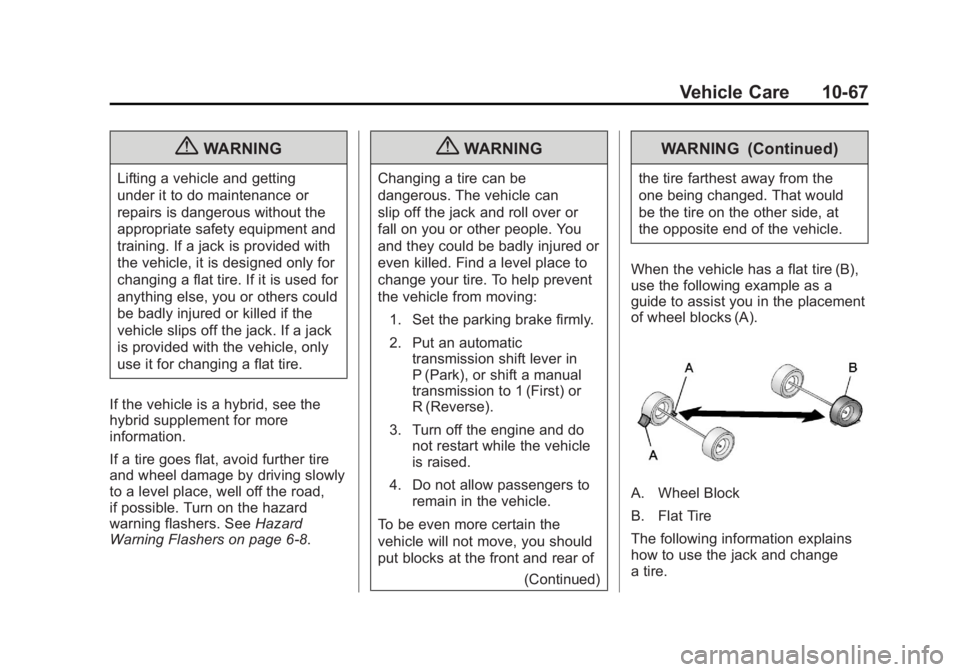
When the vehicle has a flat tire (B),
use the following example as a
guide to assist you in the placement
of wheel blocks (A).
A. Wheel Block
B. Flat Tire
The following information explains
how to use the jack and change
a tire.
Page 505 of 548
Black plate (5,1)Cadillac Escalade/Escalade ESV Owner Manual - 2011
Service and Maintenance 11-5Once a Year .
See Starter Switch Check on
page 10 ‑ 30 ..
See Automatic Transmission
Shift Lock Control Function
Check on page 10 ‑ 31 ..
See Ignition Transmission Lock
Check on page 10 ‑ 31 ..
See Park Brake and P (Park)
Mechanism Check on
page 10 ‑ 32 ..
Accelerator pedal check for
damage, high effort, or binding.
Replace if needed. .
Underbody flushing service. .
Hood/Decklid/Liftgate/Liftglass
Support Gas Strut Service:
Visually inspect gas strut,
if equipped, for signs of wear,
cracks, or other damage. Check
the hold open ability of the gas
strut. Contact your dealer if
service is required. First Engine Oil Change After
Every 80 000 km/50,000 Miles .
Engine air cleaner filter
replacement. See Engine Air
Cleaner/Filter on page 10 ‑ 14 ..
Automatic transmission fluid and
filter change (severe service) for
vehicles mainly driven in heavy
city traffic in hot weather, in hilly
or mountainous terrain, when
frequently towing a trailer,
or used for taxi, police,
or delivery service. See
Automatic Transmission Fluid on
page 10 ‑ 11 . .
All ‐ wheel drive only: Transfer
case fluid change (severe
service) for vehicles mainly
driven when frequently towing a
trailer, or used for taxi, police,
or delivery service. Check vent
hose at transfer case for kinks
and proper installation.
Check to be sure vent hose is
unobstructed, clear, and free of
debris. During any maintenance,
if a power washer is used to
clean mud and dirt from the
underbody, care should be taken
to not directly spray the transfer
case output seals. High pressure
water can overcome the seals
and contaminate the transfer
case fluid. Contaminated fluid
will decrease the life of the
transfer case and should be
replaced.
Page 506 of 548

Black plate (6,1)Cadillac Escalade/Escalade ESV Owner Manual - 2011
11-6 Service and Maintenance .
Evaporative control system
inspection. Check all fuel and
vapor lines and hoses for proper
hook ‐ up, routing, and condition.
Check that the purge valve,
if the vehicle has one, works
properly. Replace as needed.
An Emission Control Service.
The U.S. Environmental
Protection Agency or the
California Air Resources Board
has determined that the failure
to perform this maintenance item
will not nullify the emission
warranty or limit recall liability
prior to the completion of the
vehicle's useful life. We,
however, urge that all
recommended maintenance
services be performed at the
indicated intervals and the
maintenance be recorded. First Engine Oil Change After
Every 160 000 km/100,000 Miles .
Automatic transmission fluid and
filter change (normal service).
See Automatic Transmission
Fluid on page 10 ‑ 11 . .
All ‐ wheel drive only: Transfer
case fluid change (normal
service). Check vent hose at
transfer case for kinks and
proper installation. Check to be
sure vent hose is unobstructed,
clear, and free of debris. During
any maintenance, if a power
washer is used to clean mud
and dirt from the underbody,
care should be taken to not
directly spray the transfer case
output seals. High pressure
water can overcome the seals
and contaminate the transfer
case fluid. Contaminated fluid
will decrease the life of the
transfer case and should be
replaced. .
Spark plug replacement and
spark plug wires inspection. An
Emission Control Service.
First Engine Oil Change After
Every 240 000 km/150,000 Miles .
Engine cooling system drain,
flush, and refill (or every five
years, whichever occurs first).
See Engine Coolant on
page 10 ‑ 16 . An Emission
Control Service. .
Engine drive belts inspection for
fraying, excessive cracks,
or obvious damage (or every
10 years, whichever occurs
first). Replace, if needed.