belt CADILLAC ESCALADE ESV 2011 Workshop Manual
[x] Cancel search | Manufacturer: CADILLAC, Model Year: 2011, Model line: ESCALADE ESV, Model: CADILLAC ESCALADE ESV 2011Pages: 548, PDF Size: 8.45 MB
Page 127 of 548
Black plate (71,1)Cadillac Escalade/Escalade ESV Owner Manual - 2011
Seats and Restraints 3-716. If the child restraint has a top
tether, follow the child restraint
manufacturer's instructions
regarding the use of the top
tether. See Lower Anchors and
Tethers for Children (LATCH
System) on page 3 ‑ 59 for more
information.
7. Before placing a child in the
child restraint, make sure it is
securely held in place. To check,
grasp the child restraint at the
safety belt path and attempt
to move it side ‐ to ‐ side and
back ‐ and ‐ forth. When the child
restraint is properly installed,
there should be no more than
2.5 cm (1 in) of movement.
To remove the child restraint,
unbuckle the vehicle safety belt and
let it return to the stowed position.
If the top tether is attached to a top
tether anchor, disconnect it. Securing Child Restraints
(Center Front Seat
Position)
{ WARNINGA child in a child restraint in the
center front seat can be badly
injured or killed by the frontal
airbags if they inflate. Never
secure a child restraint in the
center front seat. It is always
better to secure a child restraint
in a rear seat.
Do not use child restraints in the
center front seat position. Securing Child Restraints
(Right Front Seat
Position) This vehicle has airbags. A rear
seat is a safer place to secure a
forward-facing child restraint. See
Where to Put the Restraint on
page 3 ‑ 58 .
In addition, the vehicle may have a
passenger sensing system which is
designed to turn off the right front
passenger frontal airbag under
certain conditions. See Passenger
Sensing System on page 3 ‑ 44 and
Passenger Airbag Status Indicator
on page 5 ‑ 16 for more information,
including important safety
information.
Page 128 of 548
Black plate (72,1)Cadillac Escalade/Escalade ESV Owner Manual - 2011
3-72 Seats and Restraints A label on the sun visor says,
“ Never put a rear-facing child seat
in the front. ” This is because the risk
to the rear-facing child is so great if
the airbag deploys.
{ WARNINGA child in a rear-facing child
restraint can be seriously
injured or killed if the right front
passenger airbag inflates. This
is because the back of the
rear-facing child restraint would
be very close to the inflating
airbag. A child in a forward-facing
child restraint can be seriously
injured or killed if the right front
passenger airbag inflates and the
passenger seat is in a forward
position.
The vehicle may have a
passenger sensing system
which is designed to turn off the
right front passenger frontal
airbag under certain conditions.
(Continued) WARNING (Continued) Even if the passenger sensing
system, if equipped, has turned
off the right front passenger
frontal airbag, no system is
fail-safe. No one can guarantee
that an airbag will not deploy
under some unusual
circumstance, even though
it is turned off.
Secure rear-facing child
restraints in a rear seat, even if
the airbag is off. If you secure a
forward-facing child restraint in
the right front seat, always move
the front passenger seat as far
back as it will go. It is better to
secure the child restraint in a
rear seat.
See Passenger Sensing System
on page 3 ‑ 44 for additional
information. If the child restraint has the LATCH
system, see Lower Anchors and
Tethers for Children (LATCH
System) on page 3 ‑ 59 for how and
where to install the child restraint
using LATCH. If a child restraint is
secured using a safety belt and it
uses a top tether, see Lower
Anchors and Tethers for Children
(LATCH System) on page 3 ‑ 59 for
top tether anchor locations.
Do not secure a child seat in a
position without a top tether anchor
if a national or local law requires
that the top tether be anchored, or if
the instructions that come with the
child restraint say that the top strap
must be anchored.
In Canada, the law requires that
forward-facing child restraints have
a top tether, and that the tether be
attached.
Page 129 of 548
Black plate (73,1)Cadillac Escalade/Escalade ESV Owner Manual - 2011
Seats and Restraints 3-73You will be using the lap-shoulder
belt to secure the child restraint in
this position. Follow the instructions
that came with the child restraint.
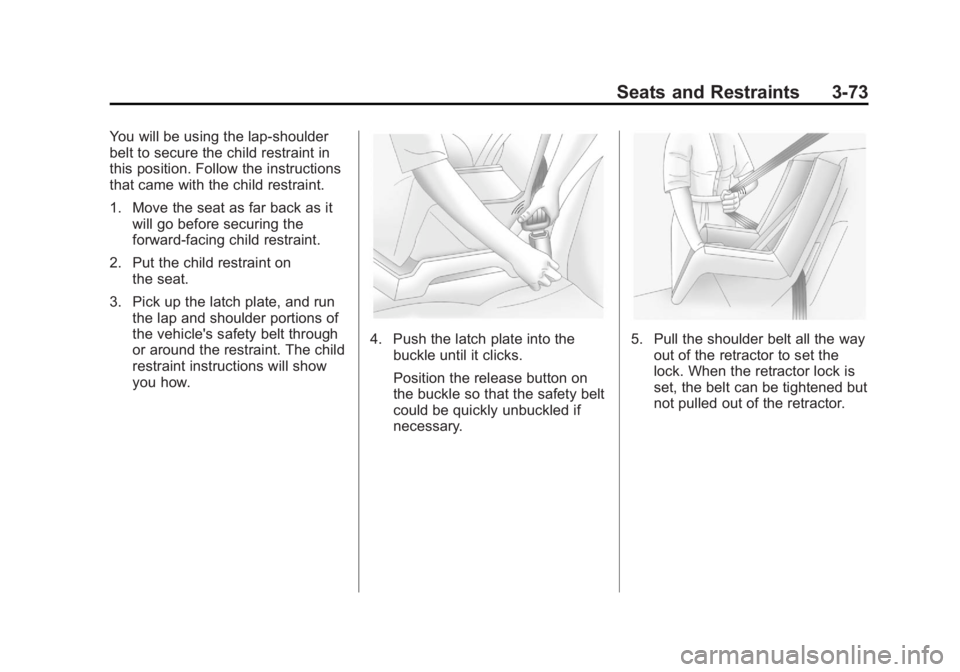
1. Move the seat as far back as it
will go before securing the
forward-facing child restraint.
2. Put the child restraint on
the seat.
3. Pick up the latch plate, and run
the lap and shoulder portions of
the vehicle's safety belt through
or around the restraint. The child
restraint instructions will show
you how. 4. Push the latch plate into the
buckle until it clicks.
Position the release button on
the buckle so that the safety belt
could be quickly unbuckled if
necessary. 5. Pull the shoulder belt all the way
out of the retractor to set the
lock. When the retractor lock is
set, the belt can be tightened but
not pulled out of the retractor.
Page 130 of 548
Black plate (74,1)Cadillac Escalade/Escalade ESV Owner Manual - 2011
3-74 Seats and Restraints
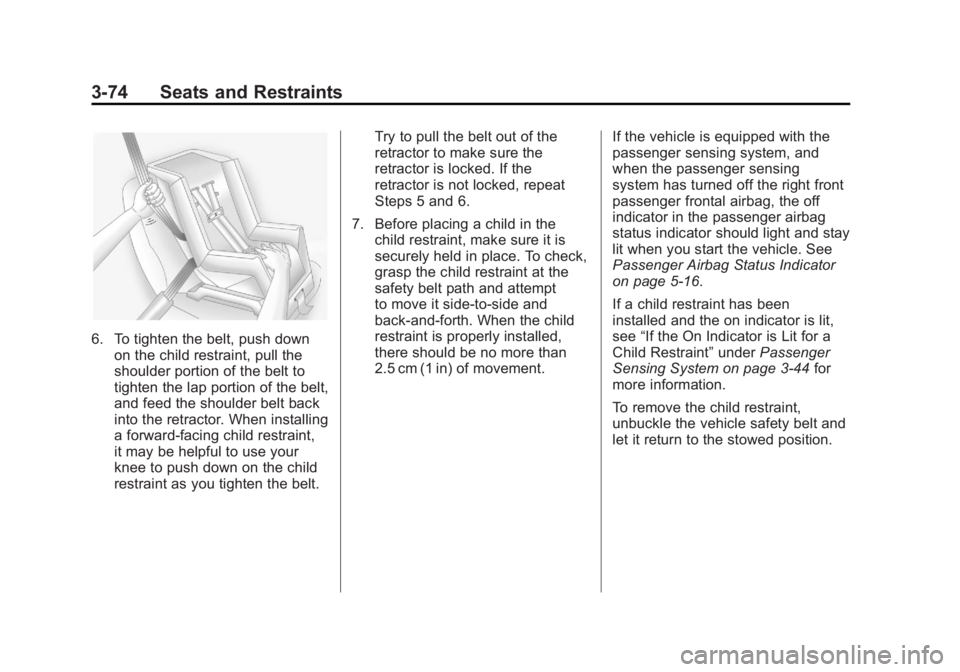
6. To tighten the belt, push down
on the child restraint, pull the
shoulder portion of the belt to
tighten the lap portion of the belt,
and feed the shoulder belt back
into the retractor. When installing
a forward-facing child restraint,
it may be helpful to use your
knee to push down on the child
restraint as you tighten the belt. Try to pull the belt out of the
retractor to make sure the
retractor is locked. If the
retractor is not locked, repeat
Steps 5 and 6.
7. Before placing a child in the
child restraint, make sure it is
securely held in place. To check,
grasp the child restraint at the
safety belt path and attempt
to move it side ‐ to ‐ side and
back ‐ and ‐ forth. When the child
restraint is properly installed,
there should be no more than
2.5 cm (1 in) of movement. If the vehicle is equipped with the
passenger sensing system, and
when the passenger sensing
system has turned off the right front
passenger frontal airbag, the off
indicator in the passenger airbag
status indicator should light and stay
lit when you start the vehicle. See
Passenger Airbag Status Indicator
on page 5 ‑ 16 .
If a child restraint has been
installed and the on indicator is lit,
see “ If the On Indicator is Lit for a
Child Restraint ” under Passenger
Sensing System on page 3 ‑ 44 for
more information.
To remove the child restraint,
unbuckle the vehicle safety belt and
let it return to the stowed position.
Page 135 of 548

Black plate (1,1)Cadillac Escalade/Escalade ESV Owner Manual - 2011
Instruments and Controls 5-1
Instruments and
Controls Controls Steering Wheel Adjustment . . . 5-2
Steering Wheel Controls . . . . . . 5-3
Heated Steering Wheel . . . . . . . 5-5
Horn . . . . . . . . . . . . . . . . . . . . . . . . . . 5-5
Windshield Wiper/Washer . . . . . 5-5
Rear Window Wiper/
Washer . . . . . . . . . . . . . . . . . . . . . . 5-6
Compass . . . . . . . . . . . . . . . . . . . . . 5-6
Clock . . . . . . . . . . . . . . . . . . . . . . . . . 5-8
Power Outlets . . . . . . . . . . . . . . . . . 5-9
Cigarette Lighter . . . . . . . . . . . . . 5-10
Ashtrays . . . . . . . . . . . . . . . . . . . . . 5-11 Warning Lights, Gauges, and
Indicators Warning Lights, Gauges, and
Indicators . . . . . . . . . . . . . . . . . . . 5-11
Instrument Cluster . . . . . . . . . . . 5-12
Speedometer . . . . . . . . . . . . . . . . 5-13
Odometer . . . . . . . . . . . . . . . . . . . . 5-13
Trip Odometer . . . . . . . . . . . . . . . 5-13
Tachometer . . . . . . . . . . . . . . . . . . 5-13
Fuel Gauge . . . . . . . . . . . . . . . . . . 5-13
Engine Coolant Temperature
Gauge . . . . . . . . . . . . . . . . . . . . . . 5-14
Safety Belt Reminders . . . . . . . 5-15
Airbag Readiness Light . . . . . . 5-16
Passenger Airbag Status
Indicator . . . . . . . . . . . . . . . . . . . . 5-16
Charging System Light . . . . . . 5-18
Malfunction
Indicator Lamp . . . . . . . . . . . . . 5-18 Brake System Warning
Light . . . . . . . . . . . . . . . . . . . . . . . 5-21
Antilock Brake System (ABS)
Warning Light . . . . . . . . . . . . . . 5-22
Tow/Haul Mode Light . . . . . . . . 5-23
StabiliTrak ®
Indicator Light . . . 5-23
Tire Pressure Light . . . . . . . . . . 5-23
Engine Oil Pressure Light . . . . 5-24
Security Light . . . . . . . . . . . . . . . . 5-25
High-Beam On Light . . . . . . . . . 5-25
Front Fog Lamp Light . . . . . . . . 5-25
Lamps On Reminder . . . . . . . . . 5-25
Cruise Control Light . . . . . . . . . 5-25
Information Displays Driver Information
Center (DIC) . . . . . . . . . . . . . . . 5-26
Page 149 of 548

Black plate (15,1)Cadillac Escalade/Escalade ESV Owner Manual - 2011
Instruments and Controls 5-15
Safety Belt Reminders Driver Safety Belt Reminder
Light When the engine is started, a chime
sounds for several seconds to
remind a driver to fasten the safety
belt, unless the driver safety belt is
already buckled.
The safety belt light flashes for
several seconds, then comes on
solid for several more. This chime and light sequence
are repeated if the driver remains
unbuckled and the vehicle is in
motion. If the driver safety belt is
already buckled, neither the chime
nor the light comes on.
Passenger Safety Belt
Reminder Light For vehicles equipped with the
passenger safety belt reminder light,
several seconds after the engine is
started, a chime sounds for several
seconds to remind the front
passenger to buckle their safety
belt. The passenger safety belt light,
located on the overhead console,
comes on and stays on for several
seconds, flashes for several more
seconds and then comes on solid
for several more. This chime and light sequence is
repeated if the passenger remains
unbuckled and the vehicle is in
motion.
If the passenger safety belt is
buckled, neither the chime nor the
light comes on.
The front passenger safety belt
warning light and chime may turn on
if an object is put on the seat such
as a briefcase, handbag, grocery
bag, laptop or other electronic
device. To turn off the warning light
and or chime, remove the object
from the seat or buckle the
safety belt.
Page 152 of 548

Black plate (18,1)Cadillac Escalade/Escalade ESV Owner Manual - 2011
5-18 Instruments and Controls
Charging System Light
This light comes on briefly when
the ignition key is turned to START,
but the engine is not running, as a
check to show it is working.
If it does not, have the vehicle
serviced by your dealer.
The light should go out once the
engine starts. If it stays on,
or comes on while driving, there
could be a problem with the
charging system. A charging system
message in the Driver Information Center (DIC) can also appear. See
Battery Voltage and Charging
Messages on page 5 ‑ 31 for more
information. This light could indicate
that there are problems with a
generator drive belt, or that there is
an electrical problem. Have it
checked right away. If the vehicle
must be driven a short distance with
the light on, turn off accessories,
such as the radio and air
conditioner.
If the vehicle is a hybrid, see the
hybrid supplement for more
information. Malfunction
Indicator Lamp A computer system called OBD II
(On-Board Diagnostics-Second
Generation) monitors operation of
the fuel, ignition, and emission
control systems. It ensures that
emissions are at acceptable levels
for the life of the vehicle, helping to
produce a cleaner environment.
This light should come on when the
ignition is on, but the engine is not
running, as a check to show it is
working. If it does not, have the
vehicle serviced by your dealer.
Page 212 of 548
Black plate (10,1)Cadillac Escalade/Escalade ESV Owner Manual - 2011
7-10 Infotainment System
Radio AM-FM Radio Notice: Before adding any sound
equipment to the vehicle, such
as an audio system, CD player,
CB radio, mobile telephone,
or two-way radio, make sure that
it can be added by checking with
your dealer. Also, check federal
rules covering mobile radio
and telephone units. If sound
equipment can be added, it is
very important to do it properly.
Added sound equipment can
interfere with the operation of the
vehicle's engine, radio, or other
systems, and even damage them.
The vehicle's systems can
interfere with the operation of
sound equipment that has been
added. Notice: The chime signals related
to safety belts, parking brake, and
other functions of the vehicle
operate through the navigation
system. If that equipment is
replaced or additional equipment
is added to the vehicle, the
chimes may not work. Make sure
that replacement or additional
equipment is compatible with the
vehicle before installing it. See
“ Accessories and Modifications ”
in the vehicle's owner manual.
Playing the Radio
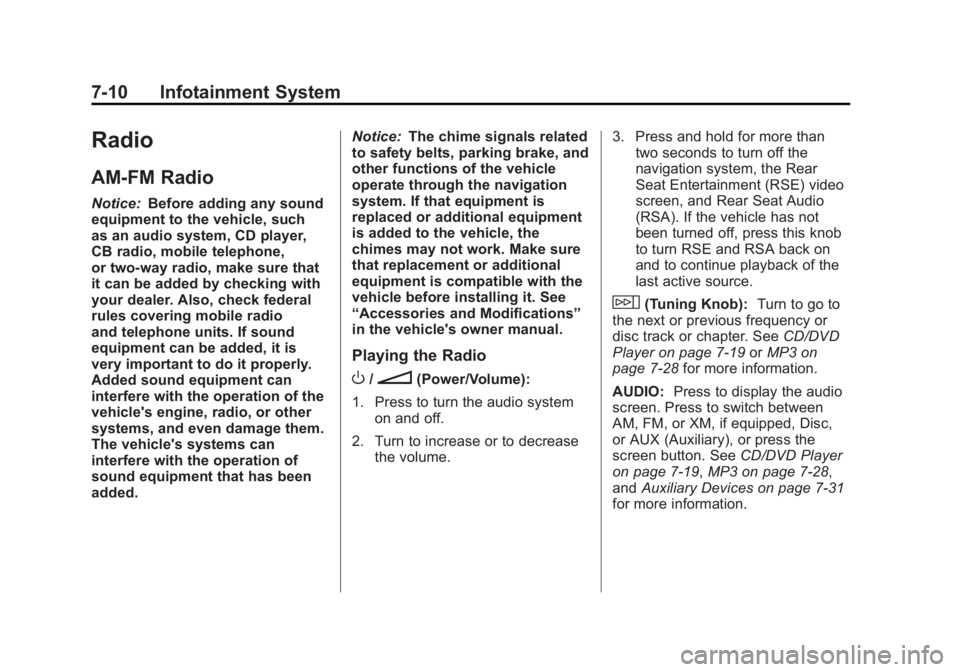
O /
n (Power/Volume):
1. Press to turn the audio system
on and off.
2. Turn to increase or to decrease
the volume. 3. Press and hold for more than
two seconds to turn off the
navigation system, the Rear
Seat Entertainment (RSE) video
screen, and Rear Seat Audio
(RSA). If the vehicle has not
been turned off, press this knob
to turn RSE and RSA back on
and to continue playback of the
last active source.
w (Tuning Knob): Turn to go to
the next or previous frequency or
disc track or chapter. See CD/DVD
Player on page 7 ‑ 19 or MP3 on
page 7 ‑ 28 for more information.
AUDIO: Press to display the audio
screen. Press to switch between
AM, FM, or XM, if equipped, Disc,
or AUX (Auxiliary), or press the
screen button. See CD/DVD Player
on page 7 ‑ 19 , MP3 on page 7 ‑ 28 ,
and Auxiliary Devices on page 7 ‑ 31
for more information.
Page 246 of 548
Black plate (44,1)Cadillac Escalade/Escalade ESV Owner Manual - 2011
7-44 Infotainment System Using the RSE System
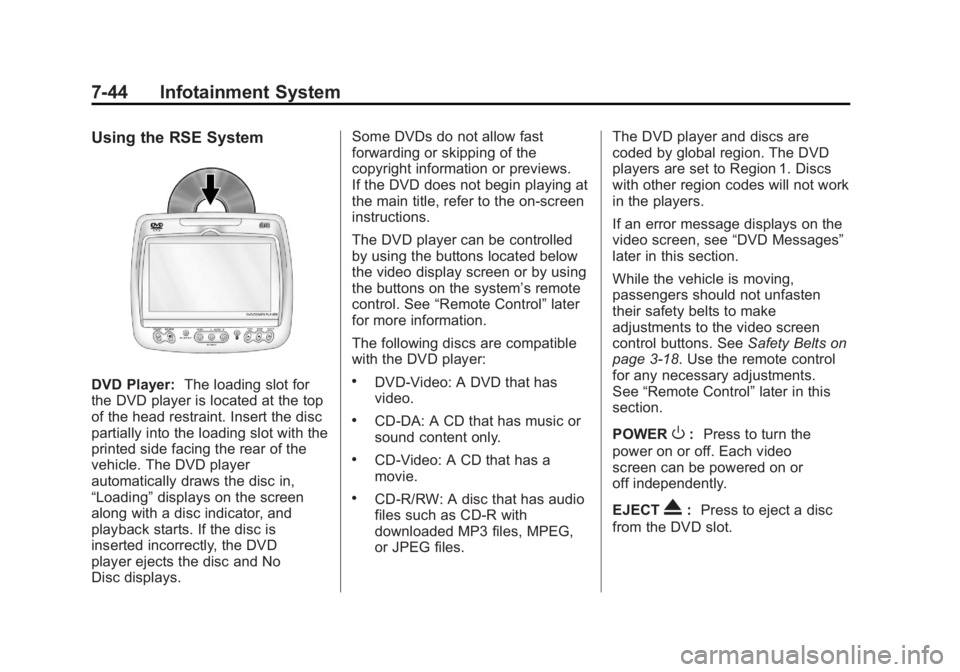
DVD Player: The loading slot for
the DVD player is located at the top
of the head restraint. Insert the disc
partially into the loading slot with the
printed side facing the rear of the
vehicle. The DVD player
automatically draws the disc in,
“ Loading ” displays on the screen
along with a disc indicator, and
playback starts. If the disc is
inserted incorrectly, the DVD
player ejects the disc and No
Disc displays. Some DVDs do not allow fast
forwarding or skipping of the
copyright information or previews.
If the DVD does not begin playing at
the main title, refer to the on-screen
instructions.
The DVD player can be controlled
by using the buttons located below
the video display screen or by using
the buttons on the system ’ s remote
control. See “ Remote Control ” later
for more information.
The following discs are compatible
with the DVD player: .
DVD-Video: A DVD that has
video. .
CD-DA: A CD that has music or
sound content only. .
CD-Video: A CD that has a
movie. .
CD-R/RW: A disc that has audio
files such as CD-R with
downloaded MP3 files, MPEG,
or JPEG files. The DVD player and discs are
coded by global region. The DVD
players are set to Region 1. Discs
with other region codes will not work
in the players.
If an error message displays on the
video screen, see “ DVD Messages ”
later in this section.
While the vehicle is moving,
passengers should not unfasten
their safety belts to make
adjustments to the video screen
control buttons. See Safety Belts on
page 3 ‑ 18 . Use the remote control
for any necessary adjustments.
See “ Remote Control ” later in this
section.
POWER
O : Press to turn the
power on or off. Each video
screen can be powered on or
off independently.
EJECT
X : Press to eject a disc
from the DVD slot.
Page 322 of 548

Black plate (2,1)Cadillac Escalade/Escalade ESV Owner Manual - 2011
9-2 Driving and Operating Fuel E85 (85% Ethanol) . . . . . 9-66
Filling the Tank . . . . . . . . . . . . . . 9-68
Filling a Portable Fuel
Container . . . . . . . . . . . . . . . . . . . 9-70
Towing General Towing
Information . . . . . . . . . . . . . . . . . 9-70
Driving Characteristics and
Towing Tips . . . . . . . . . . . . . . . . 9-71
Trailer Towing . . . . . . . . . . . . . . . . 9-74
Towing Equipment . . . . . . . . . . . 9-78
Conversions and Add-Ons Add-On Electrical
Equipment . . . . . . . . . . . . . . . . . 9-82 Driving Information Defensive Driving Defensive driving means “ always
expect the unexpected. ” The first
step in driving defensively is to wear
the safety belt. See Safety Belts on
page 3 ‑ 18 .
{ WARNINGAssume that other road users
(pedestrians, bicyclists, and other
drivers) are going to be careless
(Continued) WARNING (Continued) and make mistakes. Anticipate
what they might do and be ready.
In addition: .
Allow enough following
distance between you and
the driver in front of you. .
Focus on the task of driving.
Driver distraction can cause
collisions resulting in injury or
possible death. These simple
defensive driving techniques
could save your life.