check engine CADILLAC FLEETWOOD 1993 2.G User Guide
[x] Cancel search | Manufacturer: CADILLAC, Model Year: 1993, Model line: FLEETWOOD, Model: CADILLAC FLEETWOOD 1993 2.GPages: 386, PDF Size: 19.17 MB
Page 141 of 386
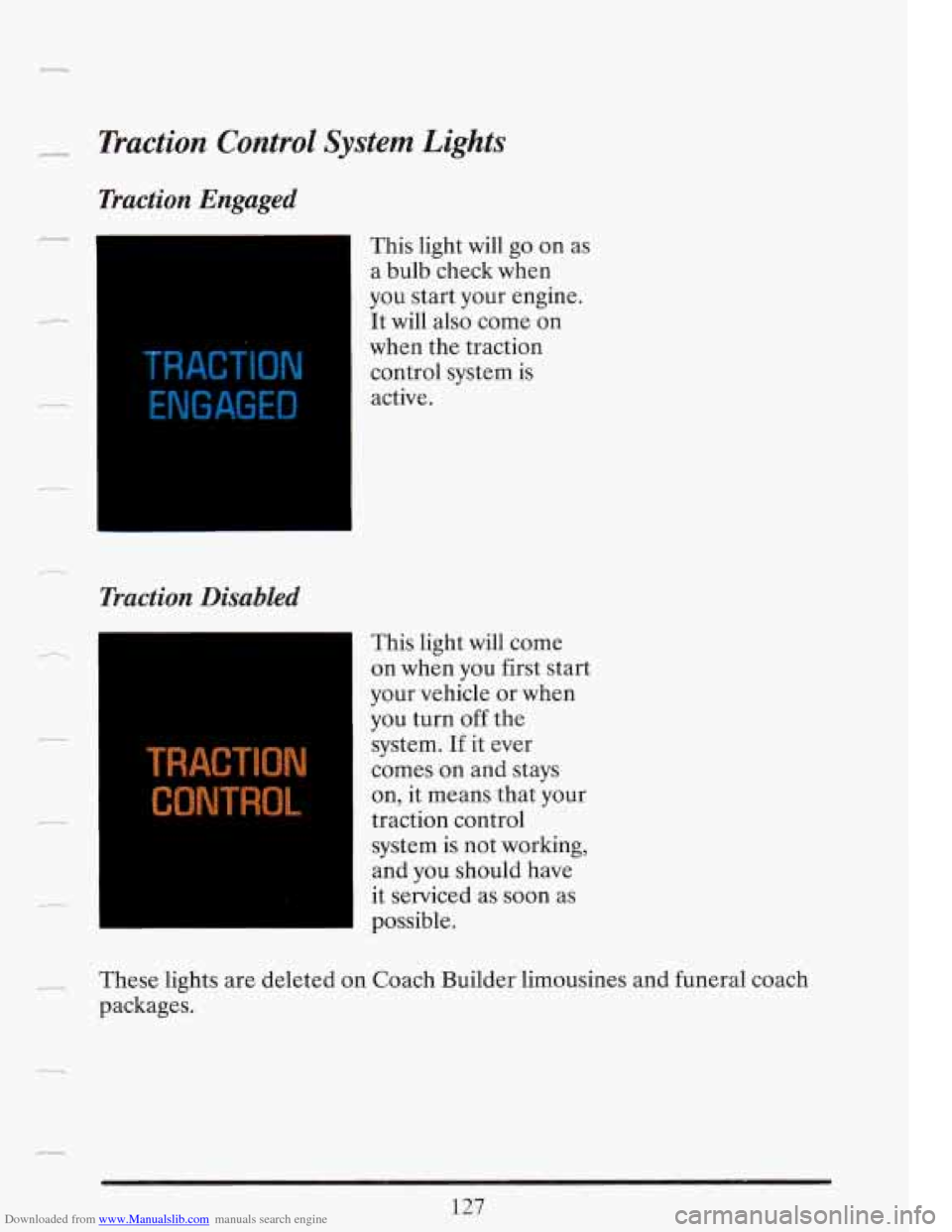
Downloaded from www.Manualslib.com manuals search engine *_* Traction Control System Lights
Traction Engaged
1
TRACTION
ENGAGED
Traction Disabled
This light will go on as
a bulb check when
you start your engine.
It will also come on
when the traction
control system is
active.
This light will come
on when you first start
your vehicle
or when
you turn
off the
system. If it ever
comes on and stays
on, it means that your
traction control
system is not working,
and you should have
it serviced as soon as
possible.
These lights are deleted on Coach Builder limousines and funeral coach
packages.
Page 143 of 386
Downloaded from www.Manualslib.com manuals search engine HOT COOLANT CAN BURN YOU BADLY!
In “Problems on the Road,’’ this manual shows what to do. See “Engine
Overheating”
in the Index.
1
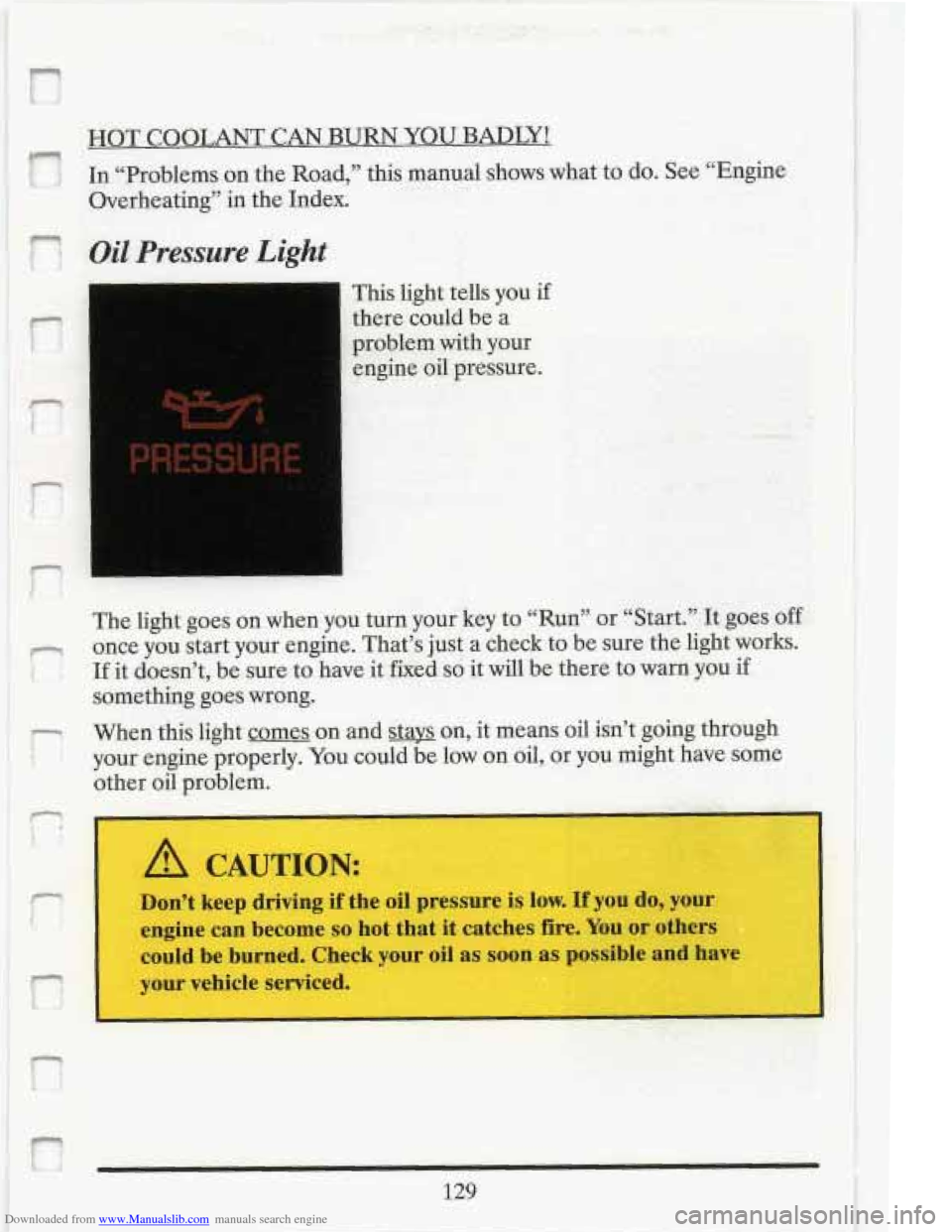
1 I LNl Prere Light
This light tells you if
there couldbe a
i+gg&dea with your
engine oil pressure.
i
I Don’t keep driving if the oil pressure is low. If you do, your
engine can become
so hot that it catches fire. You or others
could be burned. Check your oil as soon as possible and have
your vehicle serviced.
i I’
I
- ~-...
129
Page 145 of 386
Downloaded from www.Manualslib.com manuals search engine If it doesn’t come on, have it repaired. If the light comes on and stays on,
your engine oil level is too low. Check your oil level and add enough oil
to bring the engine oil level up to the proper level. See “Engine Oil” in
the Index.
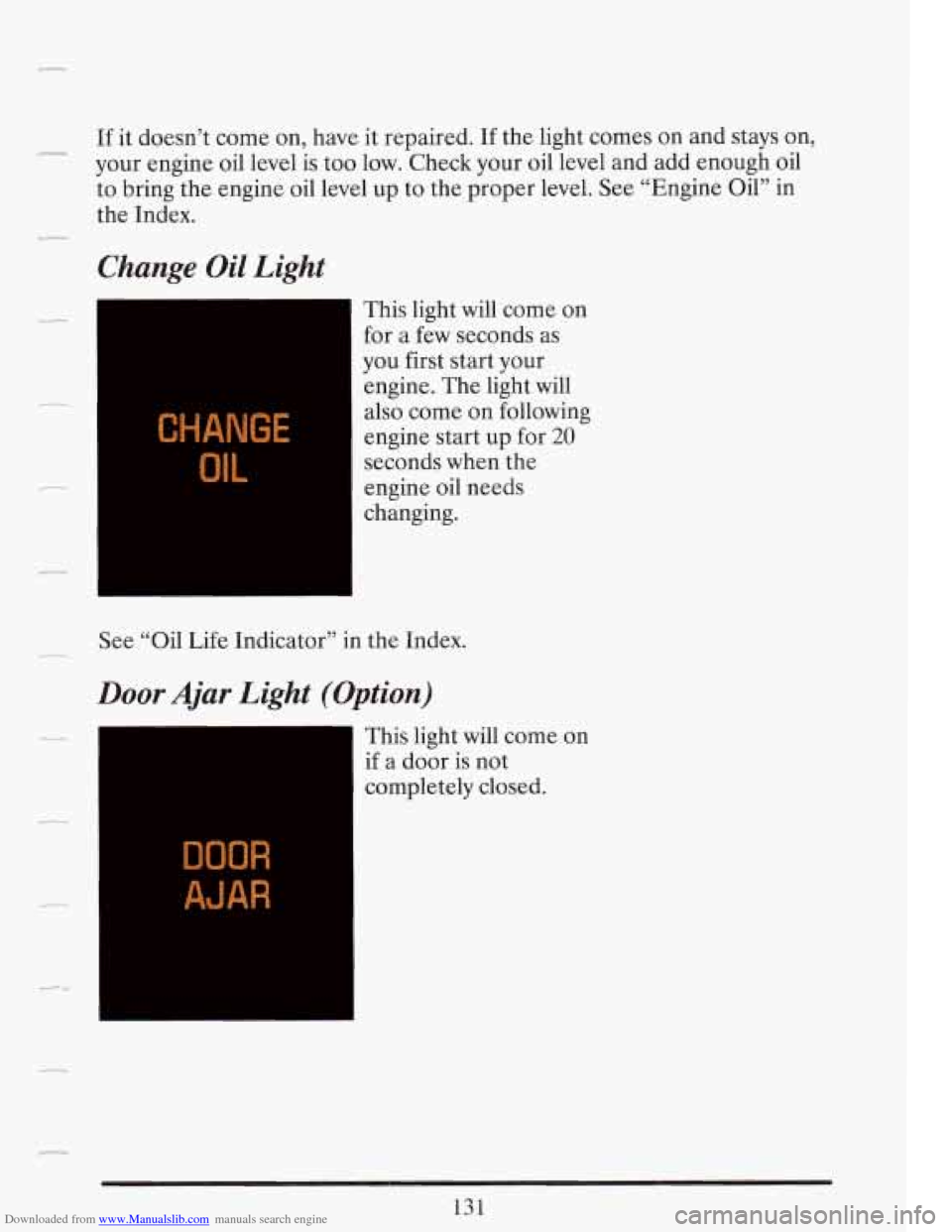
Change Oil Light
r
H E
This light will come on
for .a few seconds as
you first start your
engine. The light
will
also come on following
engine start up for
20
seconds when the
engine oil needs
changing.
See “Oil Life Indicator” in the Index.
Door Ajar Light (Option)
This light will come on
if
a door is not
completely closed.
r
Page 147 of 386
Downloaded from www.Manualslib.com manuals search engine r
r
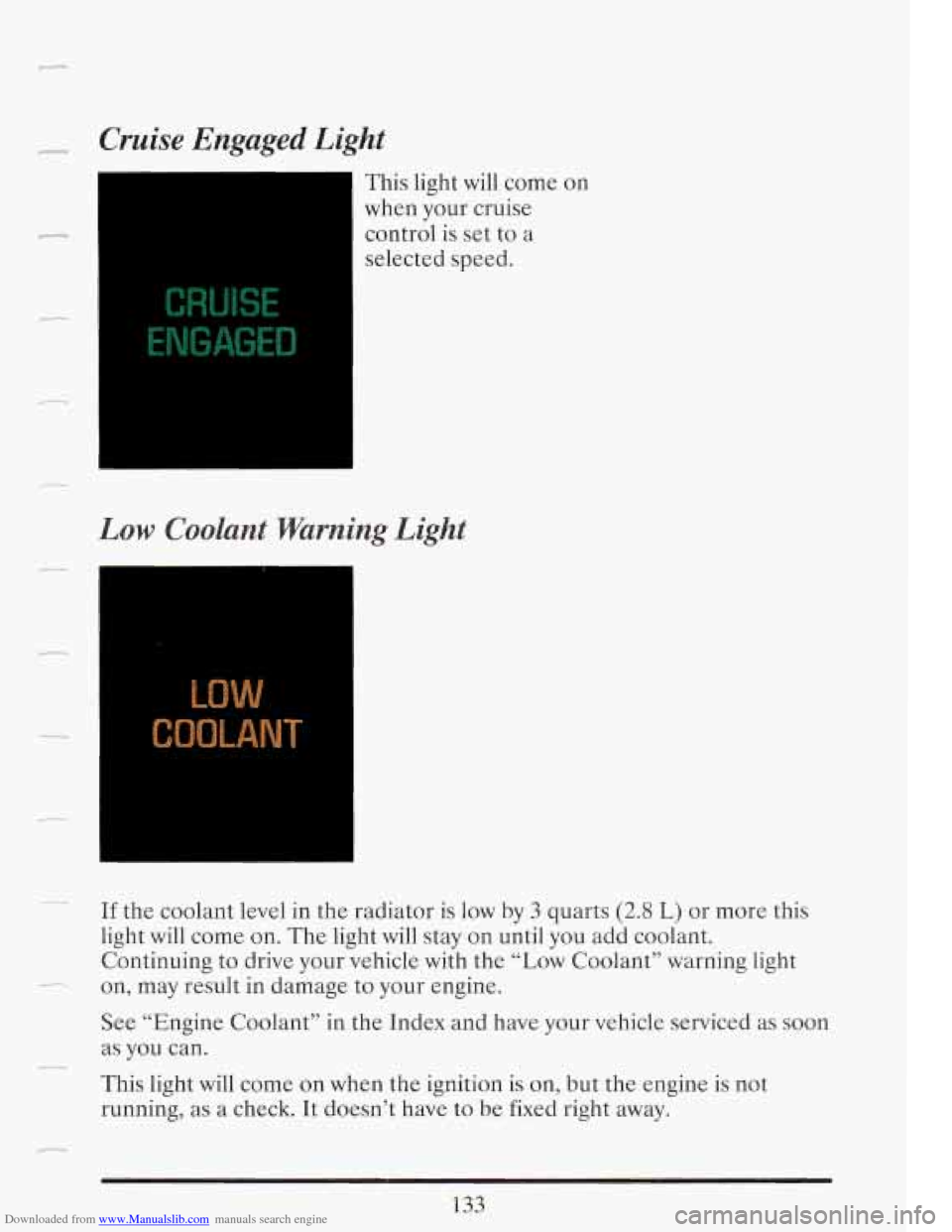
Cruise Engaged Light
This light will come on
when your cruise
control is set to a
selected speed.
Low Coolant Warning Light
-- If the coolant level in the radiator is low by 3 quarts (2.8 L) or more this
light will come on.
The light will stay on until you add coolant.
Continuing to drive your vehicle with the “Low Coolant” warning light
See “Engine Coolant” in the Index and have
your vehicle serviced as soon
as you can.
This light will come on when the ignition is on, but the engine is not
running, as a check. It doesn’t have to be fixed right away.
- . on, may result in damage to your engine.
,. ~. .
Page 148 of 386
Downloaded from www.Manualslib.com manuals search engine 1
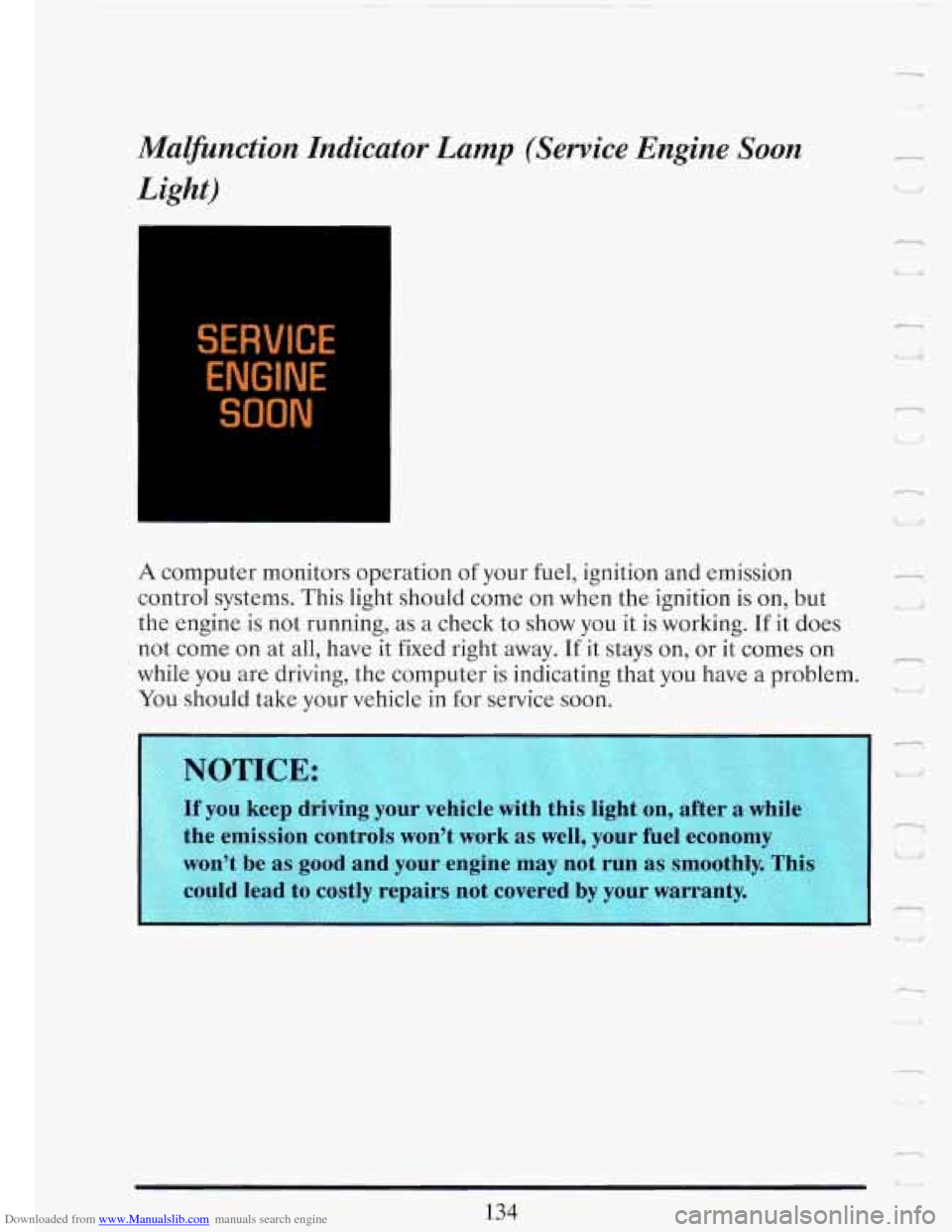
Malfunction Indicator Lamp (Service Engine Soon
Light)
A computer monitors operation of your fuel, ignition and emission
control systems. This light should come
on when the ignition is on, but
the engine is not running, as a check
to show you it is working. If it does
not come
on at all, have it fixed right away. If it stays on, or it comes on
while you are driving, the computer is indicating that you have a problem.
You should take your vehicle in for service soon.
~~
NOTICE:
If you keep driv
the emission controls won’t work as well, your fuel economy
won’t be as good and your engine may not run as smoothly. This
could lead to costly repairs not covered
by your warranty.
t
d, I
T
~ L
134
Page 150 of 386
Downloaded from www.Manualslib.com manuals search engine i
FUEL GAGE
fI
I
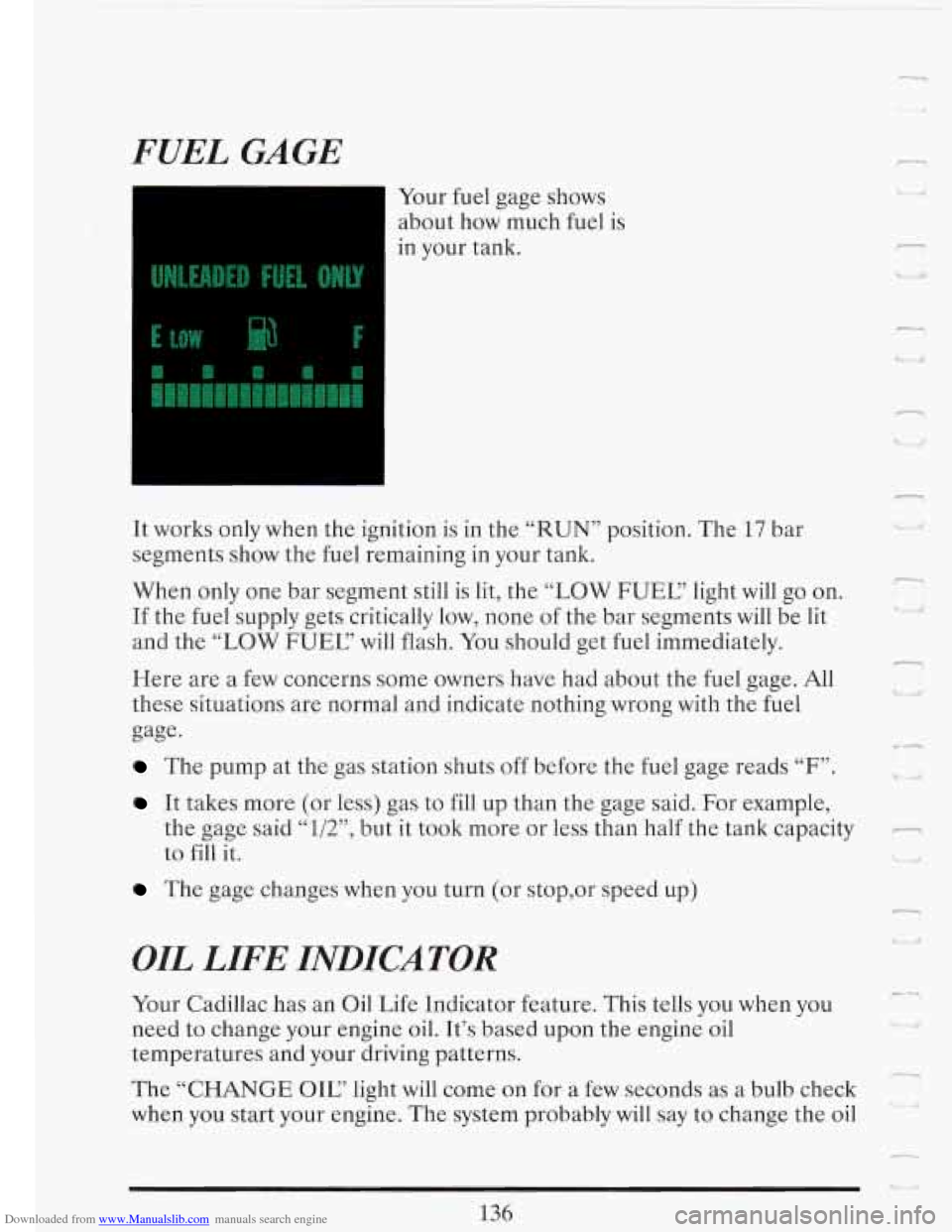
Your fuel gage shows
about how much fuel is
in your tank.
It works only when the ignition is in the “RUN” position. The
17 bar
segments show the fuel remaining in your tank.
When only one bar segment still is lit, the
“LOW FUEC’ light will go on.
If the fuel supply gets critically low, none of the bar segments will be lit
and the
“LOW FUEC’ will flash. You should get fuel immediately.
Here are
a few concerns some owners have had about the fuel gage. All
these situations are normal and indicate nothing wrong with the fuel
gage.
The pump at the gas station shuts off before the fuel gage reads “F”.
I.
3, I
It takes more (or less) gas to fill up than the gage said. For example,
the gage said
“l/Y, but it took more or less than half the tank capacity -
to fill it. I
The gage changes when you turn (or stop,or speed up)
OIL LIFE INDICATOR
Your Cadillac has an Oil Life Indicator feature. This tells you when you
need to change your engine
oil. It’s based upon the engine oil
temperatures and your driving patterns.
-1
-1
The “CHANGE OIE’ light will come on for a few seconds as a bulb check
when
you start your engine. The system probably will say to change the oil
-.
n
- I
136
Page 151 of 386
Downloaded from www.Manualslib.com manuals search engine 1 between 3000 miles (5000 km) and 7500 miles (12500 km), but it may
even say to change it before
3000 miles under severe conditions. It all
depends on your driving patterns. (If it doesn’t, or
if it doesn’t even light
up, then something is wrong.
You will need to have it serviced.)
There are
two things the system won’t do: It can’t sense heavy dust in the
places where you drive.
If you drive in a dusty area, you should change
your oil every
3000 miles (5000 krn) or 3 months (whichever comes first),
unless the
“CHANGE OIL? light comes on sooner.
It doesn’t check how much oil you have
so you will still have to check for
that.
To check it, see the Index under “Engine Oil.”
When You’ve Changed the Oil
When new oil is put in, you’ll need to reset your system. To do that, turn
the ignition switch to the
“ON” position with the engine stopped. Fully
depress and release the accelerator pedal
3 times within 5 seconds.
If the “CHANGE OK’ light comes on and stays on for
5 seconds, it did
not reset. You’ll need to reset the system again.
137
Page 157 of 386
Downloaded from www.Manualslib.com manuals search engine r
A CAUTION:
Hearing damage from loud noise is almost undetectable until it
is too late. Your hearing can adapt to higher volumes of sound.
Sound that seems normal can be loud and harmful to your
hearing. Take precautions by adjusting the volume control on
your radio to
a safe sound level before your hearing adapts to it.
'
Adjust the volume control to the lowest setting.
Increase volume slowly until you hear comfortably and
1 help avoid hearing loss or damage:
clearly.
I
So, before adding sound equipment, check with your dealer and - -- .. I
FM Stereo
FM stereo will give you the best sound, but FM signals will reach only
about 10 to 40 miles (16 to 65 km). Tall buildings or hills can interfere
with
FM signals, causing the sound to come and go
Page 166 of 386
Downloaded from www.Manualslib.com manuals search engine ST-PLAY (Stop-Play)
Press ST-PLAY to switch back to the radio without ejecting the tape. In
ST-PLAY function
only the tuning knob can be used for selecting stations.
To Eject A Tape
To remove the tape once it is stopped, push EJECT
The Delco Cassette And Compact Disc Music System
This optional sound system combines an AM/FM stereo radio with a
cassette tape player and a compact disc player in a single unit.
To operate the radio and cassette tape player portion of this music
system, please read the beginning of this section, “How To Operate Your
Sound System” and “Your Cassette Tape Player”.
To Play the Disc Player
Before you begin, please note: don’t use the mini-discs that are called
“singles”
. They won’t eject. Use full-size compact discs only.
Turn the radio on.
2
U a,
Insert a disc (label side up) partway into the slot. The player will pull it in.
Wait a few seconds and the disc will play.
The DNR@ will be disabled and -
I
the display will show Track “ 1 TRKCD” for about 5 seconds, then “CD”
will show in the display.
1F
If the disc comes back out, check to see if
The disc is upside down.
The disc is dirty, scratched, or wet.
There’s too much moisture in the air. (If there is, wait about one hour
and try again).
I
RCLIPROG (RecalllProgram)
Press once to see which track is being played. (It also allows for disc
programming.)
n
-
152
Page 197 of 386
Downloaded from www.Manualslib.com manuals search engine So here are some tips for passing:
0
r
0
0
0
._ 0
0
0
“Drive ahead.” Look down the road, to the sides, and to crossroads
for situations that might affect your passing patterns.
If you have any
doubt whatsoever about making a successful pass, wait for
a better
time.
Watch for traffic signs, pavement markings, and lines. If you can see a
sign up ahead that might indicate a turn or an intersection, delay your
pass.
A broken center line usually indicates it’s all right to pass
(providing the road ahead is clear). Never cross a solid line on your
side
of the lane or a double solid line, even if the road seems empty of
approaching traffic.
If you suspect that the driver of the vehicle you want to pass isn’t
aware
of your presence, tap the horn a couple of times before passing.
Do not get too close to the vehicle you want to pass while you’re
awaiting an opportunity. For one thing, following too closely reduces
your area of vision, especially if you’re following a larger vehicle.
Also,
you won’t have adequate space if the vehicle ahead suddenly slows or
stops. Keep back a reasonable distance.
When it looks like a chance to pass is coming up, start to accelerate
but stay in the right lane and don’t get
too close. Time your move so
you will be increasing speed as the time comes to move into the other
lane. If the way is clear to pass, you will have a “running start” that
more than makes up for the distance you would lose by dropping back.
And if something happens
to cause you to cancel your pass, you need
only slow down and drop back again and wait for another opportunity.
If other cars are lined up to pass a slow vehicle, wait your turn. But
take care that someone isn’t trying to pass you as you pull out to pass
the slow vehicle. Remember to glance over your shoulder and check
the blind spot.
Check your mirrors
, glance over your shoulder, and start your left
lane change signal before moving out of the right lane to pass. When
you are far enough ahead of the passed vehicle to see its front in your
inside mirror, activate your right lane change signal and move back
into the right lane. (Remember that your right outside mirror is
convex. The vehicle you just passed may seem to be farther away from
you than it really is.)