light CADILLAC FLEETWOOD 1996 2.G Workshop Manual
[x] Cancel search | Manufacturer: CADILLAC, Model Year: 1996, Model line: FLEETWOOD, Model: CADILLAC FLEETWOOD 1996 2.GPages: 306, PDF Size: 15.72 MB
Page 166 of 306
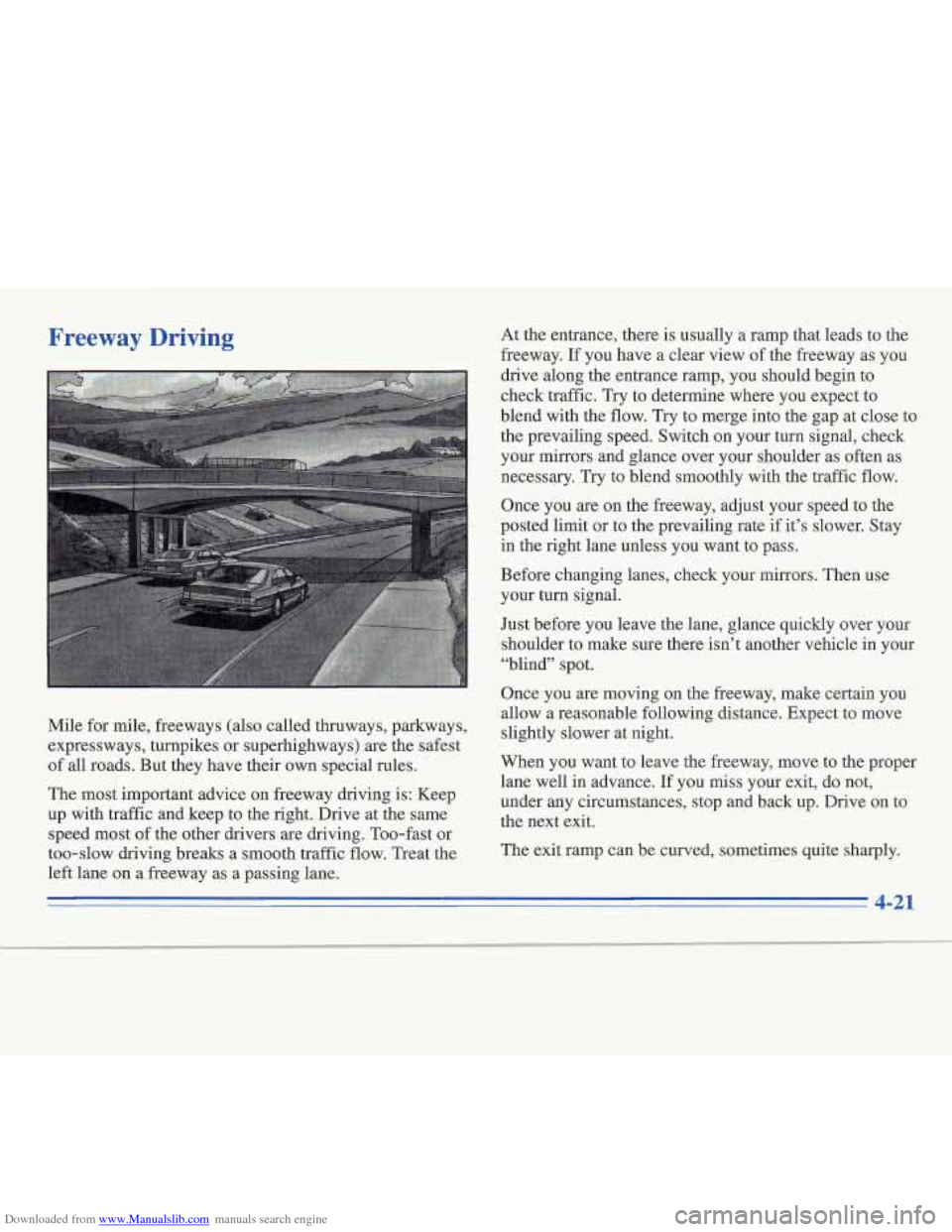
Downloaded from www.Manualslib.com manuals search engine Freeway Driving
Mile for mile, freeways (also called thruways, parkways,
expressways, turnpikes or superhighways)
are the safest
of all roads. But they have their own special rules.
The most important advice
on freeway driving is: Keep
up with traffic and keep to the right. Drive at the same
speed most of the other drivers are driving. Too-fast or
too-slow driving breaks a smooth traffic flow. Treat the
left lane on a freeway as a passing lane. At the entrance, there
is usually a ramp that leads to the
freeway. If you have a clear view of the freeway as you
drive along the entrance ramp, you should begin to
check traffic. Try to determine where you expect to
blend with the
flow. Try to merge into the gap at close to
the prevailing speed. Switch on your turn signal, check
your mirrors and glance over your shoulder as often as
necessary. Try to blend smoothly with the traffic flow.
Once you are on the freeway, adjust your speed to the
posted limit or to the prevailing rate if it’s slower. Stay
in the right lane unless you want to pass.
Before changing lanes, check your mirrors. Then use
your turn signal.
Just before you leave the lane, glance quickly over your
shoulder to make sure there isn’t another vehicle in your
“blind” spot.
Once you are moving on the freeway, make certain you
allow a reasonable following distance. Expect to move
slightly slower at night.
When you want to leave the freeway, move to the proper
lane well in advance.
If you miss your exit, do not,
under any circumstances, stop and back up. Drive on to
the next exit.
The exit ramp can be curved, sometimes quite sharply.
4-21
Page 170 of 306
Downloaded from www.Manualslib.com manuals search engine Winter Driving
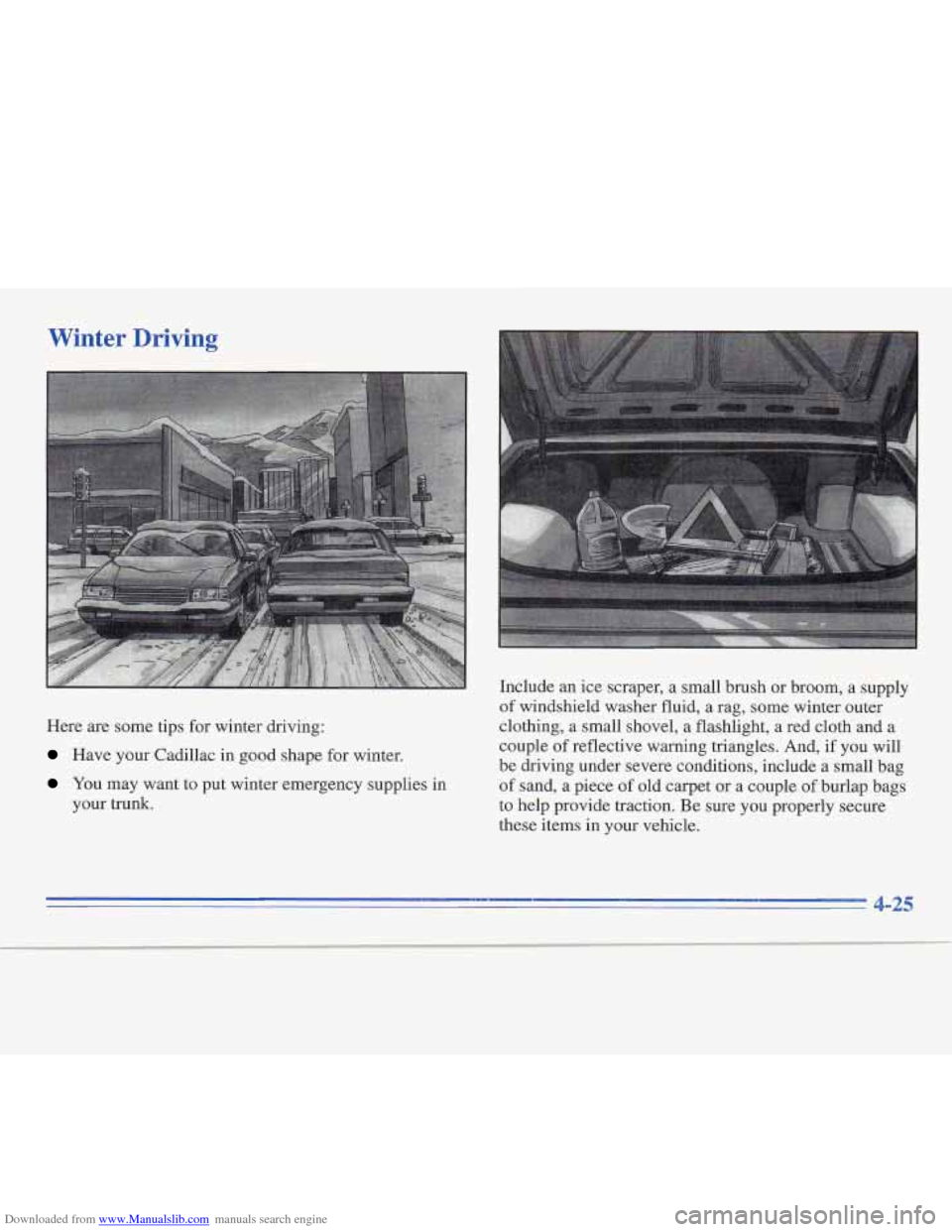
Here are some tips for winter driving:
Have your Cadillac in good shape for winter.
YOU may want to put winter emergency supplies in
your trunk. Include an
ice scraper, a small brush or broom, a supply
of windshield washer fluid, a rag, some winter outer
clothing, a small shovel,
a flashlight, a red cloth and a
couple of reflective warning triangles. And, if
you will
be driving under severe conditions, include a small bag
of sand, a piece of old carpet or a couple of burlap bags
to help provide traction. Be sure you properly secure
these items in your vehicle.
4-25
Page 174 of 306
Downloaded from www.Manualslib.com manuals search engine Run your engine only as long as you must. This saves
fuel. When you run the engine, make it go a little faster
than just idle. That is, push the accelerator slightly. This
uses
less fuel for the heat that you get and it keeps the
battery charged. You will need a well-charged battery to
restart the vehicle, and possibly for signaling later on
with your headlamps. Let the heater
run for awhile.
Then, shut the engine
off and close the window almost
all the way to preserve the heat. Start the engine again
and repeat this only when you feel really uncomfortable
from the cold. But do it as little as possible. Preserve the
fuel as long as you can. To help keep warm, you can get
out of the vehicle and do some fairly vigorous exercises
every half hour or
so until help comes.
Loading Your Vehicle
Fm OCCUPANTS
VEHICLE CAP. WT.
TIRE-LOADING INFORMATION 7
FRT. CTR. RR. TOTAL LBS. KG
MAX. LOADING & GVWR SAME AS VEHICLE
CAPACITY WEIGHT
XXX COLD TIRE
TIRE SIZE SPEED PRESSURE RTG PSVKPa
FRT.
RR.
SPA.
IF TIRES ARE HOT, ADD 4PS1/28KPa
SEE OWNER'S MANUAL FOR ADDITIONAL
INFORMATION
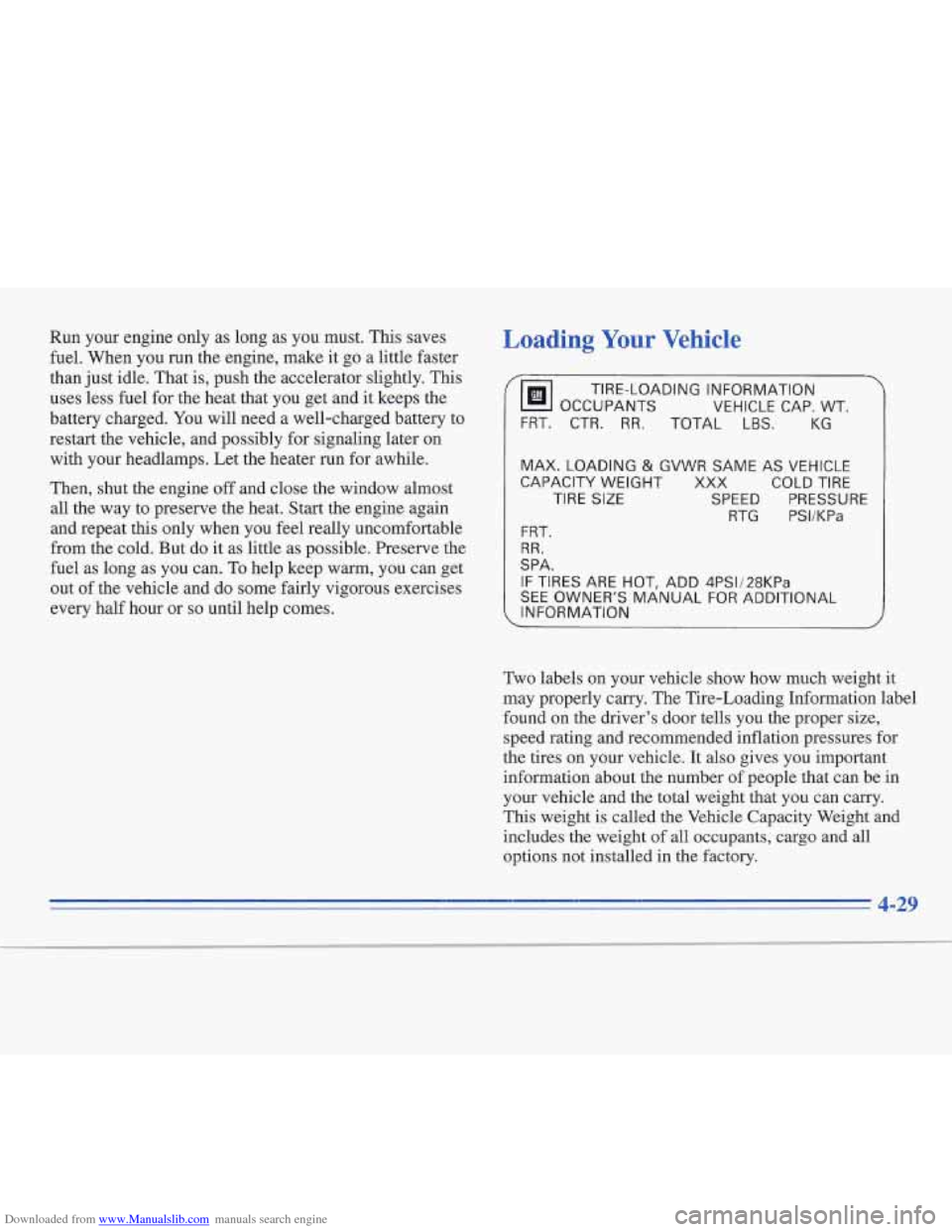
Two labels on your vehicle show how much weight it
may properly carry. The Tire-Loading Information label
found on the driver's door tells you the proper size,
speed rating and recommended inflation pressures
for
the tires on your vehicle. It also gives you important
information about the number
of people that can be in
your vehicle and the total weight that you can carry.
This weight is called the Vehicle Capacity Weight and
includes the weight of all occupants, cargo and all
options not installed
in the factory.
4-29
Page 188 of 306
Downloaded from www.Manualslib.com manuals search engine 1. Check the other vehicle. It must have a 12-volt
battery with a negative ground system.
NOTICE:
If the other system isn’t a 12-volt system with a
negative ground, both vehicles can be damaged.
2. Get the vehicles close enough so the jumper cables
can reach, but be sure the vehicles aren’t touching
each other.
If they are, it could cause a ground
connection you don’t want. You wouldn’t be able to
start your Cadillac, and the bad.grounding could
damage the electrical systems.
You could be injured if the vehicles roll. Set the
parking brake firmly on each vehicle. Shift into
PARK (P).
3. Turn off the ignition on both vehicles. Unplug
unnecessary accessories plugged into the cigarette lighter. Turn off all lamps that aren’t needed as well
as radios. This will avoid sparks and help save both
batteries. In addition, it could save your radio!
NOTICE:
If you leave your radio on, it could be badly
damaged. The repairs wouldn’t be covered by
your warranty.
4. Open the hoods and locate the batteries.
Find the positive
(+) and negative (-) terminals on
each battery.
5-3
Page 209 of 306
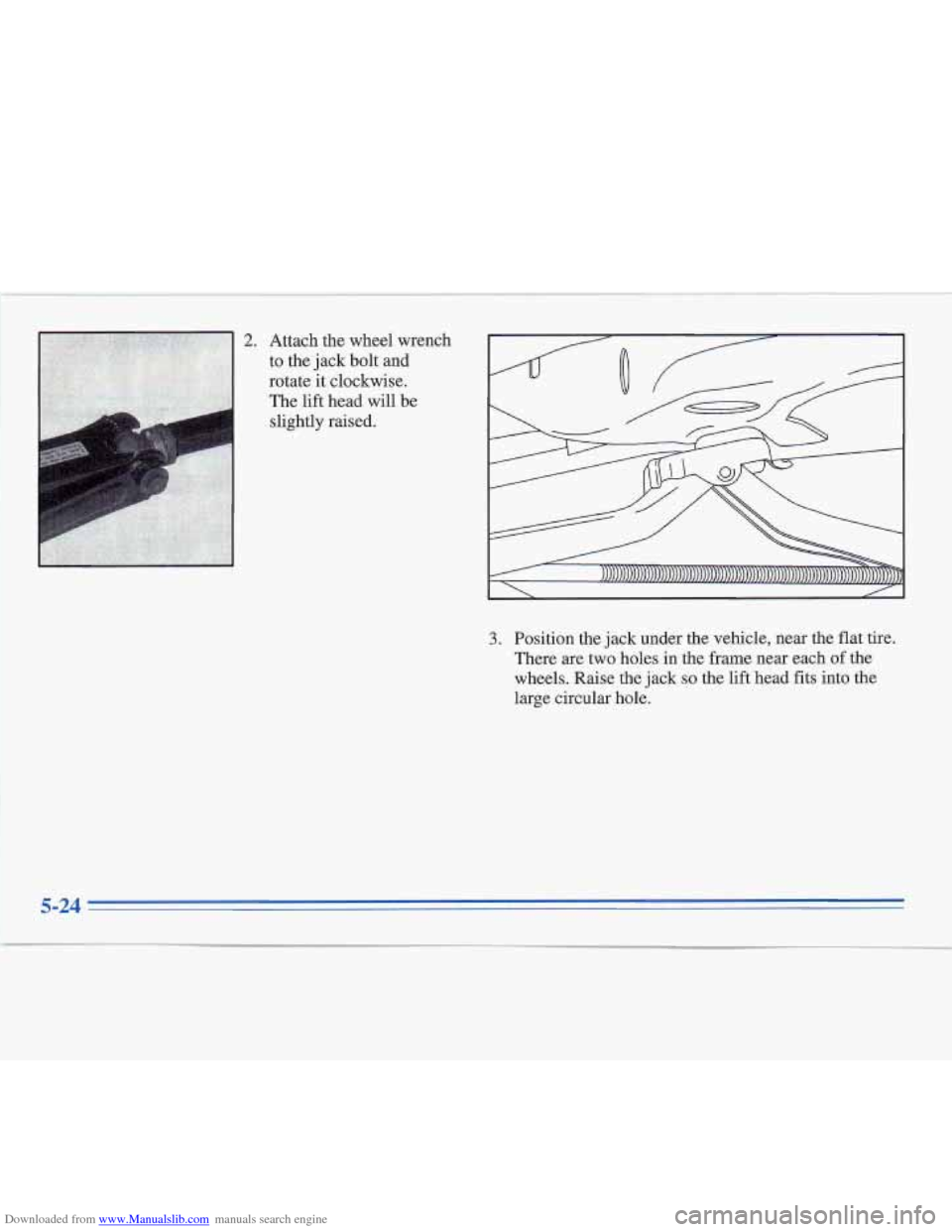
Downloaded from www.Manualslib.com manuals search engine 2. Attach the wheel wrench
to the jack bolt and
rotate it clockwise.
The lift head will be
slightly raised.
3. Position the jack under the vehicle, near the flat tire.
There
are two holes in the frame near each of the
wheels. Raise the jack
so the lift head fits into the
large circular hole.
5-24
Page 215 of 306
Downloaded from www.Manualslib.com manuals search engine 1 Compact Spare Tire (If So Equipped)
Although the compact spare tire was fully inflated when
your vehcle was new, it can lose air after a time. Check
the inflation pressure regularly. It should be
60 psi
(420 Wa).
After installing the compact spare on your vehicle, you
should stop as soon as possible and make sure your
spare tire is correctly inflated. The compact spare is
made to perform well at posted speed limits for
distances up to
3,000 miles (5 000 km), so you can
finish your trip and have your full-size tire repaired
or
replaced where you want. Of course, it’s best to replace
your spare with a full-size tire as soon as you can. Your
spare will last longer and be in good shape in case you
Your anti-lock brake system warning light may come
on
“Anti-Lock Brake System Warning Light” in the Index.
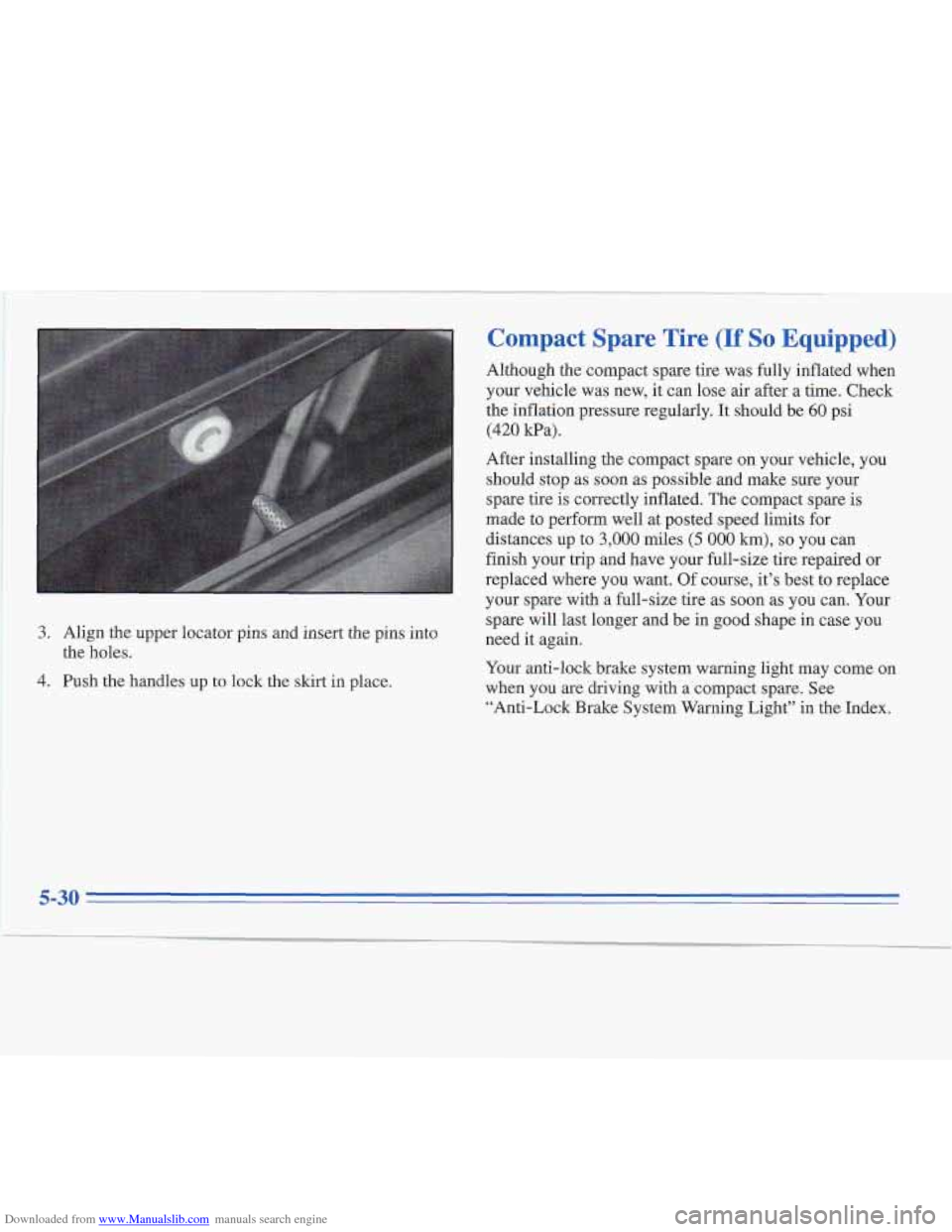
3. Align the upper locator pins and insert the pins into
need it again.
4. Push the handles up to lock the skirt in place.
when you are driving with a compact spare. See
the holes.
5-30
Page 230 of 306
Downloaded from www.Manualslib.com manuals search engine When to Change Engine Oil
Your Cadillac has an Oil Life Indicator. This feature will
let you know when to change your oil and
filter
-- usually between 3,000 miles (5 000 km) and
7,500 miles (12 500 km) since your last oil change.
Under severe conditions, the indicator may come on
before
3,000 miles (5 000 km). Never drive your vehicle
more than
7,500 miles (12 500 km) or 12 months
(whichever occurs first) without an oil change.
The system won’t detect dust in the oil.
So, if you drive
in a dusty area, be sure to change your oil every
3,000 miles (5 000 krn) or sooner if the CHANGE
ENGINE
OIL light comes on. Remember to reset the
Oil Life Indicator when the oil has been changed. For
more information, see “Oil Life Indicator” in the Index.
How to Reset the Oil Life Indicator
After the oil has been changed, you’ll need to reset your
system. To do that, turn the ignition key to the on
position with the engine stopped. Fully push and release
the accelerator pedal
three times within five seconds.
The light should flash two times, then go out if
it is
reset.
If the CHANGE OIL light comes on and stays on
for five seconds,
it did not reset. You:’Uneed to reset the
system again.
What to Do witL Used Oil
Did you know that used engine oil contains certain
elements that may be unhealthy for your skin and could
even cause cancer? Don’t let used oil stay on your skin
for very long. Clean your skin and nails with soap and
water, or a good hand cleaner. Wash or properly throw
away clothing
or rags containing used engine oil. (See
the manufacturer’s warnings about the use and disposal
of oil products.)
Used oil can be a real threat to the environment. If you
change your own oil, be sure to drain all free-flowing oil
from the filter before disposal. Don’t ever dispose of oil
by putting it in the trash, pouring it on the ground, into
sewers, or into streams or bodies of water. Instead,
recycle it by taking
it to a place that collects used oil, If
you have
a problem properly disposing of your used oil,
ask your dealer, a service station or a local recycling
center for help.
Page 237 of 306
Downloaded from www.Manualslib.com manuals search engine Engine Coolant
The cooling system in your vehicle is filled with new
DEX-COOL
TM (orange-colored, silicate-free) engine
coolant.
This coolant is designed to remain in your
vehicle for
5 years or 100,000 miles (166 000 km),
whichever occurs first.
The following explains your cooling system and how to
add coolant when it is low. If you have a problem with
engine overheating, see “Engine Overheating” in
the Index.
A 50/50 mixture of water and the proper coolant for
your Cadillac will:
0
0
0
0
0
Give freezing protection down to -34°F (-37°C).
Give boiling protection up to 265
” F ( 129 O C).
Protect against rust and corrosion.
Help keep the proper engine temperature.
Let the warning lights and gages work as
they should.
6-20
Page 239 of 306
Downloaded from www.Manualslib.com manuals search engine :: ’ 1 ,-
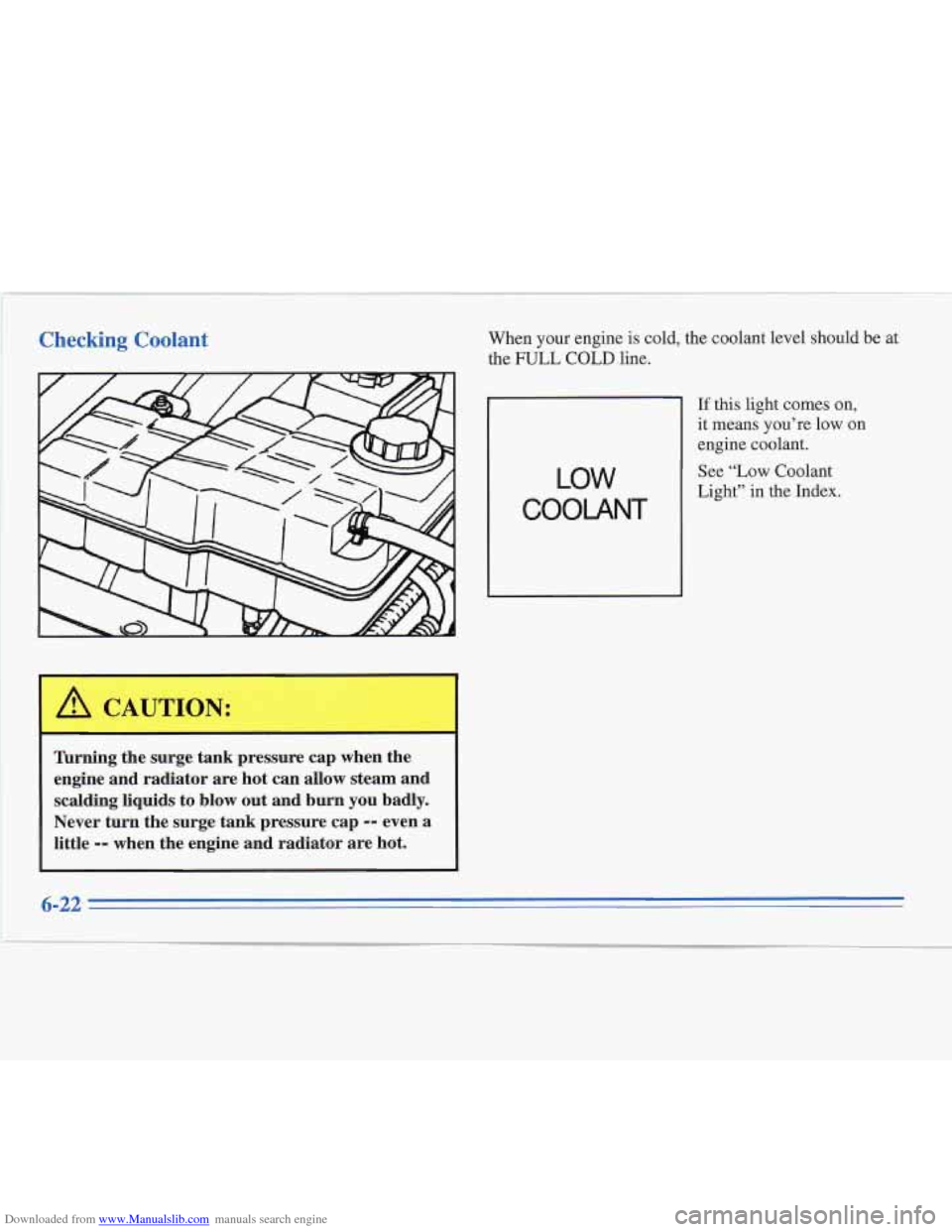
Checking Coolant
Turning the surge t engine and radiator are hot can allow steam and
scalding liquids to blow out and burn you badly.
Never turn the surge tank pressure cap
-- even a
little
-- when the engine and radiator are hot.
LOW
COOLANT
J
If this light comes on,
it means you’re low on
engine coolant.
See “Low Coolant
Light” in the Index.
6-22
Page 246 of 306
Downloaded from www.Manualslib.com manuals search engine Brake Wear
Your Cadillac has fiont disc brakes and rear drum brakes.
Disc brake pads have built-in wear indicators that make a
high-pitched warning sound when
the brake pads are worn
and new pads
are needed. The sound may come and go or
be heard
all the time your vehicle is moving (except when
you are pushing on the brake pedal firrnly).
I A CAUTION:
The brake wear warning sound means that
sooner or later your brakes won’t work well.
That could lead to an accident. When you hear
the brake wear warning sound, have your
vehicle serviced.
I NOTICE:
Continuing to drive with worn-out brake pads
could result in costly brake repair.
Some driving conditions or climates may cause a brake
squeal when the brakes
are first applied or lightly
applied. This does not mean something is wrong with
your brakes.
Free movement of brake calipers and properly torqued
wheel nuts are necessary to help prevent brake
pulsation. When tires are rotated, inspect brake calipers
for movement, brake pads for wear, and evenly torque
wheel nuts
in the proper sequence to GM specifications.
Your rear drum brakes don’t have wear indicators, but if
you ever hear a rear brake rubbing noise, have the rear
brake linings inspected. Also, the rear brake drums
should be removed and inspected each time the tires
are removed for rotation or changing. When you have
the front brakes replaced, have the rear brakes
inspected, too.
Brake linings should always be replaced as complete
axle sets.
6-29
~~