cooling CADILLAC FLEETWOOD 1996 2.G Owners Manual
[x] Cancel search | Manufacturer: CADILLAC, Model Year: 1996, Model line: FLEETWOOD, Model: CADILLAC FLEETWOOD 1996 2.GPages: 306, PDF Size: 15.72 MB
Page 129 of 306
Downloaded from www.Manualslib.com manuals search engine 1
OUT TEMP: Press this to display the outside
temperature. Press it again to return to the regular
system display.
TEMP: This sets the interior temperature you want.
Press the lower portion to lower the inside temperature
setting. Press the upper portion to raise the temperature
setting. Once you set the temperature, the system will
automatically maintain the set temperature.
You can change the temperature from
65 OF (1 8 O C) to
85 OF (29"C), one degree at a time. You may also choose
60 OF ( 16 O C) for maximum cooling or 90 OF (33 O C) for
maximum heating. The fan will stay on high speed
unless you select a different speed. In maximum heating,
most of the air will flow out the heater outlets. In
maximum cooling, the system will recirculate the air
inside your vehicle instead of pulling air from outside.
OFF: This turns off anything set in the ECC, but air will
flow through your Cadillac.
ECON: Use this in cold or cool weather to save fuel. It
won't cool or remove humidity from the air. However,
the system will try to keep the air at the chosen
temperature. If it's
so warm outside that you need to
cool the air, use AUTO.
AUTO: With this setting, the system automatically
controls the temperature, air distribution and fan
speeds. In cold conditions, the fan will not come on
until the system senses that the engine has started to warrn up. This prevents cold air from blowing on you
and your passengers.
FAN: The fan speed is controlled automatically if
you have the ECC set
on AUTO. However, if you want
the fan to run at a lower speed, press the lower portion
of the fan switch.
If you want the blower to run at a fixed higher speed,
press the upper portion
of the fan switch until you see
HI on the display.
If you want the fan to run at a fixed low speed, press the
switch until
LO is shown on the display.
If you want the fan speed to be automatic but you like
the fan to be higher or lower than the AUTO settings,
just press the switch until either HI AUTO or AUTO
LO
is displayed.
If the Fahrenheit
(F") or Celsius (C")
flash, or flashes when you turn
on the symbol begins to
ignition, it
indicates an electrical problem with your air
conditioning system. The flashing will continue for
about two minutes. It means you should have your
system serviced.
Page 185 of 306
Downloaded from www.Manualslib.com manuals search engine ’men You Are Ready to Leave After
Parking on a Hill
1. Apply your regular brakes and hold the pedal down
while you:
Start your engine;
Shift into a gear; and
Be sure the parking brake has released.
2. Let up on the brake pedal.
3. Drive slowly until the trailer is clear of the chocks.
4. Stop and have someone pick up and store the chocks.
Engine Cooling When Trailering
Your cooling system may temporarily overheat during
severe operating conditions such as:
Climbing grades steeper than four percent at
temperatures above
90°F (32°C) with a loaded
vehicle and trailer.
Stopping after high-speed driving.
Idling for long periods in stop-and-go traffic.
Maintenance When Trailer Towing
Your vehicle will need service more often when you’re
pulling a trailer. See the Maintenance Schedule for more
on this. Things that
are especially important in trailer
operation are automatic transmission fluid (don’t
overfill), engine oil, axle lubricant, belt, cooling system and brake adjustment. Each of these is covered in this
manual, and the Index will help you find them quickly.
If you’re trailering, it’s a good idea to review these
sections before
you start your trip.
Check periodically to see that all hitch nuts and bolts
are tight.
4-40
Page 200 of 306
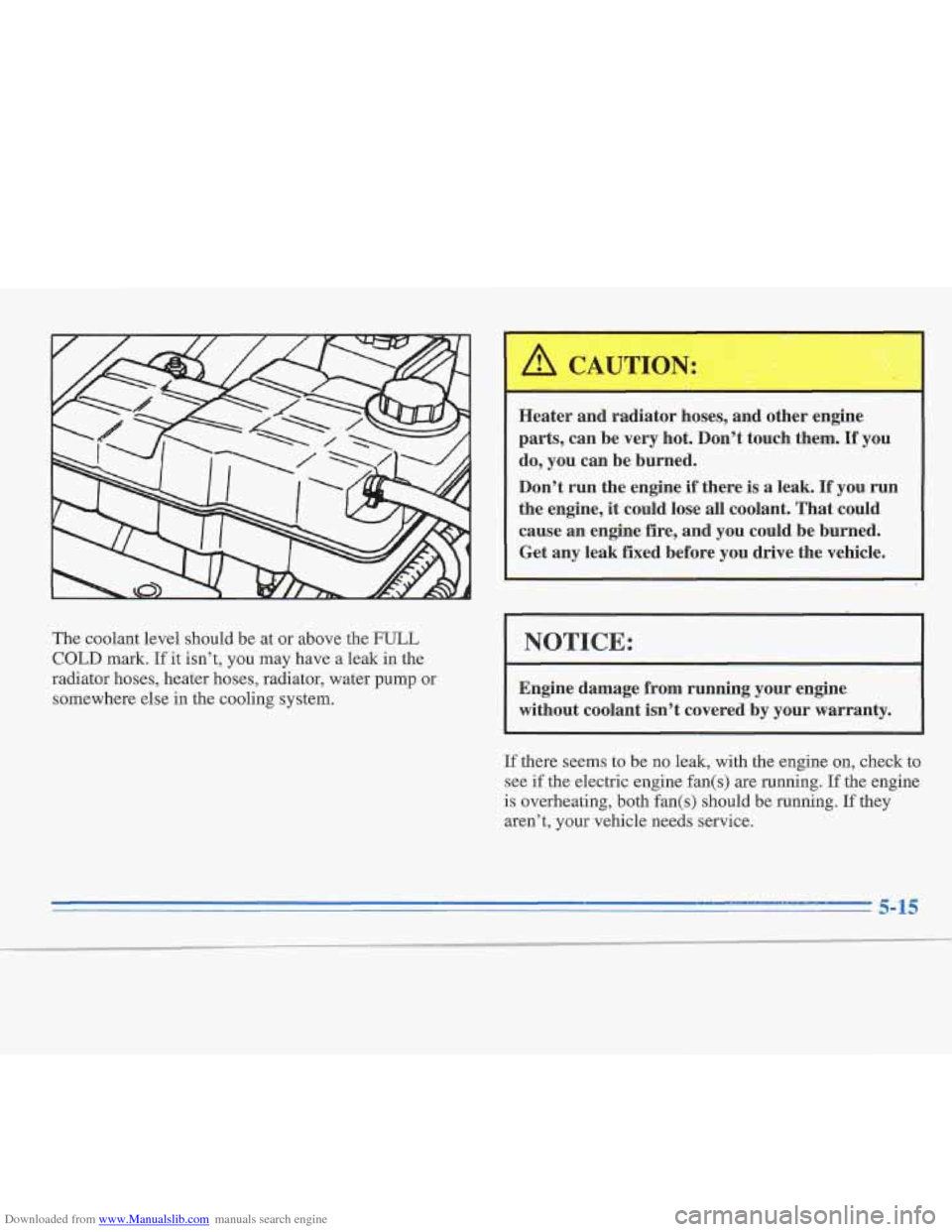
Downloaded from www.Manualslib.com manuals search engine The coolant level should be at or above the FULL
COLD mark. If it isn’t, you may have a leak in the
radiator hoses, heater hoses, radiator, water pump or
somewhere else in the cooling system.
I/“. CArnQ!y: ,;~:!
$21 >p ,”/’
_,J’ =
Heater and radiator hoses, and other engine
parts, can be very hot. Don’t touch them.
If you
do, you can be burned.
Don’t run the engine if there is a leak. If you run
the engine, it could lose all coolant. That could
cause an engine fire, and you could be burned.
Get any leak fixed before you drive the vehicle.
I NOTICE: I
Engine damage from running your engine
without coolant isn’t covered by your warranty.
If there seems to be no leak, with the engine on, check to
see if the electric engine fan(s) are running. If the engine
is overheating, both fan(s) should be running.
If they
aren’t, your vehicle needs service.
Page 201 of 306
Downloaded from www.Manualslib.com manuals search engine How to Add Coolant to the Coolant Surge
Tank
If you haven’t found a problem yet, but the coolant level
isn’t at the
FULL COLD mark, add a 50/50 mixture of
clean water (preferably distilled) and DEX-COOL TM
antifreeze at the coolant surge tank, but be sure the
cooling system, including the coolant surge tank
pressure cap, is cool before you do it. (See “Engine
Coolant”
in the Index for more information.)
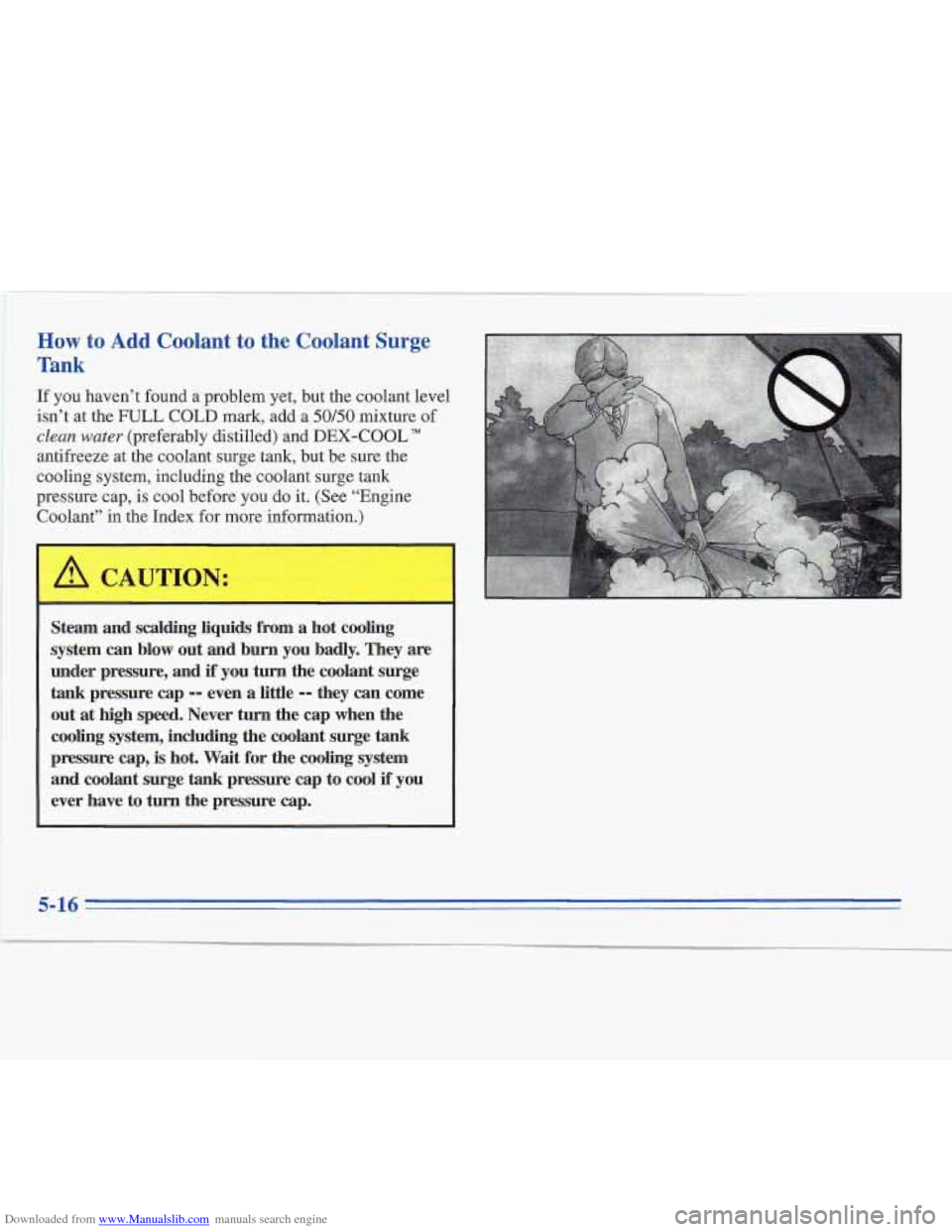
Steam and scalding liquids from a hot cooling
system
can blow out and burn you badly. They are
under pressure, and if you turn the coolant surge
tank pressure cap -- even a little -- they can come
out
at high speed. Never turn the cap when the
cooling system, including the coolant surge
tank
pressure cap, is hot. Wait for the cooling system
and coolant surge
tank pressure cap to cool if you
ever have to
turn the pressure cap.
5-16
Page 202 of 306
Downloaded from www.Manualslib.com manuals search engine A I
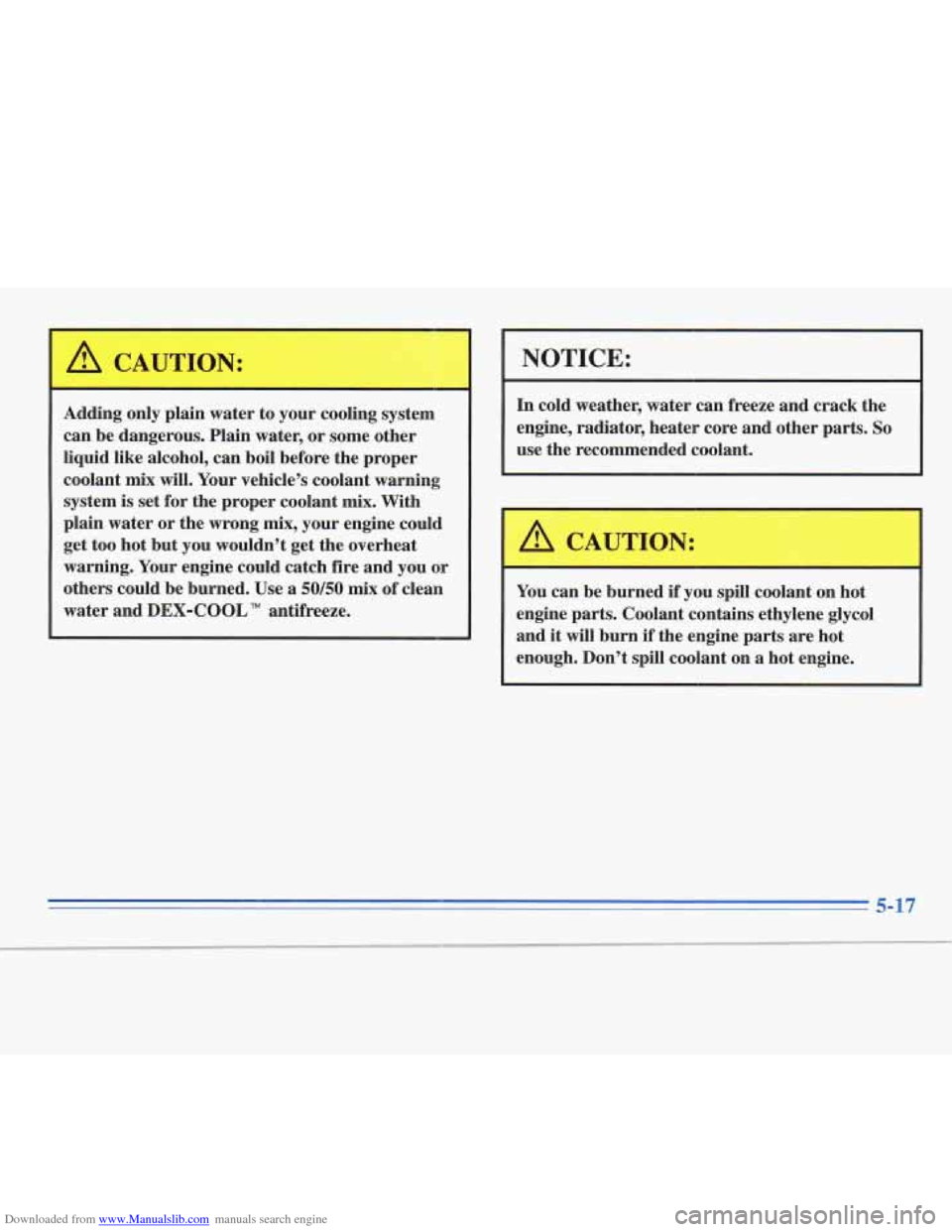
k!!!L CAUTION:
Adding only plain water to your cooling system
can be dangerous. Plain water, or some other
liquid like alcohol, can boil before the proper
coolant mix will. Your vehicle’s coolant warning
system is set for the proper coolant mix. With
plain water or the wrong mix, your engine could
get too hot but you wouldn’t get the overheat
warning. Your engine could catch fire and you or
others could be burned. Use a
50/50 mix of clean
water and DEX-COOL antifreeze.
NOTICE:
In cold weather, water can freeze and crack the
engine, radiator, heater core and other parts.
So
use the recommended coolant.
A CAUTION:
You can be burned if you spill coolant on hot
engine parts. Coolant contains ethylene glycol
and
it will burn if the engine parts are hot
enough. Don’t spill coolant on a hot engine.
Page 203 of 306
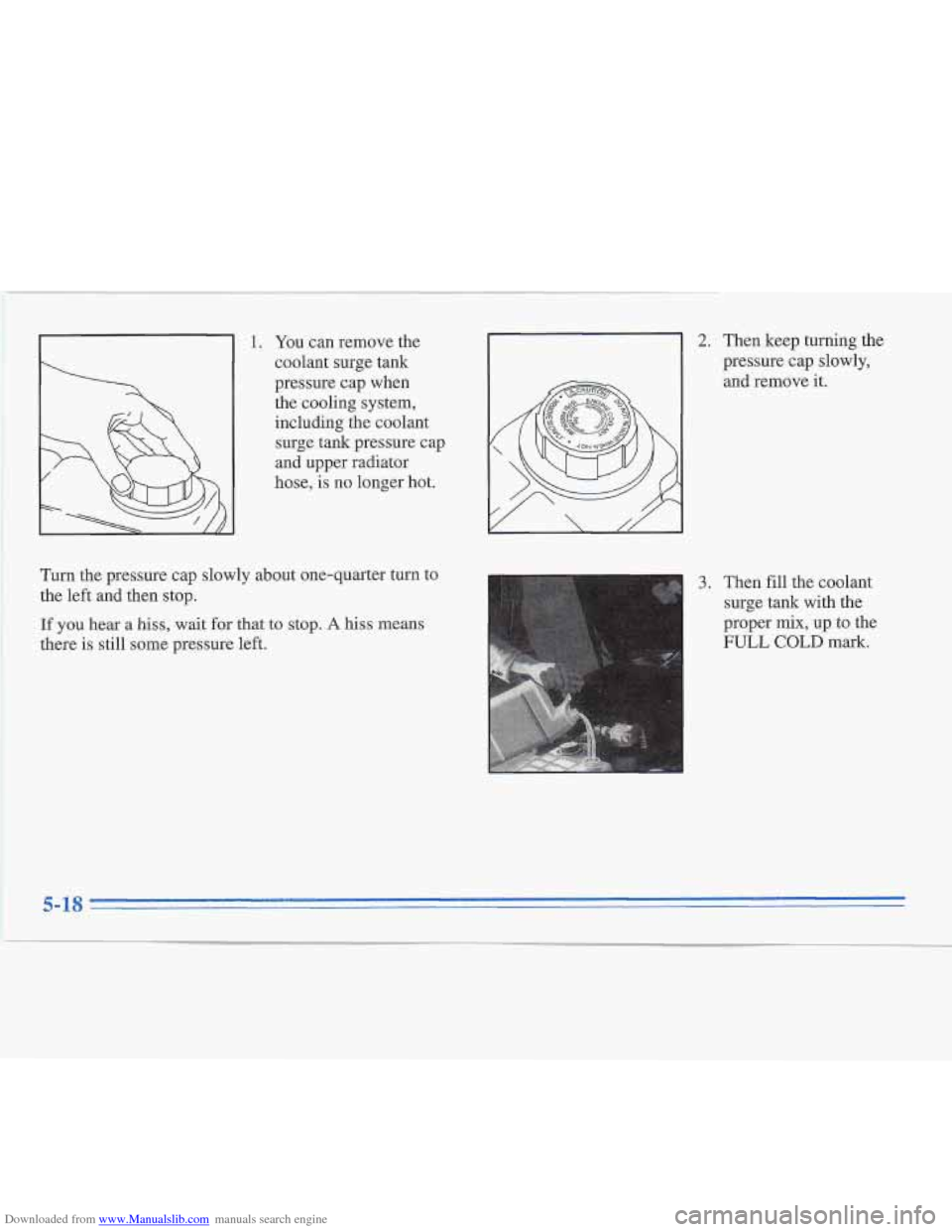
Downloaded from www.Manualslib.com manuals search engine 1. You can remove the
coolant surge tank
pressure cap when
the cooling system,
including the coolant surge tank pressure cap
and upper radiator
hose, is no longer hot.
urn t' Turn the pressure cap slowly about one-quarter ti
the left and then stop.
If you hear a hiss, wait for that to stop. A hiss means
there is still some pressure left.
0
2. Then keep turning the
pressure cap slowly,
and remove it.
3. Then fill the coolant
surge tank with the
proper
mix, up to the
FULL COLD mark.
5-18
n I
Page 237 of 306
Downloaded from www.Manualslib.com manuals search engine Engine Coolant
The cooling system in your vehicle is filled with new
DEX-COOL
TM (orange-colored, silicate-free) engine
coolant.
This coolant is designed to remain in your
vehicle for
5 years or 100,000 miles (166 000 km),
whichever occurs first.
The following explains your cooling system and how to
add coolant when it is low. If you have a problem with
engine overheating, see “Engine Overheating” in
the Index.
A 50/50 mixture of water and the proper coolant for
your Cadillac will:
0
0
0
0
0
Give freezing protection down to -34°F (-37°C).
Give boiling protection up to 265
” F ( 129 O C).
Protect against rust and corrosion.
Help keep the proper engine temperature.
Let the warning lights and gages work as
they should.
6-20
Page 238 of 306
Downloaded from www.Manualslib.com manuals search engine What to Use
Use a mixture of one-half clean water (preferably
distilled) and one-half DEX-COOL
TM (orange-colored,
silicate-free) antifreeze that meets GM
Specification 6277M, which won’t damage aluminum
parts. Use GM Engine Coolant Supplement (sealer)
(GM
Part No. 3634621) with any complete coolant
change.
If you use this mixture, you don’t need to add
anything else.
I-
Adding only plain water to your cooling system
can be dangerous. Plain water, or some other
liquid like alcohol, can boil before the proper
coolant mix will. Your vehicle’s coolant warning
system is set for the proper coolant mix. With
plain water or the wrong
mix, your engine could
get too hot but you wouldn’t get the overheat
warning. Your engine could catch fire and you or
others could be burned. Use
a 50/50 mix of clean
water and
DEX-COOL TM (orange-colored,
silicate-free) antifreeze.
NOTICE:
If you use an improper coolant mix, your engine
could overheat and be badly damaged. The
repair cost wouldn’t be covered by your
warranty. Too much water in the
mix can freeze
and crack the engine, radiator, heater core and
other parts.
If you have to add coolant more than four times a year,
have your dealer check your cooling system.
1
NOTICE:
If you use the proper coolant, you don’t have to
add extra inhibitors or additives which claim to
improve the system. These can be harmful.
Page 263 of 306
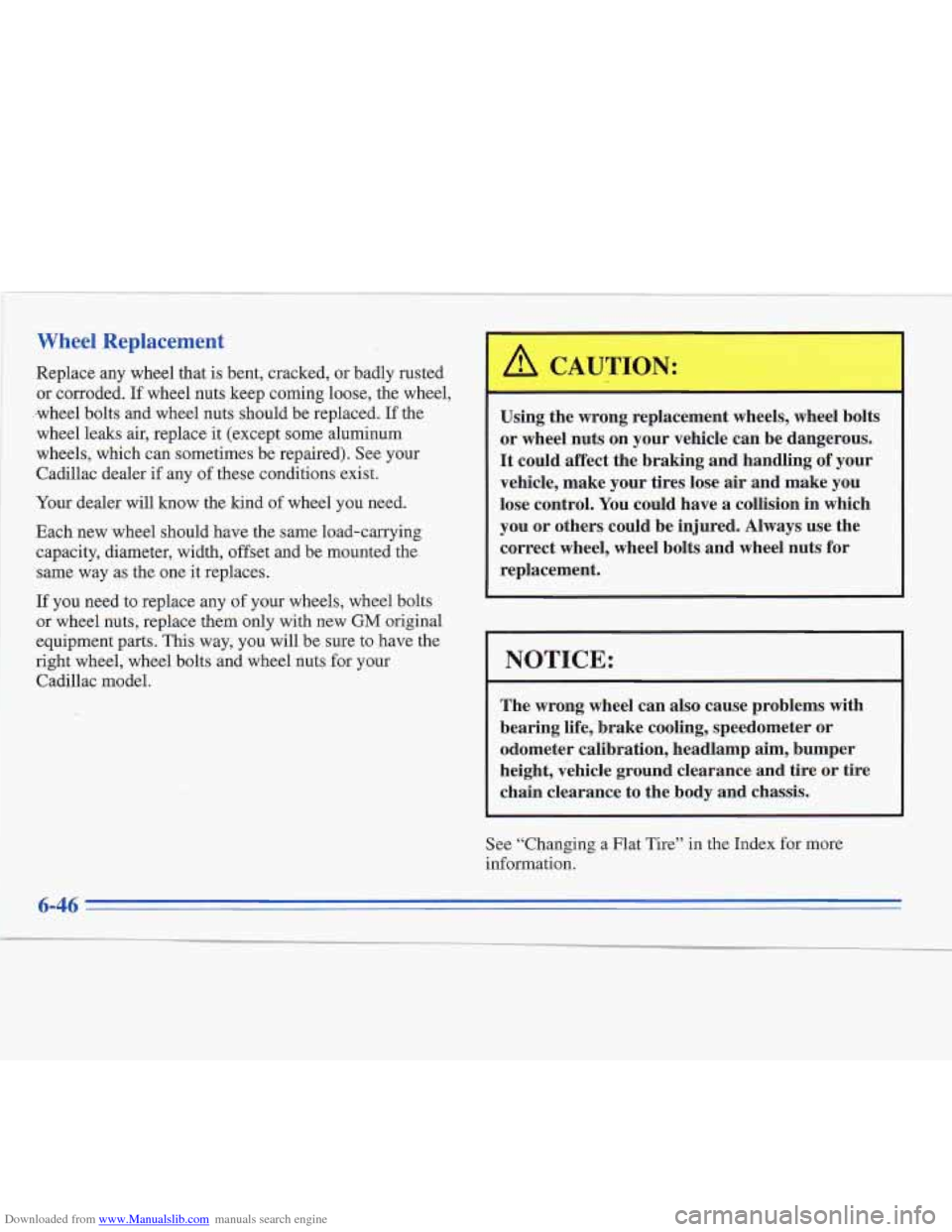
Downloaded from www.Manualslib.com manuals search engine Wheel Replacement
Replace any wheel that is bent, cracked, or badly rusted
or corroded.
If wheel nuts keep coming loose, the wheel,
-wheel bolts and wheel nuts should be replaced.
If the
wheel
leaks air, replace it (except some aluminum
wheels, which can sometimes be repaired). See your
Cadillac dealer if any
of these conditions exist.
Your dealer will know the kind
of wheel you need.
Each new.whee1 should have the same load-carrying
capacity, diameter, width, offset and be mounted the
same way as the one it replaces.
If you need to replace any of your wheels, wheel bolts
or wheel nuts, replace them only with new
GM original
equipment parts. This way, you will be sure to h.ave the
right wheel, wheel bolts and wheel nuts for your
Cadillac model.
Using the wrong replacement w
or wheel nuts on your vehicle can be dangerous.
It could affect the braking and handling of your
vehicle, make your tires lose
air and make you
lose control. You could have
a collision in which
you or others could be injured. Always use the
correct wheel, wheel bolts and wheel nuts for
replacement.
NOTICE:
The wrong wheel can also cause problems with
bearing life, brake cooling, speedometer or
odometer calibration, headlamp aim, bumper
height, vehicle ground clearance and tire or tire
chain clearance to the body and chassis.
See “Changing a Flat Tire” in the Index for more
information.
6-46
Page 277 of 306
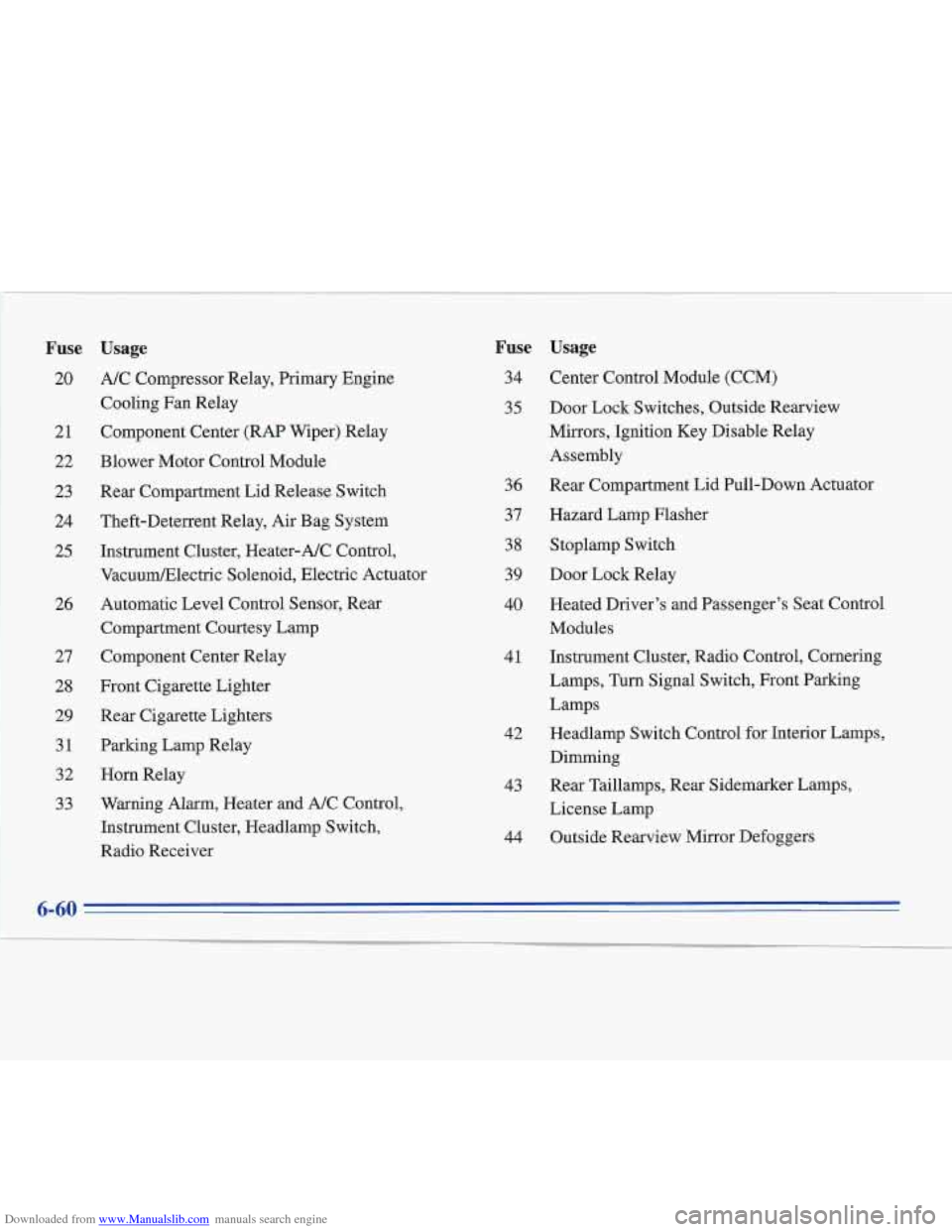
Downloaded from www.Manualslib.com manuals search engine Fuse
20
21
22
23
24 25
26
27
28 29
31 32
33
Usage
A/C Compressor Relay, Primary Engine
Cooling Fan Relay
Component Center (RAP Wiper) Relay
Fuse
34
35
Blower Motor Control Module
Rear Compartment Lid Release Switch
Theft-Deterrent Relay, Air Bag System
Instrument Cluster, Heater-A/C Control,
VacuundElectric Solenoid, Electric Actuator
Automatic Level Control Sensor, Rear
Compartment Courtesy Lamp
Component Center Relay
Front Cigarette Lighter
Rear Cigarette Lighters
Parking Lamp Relay
Horn Relay
Warning Alarm, Heater and A/C Control,
Instrument Cluster, Headlamp Switch, Radio Receiver
36
37
38
39
40
41
42
43
44
Usage
Center Control Module (CCM)
Door Lock Switches, Outside Rearview
Mirrors, Ignition Key Disable Relay
Assembly
Rear Compartment Lid Pull-Down Actuator
Hazard Lamp Flasher
Stoplamp Switch
Door Lock Relay
Heated Driver’s and Passenger’s Seat Control
Modules
Instrument Cluster, Radio Control, Cornering
Lamps, Turn Signal Switch, Front Parking
Lamps
Headlamp Switch Control for Interior Lamps,
Dimming
Rear Taillamps, Rear Sidemarker Lamps,
License Lamp
Outside Rearview Mirror Defoggers
6-60
~
~ r