oil CADILLAC SEVILLE 1993 4.G User Guide
[x] Cancel search | Manufacturer: CADILLAC, Model Year: 1993, Model line: SEVILLE, Model: CADILLAC SEVILLE 1993 4.GPages: 407, PDF Size: 22.28 MB
Page 215 of 407
Downloaded from www.Manualslib.com manuals search engine time and flash your brake lights (in addition to your turn signal) as extra
warning that you are about to slow down and exit.
The exit ramp can be curved, sometimes quite sharply.
The exit speed is usually posted. Reduce your speed according
to your
speedometer, not to your sense
of motion. After driving for any distance
at higher speeds, you may tend to think you are going slower than you
actually are. For example,
40 mph (65 km/h) might seem like only 20 mph
(30 km/h). Obviously, this could lead to serious trouble on a ramp
designed for
20 mph (30 km/h)!
DMNG A LONG DISTANCE
Although most long trips today are made on freeways, there are still
many made
on regular highways.
Long-distance driving on freeways and regular highways is the same
in
some ways. The trip has to be planned and the vehicle prepared, you
drive at higher-than-city speeds, and there are longer turns behind
the
wheel. You’ll enjoy your trip more if you and your vehicle are in good
shape. Here are some tips for a successful long trip.
BEFORE LEAWNG ONA LONG THP
Make sure you’re ready. Try to be well rested. If you must start when
you’re not fresh
-- such as after a day’s work -- don’t plan to make too
many miles that first part of
the journey. Wear comfortable clothing and
shoes
you can easily drive in.
Is your vehicle ready for a long trip? If you keep it serviced and
maintained, it’s ready to
go. If it needs service, have it done before
starting out. Of course, you’ll find experienced and able service experts
in
Cadillac dealerships all across North America. They’ll be ready and
willing to help
if you need it.
Here are some things
you can check before a trip:
Windshield Washer Fluid: Is the reservoir full? Are all windows clean
inside and outside?
Wiper Blades: Are they in good shape?
0 Fuel. Enpine Oil. Other Fluids: Have you checked all levels?
201
Page 233 of 407
Downloaded from www.Manualslib.com manuals search engine Maintenance when Trailer Towing
Your vehicle will need service more often when you’re pulling a trailer.
See the Maintenance Schedule for more on this. Things that are
especially important
in trailer operation are automatic transaxle fluid
(don’t overfill), engine oil, axle lubricant, belts, cooling system, and brake
adjustment. Each
of these is covered in this manual, and the Index will
help you find them quickly. If you’re trailering, it’s a good idea to review
these sections before you start your trip.
Check periodically to see that all hitch nuts and bolts are tight.
219
Page 249 of 407
Downloaded from www.Manualslib.com manuals search engine COOLING SYSTEM - 4.9 LITER
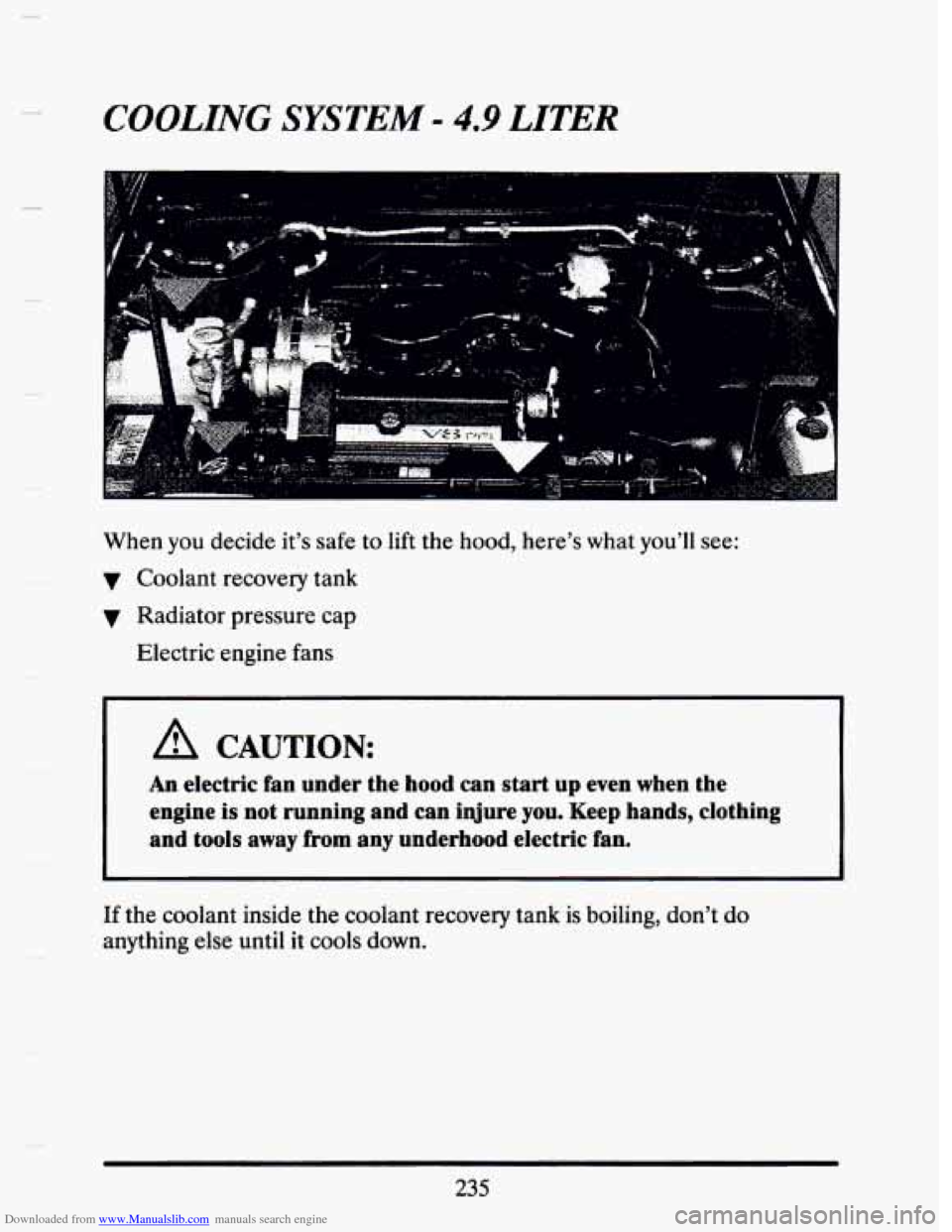
When you decide it's safe to lift the hood, here's what you'll see:
v Coolant recovery tank
v Radiator pressure cap
Electric engine fans
1 A CAUTION:
An electric fan under the hood can start up even when the
engine is not running and can injure you,
Keep hands, clothing
and
tools away from any underhood electric fan,
If the coolant inside the coolant recovery tank is boiling, don't do
anything else until
it cools down.
235
Page 251 of 407
Downloaded from www.Manualslib.com manuals search engine L ..
r-
r
r
t
How to Add Coolant to the Coolant Recovery Tank
If you haven’t found a problem yet, but the coolant level isn’t at or above
“FULL COLD,” add a 50/50 mixture of clean water (preferably distilled)
and
a proper antifreeze at the coolant recovery tank. (See “Engine
Coolant” in the Index for more information about the proper coolant
mix.)
A CAUTION
Adding only plain water to your cooling system can be
dangerous. Plain water, or some other liquid like alcohol, can
boil before the proper coolant
mix will. Your vehicle’s coolant
warning system is set for the proper coolant
mix. With plain
I water or the wrong mix, your engine could get too hot but you
~ wouldn’t get the overheat warning. Your engine could catch fire
~ and you or others could be burned. Use a 50/50 mix of clean
~ water and a proper antifreeze.
r
r 237
Page 258 of 407
Downloaded from www.Manualslib.com manuals search engine I A CAUTION
An electric fan under the hood can start up even when the
engine
is not running and can injure you. Keep hands, clothing
and tools
away from any underhood electric fan.
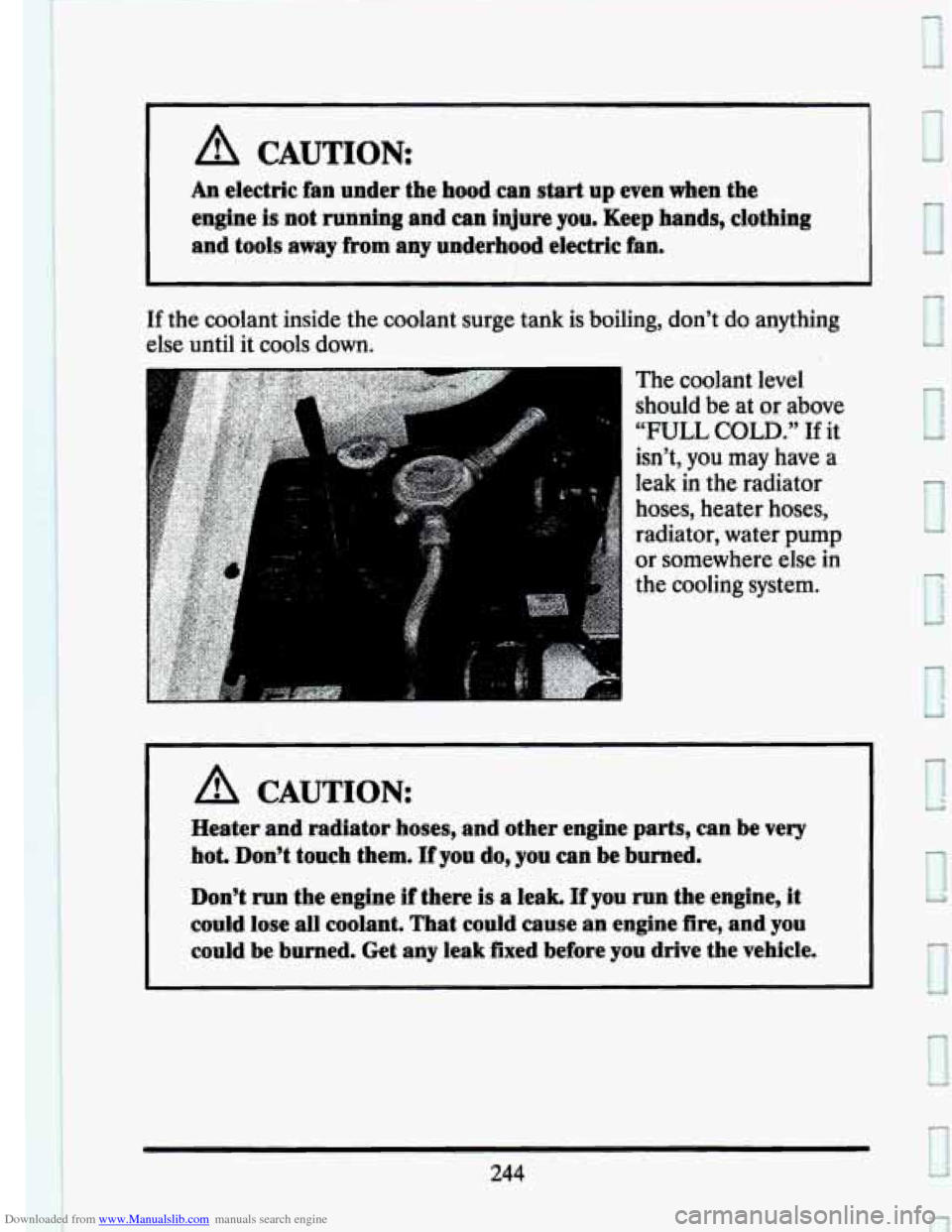
If the coolant inside the coolant surge tank is boiling, don’t do anything
else until it cools
down.
The coolant level
should be at or above
“FULL COLD.” If it
isn’t,
you may have a
leak in the radiator
hoses, heater hoses,
radiator, water pump
or somewhere else in
the cooling
system.
A CAUTION:
Heater and radiator hoses, and other engine parts, can be very
hot. Don’t touch them.
If you do, you can be burned.
Don’t
run the engine if there is a leak If you run the engine, it
could lose
all coolant. That could cause an engine fire, and you
could be burned. Get any leak fixed before you drive the vehicle.
244
Page 259 of 407
Downloaded from www.Manualslib.com manuals search engine ...-
c
If there seems to be no leak, check to see if the electric engine fans are
running. If the engine
is overheating, both fans should be running. If they
aren’t, your vehicle needs service.
How to Add Coolant to the Coolant Surge Tank
If you haven’t found a problem yet, but the coolant level isn’t at or above
“FULL COLD,” add a 50/50 mixture of clean water (preferably distilled)
and a proper antifreeze at
the coolant recovery tank. (See “Engine
Coolant”
in the Index for more information about the proper coolant
mix.)
A CAUTION
Adding only plain water to your cooling system can De
dangerous. Plain water, or some other liquid like alcohol, can
boil before the proper coolant mix will.
Your vehicle’s coolant
warning system is set
for the proper coolant mix. With plain
water
or the wrong mix, your engine could get too hot but you
wouldn’t get the overheat warning. Your engine could catch fire
and you or others could be burned. Use a
50/50 mix of clean
water and
a proper antifreeze.
245
Page 270 of 407
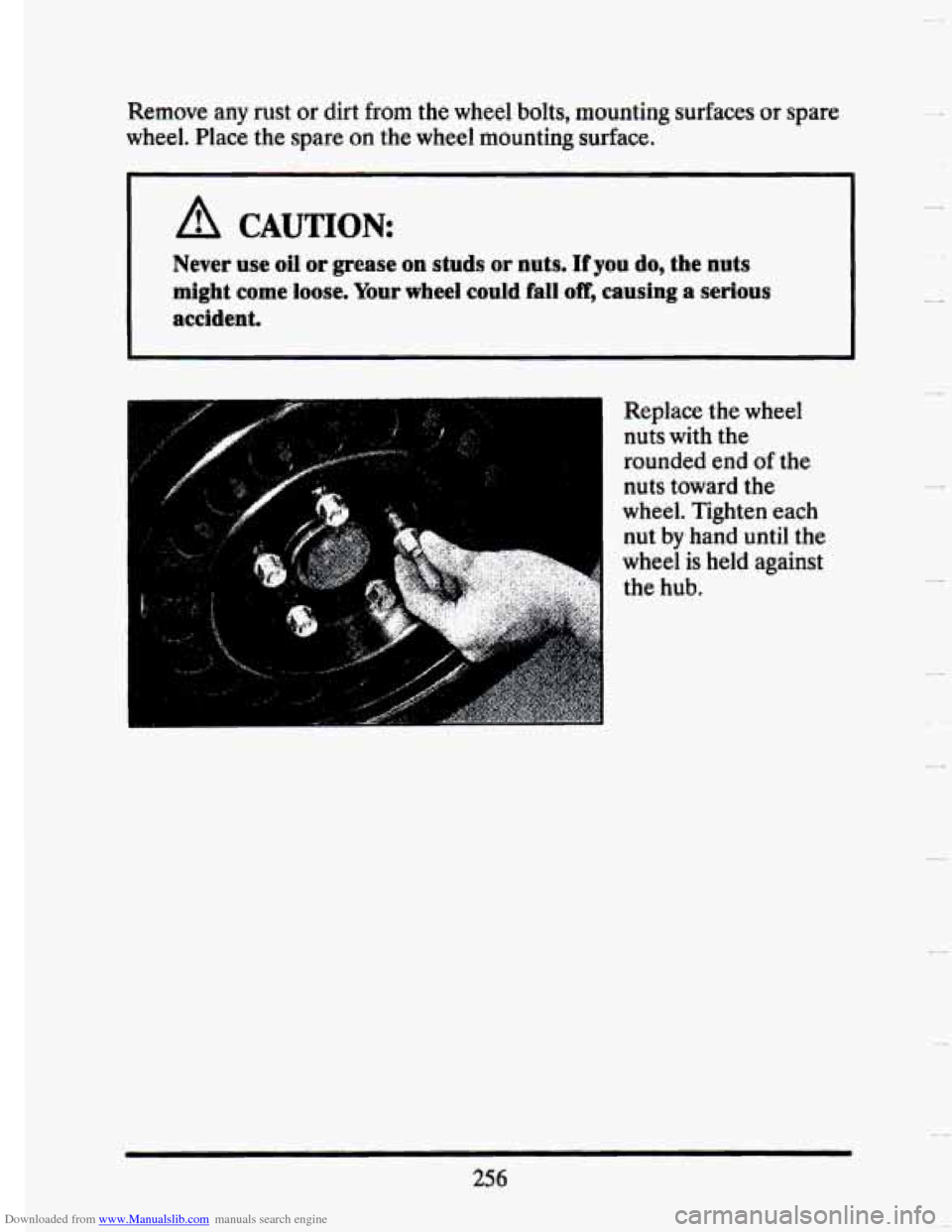
Downloaded from www.Manualslib.com manuals search engine Remove any rust or dirt from the wheel bolts, mounting surfaces or spare
wheel. Place the spare
on the wheel mounting surface.
A CAUTION
Never use oil or grease on studs or nuts. If you do, the nuts
might come loose. Your wheel could fall
off, causing a serious
accident.
Replace the wheel
nuts with the
rounded end
of the
nuts toward the
wheel. Tighten each
nut
by hand until the
256
Page 278 of 407
Downloaded from www.Manualslib.com manuals search engine FUELS IN FOREIGN COUNTMES
If you plan on driving in another country outside the U.S. or Canada,
unleaded fuel may be hard to find.
Do not use leaded gasoline. If you use
even one tankful, your
emission controls won't work well or at all. With
continuous use, spark plugs can get fouled, the exhaust system can
4. $8. corrode, and your engine oil can deteriorate quickly. Your vehicle's
" oxygen sensor will be damaged. All of that means costly repairs that
wouldn't be covered by your warranty.
To check on fuel availability, ask an auto club, or contact a major oil
company that does business
in the country where you'll be driving.
You can also write us at the following address for advice. Just tell us
where you're going and give your Vehicle Identification Number (VIN).
General Motors
of Canada Ltd.
International Export Sales
PO. Box 828
Oshawa, Ontario L1H 7N1, Canada
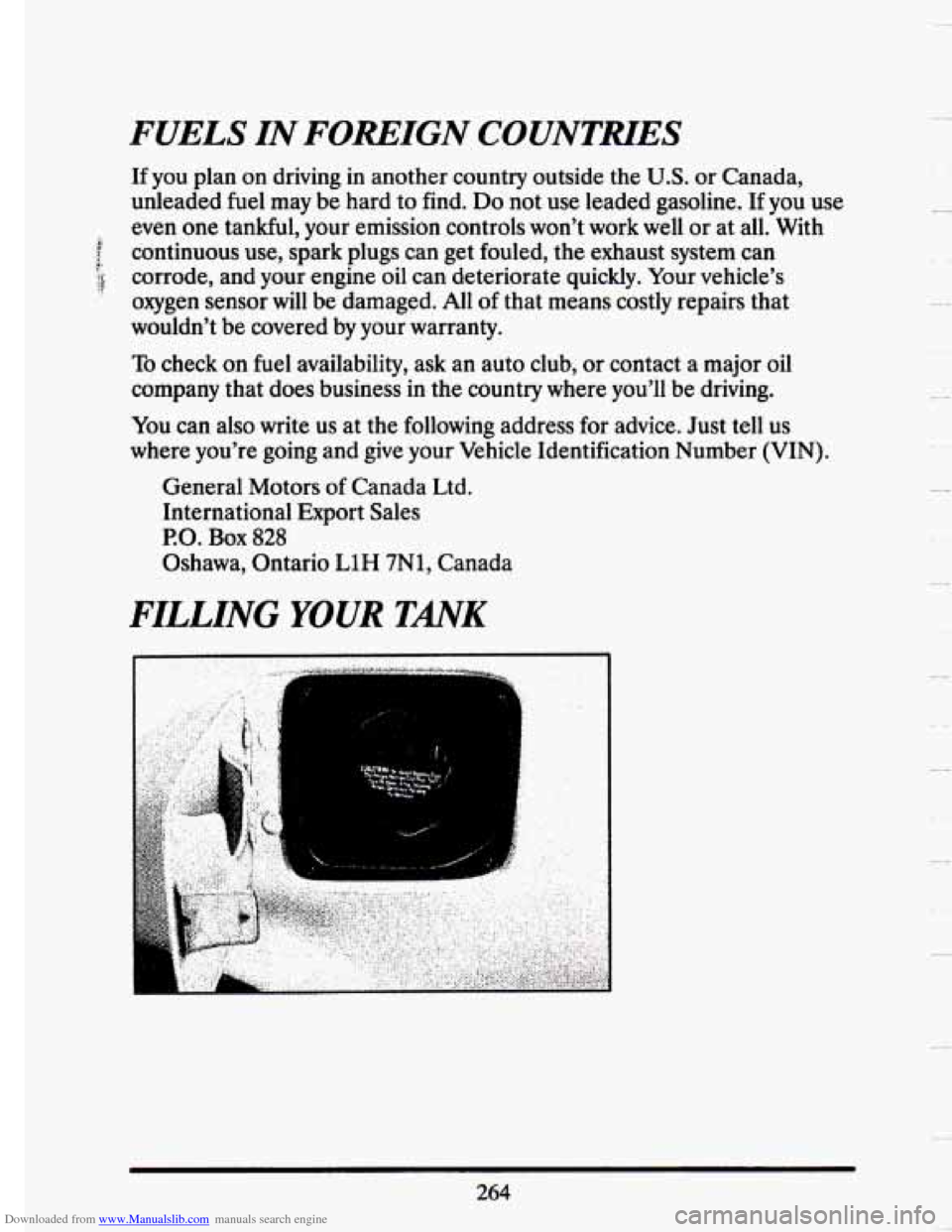
FILLING YOUR TANK
264
c
Page 283 of 407
Downloaded from www.Manualslib.com manuals search engine ENGINE OIL
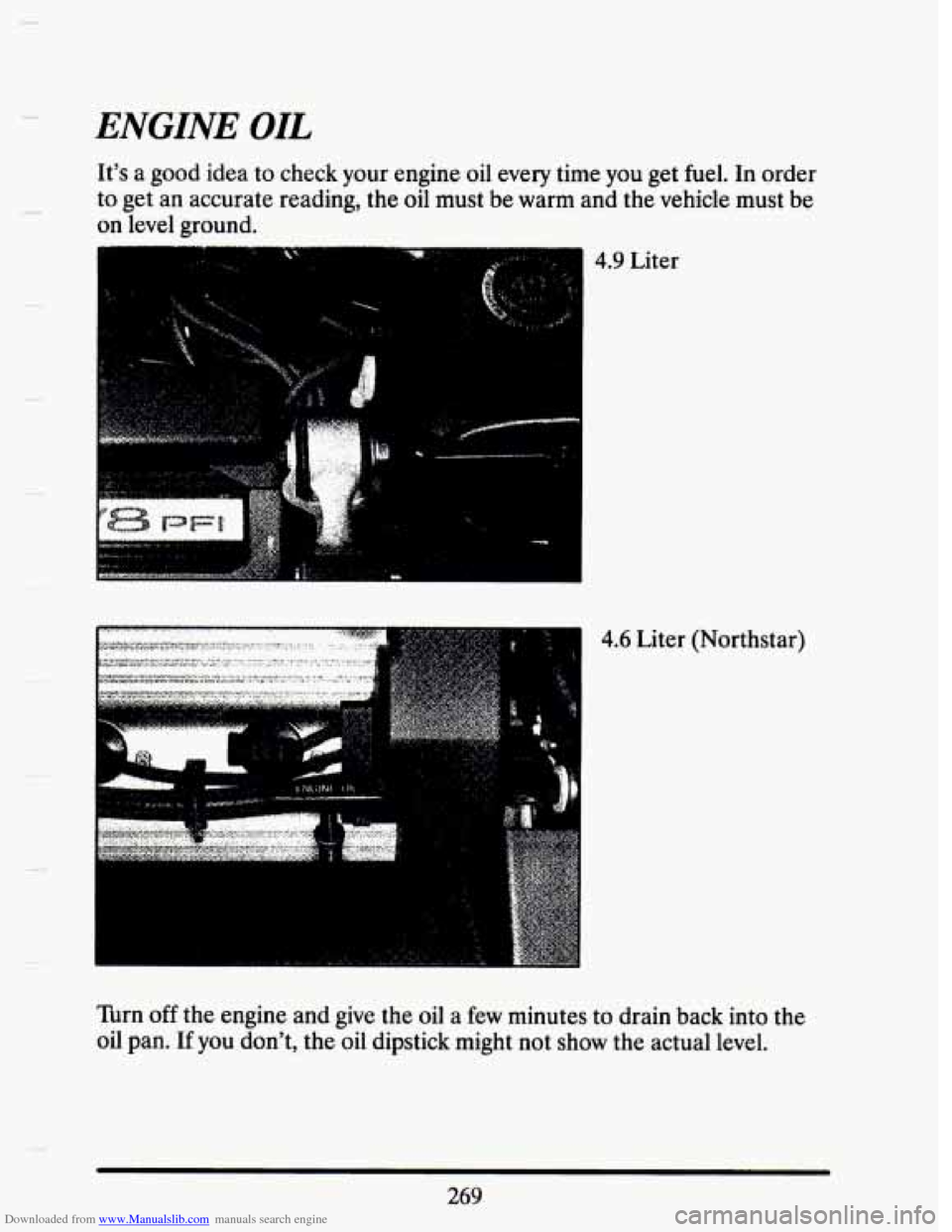
It’s a good idea to check your engine oil every time you get fuel. In order
to get an accurate reading,
the oil must be warm and the vehicle must be
on level ground.
..
4.9 Liter
4.6 Liter (Northstar)
Turn
off the engine and give the oil a few minutes to drain back into the
oil pan. If
you don’t, the oil dipstick might not show the actual level.
269
Page 284 of 407
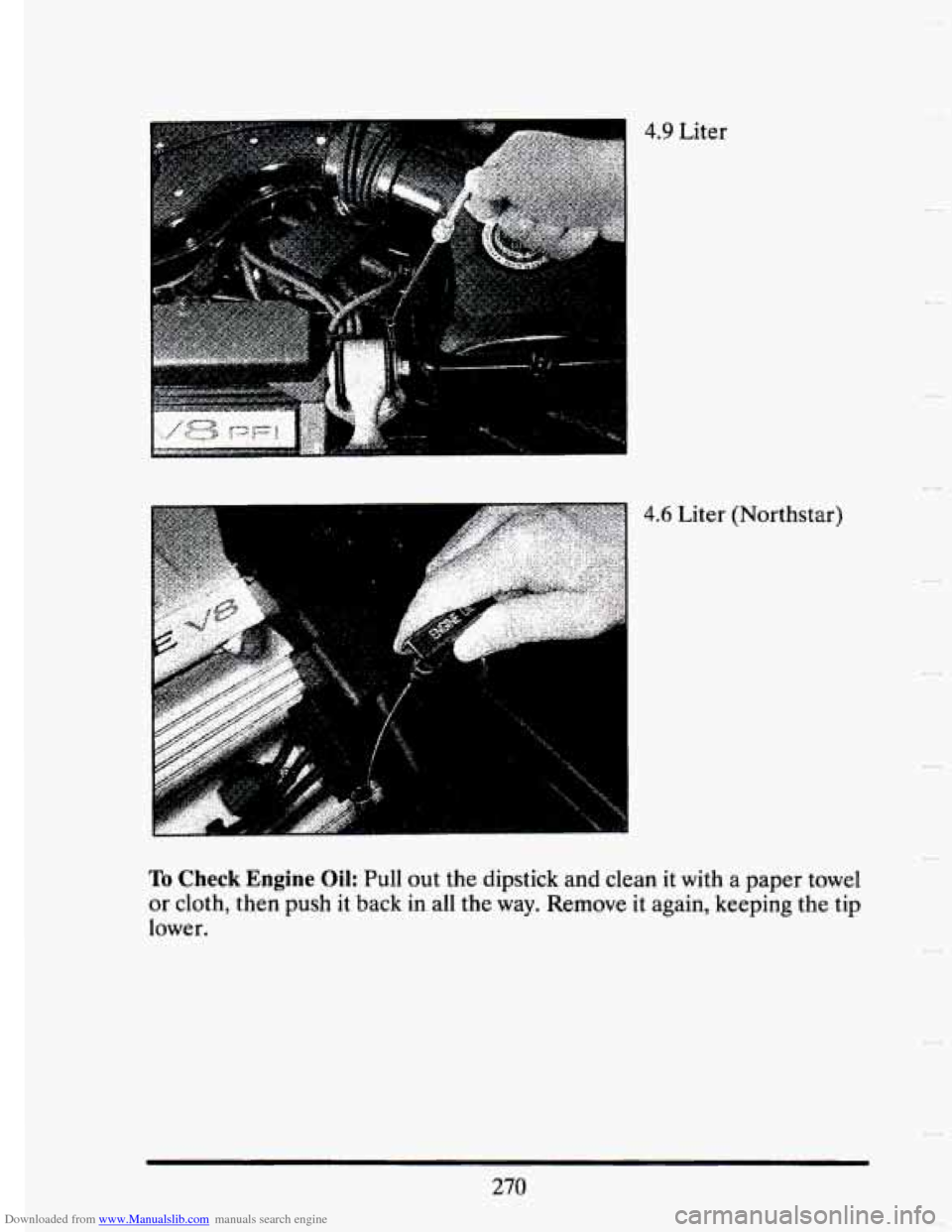
Downloaded from www.Manualslib.com manuals search engine 4.6 Liter (Northstar)
To Check Engine Oil: Pull out the dipstick and clean it with a paper towel
or cloth, then push it back in all the way. Remove it again, keeping the tip
lower.
270