inflation pressure CADILLAC SEVILLE 1995 4.G Owners Manual
[x] Cancel search | Manufacturer: CADILLAC, Model Year: 1995, Model line: SEVILLE, Model: CADILLAC SEVILLE 1995 4.GPages: 410, PDF Size: 19.98 MB
Page 228 of 410
Downloaded from www.Manualslib.com manuals search engine -- -
Then, shut the engine off and close the window almost all the way to
preserve the heat. Start the engine again and repeat this only when you
feel really uncomfortable from the cold. But do it as little as possible.
Preserve
the fuel as long as you can. To help keep warm, you can get out
of the vehicle and do some fairly vigorous exercises every half hour or so
until help comes.
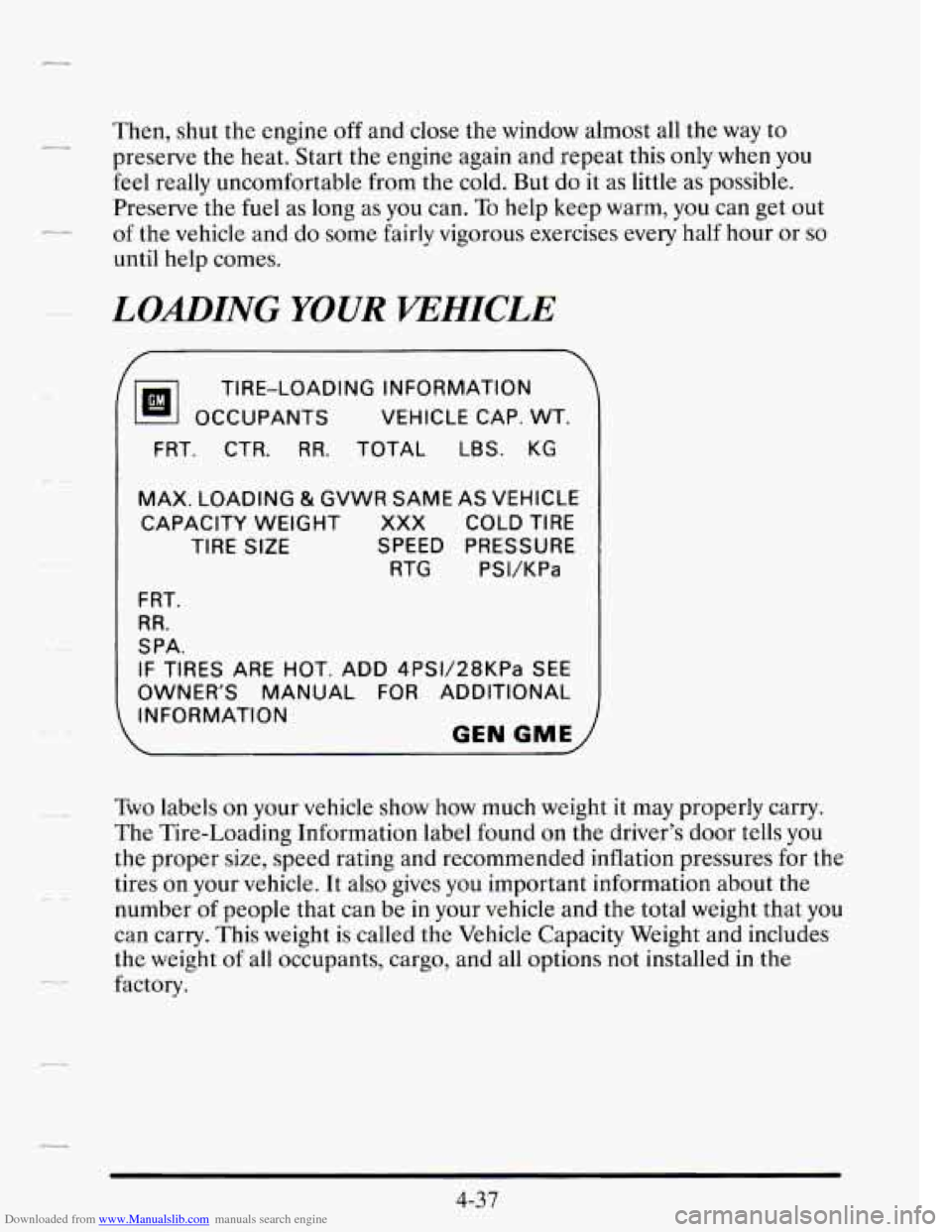
LOADING YOUR VEHICLE
OCCUPANTS VEHICLE
CAP. WT.
TIRE-LOADING INFORMATION
FRT. CTR.
RR. TOTAL LBS. KG
MAX. LOADING
& GVWR SAME AS VEHICLE
CAPACITY WEIGHT XXX COLD TIRE
TIRE
SIZE SPEED PRESSURE RTG PSVKPa
F RT.
RR.
SPA.
IF TIRES ARE
HOT. ADD 4PSV28KPa SEE
OWNER'S MANUAL FOR ADDITIONAL
INFORMATION
GEN GME 1
Two labels on your vehicle show how much weight it may properly carry.
The Tire-Loading Information label found
on the driver's door tells you
the proper size, speed rating and recommended inflation pressures for the
tires on your vehicle. It also gives you important information about the
number
of people that can be in your vehicle and the total weight that you
can carry. This weight is called the Vehicle Capacity Weight and includes
the weight of all occupants, cargo, and all options
not installed in the
factory.
4-37
Page 270 of 410
Downloaded from www.Manualslib.com manuals search engine COMPACT SPARE TIRE
Although the compact spare was fully inflated when your vehicle was new,
it can lose air after a time. Check the inflation pressure regularly. It
should be
60 psi (420 kPa). After installing the compact spare on your
vehicle, you should stop as soon as possible and make sure your spare tire
is correctly inflated. The compact spare
is made to perform well at posted
speed limits for distances up to
3,000 miles (5 000 km), so you can finish
your trip and have your full-size tire repaired
or replaced where you want.
Of course, it’s best to replace your spare
with a full-size tire as soon as
you can. Your spare will last longer and be
in good shape in case you need
it again.
1 NOTICE:
Don’t take your compact spare through an automatic car wash
with guide rails. The compact spare can get caught on the rails.
That can damage the tire and wheel, and maybe other parts
of
your vehicle.
Don’t use your compact spare on some other vehicle.
And don’t mix your compact spare or wheel with other wheels or tires.
They won’t fit. Keep your spare and its wheel together.
NOTICE:
Tire chains won’t fit your compact spare. Using them will
damage your vehicle and destroy the chains too. Don’t use tire
chains on your compact spare.
5-3 1
Page 315 of 410
Downloaded from www.Manualslib.com manuals search engine Inflation - Tire Pressure
The Tire-Loading Information label which is located on the driver’s door
shows the correct inflation pressures for your tires, when they’re cold.
“Cold’’ means your vehicle has been sitting for at least three hours
or
driven no more than a mile.
If you’ll be driving at speeds higher than 100 mph (160 km/h) where it is
legal, raise the “cold” inflation pressure
of each tire to 35 psi (240 kPa).
When you end this very high speed driving, reduce the “cold” inflation
pressures to those listed on the Tire-Loading Information label.
NOTICE:
Don’t let anyone tell you that underinflation or overinflation is
all right. It’s not. If your tires don’t have enough air
(underinflation) you can get:
0 Too much flexing
0 Too much heat
0 Tire overloading
Bad wear
Bad handling
0 Bad fuel economy.
If your tires have too much air (overinflation), you can get:
0 Unusual wear
Bad handling
Rough ride
Needless damage from road hazards.
6-44
c-
---
I --
cy-
t4
L-
Page 316 of 410
Downloaded from www.Manualslib.com manuals search engine When to Check
- -c
- --
c-
Check your tires once a month or more.
Don’t forget your compact spare. It should be at
60 psi (420 kPa).
How to Check
Use a good quality pocket-type gage to check tire pressure. Simply looking
at the tires will not tell you the pressure, especially if you have radial
tires
-- which may look properly inflated even if they’re underinflated.
If your tires have valve caps, be sure to put them back on. They help
prevent leaks by keeping out dirt and moisture.
Tire Inspection and Rotation
Tires should be inspected every 6,000 to 8,000 miles (10 030 to 13 000 km)
for any signs
of unusual wear. If unusual wear is present, rotate your tires
as
soon as possible and check wheel alignment. Also check for damaged
tires or wheels. See “When it’s Time for New Tires” and “Wheel
Replacement’’ later in this section
for more information.
The purpose of regular rotation is to achieve more uniform wear for all tires
on the vehicle. The first rotation is the most important. See “Scheduled
Maintenance Services” in the Index for scheduled rotation intervals.
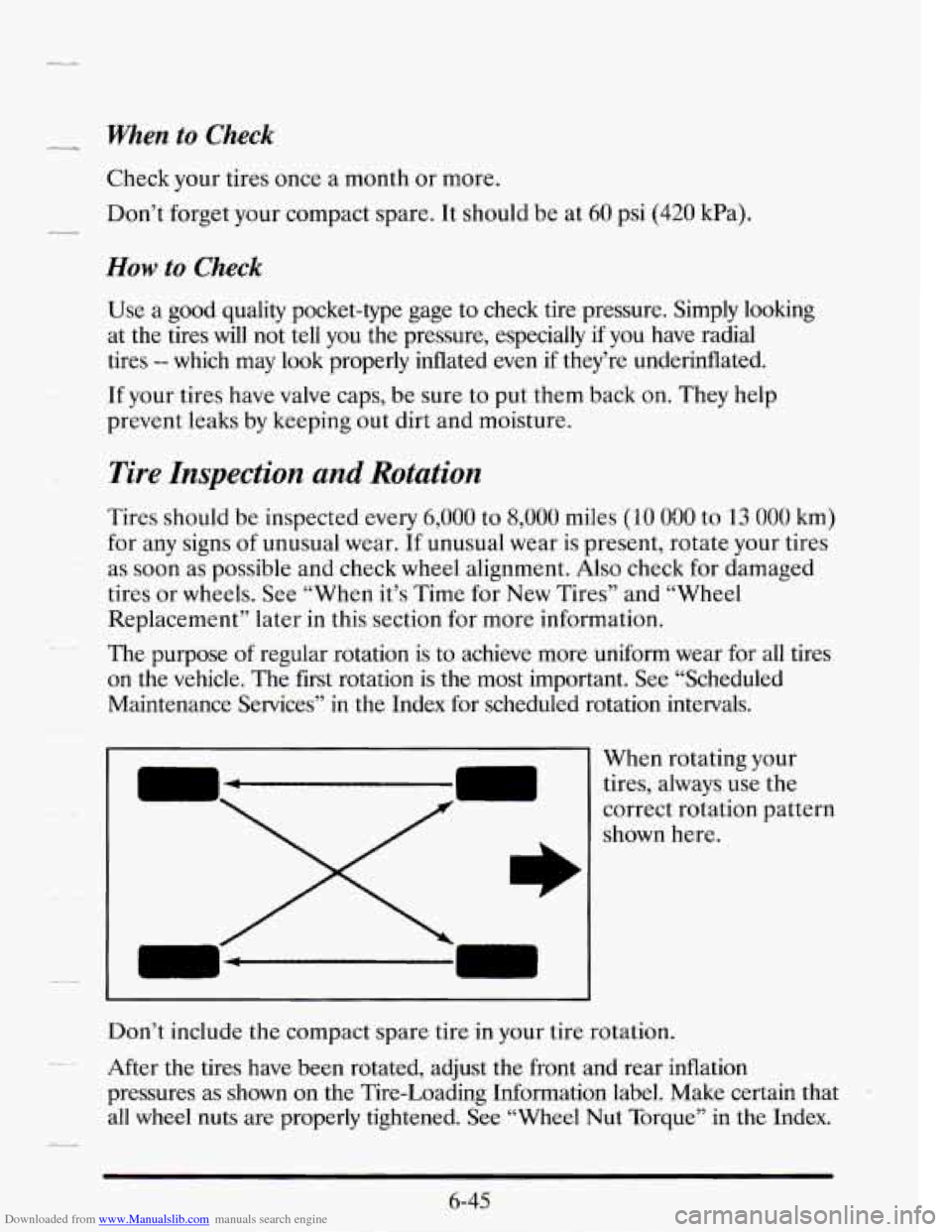
When rotating your
tires, always use the
correct rotation pattern
shown here.
Don’t include the compact spare tire in your tire rotation.
After the tires have been rotated, adjust the front and rear inflation
pressures as shown
on the Tire-Loading Information label. Make certain that
all wheel nuts are properly tightened. See “Wheel
Nut Torque” in the Index.
6-45
Page 406 of 410
Downloaded from www.Manualslib.com manuals search engine .
Stop Engine Engine Overheated Message .............. 2-94
Stop Engine Low Oil Pressure Message ................ 2-94
Storage Armrest. Rear Seat .......................... 2-14
Storage. Of Your Vehicle ............................ 6-32
Stuck. If You Are ................................... 5-32
Sunglasses Storage ................................. 2-66
Supplemental Inflatable Restraint (SIR) ............... 1-22
Surge lknk Pressure Cap ............................ 6-26
Suspension. Road Sensing ........................... 2-96
Symbols. Vehicle ...................................... v
T
Tachometer ....................................... 2-84
Taillamps. Bulb Replacement ......................... 6-38
Tape Player Care ................................... 3-20
Temperature ........................................ 3-3
Theft ............................................. 2-15
Theft Deterrent Alarm System ....................... 2-16
Theft System Problem/Car May Not Restart Message .... 2-94
Thermostat ........................................ 6-26
Third (3) Position. Automatic Transaxle ................ 2-27
Tilt Steering Wheel ................................. 2-39
Time. Setting the ................................... 3-10
Timer Button. Driver Information Center .............. 2-88
Tire Chains ........................................ 6-51
Tire Inspection and Rotation ......................... 6-45
Tire Loading ...................................... 4-37
Tires ............................................. 6-43
Alignment and Balance ........................... 6-49
Buying New ..................................... 6-47
Changing a Flat ................................. 5-22
Inflation ....................................... 6-44
Spare. Compact ................................. 5-31
Temperature .................................... 6-48
Traction ........................................ 6-48
Treadwear ...................................... 6-48
Uniform Quality Grading ......................... 6-48
Wear Indicators ................................. 6-46
Wheel Replacement .............................. 6-49
When It's Time for New .......................... 6-46
1-4.
L-
c-
i. ..
.-
.
.--.-
L- A
..
14