check engine CADILLAC SEVILLE 1997 4.G Owner's Guide
[x] Cancel search | Manufacturer: CADILLAC, Model Year: 1997, Model line: SEVILLE, Model: CADILLAC SEVILLE 1997 4.GPages: 370, PDF Size: 20.52 MB
Page 213 of 370
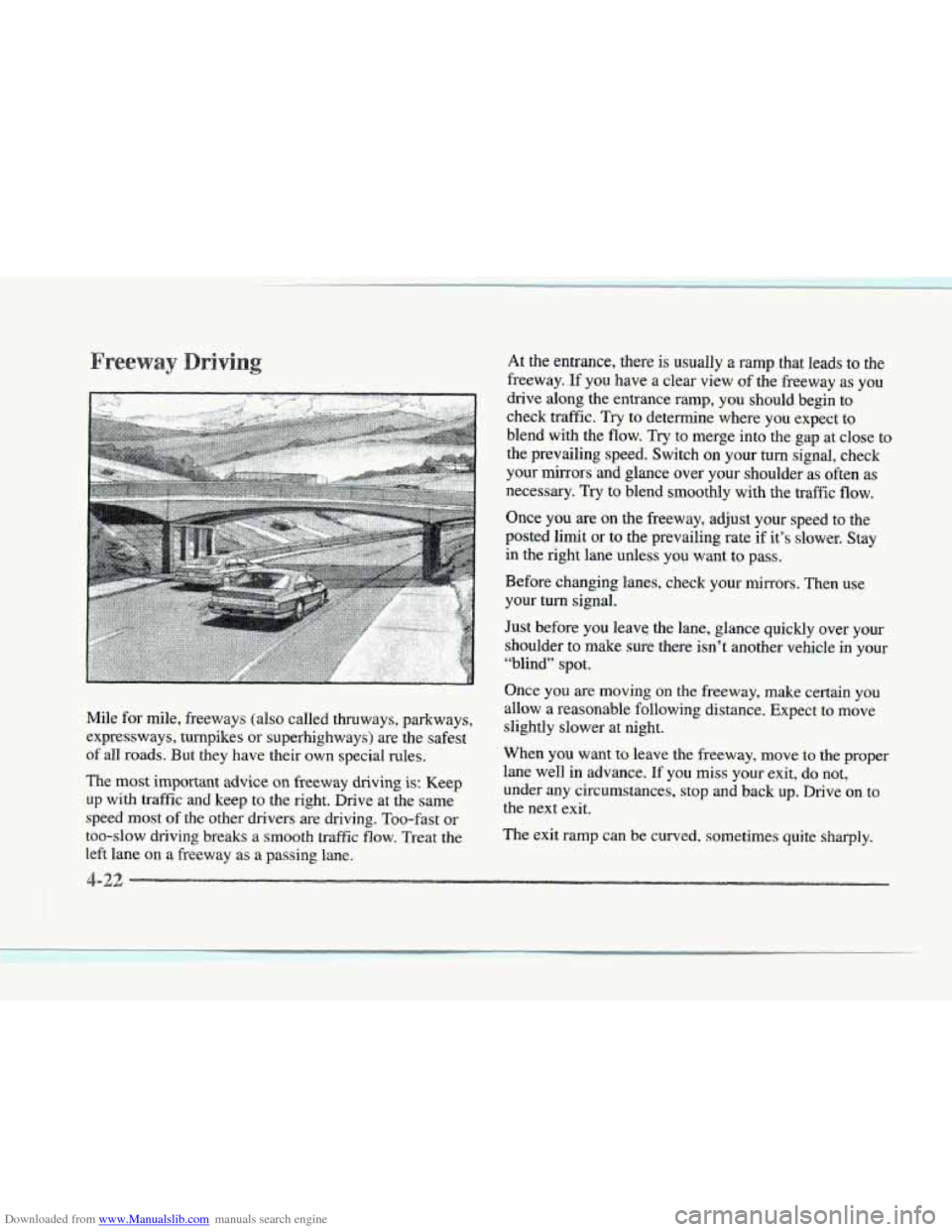
Downloaded from www.Manualslib.com manuals search engine Mile for mile, freeways (also called thruways, parkways,
expressways, turnpikes or superhighways) are the safest
of all roads. But they have their own special rules.
The most important advice on freeway driving
is: Keep
up with traffic and keep to the right. Drive at the same
speed most
of the other drivers are driving. Too-fast or
too-slow driving breaks
a smooth traffic flow. Treat the
left lane
on a freeway as a passing lane. At
the entrance, there is usually a ramp that leads to the
freeway.
If you have a clear view of the freeway as you
drive along the entrance
ramp, you should begin to
check traffic. Try to determine where you expect to
blend with the flow. Try to merge into the gap at close to
the prevailing speed. Switch on your turn signal, check
your
mirrors and glance over your shoulder as often as
necessary. Try to blend smoothly with the traffic flow.
Once you are on the freeway, adjust your speed to the
posted limit or to the prevailing rate if it’s slower. Stay
in the right lane unless you want to pass.
B.efore changing lanes, check your mirrors. Then use
your turn signal.
Just before you leave, the lane, glance quickly over your
shoulder to make sure there isn’t another vehicle in your
“blind” spot.
Once you are moving
on the freeway, make certain you
allow a reasonable following distance. Expect to move
slightly slower at night.
When you want
to leave the freeway, move to the proper
lane well in advance. If you miss your exit,
do not,
under any circumstances, stop and back up. Drive
on to
the next exit.
The exit ramp can be curved, sometimes quite sharply.
I
Page 214 of 370
Downloaded from www.Manualslib.com manuals search engine c
II
c
L.
L-
P
The exit speed is usually posted.
Reduce your speed according to your speedometer, not
to your sense
of motion. After driving for any distance
at higher speeds, you may tend to think you are going
slower than you actually are.
Make sure you‘re ready. Try to
be well rested. If you
must
start when you’re not fresh -- such as after a day‘s
work
-- don’t plan to make too many miles that first part
of the journey. Wear comfortable clothing and shoes you
can easily drive in.
Is your vehicle ready for a long trip? If you keep it
serviced and maintained, it’s ready to
go. If it needs
service. have it done before starting out.
Of course,
you’ll find experienced and able service experts in
Cadillac dealerships all across North America. They’ll
be ready and willing to help if you need
it.
Here are some things you can check before a trip:
0
0
0
e
0
0
e
Wirzdshield Wcsher Fluid: Is the reservoir full? Are
all windows clean inside and outside?
Wiper- Blades: Are they in good shape?
Fuel, Engine Oil, Other Fluids: Have you checked
all levels?
Lcrmps: Are they all working? Are the lenses clean?
Tires: They are vitally important to a safe,
trouble-free trip.
Is the tread good enough for
long-distance driving? Are the tires all inflated to the
recommended pressure?
Weather Forecasts: What’s the weather outlook
along your route? Should
you delay your trip a short
time to avoid a major storm system?
hlcps: Do you have up-to-date maps?
-23
Page 215 of 370
Downloaded from www.Manualslib.com manuals search engine Is there actually such a condition as “highway hypnosis”?
Or is it just plain falling asleep at the wheel? Call it
highway hypnosis, lack
of awareness, or whatever.
There
is something about an easy stretch of road with
the same scenery, along with the hum
of the tires on the
road, the drone
of the engine, and the rush of the wind
against the vehicle that can make you sleepy. Don’t let it
happen to you!
If it does, your vehicle can leave the
road
in less than a second, and you could crash and
be injured.
What can you do about highway hypnosis? First, be
aware that it can happen.
Then here are
some tips:
Make sure your vehicle is well ventilated, with a
comfortably cool interior.
Keep your eyes moving. Scan the road ahead and to
the sides. Check your rearview mirrors and your
instruments frequently.
0 If you get sleepy, pull off the road into a rest, service
or parking area and take a nap, get some exercise, or
both. For safety, treat drowsiness on the highway as
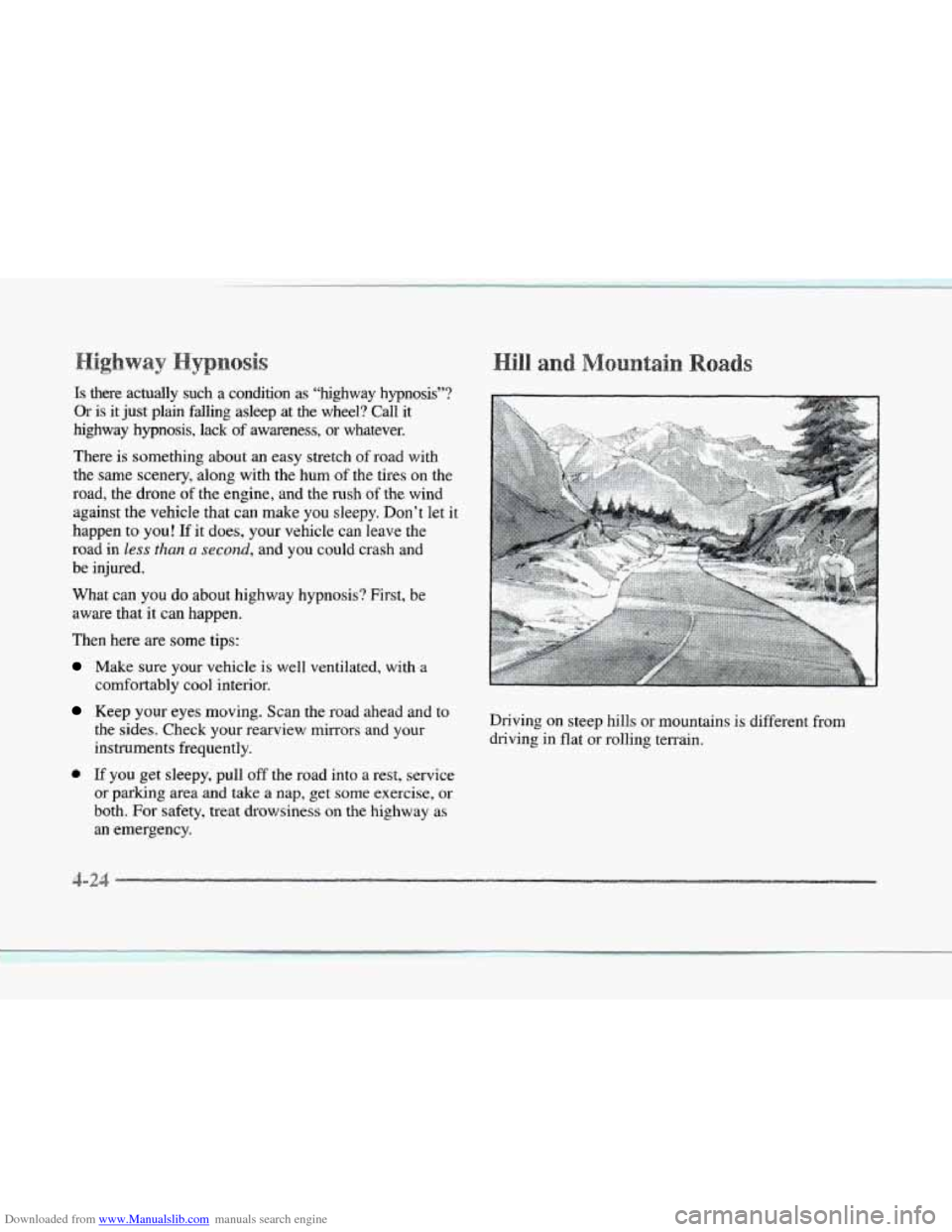
an emergency. Driving
on steep hills or mountains
is different from
driving
in flat or rolling terrain.
P
I
I
I
Page 216 of 370
Downloaded from www.Manualslib.com manuals search engine c
c
c
c
If you drive regularly in steep country, or if you’re
planning to visit there, here are some tips that can make
your trips safer and more enjoyable.
0 Keep your vehicle in good shape. Check all fluid
levels and also the brakes, tires, cooling system
and transaxle. These parts can work hard
on
mountain roads.
Know how to go down hills. The most important
thing to know is this:
let your engine do some of the
slowing down. Shift to a lower gear when
you go
down a steep or long hill.
Coasting downhill in NEUTRAL (N) or with the
ignition off is dangerous. Your brakes will have to
do
all the work of slowing down. They could get so
hot that they wouldn’t work well. You would then
have poor braking or even none going down
a hill.
You could crash. Always have your engine running
and your vehicle in gear when
you go downhill.
~
If you don’t shift down, your brakes could get so
hot that they wouldn’t work well. You would then
have
poor braking or even none going down a hill.
I’ou could crash. Shift down to let your engine
assist your brakes on a steep downhill slope.
~~~~~ ~~ ~~~
Know how to go uphill. You may want to shift down to 0
a
e
e
a lower gear. The lower gears help cool your engine and
transaxle, and you can chb the hill better.
Stay in your own lane when driving on two-lane
roads
in hills or mountains. Don’t swing wide or cut
across the center of the road. Drive at speeds that let
you stay
in your own lane.
As you go over the top of a hill, be alert. There could be
something in your lane. like a stalled car or an accident.
You may see highway signs on mountains that warn of
special problems. Examples
are long grades, passing or
no-passing zones, a falling rocks area or winding
roads. Be
alert to these and take appropriate action.
Page 220 of 370
Downloaded from www.Manualslib.com manuals search engine r 1
F
1
1”
r
r
i
r
@ Tie a red cloth to your vehicle to alert police that
you’ve been stopped by the snow.
@ Put on extra clothing or wrap a blanket around you.
If you have no blankets or extra clothing, make body
insulators
from newspapers, burlap bags, rags, floor
mats
-- anything you can wrap around yourself or
tuck under your clothing
to keep warm.
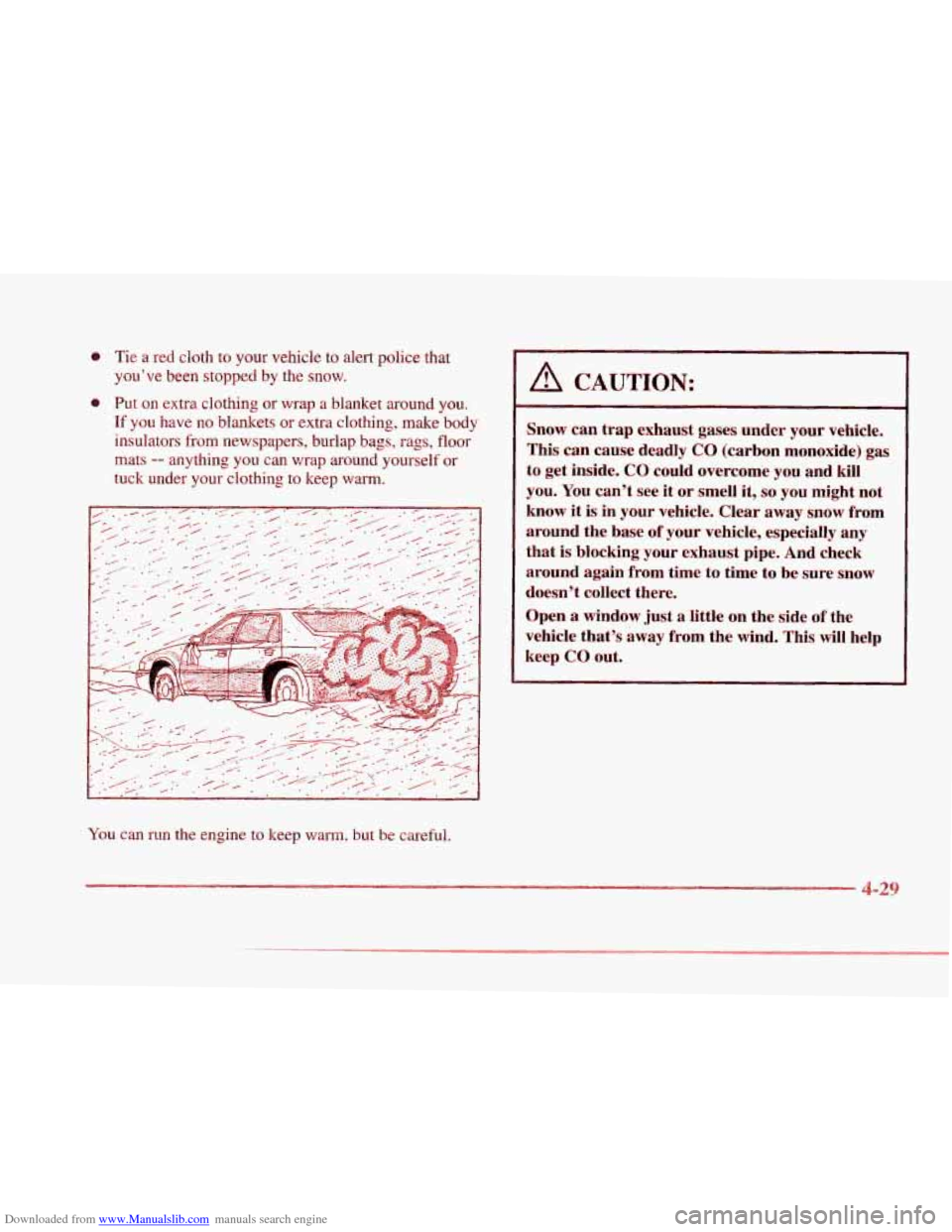
A CAUTION:
Snow can trap exhaust gases under your vehicle.
This can
cause deadly CO (carbon monoxide) gas
to get inside. CO
could overcome you and kill
you. You can’t see it or smell it, so you might not
know
it is in your vehicle. Clear away snow from
around the base
of your vehicle, especially any
that
is blocking your exhaust pipe. And check
around again from time to time to
be sure snow
doesn’t collect there.
Open a window just a little on the side
of the
vehicle that’s away from the wind. This
will help
keep
CO out.
You can run the engine to keep warm, but be careful.
Page 227 of 370
Downloaded from www.Manualslib.com manuals search engine IOU should always attach chains between your vehicle
and your trailer. Cross the safety chains under the tongue
of the trailer so that the tongue will not drop to the road
if it becomes separated from the hitch. Instructions
about safety chains may
be provided by the hitch
manufacturer or by the trailer manufacturer. Follow the
manufacturer’s recommendation for attaching safety
chains and do not attach them
to the bumper. Always
leave just enough slack
so you can turn with your rig.
And, never allow safety chains
to drag on the ground.
Because you have anti-lock brakes, don’t try to tap into
your vehicle’s hydraulic brake system.
If you do, both
brake systems won’t work well, or at all.
Be sure to read and follow the instructions for
the trailer
brakes
so you’ll be able to install, adjust and maintain
them properly.
Towing a trailer requires a certain amount
of experience.
Before setting out for
the open road, you’ll want to get
to know your rig. Acquaint yourself with the feel of
handling and braking with the added weight
of the
trailer. And always keep
in mind that the vehicle you are driving
is now
a good deal longer and not nearly as
responsive as your vehicle is by itself.
Before you start, check the trailer hitch and platform
(and attachments), safety chains, electrical connector,
lamps, tires and mirror adjustment. If the trailer has
electric brakes, start your vehicle and trailer moving and
then apply the trailer brake controller by hand to be
sure
the brakes are working. This lets you check your
electrical connection at the same time.
During your trip, check occasionally to be sure that the
load is secure, and that the lamps and any trailer brakes
are still working.
Stay at least twice as far behind the vehicle ahead as you
would when driving your vehicle without a trailer. This
can help you avoid situations that require heavy braking
and sudden turns.
You’ll need more passing distance
up ahead when
you’re towing a trailer. And, because you’re a good deal
longer,
you’ll need to go much farther beyond the
passed vehicle before you can return to your lane.
3-36
Page 228 of 370
Downloaded from www.Manualslib.com manuals search engine L
Hold the bottom of the steering wheel with one hand.
Then,
to move the trailer to the left, just move that hand
to the left. To move the trailer to the right, move your
hand to the right. Always back up
slowly and, if
possible, have someone guide you.
When you tow a trailer, your vehicle may need a
different turn signal flasher and/or extra wiring. Check
with your Cadillac dealer. The green arrows
on your
instrument panel will flash whenever
you signal a turn
or lane change. Properly hooked
up, the trailer lamps
will also flash, telling other drivers you’re about to turn,
change lanes or stop.
When towing
a trailer, the green arrows on your
instrulnent panel will flash for turns even if the bulbs on
the trailer are burned
out. Thus, you may think drivers NOTICE:
Making very sharp turns while trailering could
cause the trailer to come in contact with t,he
vehicle. Your vehicle could be damaged. Avoid
behind you are seeing your signal when they are not. It’s
important to check occasionally to be sure the trailer
bulbs are still working.
making very sharp turns while trailering.
Reduce speed and shift to a lower gear before you start
When you’re turning with
a trailer, make wider turns down a long or steep downgrade. If you don’t shift
than normal.
Do this so your trailer won’t strike soft down, you might have to use your brakes so much that
shoulders, curbs, road signs, trees
or other objects. they would get hot and no longer work well.
Avoid jerky or sudden maneuvers. Signal weil
in advance. On
a long uphill grade.
shift down and reduce your
speed to around
45 mph (70 km/h) or less to reduce the
possibility
of engine and transaxle overheating.
Page 229 of 370
Downloaded from www.Manualslib.com manuals search engine You really should not park your vehicle, with a trailer
attached, on
a hill. If something goes wrong, your rig
could start to move. People can be injured, and both
your vehicle and
the trailer can be damaged.
But if
you ever have to park your rig on a hill. here’s
how to do it:
1.
2.
3.
4.
5.
Apply your regular brakes, but do not shift into
PARK
(P).
Have someone place chocks under the trailer wheels.
When the wheel chocks are in place, release the
regular brakes until the chocks absorb the load.
Reapply the regular brakes. Then shift into
PARK (P) firmly and apply your parking brake.
Release the regular brakes. 1. Apply your regular brakes and hold the pedal
down
while
you:
Start your engine;
Shift into a gear: and
Be sure the parking brake has released.
2. Let up on the brake pedal.
3. Drive slowly until the trailer is clear of the chocks.
4. Stop and have someone pick up and store the chocks.
Your vehicle will need service more often when you’re
pulling
a trailer. See the Maintenance Schedule for more
on
this. Things that are especially important in trailer
operation are automatic transaxle fluid (don’t overfill),
engine oil, belt, cooling system and brake adjustment.
Each of these
is covered in this manual, and the Index
will help you find them quickly. If you’re trailering, it’s
a good idea to review these sections before you start
your trip.
Check periodically to see that all hitch nuts and
bolts
are tight.
Page 235 of 370
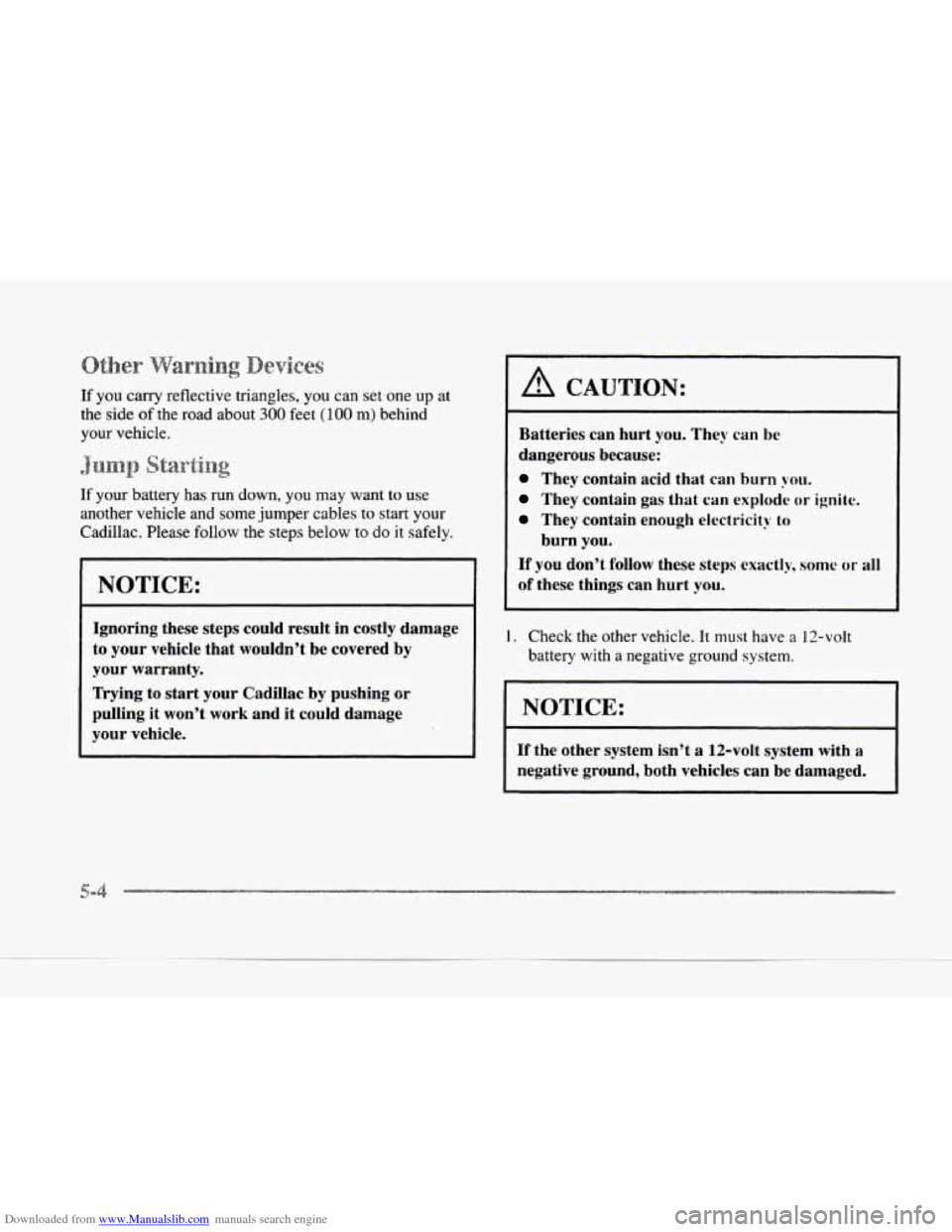
Downloaded from www.Manualslib.com manuals search engine If you carry reflective triangles, you can set one up at
the side of the road about 300 feet (100 m) behind
your vehicle.
If your battery has run down, you may want
to use
another vehicle and some jumper cables to start your
Cadillac. Please follow the steps below to do
it safely.
NOTICE:
Ignoring these steps could result in costly damage
to
your vehicle that wouldn’t be covered by
your warranty.
Trying to start your Cadillac by pushing or
pulling it won’t work and it could damage
your vehicle.
I A CAUTION:
Batteries can hurt you. They can be
dangerous because:
They contain acid that can burn you.
They contain gas that can explode or ignite.
They contain enough electricity to
If you don’t follow these steps exactly, some or all
of these things can hurt you.
burn
you.
1. Check the other vehicle. It must have a 12-volt
battery with
a negative ground system.
I NOTICE: I
~ ~~ ~~ ~~~~~
If the other system isn’t a 12-volt system with a
negative ground, both vehicles can be damaged.
Page 237 of 370
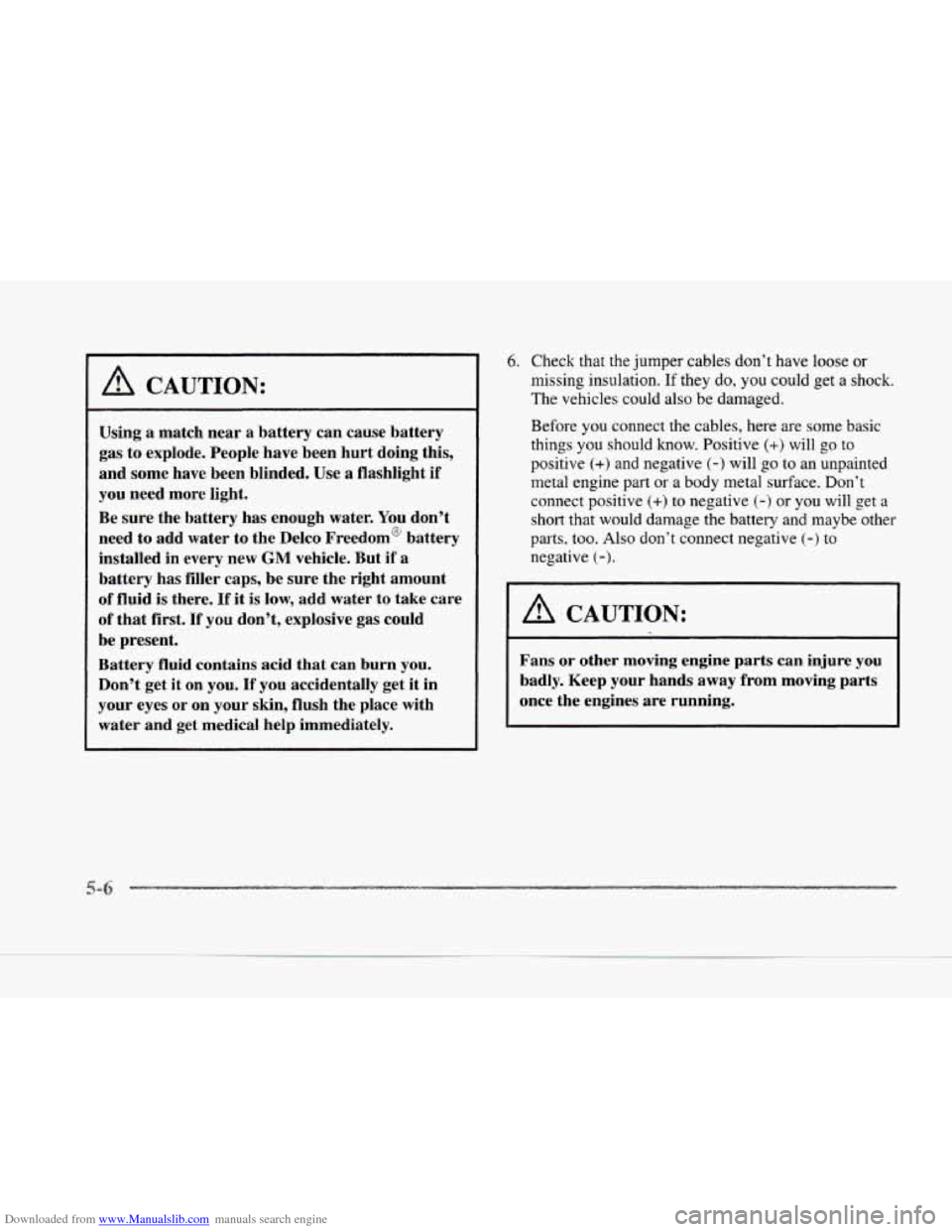
Downloaded from www.Manualslib.com manuals search engine A CAUTION:
Using a match near a battery can cause battery
gas to explode. People have been hurt doing this,
and some have been blinded. Use a flashlight if
you need more light.
Be sure the battery has enough water.
You don’t
need to add water to the Delco Freedom‘ battery
installed in every new
GM vehicle. Rut if a
battery has filler caps, be sure the right amount
of fluid is there. If it is low, add water to take care
of that first. If you don’t, explosive gas could
be present.
Battery
fluid contains acid that can burn you.
Don’t get it on you.
If you accidentally get it in
your eyes
or on your skin, flush the place with
water and get medical help immediately.
6. Check that the jumper cables don’t have loose or
missing insulation.
If they do, you could get a shock.
The vehicles could also be damaged.
Before
you connect the cables, here are some basic
things
you should know. Positive (+) will go to
positive
(+) and negative (-) will go to an unpainted
metal engine part or a body metal surface. Don’t
connect positive
(+) to negative (-) or you will get a
short that would damage the battery and maybe other
parts, too. Also don’t connect negative
(-) to
negative
(-).
I A CAUTION:
Fans or other moving engine parts can injure you
badly. Keep your hands
away from moving parts
once the engines are running.
.1.
-.