Traction CADILLAC SRX 2004 1.G Owner's Manual
[x] Cancel search | Manufacturer: CADILLAC, Model Year: 2004, Model line: SRX, Model: CADILLAC SRX 2004 1.GPages: 468, PDF Size: 2.92 MB
Page 291 of 468
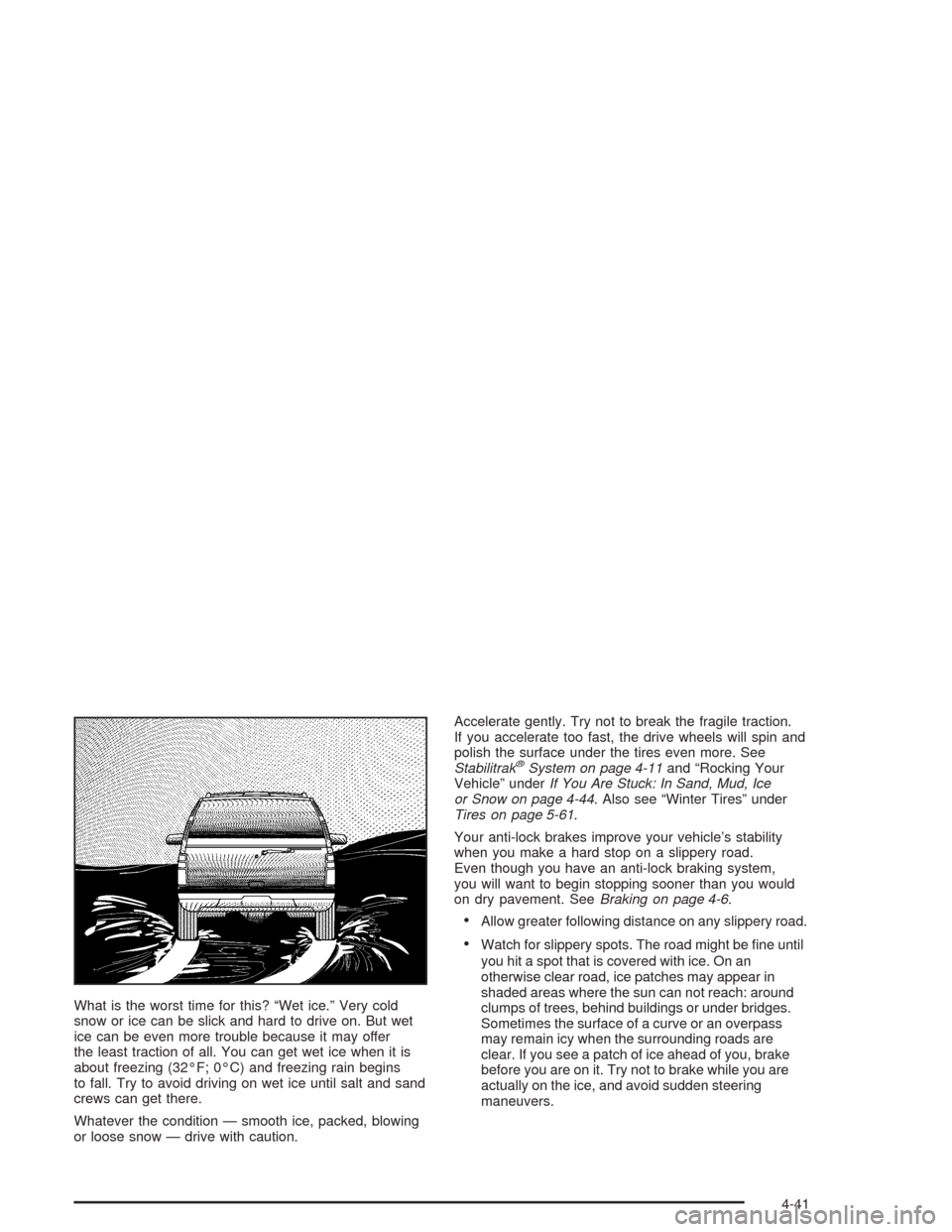
What is the worst time for this? “Wet ice.” Very cold
snow or ice can be slick and hard to drive on. But wet
ice can be even more trouble because it may offer
the least traction of all. You can get wet ice when it is
about freezing (32°F; 0°C) and freezing rain begins
to fall. Try to avoid driving on wet ice until salt and sand
crews can get there.
Whatever the condition — smooth ice, packed, blowing
or loose snow — drive with caution.Accelerate gently. Try not to break the fragile traction.
If you accelerate too fast, the drive wheels will spin and
polish the surface under the tires even more. See
Stabilitrak
®System on page 4-11and “Rocking Your
Vehicle” underIf You Are Stuck: In Sand, Mud, Ice
or Snow on page 4-44. Also see “Winter Tires” under
Tires on page 5-61.
Your anti-lock brakes improve your vehicle’s stability
when you make a hard stop on a slippery road.
Even though you have an anti-lock braking system,
you will want to begin stopping sooner than you would
on dry pavement. SeeBraking on page 4-6.
Allow greater following distance on any slippery road.
Watch for slippery spots. The road might be ne until
you hit a spot that is covered with ice. On an
otherwise clear road, ice patches may appear in
shaded areas where the sun can not reach: around
clumps of trees, behind buildings or under bridges.
Sometimes the surface of a curve or an overpass
may remain icy when the surrounding roads are
clear. If you see a patch of ice ahead of you, brake
before you are on it. Try not to brake while you are
actually on the ice, and avoid sudden steering
maneuvers.
4-41
Page 294 of 468
If You Are Stuck: In Sand, Mud,
Ice or Snow
In order to free your vehicle when it is stuck, you will
need to spin the wheels, but you do not want to
spin your wheels too fast. The method known as
“rocking” can help you get out when you are stuck,
but you must use caution.
{CAUTION:
If you let your tires spin at high speed, they can
explode, and you or others could be injured.
And, the transmission or other parts of the
vehicle can overheat. That could cause an
engine compartment re or other damage.
When you are stuck, spin the wheels as little as
possible. Do not spin the wheels above 35 mph
(55 km/h) as shown on the speedometer.Notice:Spinning your wheels can destroy parts of
your vehicle as well as the tires. If you spin the
wheels too fast while shifting your transmission
back and forth, you can destroy your transmission.
For information about using tire chains on your
vehicle, seeTire Chains on page 5-77.
Rocking Your Vehicle To Get It Out
First, turn your steering wheel left and right. That will
clear the area around your front wheels. If your vehicle
has the Stabilitrak
®System, turn the system off by
pressing and holding the Traction button so that
the STABILITY SYS DISABLED message and the
traction off light are illuminated on the instrument
panel cluster. Then shift back and forth between
REVERSE (R) and a forward gear, spinning the wheels
as little as possible. Release the accelerator pedal
while you shift, and press lightly on the accelerator pedal
when the transmission is in gear. By slowly spinning
your wheels in the forward and reverse directions,
you will cause a rocking motion that may free your
vehicle. If that does not get you out after a few tries,
you may need to be towed out. Or, you can use
your recovery hook if your vehicle has one. If you do
need to be towed out, seeTowing Your Vehicle on
page 4-45.
4-44
Page 370 of 468

Winter Tires
If you expect to drive on snow or ice covered roads
often, you may want to get winter tires for your vehicle.
All season tires provide good overall performance on
most surfaces but they may not offer the traction
you would like or the same level of performance as
winter tires on roads covered with snow or ice.
See your dealer for details regarding winter tire
availability and proper tire selection. Also, seeBuying
New Tires on page 5-72.
If you choose to use snow tires:
Use tires of the same brand and tread type on all
four wheel positions.
Use only radial ply tires of the same size,
load range and speed rating as your original
equipment tires.
Winter tires with the same speed rating as your original
equipment tires may not be available for H, V, W
and ZR speed rated tires. If you choose snow tires with
a lower speed rating, never exceed the tire’s maximum
speed capability.
Tire Sidewall Labeling
Useful information about a tire is molded into its
sidewall. The examples below show a typical P-Metric
and compact spare tire sidewall.
(A) Tire Size:The tire size code is a combination of
letters and numbers used to dene a particular
tire’s width, height, aspect ratio, construction type and
service description. See the “Tire Size Code” illustration
later in this section for more detail.P-Metric Tire Example
5-62
Page 371 of 468
(B) Tire Performance Criteria Specication (TPC
Spec):Original equipment tires designed to GM’s
specic tire performance criteria have a TPC
specication code molded onto the sidewall. GM’s TPC
specications meet or exceed all federal safety
guidelines.
(C) Department of Transportation (DOT):The
Department of Transportation (DOT) code indicates that
the tire is in compliance with the U.S. Department of
Transportation Motor Vehicle Safety Standards.
(D) Tire Identication Number (TIN):The letters and
numbers following DOT code are the Tire Identication
Number (TIN). The TIN shows the manufacturer
and plant code, tire size, and date the tire was
manufactured. The TIN is molded onto both sides of the
tire, although only one side may have the date of
manufacture.(E) Tire Ply Material:The type of cord and number of
plies in the sidewall and under the tread.
(F) Uniform Tire Quality Grading (UTQG):Tire
manufacturers are required to grade tires based on
three performance factors: treadwear, traction and
temperature resistance. For more information, see
Uniform Tire Quality Grading on page 5-74.
(G) Maximum Cold Ination Load Limit:Maximum
load that can be carried and the maximum pressure
needed to support that load.
5-63
Page 375 of 468
Occupant Distribution:Designated seating positions.
Outward Facing Sidewall:The side of a asymmetrical
tire that has a particular side that faces outward
when mounted on a vehicle. The side of the tire that
contains a whitewall, bears white lettering or bears
manufacturer, brand and or model name molding that is
higher or deeper than the same moldings on the
other sidewall of the tire.
Passenger (P-Metric) Tire:A tire used on passenger
cars and some light duty trucks and multipurpose
vehicles.
Recommended Ination Pressure:Vehicle
manufacturer’s recommended tire ination pressure and
shown on the tire placard. SeeInation - Tire Pressure
on page 5-68andLoading Your Vehicle on page 4-47.
Radial Ply tire:A pneumatic tire in which the ply cords
that extend to the beads are laid at 90 degrees to the
centerline of the tread.
Rim:A metal support for a tire and upon which the tire
beads are seated.
Sidewall:The portion of a tire between the tread and
the bead.
Speed Rating:An alphanumeric code assigned to a
tire indicating the maximum speed at which a tire
can operate.Traction:The friction between the tire and the road
surface. The amount of grip provided.
Tread:The portion of a tire that comes into contact
with the road.
Treadwear Indicators:Narrow bands, sometimes
called “wear bars,” that show across the tread of a tire
when only 2/32 inch of tread remains. SeeWhen It
Is Time for New Tires on page 5-72.
UTQGS:Uniform Tire Quality Grading Standards, a tire
information system that provides consumers with
ratings for a tire’s traction, temperature and treadwear.
Ratings are determined by tire manufacturers using
government testing procedures. The ratings are molded
into the sidewall of the tire. SeeUniform Tire Quality
Grading on page 5-74.
Vehicle Capacity Weight:The number of designated
seating positions multiplied by 150 lbs. (68 kg) plus
the rated cargo load. SeeLoading Your Vehicle
on page 4-47.
Vehicle Maximum Load on the Tire:Load on an
individual tire due to curb weight, accessory weight,
occupant weight and cargo weight.
Vehicle Placard:A label permanently attached to a
vehicle showing the original equipment tire size
and recommended ination pressure. SeeLoading Your
Vehicle on page 4-47.
5-67
Page 380 of 468
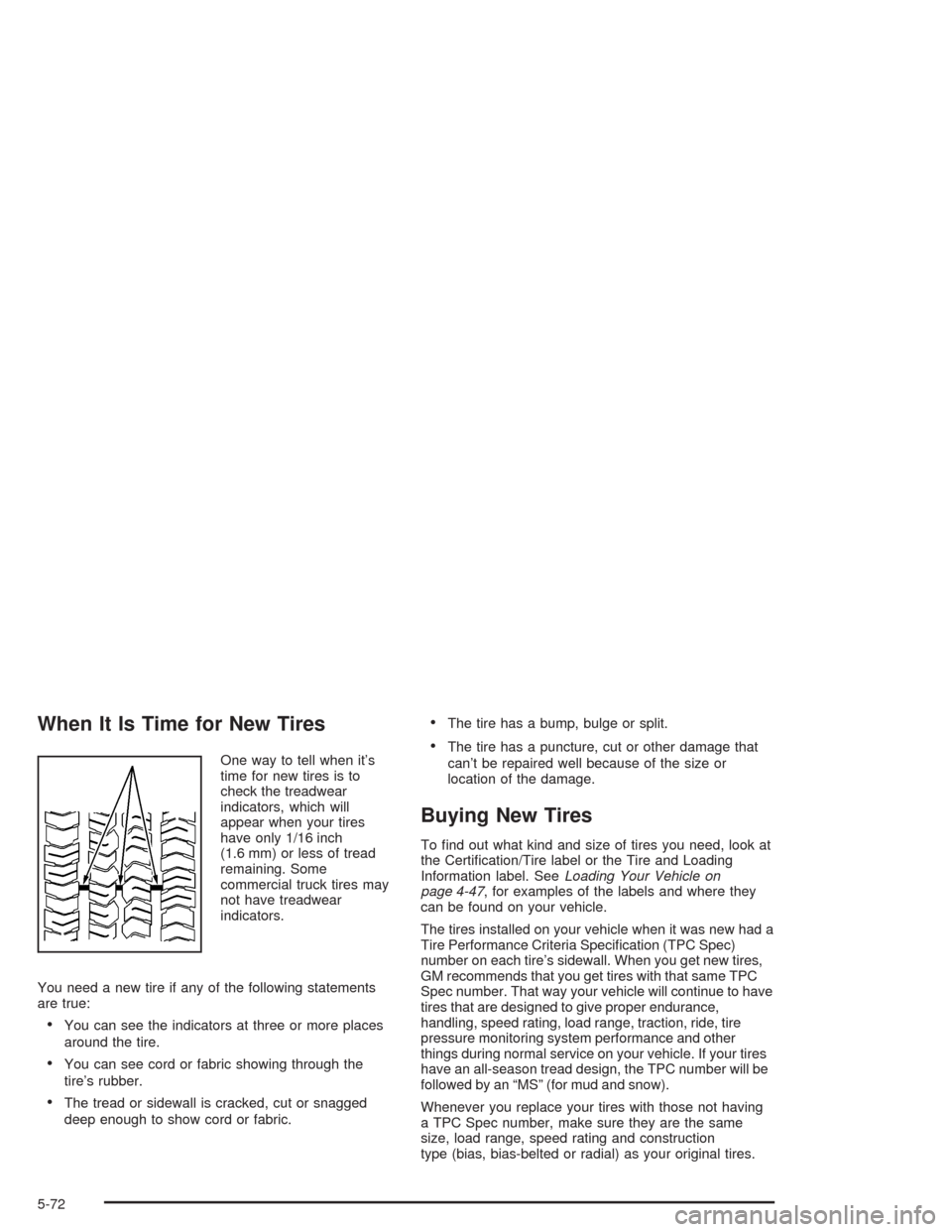
When It Is Time for New Tires
One way to tell when it’s
time for new tires is to
check the treadwear
indicators, which will
appear when your tires
have only 1/16 inch
(1.6 mm) or less of tread
remaining. Some
commercial truck tires may
not have treadwear
indicators.
You need a new tire if any of the following statements
are true:
You can see the indicators at three or more places
around the tire.
You can see cord or fabric showing through the
tire’s rubber.
The tread or sidewall is cracked, cut or snagged
deep enough to show cord or fabric.
The tire has a bump, bulge or split.
The tire has a puncture, cut or other damage that
can’t be repaired well because of the size or
location of the damage.
Buying New Tires
To nd out what kind and size of tires you need, look at
the Certication/Tire label or the Tire and Loading
Information label. SeeLoading Your Vehicle on
page 4-47, for examples of the labels and where they
can be found on your vehicle.
The tires installed on your vehicle when it was new had a
Tire Performance Criteria Specication (TPC Spec)
number on each tire’s sidewall. When you get new tires,
GM recommends that you get tires with that same TPC
Spec number. That way your vehicle will continue to have
tires that are designed to give proper endurance,
handling, speed rating, load range, traction, ride, tire
pressure monitoring system performance and other
things during normal service on your vehicle. If your tires
have an all-season tread design, the TPC number will be
followed by an “MS” (for mud and snow).
Whenever you replace your tires with those not having
a TPC Spec number, make sure they are the same
size, load range, speed rating and construction
type (bias, bias-belted or radial) as your original tires.
5-72
Page 382 of 468

Uniform Tire Quality Grading
Quality grades can be found where applicable on the
tire sidewall between tread shoulder and maximum
section width. For example:
Treadwear 200 Traction AA Temperature A
The following information relates to the system
developed by the United States National Highway
Traffic Safety Administration, which grades tires by
treadwear, traction and temperature performance. (This
applies only to vehicles sold in the United States.)
The grades are molded on the sidewalls of most
passenger car tires. The Uniform Tire Quality Grading
system does not apply to deep tread, winter-type
snow tires, space-saver or temporary use spare tires,
tires with nominal rim diameters of 10 to 12 inches
(25 to 30 cm), or to some limited-production tires.
While the tires available on General Motors passenger
cars and light trucks may vary with respect to these
grades, they must also conform to federal safety
requirements and additional General Motors Tire
Performance Criteria (TPC) standards.
Treadwear
The treadwear grade is a comparative rating based on
the wear rate of the tire when tested under controlled
conditions on a specied government test course.
For example, a tire graded 150 would wear one and
a half (1.5) times as well on the government course as
a tire graded 100. The relative performance of tires
depends upon the actual conditions of their use,
however, and may depart signicantly from the norm
due to variations in driving habits, service practices and
differences in road characteristics and climate.
Traction – AA, A, B, C
The traction grades, from highest to lowest, are AA, A,
B, and C. Those grades represent the tire’s ability
to stop on wet pavement as measured under controlled
conditions on specied government test surfaces of
asphalt and concrete. A tire marked C may have poor
traction performance. Warning: The traction grade
assigned to this tire is based on straight-ahead braking
traction tests, and does not include acceleration,
cornering, hydroplaning, or peak traction characteristics.
5-74
Page 459 of 468
L
Lamps
Exterior......................................................3-18
Interior.......................................................3-20
Lap-Shoulder Belt...................................1-15, 1-24
LATCH System
Child Restraints...........................................1-42
Securing a Child Restraint Designed for
the LATCH System...................................1-44
Leaving Your Vehicle.......................................2-11
Leaving Your Vehicle With the Engine
Running.....................................................2-31
Left Rear Door Ajar.........................................3-68
Level Control..................................................4-52
Lift Gate Ajar.................................................3-68
Liftgate..........................................................2-12
Light
Air Bag Readiness.......................................3-39
Anti-Lock Brake System Warning...................3-42
Brake System Warning.................................3-41
Charging System.........................................3-40
Cruise Control.............................................3-50
Engine Coolant Temperature Warning.............3-43
Fog Lamp..................................................3-49
Highbeam On.............................................3-50
Lights On Reminder.....................................3-49Light (cont.)
Malfunction Indicator....................................3-44
Oil Pressure...............................................3-48
Safety Belt Reminder...................................3-39
Security.....................................................3-49
Sport Mode................................................3-49
TCS Warning Light......................................3-42
Tire Pressure..............................................3-44
Traction Control System (TCS) Warning..........3-42
Lighted Visor Vanity Mirror...............................2-16
Loading Your Vehicle.......................................4-47
Loading Your Vehicle for Off-Road Driving..........4-18
Lockout Protection..........................................2-11
Locks
Central Door Unlocking System....................... 2-9
Delayed Locking........................................... 2-9
Door........................................................... 2-8
Leaving Your Vehicle....................................2-11
Lockout Protection.......................................2-11
Power Door.................................................. 2-9
Programmable Automatic Door Locks.............2-10
Rear Door Security Locks.............................2-10
Loss of Control...............................................4-16
Luggage Carrier..............................................2-46
Lumbar
Power Controls............................................. 1-3
9
Page 466 of 468
Tires (cont.)
If a Tire Goes Flat.......................................5-78
Ination - Tire Pressure................................5-68
Inspection and Rotation................................5-71
Pressure Monitor System..............................5-69
Uniform Tire Quality Grading.........................5-74
Wheel Alignment and Tire Balance.................5-75
Wheel Replacement.....................................5-76
When It Is Time for New Tires......................5-72
Matching Transmitter(s) to Your Vehicle............... 2-7
To Use the Engine Coolant Heater....................2-24
Top Speed – Fuel Cut Off................................3-72
Top Strap......................................................1-39
Top Strap Anchor Location...............................1-41
Torque Lock...................................................2-31
Total Weight on Your Vehicle’s Tires..................4-55
Towing
Recreational Vehicle.....................................4-45
Towing a Trailer..........................................4-52
Your Vehicle...............................................4-45
Traction
Control System (TCS).................................... 4-9
Control System Warning Light.......................3-42
Magnetic Ride Control..................................4-10
Stabilitrak
®System......................................4-11
Traction Engaged............................................3-72
Traction Suspended........................................3-72Trailer Brakes.................................................4-55
Trans (Transmission) Hot – Idle Engine..............3-72
Transfer Case................................................5-51
Transmission
Fluid, Automatic...........................................5-24
Transmission Operation, Automatic....................2-25
Transmission, Transaxle, Transfer Case
Unit Repair Manual......................................7-11
Transportation Options...................................... 7-7
Traveling to Remote Areas...............................4-19
Trip Odometers..............................................3-37
Turn and Lane-Change Signals.......................... 3-8
Turn Signal On...............................................3-72
Turn Signal/Multifunction Lever........................... 3-8
Turn Signals When Towing a Trailer..................4-57
U
Ultrasonic Rear Parking Assist (URPA)...............3-22
Underhood Fuse Block...................................5-103
Understanding Radio Reception.......................3-125
Uniform Tire Quality Grading............................5-74
United States – Customer Assistance.................. 7-4
Used Replacement Wheels..............................5-77
Using DSP...................................................3-100
Using HomeLink
®...........................................2-44
16