seats CADILLAC SRX 2007 1.G Owner's Manual
[x] Cancel search | Manufacturer: CADILLAC, Model Year: 2007, Model line: SRX, Model: CADILLAC SRX 2007 1.GPages: 522, PDF Size: 2.71 MB
Page 154 of 522
Cupholder(s)
Your vehicle has cupholders located between the
front seats. Slide the cover back to expose
them. There are also cupholders in the armrest of
the second row seat. Press the panel on the
front of the armrest to expose the cupholders. On
the outboard sides of the third row there may
also be cupholders.
Cell Phone Storage Area
Your vehicle has a closeable cell phone/
sunglasses storage area inside both of the front
doors. Press the button to open the door.
Center Console Storage Area
Your vehicle has a center console storage area
located between the front seats. It includes storage
areas, and accessory power outlet(s) on the
rear of the console.
Luggage Carrier
{CAUTION:
If you try to carry something on top of
your vehicle that is longer or wider than
the luggage carrier — like paneling,
plywood, a mattress and so forth — the
wind can catch it as you drive along. This
can cause you to lose control. What you
are carrying could be violently torn off,
and this could cause you or other drivers
to have a collision, and of course damage
your vehicle. You may be able to carry
something like this inside. But, never
carry something longer or wider than the
luggage carrier on top of your vehicle.
154
Page 156 of 522
Sunroof
Sunroof (Ultra View®)
{CAUTION:
People who are in a crash and not
wearing a safety belt properly can suffer
much worse injuries. They can hit things
inside the vehicle or be ejected from it,
and be seriously injured or killed. This is
true for any vehicle occupant, in any
motor vehicle. In a rollover or other crash,
the Ultra View
®roof can be damaged or
destroyed. People who are unbelted would
be at risk of being ejected from the
vehicle. Always fasten your safety belt,
and check that your passengers’ belts are
fastened properly too.The vehicle may have an Ultra View
®sunroof over
the rst two rows of seats. The ignition must be
turned to ON, or ACCESSORY, or the Retained
Accessory Power (RAP) must be active to operate
it. SeeRetained Accessory Power (RAP) on
page 118.
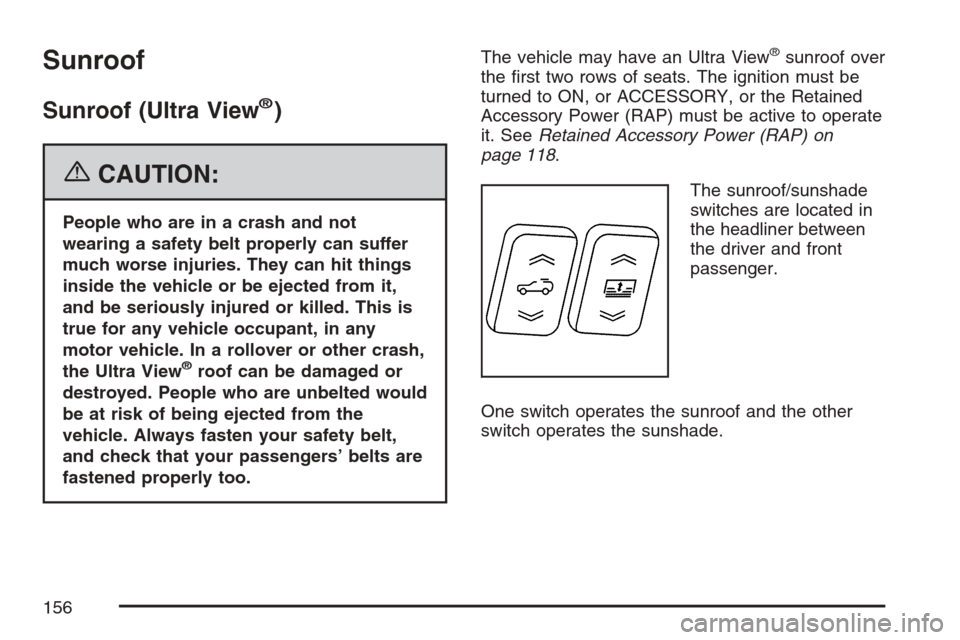
The sunroof/sunshade
switches are located in
the headliner between
the driver and front
passenger.
One switch operates the sunroof and the other
switch operates the sunshade.
156
Page 158 of 522
Sunroof (Ultra View®Plus)
{CAUTION:
People who are in a crash and not
wearing a safety belt properly can suffer
much worse injuries. They can hit things
inside the vehicle or be ejected from it,
and be seriously injured or killed. This is
true for any vehicle occupant, in any
motor vehicle. In a rollover or other crash,
the Ultra View
®roof can be damaged or
destroyed. People who are unbelted would
be at risk of being ejected from the
vehicle. Always fasten your safety belt,
and check that your passengers’ belts are
fastened properly too.The vehicle may have an Ultra View
®sunroof over
the rst two rows of seats and a smaller sunroof
over the third row seat. Both have sunshades, but
the back sunroof does not open. The ignition
must be turned to ON, or ACCESSORY, or the
Retained Accessory Power (RAP) must be active
to operate it. SeeRetained Accessory Power
(RAP) on page 118
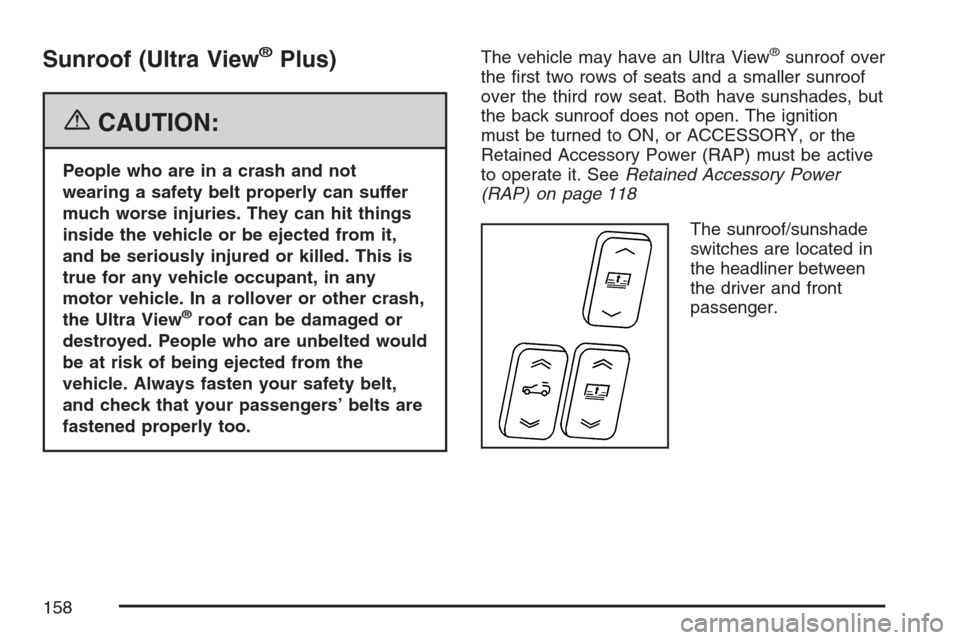
The sunroof/sunshade
switches are located in
the headliner between
the driver and front
passenger.
158
Page 183 of 522
Electric Power Management
The vehicle has Electric Power Management
(EPM) that estimates the battery’s temperature and
state of charge. It then adjusts the voltage for
best performance and extended life of the battery.
When the battery’s state of charge is low, the
voltage is raised slightly to quickly put the charge
back in. When the state of charge is high, the
voltage is lowered slightly to prevent overcharging.
If the vehicle has a voltmeter gage or voltage
display on the Driver Information Center (DIC), you
may see the voltage move up or down. This is
normal. If there is a problem, an alert will be
displayed.
The battery can be discharged at idle if the
electrical loads are very high. This is true for all
vehicles. This is because the generator (alternator)
may not be spinning fast enough at idle to
produce all the power that is needed for very high
electrical loads.A high electrical load occurs when several of the
following loads are on: headlamps, high beams, fog
lamps, rear window defogger, climate control fan at
high speed, heated seats, engine cooling fans,
trailer loads, and loads plugged into accessory
power outlets.
EPM works to prevent excessive discharge of the
battery. It does this by balancing the generator’s
output and the vehicle’s electrical needs. It
can increase engine idle speed to generate more
power, whenever needed. It can temporarily
reduce the power demands of some accessories.
Normally, these actions occur in steps or levels,
without being noticeable. In rare cases at the
highest levels of corrective action, this action may
be noticeable to the driver. If so, a Driver
Information Center (DIC) message might be
displayed, such as Battery Saver Active or Service
Battery Charging System. If this message is
displayed, it is recommended that the driver
reduce the electrical loads as much as possible.
SeeDIC Warnings and Messages on page 220.
183
Page 194 of 522
Rear Window Defogger
The rear window defogger uses a warming grid to
remove fog or frost from the rear window.
<(Rear Defogger):Press the center of the
right control to turn the rear window defogger on or
off. Be sure to clear as much snow from the
rear window as possible. The rear window
defogger turns off about 20 minutes after the
button is rst pressed if the vehicle is moving at
slower speeds. At higher vehicle speeds, the rear
defogger can stay on continuously. Each
additional press runs the defogger for about
10 minutes.
The heated outside rearview mirrors also heat to
help clear fog or frost from the surface of the
mirror when the rear window defogger is on.
Notice:Do not use a razor blade or sharp
object to clear the inside rear window. Do not
adhere anything to the defogger grid lines
in the rear glass. These actions may damage
the rear defogger. Repairs would not be
covered by your warranty.
Outlet Adjustment
Use the knobs located in the center of each outlet
to change the direction of the airow. Use the
thumbwheels to open or close the outlets.
Operation Tips
Clear away any ice, snow, or leaves from the
air inlets at the base of the windshield that
could block the ow of air into the vehicle.
Use of non-GM approved hood deectors may
adversely affect the performance of the
system.
Keep the path under the front seats clear of
objects to help circulate the air inside of the
vehicle more effectively.
If the airow seems low when the fan speed is
at the highest setting, the passenger
compartment air lter might need to be
replaced. For more information, see
Passenger Compartment Air Filter on
page 195.
Set the climate control system to AUTO fan
and mode and then adjust the temperature
setting up or down a few degrees for
best comfort.
194
Page 195 of 522
Rear Air Conditioning System
If your vehicle has the rear air conditioning system
it has two fan speed selectors. One fan speed
selector is located in the front overhead console
and the other is located in the headliner above the
second row seats. The rear air conditioning
system is designed to provide cooled air only.
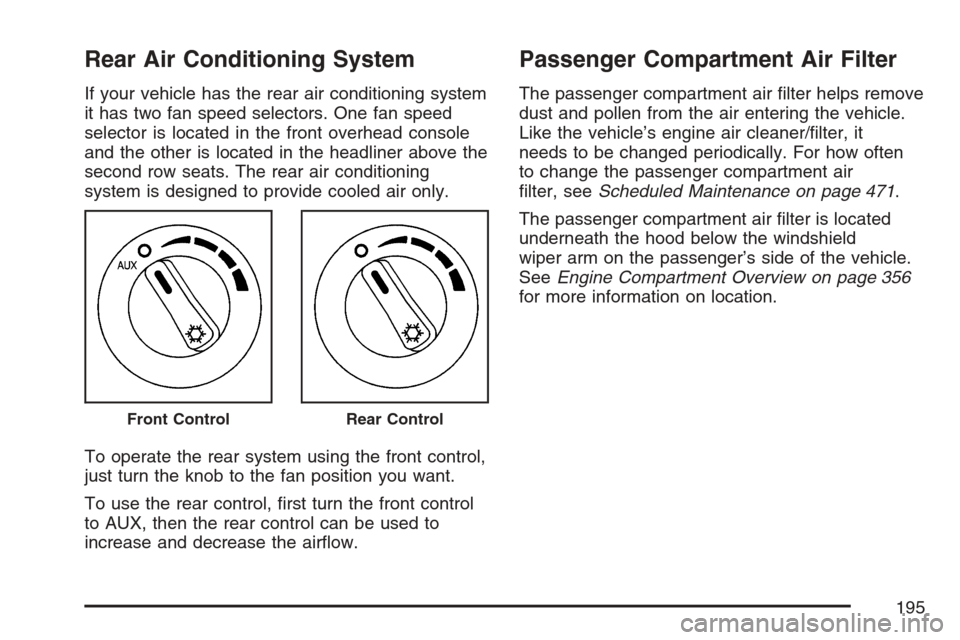
To operate the rear system using the front control,
just turn the knob to the fan position you want.
To use the rear control, rst turn the front control
to AUX, then the rear control can be used to
increase and decrease the airow.
Passenger Compartment Air Filter
The passenger compartment air lter helps remove
dust and pollen from the air entering the vehicle.
Like the vehicle’s engine air cleaner/lter, it
needs to be changed periodically. For how often
to change the passenger compartment air
lter, seeScheduled Maintenance on page 471.
The passenger compartment air lter is located
underneath the hood below the windshield
wiper arm on the passenger’s side of the vehicle.
SeeEngine Compartment Overview on page 356
for more information on location.
Front ControlRear Control
195
Page 328 of 522
If you put things inside your vehicle — like
suitcases, tools, packages, or anything else — they
will go as fast as the vehicle goes. If you have to
stop or turn quickly, or if there is a crash, they will
keep going.
{CAUTION:
Things you put inside your vehicle can
strike and injure people in a sudden stop
or turn, or in a crash.
Put things in the cargo area of your
vehicle. Try to spread the weight
evenly.
Never stack heavier things, like
suitcases, inside the vehicle so that
some of them are above the tops of
the seats.
Do not leave an unsecured child
restraint in your vehicle.
When you carry something inside the
vehicle, secure it whenever you can.
Do not leave a seat folded down
unless you need to.There is also important loading information for
off-road driving in this manual. SeeOff-Road
Driving on page 291.
Towing
Towing Your Vehicle
Consult your dealer or a professional towing
service if you need to have your disabled vehicle
towed. SeeRoadside Service on page 493.
If you want to tow your vehicle behind another
vehicle for recreational purposes (such as behind
a motorhome), see Recreational Vehicle Towing
following.
Recreational Vehicle Towing
Recreational vehicle towing means towing your
vehicle behind another vehicle – such as behind a
motorhome. The two most common types of
recreational vehicle towing are known as “dinghy
towing” (towing your vehicle with all four wheels
on the ground) and “dolly towing” (towing
your vehicle with two wheels on the ground and
two wheels up on a device known as a “dolly”).
328
Page 404 of 522
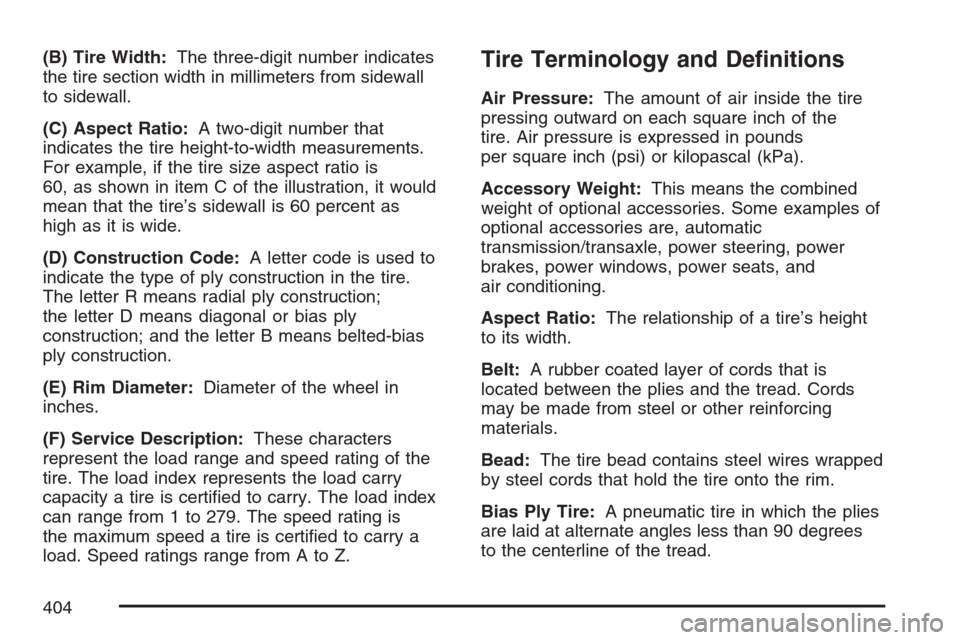
(B) Tire Width:The three-digit number indicates
the tire section width in millimeters from sidewall
to sidewall.
(C) Aspect Ratio:A two-digit number that
indicates the tire height-to-width measurements.
For example, if the tire size aspect ratio is
60, as shown in item C of the illustration, it would
mean that the tire’s sidewall is 60 percent as
high as it is wide.
(D) Construction Code:A letter code is used to
indicate the type of ply construction in the tire.
The letter R means radial ply construction;
the letter D means diagonal or bias ply
construction; and the letter B means belted-bias
ply construction.
(E) Rim Diameter:Diameter of the wheel in
inches.
(F) Service Description:These characters
represent the load range and speed rating of the
tire. The load index represents the load carry
capacity a tire is certied to carry. The load index
can range from 1 to 279. The speed rating is
the maximum speed a tire is certied to carry a
load. Speed ratings range from A to Z.Tire Terminology and Denitions
Air Pressure:The amount of air inside the tire
pressing outward on each square inch of the
tire. Air pressure is expressed in pounds
per square inch (psi) or kilopascal (kPa).
Accessory Weight:This means the combined
weight of optional accessories. Some examples of
optional accessories are, automatic
transmission/transaxle, power steering, power
brakes, power windows, power seats, and
air conditioning.
Aspect Ratio:The relationship of a tire’s height
to its width.
Belt:A rubber coated layer of cords that is
located between the plies and the tread. Cords
may be made from steel or other reinforcing
materials.
Bead:The tire bead contains steel wires wrapped
by steel cords that hold the tire onto the rim.
Bias Ply Tire:A pneumatic tire in which the plies
are laid at alternate angles less than 90 degrees
to the centerline of the tread.
404
Page 454 of 522
Electrical System
Add-On Electrical Equipment
Notice:Do not add anything electrical to your
vehicle unless you check with your dealer
rst. Some electrical equipment can damage
your vehicle and the damage would not
be covered by your warranty. Some add-on
electrical equipment can keep other
components from working as they should.
Add-on equipment can drain your vehicle’s battery,
even if your vehicle is not operating.
Your vehicle has an airbag system. Before
attempting to add anything electrical to your
vehicle, seeServicing Your Airbag-Equipped
Vehicle on page 87.
Windshield Wiper Fuses
The windshield wiper motor is protected by an
internal circuit breaker. If the wiper motor
overheats due to heavy snow, the wipers will stop
until the motor cools and will then restart.
Power Windows and Other Power
Options
Circuit breakers protect the power windows and
power seats. When the current load is too
heavy, the circuit breaker opens and closes,
protecting the circuit until the problem is xed or
goes away.
454
Page 463 of 522

Mini Fuses Usage
REAR DEFOG Rear Window Defogger
SPARE Spare
BCM 3Hush Panel Lamps, Overhead
Courtesy Lamp Assembly, Right
Side Front Turn Lamp
REAR A/C Rear Air Conditioning System
RUN Climate Control Module
HDT STR WHL Not Used
SPARE Spare
SPARE Spare
SPARE Spare
DR LCK Rear Door Locks
PDMPassenger Door Module (Locks,
Outside Mirror, Window Switches)
SIRSensing Diagnostic Module (SDM),
Occupant Sensor, Roll-over Sensor
SPARE Spare
MRRTD Suspension Module
ELCElectronic Leveling Compressor
(ELC) Exhaust Solenoid, ELC RelayJ Case Fuses Usage
SUNROOF MOD Power Sunroof Module
PWR LIFT
GATEPower Liftgate Motors
Circuit
BreakersUsage
PWR SEATS Power Seat Motors
Misc. Usage
FUSE PULLER Fuse Puller
JOINT
CONNECTORJoint Connector
463