ECU CADILLAC SRX 2007 1.G Workshop Manual
[x] Cancel search | Manufacturer: CADILLAC, Model Year: 2007, Model line: SRX, Model: CADILLAC SRX 2007 1.GPages: 522, PDF Size: 2.71 MB
Page 328 of 522
If you put things inside your vehicle — like
suitcases, tools, packages, or anything else — they
will go as fast as the vehicle goes. If you have to
stop or turn quickly, or if there is a crash, they will
keep going.
{CAUTION:
Things you put inside your vehicle can
strike and injure people in a sudden stop
or turn, or in a crash.
Put things in the cargo area of your
vehicle. Try to spread the weight
evenly.
Never stack heavier things, like
suitcases, inside the vehicle so that
some of them are above the tops of
the seats.
Do not leave an unsecured child
restraint in your vehicle.
When you carry something inside the
vehicle, secure it whenever you can.
Do not leave a seat folded down
unless you need to.There is also important loading information for
off-road driving in this manual. SeeOff-Road
Driving on page 291.
Towing
Towing Your Vehicle
Consult your dealer or a professional towing
service if you need to have your disabled vehicle
towed. SeeRoadside Service on page 493.
If you want to tow your vehicle behind another
vehicle for recreational purposes (such as behind
a motorhome), see Recreational Vehicle Towing
following.
Recreational Vehicle Towing
Recreational vehicle towing means towing your
vehicle behind another vehicle – such as behind a
motorhome. The two most common types of
recreational vehicle towing are known as “dinghy
towing” (towing your vehicle with all four wheels
on the ground) and “dolly towing” (towing
your vehicle with two wheels on the ground and
two wheels up on a device known as a “dolly”).
328
Page 338 of 522
Safety Chains
You should always attach chains between your
vehicle and your trailer. Cross the safety
chains under the tongue of the trailer so that the
tongue will not drop to the road if it becomes
separated from the hitch. Instructions about safety
chains may be provided by the hitch manufacturer
or by the trailer manufacturer. Follow the
manufacturer’s recommendation for attaching
safety chains and do not attach them to the
bumper. Always leave just enough slack so you
can turn with your rig. And, never allow safety
chains to drag on the ground.
Trailer Brakes
If you tow more than 1,000 lbs (450 kg), use trailer
brakes. Because your vehicle has anti-lock
brakes, don’t try to tap into your vehicle’s hydraulic
brake system. If you do, both brake systems
won’t work well, or at all.
Be sure to read and follow the instructions for the
trailer brakes so you’ll be able to install, adjust
and maintain them properly.
Driving with a Trailer
Towing a trailer requires a certain amount of
experience. Before setting out for the open road,
you’ll want to get to know your rig. Acquaint
yourself with the feel of handling and braking with
the added weight of the trailer. And always
keep in mind that the vehicle you are driving is
now a good deal longer and not nearly as
responsive as your vehicle is by itself.
Before you start, check all trailer hitch parts and
attachments, safety chains, electrical connector,
lamps, tires and mirror adjustment. If the trailer has
electric brakes, start your vehicle and trailer
moving and then apply the trailer brake controller
by hand to be sure the brakes are working.
This lets you check your electrical connection at
the same time.
During your trip, check occasionally to be sure
that the load is secure, and that the lamps and any
trailer brakes are still working.
338
Page 371 of 522
Adding Coolant
If you need more coolant, add the proper
DEX-COOL®coolant mixture at the surge tank,
but only when the engine is cool.
{CAUTION:
You can be burned if you spill coolant on
hot engine parts. Coolant contains
ethylene glycol, and it will burn if the
engine parts are hot enough. Do not spill
coolant on a hot engine.
When replacing the pressure cap, make sure it is
hand-tight and fully seated.
Coolant Surge Tank Pressure Cap
Notice:If the pressure cap is not tightly
installed, coolant loss and possible engine
damage may occur. Be sure the cap is properly
and tightly secured.
The coolant surge tank pressure cap must be fully
installed on the coolant surge tank. SeeEngine
Compartment Overview on page 356for more
information on location.
371
Page 423 of 522
Notice:If your vehicle has a tire size other
than P255/50R20 use tire chains only where
legal and only when you must. Use chains that
are the proper size for your tires. Install
them on the tires of the rear axle. Do not use
chains on the tires of the front axle. Tighten
them as tightly as possible with the ends
securely fastened. Drive slowly and follow the
chain manufacturer’s instructions. If you
can hear the chains contacting your vehicle,
stop and retighten them. If the contact
continues, slow down until it stops. Driving
too fast or spinning the wheels with chains on
will damage your vehicle.If a Tire Goes Flat
It is unusual for a tire to blowout while you are
driving, especially if you maintain your vehicle’s
tires properly. If air goes out of a tire, it is
much more likely to leak out slowly. But if you
should ever have a blowout, here are a few tips
about what to expect and what to do:
If a front tire fails, the at tire will create a drag
that pulls the vehicle toward that side. Take your
foot off the accelerator pedal and grip the
steering wheel rmly. Steer to maintain lane
position, and then gently brake to a stop well out
of the traffic lane.
A rear blowout, particularly on a curve, acts much
like a skid and may require the same correction
you would use in a skid. In any rear blowout
remove your foot from the accelerator pedal. Get
the vehicle under control by steering the way
you want the vehicle to go. It may be very bumpy
and noisy, but you can still steer. Gently brake
to a stop, well off the road if possible.
423
Page 434 of 522
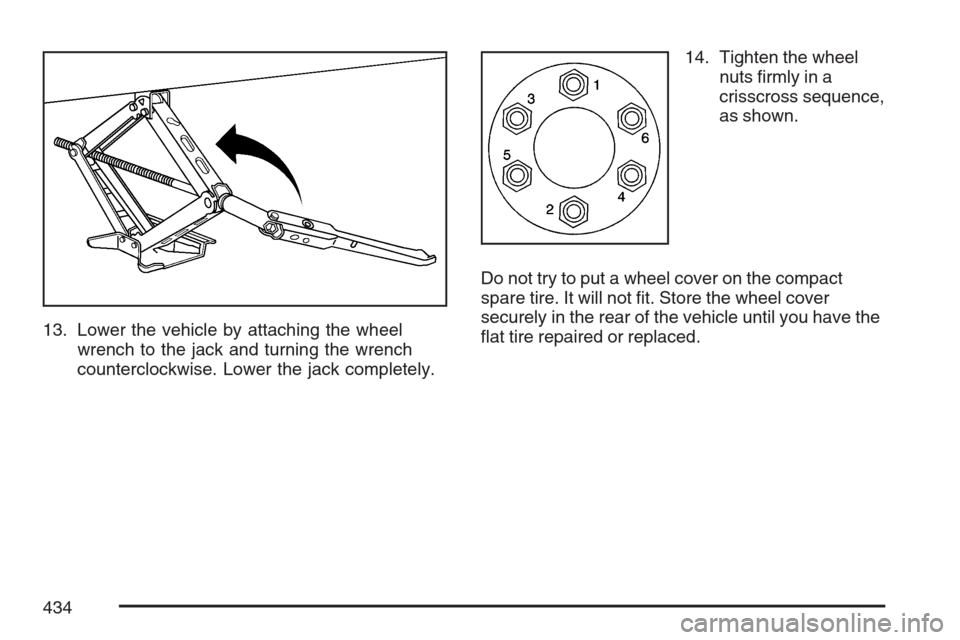
13. Lower the vehicle by attaching the wheel
wrench to the jack and turning the wrench
counterclockwise. Lower the jack completely.14. Tighten the wheel
nuts rmly in a
crisscross sequence,
as shown.
Do not try to put a wheel cover on the compact
spare tire. It will not t. Store the wheel cover
securely in the rear of the vehicle until you have the
at tire repaired or replaced.
434
Page 441 of 522
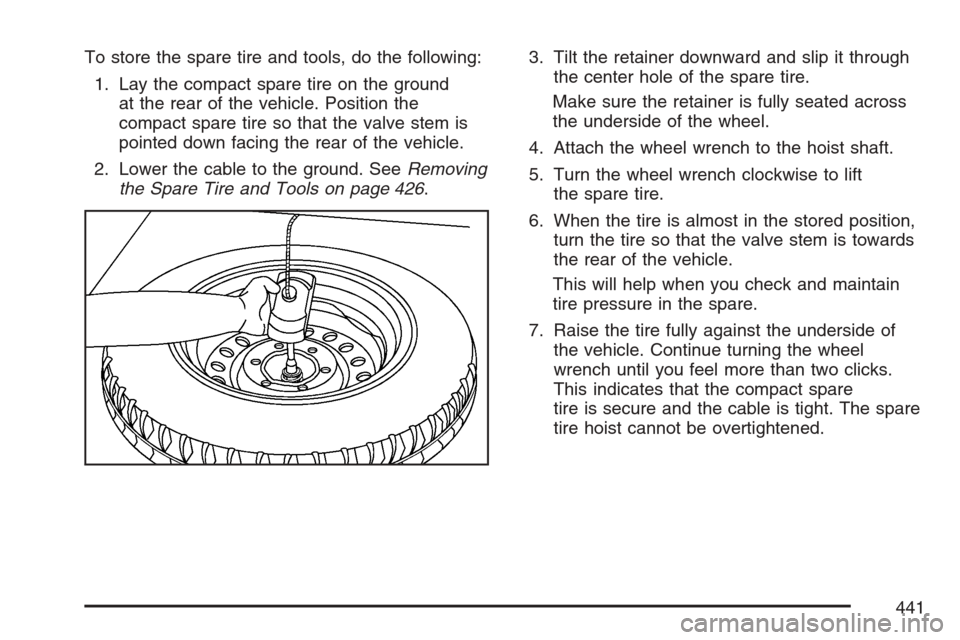
To store the spare tire and tools, do the following:
1. Lay the compact spare tire on the ground
at the rear of the vehicle. Position the
compact spare tire so that the valve stem is
pointed down facing the rear of the vehicle.
2. Lower the cable to the ground. SeeRemoving
the Spare Tire and Tools on page 426.3. Tilt the retainer downward and slip it through
the center hole of the spare tire.
Make sure the retainer is fully seated across
the underside of the wheel.
4. Attach the wheel wrench to the hoist shaft.
5. Turn the wheel wrench clockwise to lift
the spare tire.
6. When the tire is almost in the stored position,
turn the tire so that the valve stem is towards
the rear of the vehicle.
This will help when you check and maintain
tire pressure in the spare.
7. Raise the tire fully against the underside of
the vehicle. Continue turning the wheel
wrench until you feel more than two clicks.
This indicates that the compact spare
tire is secure and the cable is tight. The spare
tire hoist cannot be overtightened.
441
Page 442 of 522
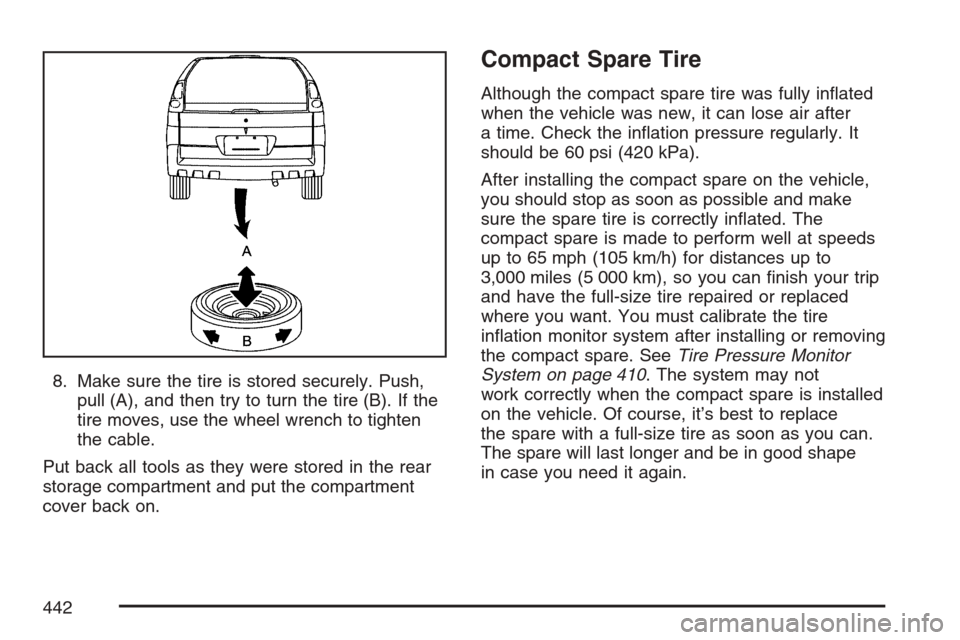
8. Make sure the tire is stored securely. Push,
pull (A), and then try to turn the tire (B). If the
tire moves, use the wheel wrench to tighten
the cable.
Put back all tools as they were stored in the rear
storage compartment and put the compartment
cover back on.
Compact Spare Tire
Although the compact spare tire was fully inated
when the vehicle was new, it can lose air after
a time. Check the ination pressure regularly. It
should be 60 psi (420 kPa).
After installing the compact spare on the vehicle,
you should stop as soon as possible and make
sure the spare tire is correctly inated. The
compact spare is made to perform well at speeds
up to 65 mph (105 km/h) for distances up to
3,000 miles (5 000 km), so you can nish your trip
and have the full-size tire repaired or replaced
where you want. You must calibrate the tire
ination monitor system after installing or removing
the compact spare. SeeTire Pressure Monitor
System on page 410. The system may not
work correctly when the compact spare is installed
on the vehicle. Of course, it’s best to replace
the spare with a full-size tire as soon as you can.
The spare will last longer and be in good shape
in case you need it again.
442
Page 477 of 522
Notice:It is important to check the engine oil
regularly and keep it at the proper level.
Failure to keep the engine oil at the proper
level can cause damage to the engine not
covered by your warranty.
Engine Coolant Level Check
Check the engine coolant level and add
DEX-COOL®coolant mixture if necessary. See
Engine Coolant on page 368for further details.
Windshield Washer Fluid Level Check
Check the windshield washer uid level in
the windshield washer uid reservoir and add the
proper uid if necessary.
At Least Once a Month
Tire Ination Check
Visually inspect your vehicle’s tires and make
sure they are inated to the correct pressures.
Do not forget to check the spare tire. See
Ination - Tire Pressure on page 407. Check to
make sure the spare tire is stored securely.
SeeChanging a Flat Tire on page 424.
At Least Once a Year
Starter Switch Check
{CAUTION:
When you are doing this inspection, the
vehicle could move suddenly. If the
vehicle moves, you or others could be
injured.
1. Before you start, be sure you have enough
room around the vehicle.
2. Firmly apply both the parking brake and the
regular brake. SeeParking Brake on
page 127.
Do not use the accelerator pedal, and be
ready to turn off the engine immediately if
it starts.
3. Try to start the engine in each gear. The
vehicle should start only in PARK (P) or
NEUTRAL (N). If the vehicle starts in any
other position, contact your GM Goodwrench
®
dealer for service.
477
Page 493 of 522
Roadside Service
In the United States or Canada, call
1-800-882-1112. Service is available 24 hours a
day, 365 days a year.
Who Is Covered?
Roadside Assistance coverage is for the vehicle
operator, regardless of ownership. A person driving
this vehicle without the consent of the owner is
not eligible for coverage.
The following services are provided in the United
States during the Bumper-to-Bumper warranty
period and in Canada, during the Base Warranty
coverage period of the New Vehicle Limited
Warranty, up to a maximum coverage of $100.
These services are provided at a nominal charge
if the Cadillac is no longer covered by the
warranties listed previously. Roadside Service is
available only in the United States and Canada.
Cadillac Owner Privileges™
Roadside Service provides several Cadillac Owner
Privileges™ at “no charge,” throughout your
Cadillac Warranty Period — 48 months/
50,000 miles (80 000 km).Emergency Road Service is performed on site for
the following situations:
Towing Service:Emergency towing from a
public roadway or highway to the nearest
dealership for warranty service or in the event
of a vehicle-disabling accident. Winch-out
assistance when the vehicle is mired in sand,
mud, or snow.
Battery Jump Starting:No-start occurrences
which require a battery jump start will be
covered at no charge.
Lock Out Assistance:To ensure security,
the driver must present the vehicle registration
and personal ID before lock-out service is
provided. Lock-out service will be covered at
no charge if you are unable to gain entry
into your vehicle. If your vehicle will not start,
Roadside Service will arrange to have
your vehicle towed to the nearest authorized
dealership. In the United States, replacement
keys made at the customer’s expense will
be delivered within 10 miles.
493
Page 494 of 522
Fuel Delivery:Delivery of enough fuel for the
customer to get to the nearest service station
(approximately $5 in the United States and
10 litres in Canada).
Flat Tire Change (Covers change only):
Installation of your spare tire, in good
condition, will be covered at no charge. The
customer is responsible for the repair or
replacement of the tire if not covered by a
warrantable failure.
Trip Interruption:If your trip is interrupted
due to a warranty failure, incidental expenses
may be reimbursed during the
48 months/50,000 miles (80 000 km) warranty
period. Items covered are hotel, meals,
and rental car.
Additional Services for Canadian
Customers
Trip Routing Service:Upon request, Cadillac
Roadside Service will send you detailed,
computer-personalized maps, highlighting your
choice of either the most direct route or the
most scenic route to your destination,
anywhere in North America, along with any
helpful travel information we may have
pertaining to your trip. To request this service,
please call us toll-free at 1-800-268-6800.
We will make every attempt to send your
personalized trip routing as quickly as
possible, but it is best to allow three weeks
before your planned departure date. Trip
routing requests will be limited to six
per calendar year.
Alternative Service:There may be times
when Roadside Service cannot provide
timely assistance. Your advisor may authorize
you to secure local emergency road service,
and you will be reimbursed up to $100
upon submission of the original receipt to
Cadillac Roadside Service
®.
494