climate control CADILLAC SRX 2009 1.G User Guide
[x] Cancel search | Manufacturer: CADILLAC, Model Year: 2009, Model line: SRX, Model: CADILLAC SRX 2009 1.GPages: 442, PDF Size: 2.42 MB
Page 160 of 442
Climate Controls
Dual Climate Control System
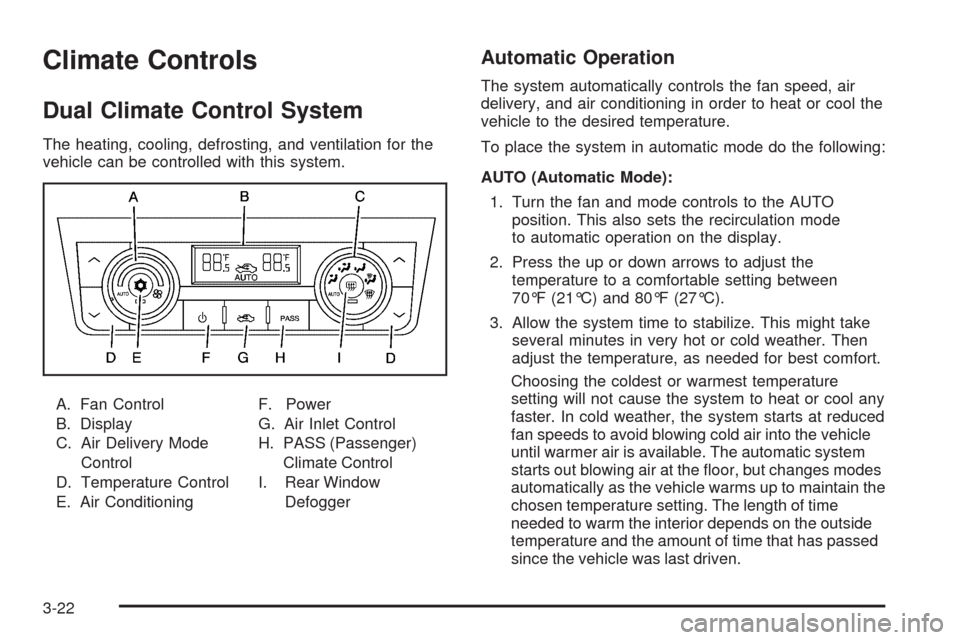
The heating, cooling, defrosting, and ventilation for the
vehicle can be controlled with this system.
A. Fan Control
B. Display
C. Air Delivery Mode
Control
D. Temperature Control
E. Air ConditioningF. Power
G. Air Inlet Control
H. PASS (Passenger)
Climate Control
I. Rear Window
Defogger
Automatic Operation
The system automatically controls the fan speed, air
delivery, and air conditioning in order to heat or cool the
vehicle to the desired temperature.
To place the system in automatic mode do the following:
AUTO (Automatic Mode):
1. Turn the fan and mode controls to the AUTO
position. This also sets the recirculation mode
to automatic operation on the display.
2. Press the up or down arrows to adjust the
temperature to a comfortable setting between
70°F (21°C) and 80°F (27°C).
3. Allow the system time to stabilize. This might take
several minutes in very hot or cold weather. Then
adjust the temperature, as needed for best comfort.
Choosing the coldest or warmest temperature
setting will not cause the system to heat or cool any
faster. In cold weather, the system starts at reduced
fan speeds to avoid blowing cold air into the vehicle
until warmer air is available. The automatic system
starts out blowing air at the oor, but changes modes
automatically as the vehicle warms up to maintain the
chosen temperature setting. The length of time
needed to warm the interior depends on the outside
temperature and the amount of time that has passed
since the vehicle was last driven.
3-22
Page 161 of 442
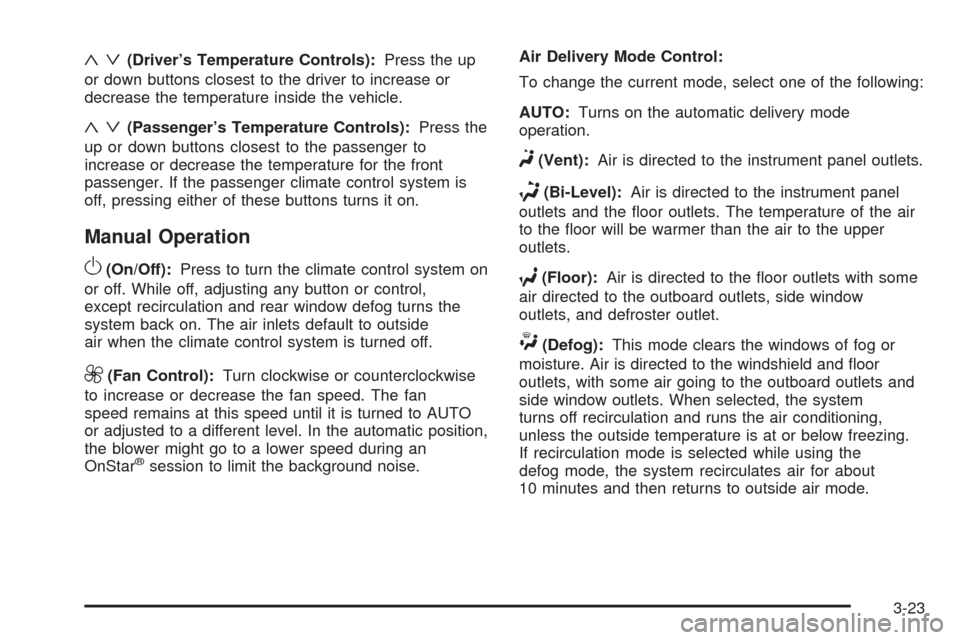
«ª(Driver’s Temperature Controls):Press the up
or down buttons closest to the driver to increase or
decrease the temperature inside the vehicle.
«ª(Passenger’s Temperature Controls):Press the
up or down buttons closest to the passenger to
increase or decrease the temperature for the front
passenger. If the passenger climate control system is
off, pressing either of these buttons turns it on.
Manual Operation
O(On/Off):Press to turn the climate control system on
or off. While off, adjusting any button or control,
except recirculation and rear window defog turns the
system back on. The air inlets default to outside
air when the climate control system is turned off.
9(Fan Control):Turn clockwise or counterclockwise
to increase or decrease the fan speed. The fan
speed remains at this speed until it is turned to AUTO
or adjusted to a different level. In the automatic position,
the blower might go to a lower speed during an
OnStar
®session to limit the background noise.Air Delivery Mode Control:
To change the current mode, select one of the following:
AUTO:Turns on the automatic delivery mode
operation.
F(Vent):Air is directed to the instrument panel outlets.
*(Bi-Level):Air is directed to the instrument panel
outlets and the oor outlets. The temperature of the air
to the oor will be warmer than the air to the upper
outlets.
7(Floor):Air is directed to the oor outlets with some
air directed to the outboard outlets, side window
outlets, and defroster outlet.
W(Defog):This mode clears the windows of fog or
moisture. Air is directed to the windshield and oor
outlets, with some air going to the outboard outlets and
side window outlets. When selected, the system
turns off recirculation and runs the air conditioning,
unless the outside temperature is at or below freezing.
If recirculation mode is selected while using the
defog mode, the system recirculates air for about
10 minutes and then returns to outside air mode.
3-23
Page 162 of 442
0(Defrost):This mode clears the windshield of fog or
frost more quickly. Air is directed to the windshield
with some air going to the side window outlets. When
selected, the system turns off recirculation and runs the
air conditioning compressor, unless the outside
temperature is at or below freezing.
Do not drive the vehicle until all the windows are clear.
PASS (Passenger’s Climate Control):Press to
turn the passenger climate control system on or off.
Then press the passenger
«orªbuttons to adjust
the temperature. Pressing PASS again automatically
sets the passengers temperature to the drivers setting.
Turning off the passenger temperature display does
not turn off the passenger climate control system.
Air Inlet Modes
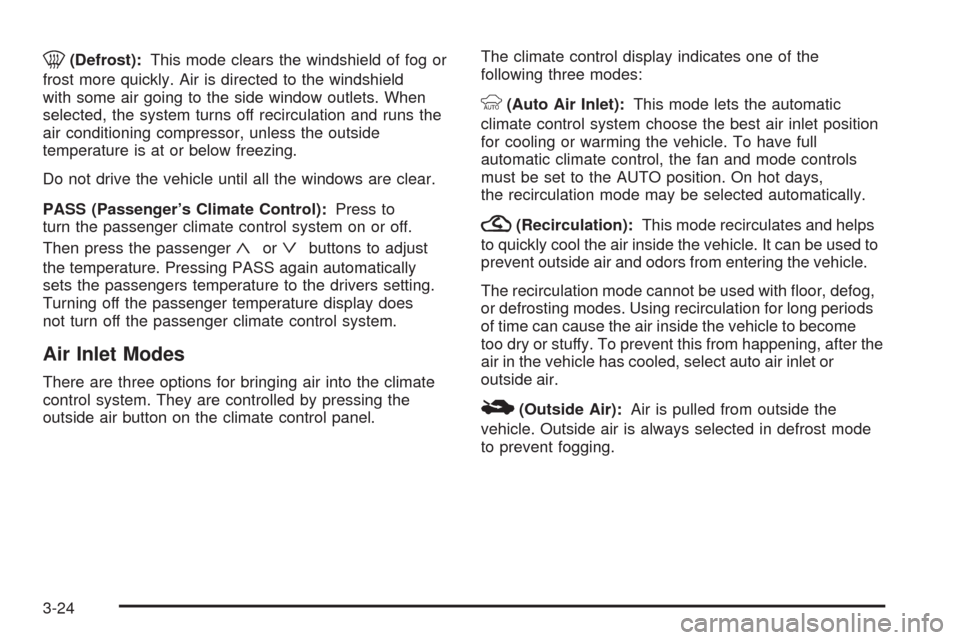
There are three options for bringing air into the climate
control system. They are controlled by pressing the
outside air button on the climate control panel.The climate control display indicates one of the
following three modes:
9(Auto Air Inlet):This mode lets the automatic
climate control system choose the best air inlet position
for cooling or warming the vehicle. To have full
automatic climate control, the fan and mode controls
must be set to the AUTO position. On hot days,
the recirculation mode may be selected automatically.
?(Recirculation):This mode recirculates and helps
to quickly cool the air inside the vehicle. It can be used to
prevent outside air and odors from entering the vehicle.
The recirculation mode cannot be used with oor, defog,
or defrosting modes. Using recirculation for long periods
of time can cause the air inside the vehicle to become
too dry or stuffy. To prevent this from happening, after the
air in the vehicle has cooled, select auto air inlet or
outside air.
F(Outside Air):Air is pulled from outside the
vehicle. Outside air is always selected in defrost mode
to prevent fogging.
3-24
Page 163 of 442
Air Conditioning
#
(Air Conditioning):Press to turn the air
conditioning on or off, and override the automatic
system. When selecting the AUTO fan or AUTO mode,
the air conditioning comes on automatically, as
necessary.
The air conditioning system removes moisture from the
air, so water might drip underneath the vehicle while
idling or after turning off the engine. This is normal.
Sensors
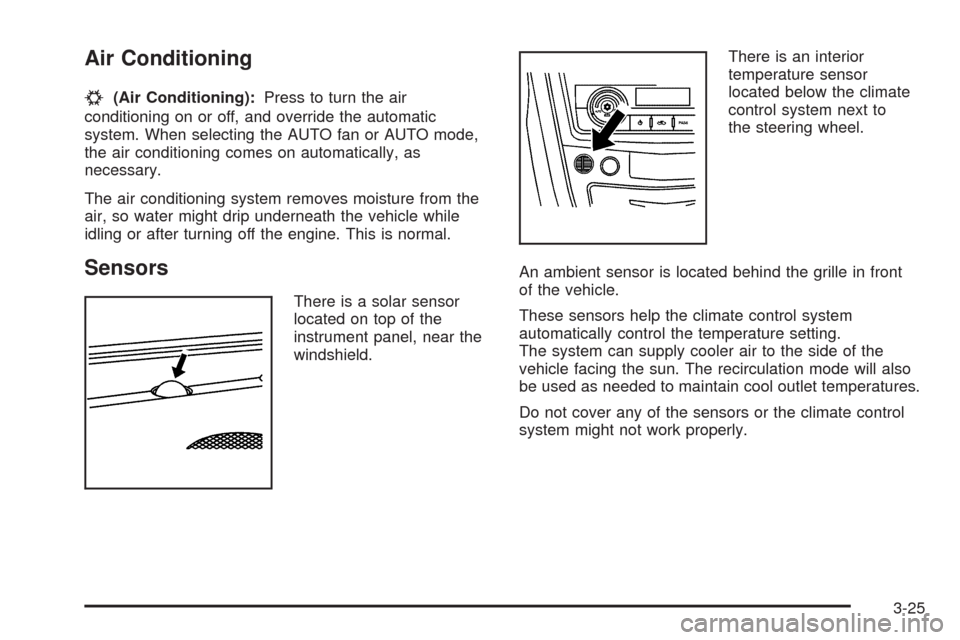
There is a solar sensor
located on top of the
instrument panel, near the
windshield.There is an interior
temperature sensor
located below the climate
control system next to
the steering wheel.
An ambient sensor is located behind the grille in front
of the vehicle.
These sensors help the climate control system
automatically control the temperature setting.
The system can supply cooler air to the side of the
vehicle facing the sun. The recirculation mode will also
be used as needed to maintain cool outlet temperatures.
Do not cover any of the sensors or the climate control
system might not work properly.
3-25
Page 164 of 442
Rear Window Defogger
The rear window defogger uses a warming grid to
remove fog or frost from the rear window.
<(Rear Defogger):Press to turn the rear window
defogger on or off. The rear window defogger stays on
for about 20 minutes, before turning off. At higher
vehicle speeds, the rear defogger can stay on
continuously. Each additional press runs the defogger
for about 10 minutes.
When the rear window defogger is pressed, the heated
outside mirrors come on. They help to clear fog or
frost from the surface of the mirror. SeeOutside Heated
Mirrors on page 2-40.
Notice:Do not use a razor blade or sharp object
to clear the inside rear window. Do not adhere
anything to the defogger grid lines in the rear glass.
These actions may damage the rear defogger.
Repairs would not be covered by your warranty.
Outlet Adjustment
Use the knobs located in the center of each outlet to
change the direction of the airow. Use the thumbwheels
to open or close the outlets.
Operation Tips
Clear away any ice, snow, or leaves from the air
inlets at the base of the windshield that could
block the ow of air into the vehicle.
Use of non-GM approved hood deectors may
adversely affect the performance of the system.
Keep the path under the front seats clear of objects
to help circulate the air inside of the vehicle more
effectively.
If the airow seems low when the fan speed is at
the highest setting, the passenger compartment
air lter might need to be replaced. For more
information, seePassenger Compartment Air Filter
on page 3-28.
Set the climate control system to AUTO fan and
mode and then adjust the temperature setting
up or down a few degrees for best comfort.
3-26
Page 193 of 442
REAR ACCESS OPEN
This message displays when the liftgate is not closed
completely. Make sure that the liftgate is closed
completely.
REMOTE KEY LEARNING ACTIVE
This message displays while you are matching a
Remote Keyless Entry (RKE) transmitter to your vehicle.
See “Matching Transmitter(s) to Your Vehicle” under
Remote Keyless Entry (RKE) System Operation
on page 2-4andDIC Operation and Displays on
page 3-46for more information.
REPLACE BATTERY IN REMOTE KEY
This message displays when the battery in the Remote
Keyless Entry (RKE) transmitter needs to be replaced.
To replace the battery, see “Battery Replacement” under
Remote Keyless Entry (RKE) System Operation on
page 2-4.
RIGHT REAR DOOR OPEN
This message displays when the passenger side rear
door is not closed completely. Make sure that the door is
closed completely.
SERVICE AIR BAG
This message displays when there is a problem with the
airbag system. Have your vehicle serviced by your
dealer/retailer immediately. SeeAirbag Readiness Light
on page 3-32for more information.
SERVICE A/C SYSTEM
This message displays when the air delivery mode
door or the electronic sensors that control the air
conditioning and heating systems are no longer working.
Have the climate control system serviced by your
dealer/retailer if you notice a drop in heating and air
conditioning efficiency.
SERVICE BATTERY CHARGING
SYSTEM
This message displays when there is a problem with the
generator and battery charging systems. Driving with
this problem could drain the battery. Turn off all
unnecessary accessories. Stop and turn off the vehicle
as soon as it is safe to do so. Have the electrical
system checked by your dealer/retailer. Under certain
conditions, the charging system light may also turn on in
the instrument panel cluster. SeeCharging System
Light on page 3-35for more information.
3-55
Page 237 of 442
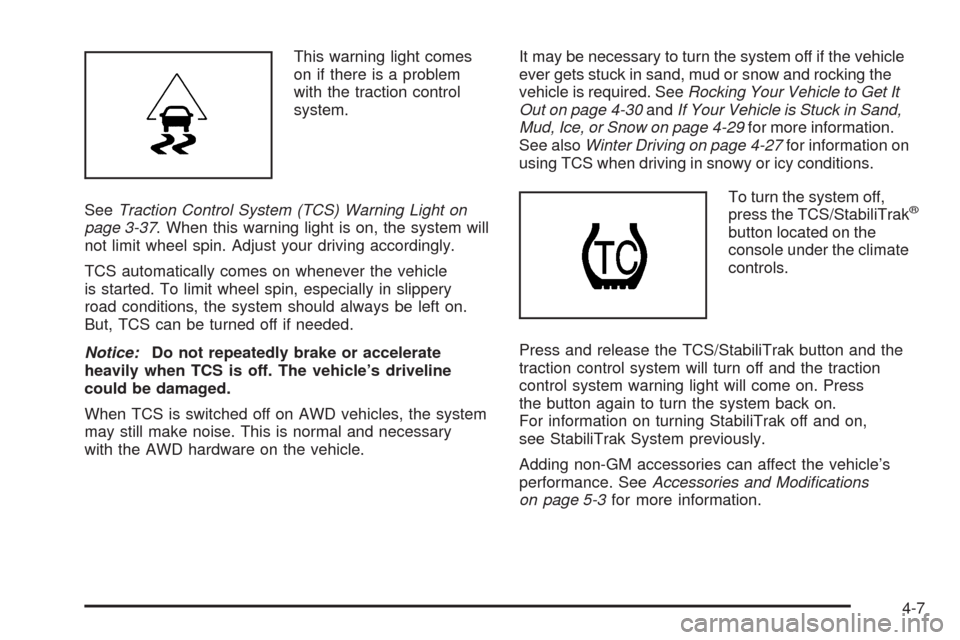
This warning light comes
on if there is a problem
with the traction control
system.
SeeTraction Control System (TCS) Warning Light on
page 3-37. When this warning light is on, the system will
not limit wheel spin. Adjust your driving accordingly.
TCS automatically comes on whenever the vehicle
is started. To limit wheel spin, especially in slippery
road conditions, the system should always be left on.
But, TCS can be turned off if needed.
Notice:Do not repeatedly brake or accelerate
heavily when TCS is off. The vehicle’s driveline
could be damaged.
When TCS is switched off on AWD vehicles, the system
may still make noise. This is normal and necessary
with the AWD hardware on the vehicle.It may be necessary to turn the system off if the vehicle
ever gets stuck in sand, mud or snow and rocking the
vehicle is required. SeeRocking Your Vehicle to Get It
Out on page 4-30andIf Your Vehicle is Stuck in Sand,
Mud, Ice, or Snow on page 4-29for more information.
See alsoWinter Driving on page 4-27for information on
using TCS when driving in snowy or icy conditions.
To turn the system off,
press the TCS/StabiliTrak
®
button located on the
console under the climate
controls.
Press and release the TCS/StabiliTrak button and the
traction control system will turn off and the traction
control system warning light will come on. Press
the button again to turn the system back on.
For information on turning StabiliTrak off and on,
see StabiliTrak System previously.
Adding non-GM accessories can affect the vehicle’s
performance. SeeAccessories and Modifications
on page 5-3for more information.
4-7
Page 258 of 442
TheAntilock Brake System (ABS) on page 4-4improves
vehicle stability during hard stops on a slippery roads, but
apply the brakes sooner than when on dry pavement.
Allow greater following distance on any slippery road
and watch for slippery spots. Icy patches can occur on
otherwise clear roads in shaded areas. The surface
of a curve or an overpass can remain icy when the
surrounding roads are clear. Avoid sudden steering
maneuvers and braking while on ice.
Turn off cruise control, if equipped, on slippery surfaces.
Blizzard Conditions
Being stuck in snow can be in a serious situation. Stay
with the vehicle unless there is help nearby. If possible,
use theRoadside Service on page 7-7. To get help and
keep everyone in the vehicle safe:
Turn on theHazard Warning Flashers on page 3-6.
Tie a red cloth to an outside mirror.
{CAUTION:
Snow can trap engine exhaust under the vehicle.
This may cause exhaust gases to get inside.
Engine exhaust contains carbon monoxide (CO)
which cannot be seen or smelled. It can cause
unconsciousness and even death.
If the vehicle is stuck in the snow:
Clear away snow from around the base of your
vehicle, especially any that is blocking the
exhaust pipe.
Check again from time to time to be sure snow
does not collect there.
Open a window about two inches (5 cm) on the
side of the vehicle that is away from the wind to
bring in fresh air.
Fully open the air outlets on or under the
instrument panel.
Adjust the Climate Control system to a setting
that circulates the air inside the vehicle and set
the fan speed to the highest setting. See
Climate Control System in the Index.
CAUTION: (Continued)
4-28
Page 276 of 442
Driving with a Trailer
{CAUTION:
When towing a trailer, exhaust gases may collect
at the rear of the vehicle and enter if the liftgate,
trunk/hatch, or rear-most window is open.
Engine exhaust contains carbon monoxide (CO)
which cannot be seen or smelled. It can cause
unconsciousness and even death.
To maximize safety when towing a trailer:
Have the exhaust system inspected for leaks
and make necessary repairs before starting
a trip.
Never drive with the liftgate, trunk/hatch, or
rear-most window open.
Fully open the air outlets on or under the
instrument panel.
Adjust the Climate Control system to a setting
that brings in only outside air and set the fan
speed to the highest setting. See Climate
Control System in the Index.
For more information about carbon monoxide,
seeEngine Exhaust on page 2-36.Towing a trailer requires a certain amount of experience.
Get to know the rig before setting out for the open
road. Get acquainted with the feel of handling and
braking with the added weight of the trailer. And always
keep in mind that the vehicle you are driving is now
longer and not as responsive as the vehicle is by itself.
Before starting, check all trailer hitch parts and
attachments, safety chains, electrical connectors,
lamps, tires and mirror adjustments. If the trailer has
electric brakes, start the vehicle and trailer moving and
then apply the trailer brake controller by hand to be
sure the brakes are working. This checks the electrical
connection at the same time.
During the trip, check occasionally to be sure that the
load is secure, and that the lamps and any trailer brakes
are still working.
While towing a trailer or when exposed to long periods
of sunshine, the oor of the truck bed may become
very warm. Avoid putting items in the truck bed
that might be affected by high ambient temperatures.
4-46
Page 349 of 442
While the tires available on General Motors
passenger cars and light trucks may vary with
respect to these grades, they must also conform
to federal safety requirements and additional
General Motors Tire Performance Criteria (TPC)
standards.
Treadwear
The treadwear grade is a comparative rating
based on the wear rate of the tire when tested
under controlled conditions on a specied
government test course. For example, a tire
graded 150 would wear one and a half (1.5) times
as well on the government course as a tire
graded 100. The relative performance of tires
depends upon the actual conditions of their use,
however, and may depart signicantly from
the norm due to variations in driving habits, service
practices, and differences in road characteristics
and climate.
Traction – AA, A, B, C
The traction grades, from highest to lowest, are AA,
A, B, and C. Those grades represent the tire’s
ability to stop on wet pavement as measured under
controlled conditions on specied government test
surfaces of asphalt and concrete. A tire marked C
may have poor traction performance.
{WARNING:
The traction grade assigned to this tire is
based on straight-ahead braking traction
tests, and does not include acceleration,
cornering, hydroplaning, or peak traction
characteristics.
5-69