parking brake CADILLAC STS 2006 1.G Owner's Manual
[x] Cancel search | Manufacturer: CADILLAC, Model Year: 2006, Model line: STS, Model: CADILLAC STS 2006 1.GPages: 480, PDF Size: 2.74 MB
Page 398 of 480
{CAUTION:
Changing a tire can be dangerous. The vehicle
can slip off the jack and roll over or fall on you
or other people. You and they could be badly
injured or even killed. Find a level place to
change your tire. To help prevent the vehicle
from moving:
1. Set the parking brake rmly.
2. Put the shift lever in PARK (P).
3. Turn off the engine and do not restart
while the vehicle is raised.
4. Do not allow passengers to remain in
the vehicle.
To be even more certain the vehicle will not
move, you should put blocks at the front
and rear of the tire farthest away from the
one being changed. That would be the tire,
on the other side, at the opposite end of the
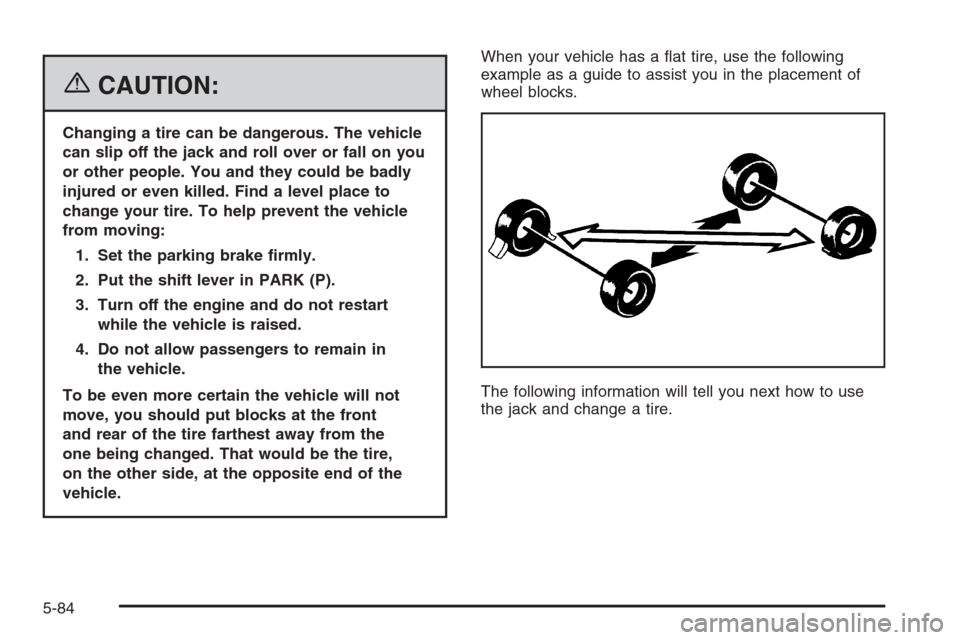
vehicle.When your vehicle has a at tire, use the following
example as a guide to assist you in the placement of
wheel blocks.
The following information will tell you next how to use
the jack and change a tire.
5-84
Page 423 of 480
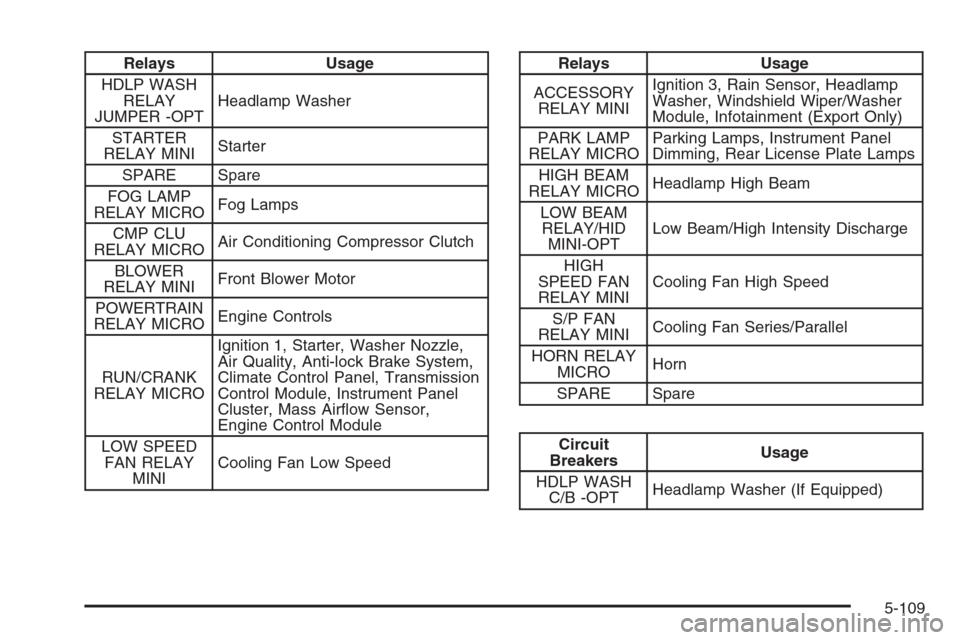
Relays Usage
HDLP WASH
RELAY
JUMPER -OPTHeadlamp Washer
STARTER
RELAY MINIStarter
SPARE Spare
FOG LAMP
RELAY MICROFog Lamps
CMP CLU
RELAY MICROAir Conditioning Compressor Clutch
BLOWER
RELAY MINIFront Blower Motor
POWERTRAIN
RELAY MICROEngine Controls
RUN/CRANK
RELAY MICROIgnition 1, Starter, Washer Nozzle,
Air Quality, Anti-lock Brake System,
Climate Control Panel, Transmission
Control Module, Instrument Panel
Cluster, Mass Airow Sensor,
Engine Control Module
LOW SPEED
FAN RELAY
MINICooling Fan Low SpeedRelays Usage
ACCESSORY
RELAY MINIIgnition 3, Rain Sensor, Headlamp
Washer, Windshield Wiper/Washer
Module, Infotainment (Export Only)
PARK LAMP
RELAY MICROParking Lamps, Instrument Panel
Dimming, Rear License Plate Lamps
HIGH BEAM
RELAY MICROHeadlamp High Beam
LOW BEAM
RELAY/HID
MINI-OPTLow Beam/High Intensity Discharge
HIGH
SPEED FAN
RELAY MINICooling Fan High Speed
S/P FAN
RELAY MINICooling Fan Series/Parallel
HORN RELAY
MICROHorn
SPARE Spare
Circuit
BreakersUsage
HDLP WASH
C/B -OPTHeadlamp Washer (If Equipped)
5-109
Page 439 of 480
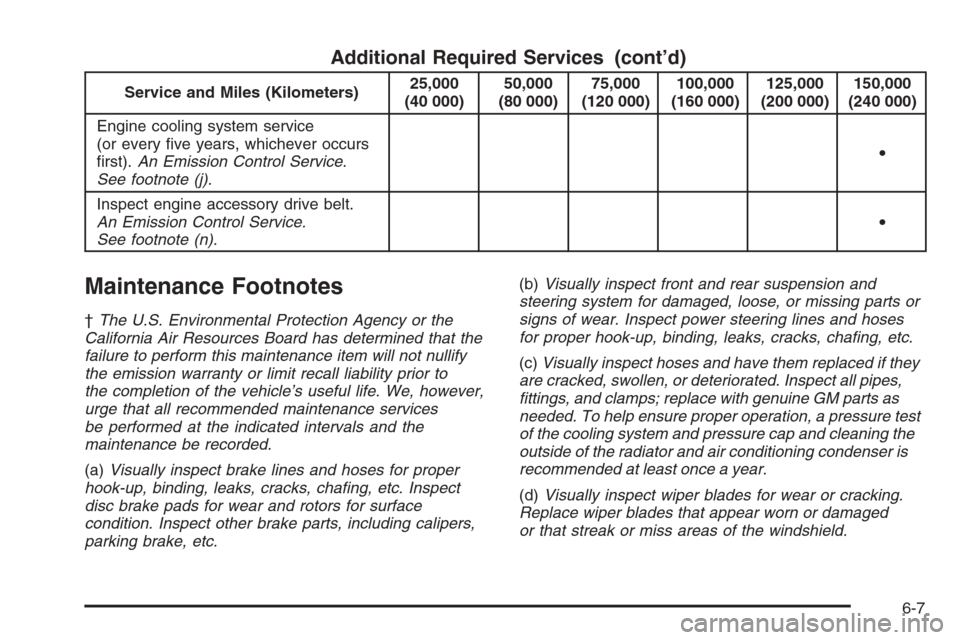
Additional Required Services (cont’d)
Service and Miles (Kilometers)25,000
(40 000)50,000
(80 000)75,000
(120 000)100,000
(160 000)125,000
(200 000)150,000
(240 000)
Engine cooling system service
(or every ve years, whichever occurs
rst).An Emission Control Service.
See footnote (j).•
Inspect engine accessory drive belt.
An Emission Control Service.
See footnote (n).•
Maintenance Footnotes
†The U.S. Environmental Protection Agency or the
California Air Resources Board has determined that the
failure to perform this maintenance item will not nullify
the emission warranty or limit recall liability prior to
the completion of the vehicle’s useful life. We, however,
urge that all recommended maintenance services
be performed at the indicated intervals and the
maintenance be recorded.
(a)Visually inspect brake lines and hoses for proper
hook-up, binding, leaks, cracks, chang, etc. Inspect
disc brake pads for wear and rotors for surface
condition. Inspect other brake parts, including calipers,
parking brake, etc.(b)Visually inspect front and rear suspension and
steering system for damaged, loose, or missing parts or
signs of wear. Inspect power steering lines and hoses
for proper hook-up, binding, leaks, cracks, chang, etc.
(c)Visually inspect hoses and have them replaced if they
are cracked, swollen, or deteriorated. Inspect all pipes,
ttings, and clamps; replace with genuine GM parts as
needed. To help ensure proper operation, a pressure test
of the cooling system and pressure cap and cleaning the
outside of the radiator and air conditioning condenser is
recommended at least once a year.
(d)Visually inspect wiper blades for wear or cracking.
Replace wiper blades that appear worn or damaged
or that streak or miss areas of the windshield.
6-7
Page 442 of 480
At Least Once a Year
Starter Switch Check
{CAUTION:
When you are doing this inspection, the
vehicle could move suddenly. If the vehicle
moves, you or others could be injured.
1. Before you start, be sure you have enough room
around the vehicle.
2. Firmly apply both the parking brake and the regular
brake. SeeParking Brake on page 2-35.
Do not use the accelerator pedal, and be ready to
turn off the engine immediately if it starts.
3. Try to start the engine in each gear. The vehicle
should start only in PARK (P) or NEUTRAL (N).
If the vehicle starts in any other position, contact
your GM Goodwrench
®dealer for service.
Automatic Transmission Shift Lock
Control System Check
{CAUTION:
When you are doing this inspection, the
vehicle could move suddenly. If the vehicle
moves, you or others could be injured.
1. Before you start, be sure you have enough room
around the vehicle. It should be parked on a level
surface.
2. Firmly apply the parking brake. SeeParking Brake
on page 2-35.
Be ready to apply the regular brake immediately
if the vehicle begins to move.
3. With the engine off and without applying the regular
brake, try to move the shift lever out of PARK (P)
with normal effort. If the shift lever moves out
of PARK (P), contact your GM Goodwrench
®dealer
for service.
6-10
Page 443 of 480
Parking Brake and Automatic
Transmission Park (P) Mechanism Check
{CAUTION:
When you are doing this check, your vehicle
could begin to move. You or others could be
injured and property could be damaged. Make
sure there is room in front of your vehicle in
case it begins to roll. Be ready to apply the
regular brake at once should the vehicle
begin to move.Park on a fairly steep hill, with the vehicle facing
downhill. Keeping your foot on the regular brake,
set the parking brake.
To check the parking brake’s holding ability:
With the engine running and transmission in
NEUTRAL (N), slowly remove foot pressure from
the regular brake pedal. Do this until the vehicle
is held by the parking brake only.
To check the PARK (P) mechanism’s holding ability:
With the engine running, shift to PARK (P). Then
release the parking brake followed by the regular
brake.
Contact your GM Goodwrench
®dealer if service is
required.
Underbody Flushing Service
At least every spring, use plain water to ush any
corrosive materials from the underbody. Take care to
clean thoroughly any areas where mud and other debris
can collect.
6-11
Page 444 of 480

Recommended Fluids and
Lubricants
Fluids and lubricants identied below by name, part
number, or specication may be obtained from
your dealer.
Usage Fluid/Lubricant
Engine OilThe engine requires a special engine
oil meeting GM Standard GM4718M.
Oils meeting this standard may be
identied as synthetic, and should
also be identied with the American
Petroleum Institute (API) Certied
for Gasoline Engines starburst
symbol. However, not all synthetic
API oils with the starburst symbol
will meet this GM standard. You
should look for and use only oil that
meets GM Standard GM4718M.
GM Goodwrench
®oil meets all the
requirements for your vehicle. For the
proper viscosity, seeEngine Oil on
page 5-18.
Engine Cooling
System50/50 mixture of clean, drinkable
water and use only DEX-COOL
®
Coolant. SeeEngine Coolant on
page 5-26.
Usage Fluid/Lubricant
Intercooler
System
(4.4L V8
Supercharged
engine)50/50 mixture of clean, drinkable
water and use only DEX-COOL
®
Coolant.
Hydraulic Brake
SystemDelco
®Supreme 11 Brake Fluid or
equivalent DOT-3 brake uid.
Windshield
WasherGM Optikleen
®Washer Solvent.
Parking Brake
Cable GuidesChassis Lubricant
(GM Part No. U.S. 12377985, in
Canada 88901242) or lubricant
meeting requirements of NLGI #2,
Category LB or GC-LB.
Power Steering
SystemGM Power Steering Fluid
(GM Part No. U.S. 89021184,
in Canada 89021186).
Automatic
Transmission
(6-Speed)DEXRON
®-VI Automatic
Transmission Fluid.
Automatic
Transmission
(5-Speed)DEXRON
®-III Automatic
Transmission Fluid. Look for
“Approved for the H-Specication”
on the label.
6-12
Page 468 of 480
Audio System(s) (cont.)
Care of Your CDs ......................................3-121
Diversity Antenna System............................3-122
Navigation/Radio System, see Navigation
Manual.................................................3-115
Audio Systems
Radio Personalization.................................3-115
Audio System(s)
Radio with CD............................................3-96
Setting the Time..........................................3-95
Theft-Deterrent Feature...............................3-119
Understanding Radio Reception...................3-120
XM™ Satellite Radio Antenna System...........3-122
Automatic Transmission
Fluid..........................................................5-26
Operation...........................................2-28, 2-32
B
Battery..........................................................5-44
Exterior Lighting Battery Saver......................3-38
Inadvertent Power Saver..............................3-40
Load Management.......................................3-40
Before Leaving on a Long Trip.........................4-24
Brake
Anti-Lock Brake System (ABS)........................ 4-7
Emergencies................................................ 4-9
Panic Assist................................................4-12Brake (cont.)
Parking......................................................2-35
System Warning Light..................................3-64
Brakes..........................................................5-41
Braking........................................................... 4-6
Braking in Emergencies..................................... 4-9
Break-In, New Vehicle.....................................2-24
Bulb Replacement...........................................5-53
Back-Up Lamps...........................................5-54
Halogen Bulbs............................................5-53
High Intensity Discharge (HID) Lighting...........5-53
Replacement Bulbs......................................5-54
Buying New Tires...........................................5-72
C
Calibration...............................................1-7, 2-42
California Fuel.................................................. 5-6
California Proposition 65 Warning....................... 5-3
Canadian Owners................................................ ii
Capacities and Specications..........................5-116
Carbon Monoxide...................2-14, 2-39, 4-27, 4-40
Care of
Safety Belts................................................5-97
Your CD Player.........................................3-122
Your CDs .................................................3-121
Center Console Storage Area...........................2-51
2
Page 475 of 480
O
Odometer......................................................3-59
Off-Road Recovery..........................................4-15
Oil
Engine.......................................................5-18
Pressure Light.............................................3-70
Oil, Engine Oil Life System..............................5-22
Older Children, Restraints................................1-26
Online Owner Center........................................ 7-3
OnStar
®System, see OnStar®Manual...............2-45
Other Warning Devices...................................... 3-6
Outlet Adjustment............................................3-54
Outlet(s), Accessory Power...............................3-46
Outside
Automatic Dimming Mirror.............................2-44
Convex Mirror.............................................2-44
Parallel Park Assist Mirror.............................2-44
Power Heated Mirrors..................................2-43
Overheated Engine Protection Operating Mode . . . 5-31
Owner Checks and Services.............................. 6-8
Owners, Canadian............................................... ii
P
Paint, Damage..............................................5-101
Panic Brake Assist..........................................4-12
Parade Dimming.............................................3-39Park Aid........................................................3-44
Park (P)
Shifting Into................................................2-36
Shifting Out of............................................2-38
Parking
Assist........................................................3-44
Brake........................................................2-35
Over Things That Burn.................................2-38
Passenger Airbag Status Indicator.....................3-61
Passenger Compartment Air Filter.....................3-55
Passenger Sensing System..............................1-59
Passing.........................................................4-15
Power
Accessory Outlet(s)......................................3-46
Door Locks.................................................2-12
Electrical System.......................................5-105
Inadvertent Battery Saver.............................3-40
Lumbar Controls........................................... 1-2
Reclining Seatbacks...................................... 1-4
Retained Accessory (RAP)............................2-25
Seat............................................................ 1-2
Steering Fluid.............................................5-39
Tilt Wheel and Telescopic Steering Column....... 3-6
Windows....................................................2-18
Pretensioners, Safety Belt................................1-25
Programmable Automatic Door Locks.................2-13
9