lock CADILLAC STS 2008 1.G Owners Manual
[x] Cancel search | Manufacturer: CADILLAC, Model Year: 2008, Model line: STS, Model: CADILLAC STS 2008 1.GPages: 500, PDF Size: 5.81 MB
Page 437 of 500
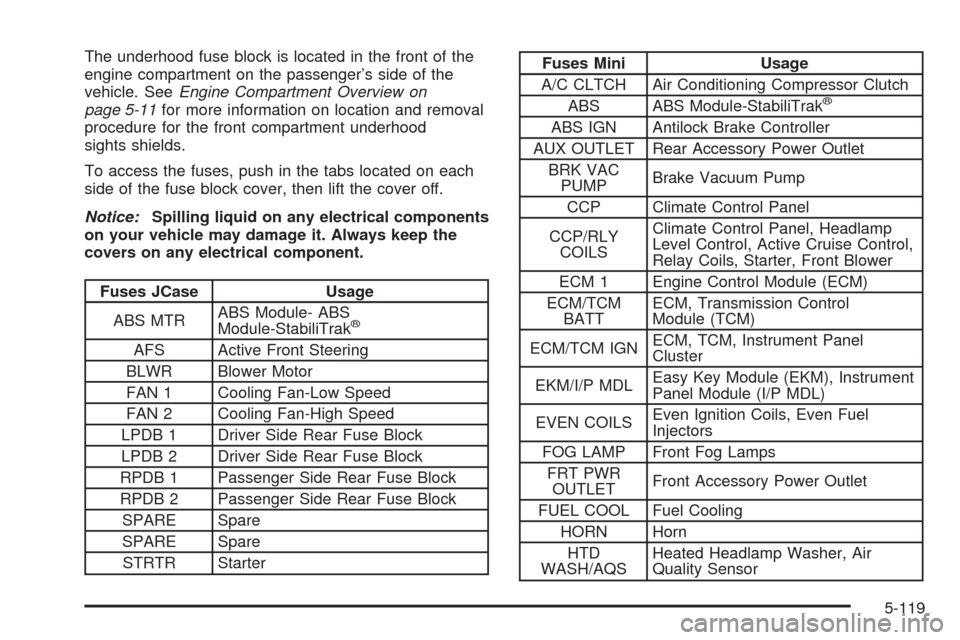
The underhood fuse block is located in the front of the
engine compartment on the passenger’s side of the
vehicle. SeeEngine Compartment Overview on
page 5-11for more information on location and removal
procedure for the front compartment underhood
sights shields.
To access the fuses, push in the tabs located on each
side of the fuse block cover, then lift the cover off.
Notice:Spilling liquid on any electrical components
on your vehicle may damage it. Always keep the
covers on any electrical component.
Fuses JCase Usage
ABS MTRABS Module- ABS
Module-StabiliTrak
®
AFS Active Front Steering
BLWR Blower Motor
FAN 1 Cooling Fan-Low Speed
FAN 2 Cooling Fan-High Speed
LPDB 1 Driver Side Rear Fuse Block
LPDB 2 Driver Side Rear Fuse Block
RPDB 1 Passenger Side Rear Fuse Block
RPDB 2 Passenger Side Rear Fuse Block
SPARE Spare
SPARE Spare
STRTR Starter
Fuses Mini Usage
A/C CLTCH Air Conditioning Compressor Clutch
ABS ABS Module-StabiliTrak
®
ABS IGN Antilock Brake Controller
AUX OUTLET Rear Accessory Power Outlet
BRK VAC
PUMPBrake Vacuum Pump
CCP Climate Control Panel
CCP/RLY
COILSClimate Control Panel, Headlamp
Level Control, Active Cruise Control,
Relay Coils, Starter, Front Blower
ECM 1 Engine Control Module (ECM)
ECM/TCM
BATTECM, Transmission Control
Module (TCM)
ECM/TCM IGNECM, TCM, Instrument Panel
Cluster
EKM/I/P MDLEasy Key Module (EKM), Instrument
Panel Module (I/P MDL)
EVEN COILSEven Ignition Coils, Even Fuel
Injectors
FOG LAMP Front Fog Lamps
FRT PWR
OUTLETFront Accessory Power Outlet
FUEL COOL Fuel Cooling
HORN Horn
HTD
WASH/AQSHeated Headlamp Washer, Air
Quality Sensor
5-119
Page 439 of 500
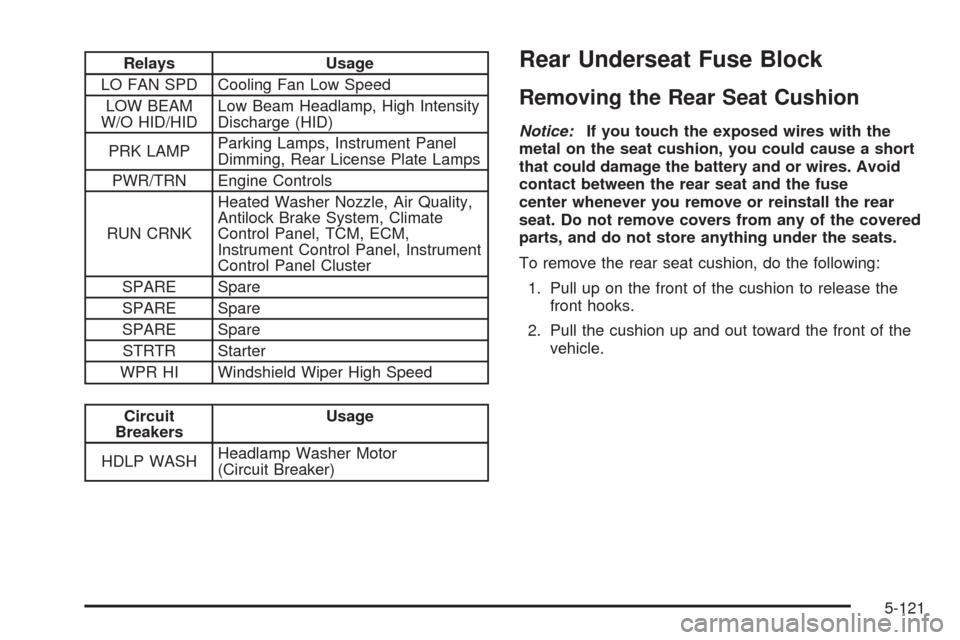
Relays Usage
LO FAN SPD Cooling Fan Low Speed
LOW BEAM
W/O HID/HIDLow Beam Headlamp, High Intensity
Discharge (HID)
PRK LAMPParking Lamps, Instrument Panel
Dimming, Rear License Plate Lamps
PWR/TRN Engine Controls
RUN CRNKHeated Washer Nozzle, Air Quality,
Antilock Brake System, Climate
Control Panel, TCM, ECM,
Instrument Control Panel, Instrument
Control Panel Cluster
SPARE Spare
SPARE Spare
SPARE Spare
STRTR Starter
WPR HI Windshield Wiper High Speed
Circuit
BreakersUsage
HDLP WASHHeadlamp Washer Motor
(Circuit Breaker)
Rear Underseat Fuse Block
Removing the Rear Seat Cushion
Notice:If you touch the exposed wires with the
metal on the seat cushion, you could cause a short
that could damage the battery and or wires. Avoid
contact between the rear seat and the fuse
center whenever you remove or reinstall the rear
seat. Do not remove covers from any of the covered
parts, and do not store anything under the seats.
To remove the rear seat cushion, do the following:
1. Pull up on the front of the cushion to release the
front hooks.
2. Pull the cushion up and out toward the front of the
vehicle.
5-121
Page 441 of 500
2. Slide the rear of the cushion up and under the
seatback so the rear-locating guides hook into
the wire loops on the back frame.
3. With the seat cushion lowered, push rearward and
then press down on the seat cushion until the
spring locks on both ends engage.
4. Check to make sure the safety belts are properly
routed and that no portion of any safety belt is
trapped under the seat. Also make sure the seat
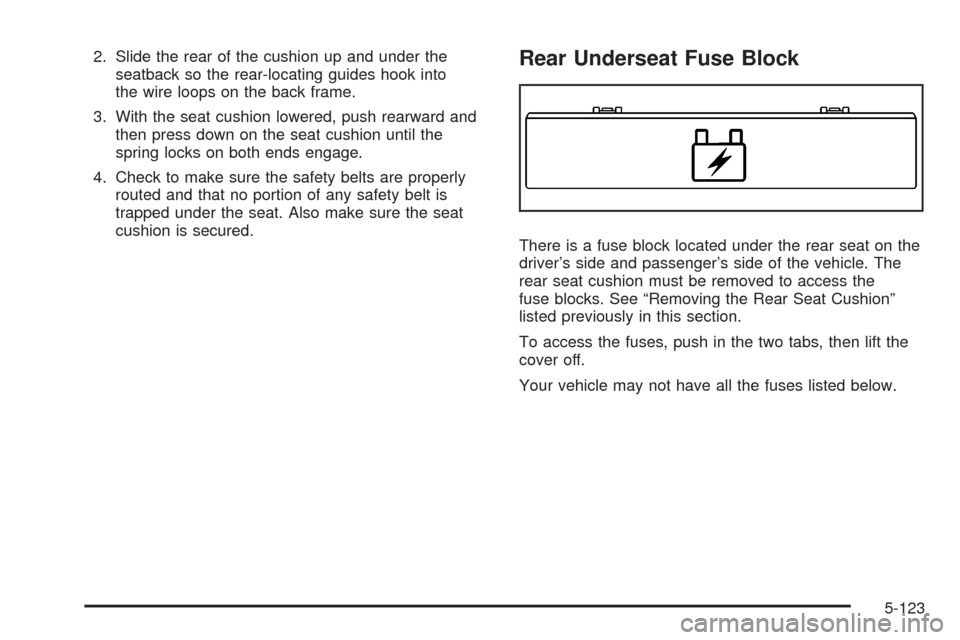
cushion is secured.Rear Underseat Fuse Block
There is a fuse block located under the rear seat on the
driver’s side and passenger’s side of the vehicle. The
rear seat cushion must be removed to access the
fuse blocks. See “Removing the Rear Seat Cushion”
listed previously in this section.
To access the fuses, push in the two tabs, then lift the
cover off.
Your vehicle may not have all the fuses listed below.
5-123
Page 443 of 500
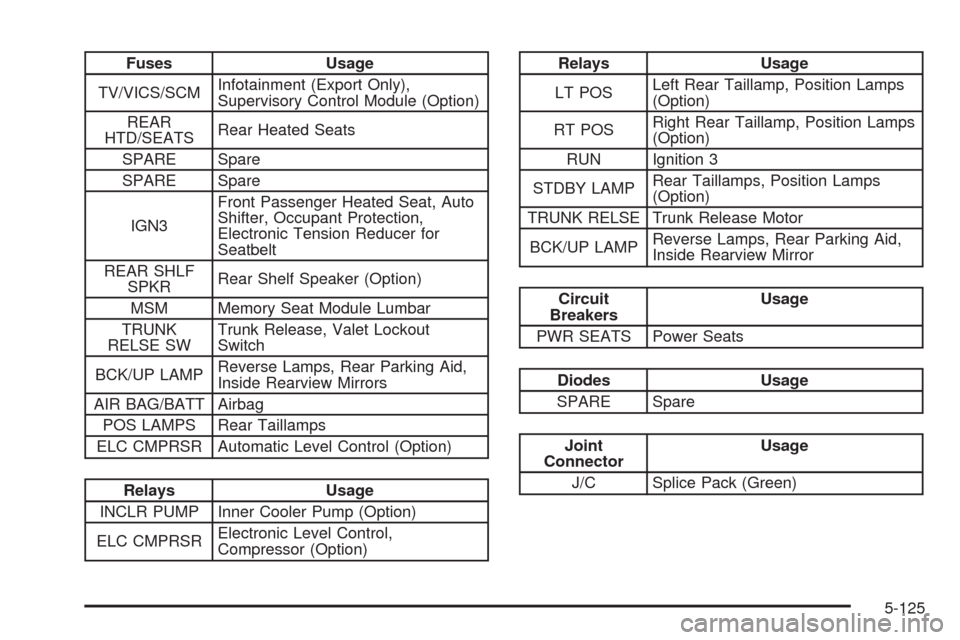
Fuses Usage
TV/VICS/SCMInfotainment (Export Only),
Supervisory Control Module (Option)
REAR
HTD/SEATSRear Heated Seats
SPARE Spare
SPARE Spare
IGN3Front Passenger Heated Seat, Auto
Shifter, Occupant Protection,
Electronic Tension Reducer for
Seatbelt
REAR SHLF
SPKRRear Shelf Speaker (Option)
MSM Memory Seat Module Lumbar
TRUNK
RELSE SWTrunk Release, Valet Lockout
Switch
BCK/UP LAMPReverse Lamps, Rear Parking Aid,
Inside Rearview Mirrors
AIR BAG/BATT Airbag
POS LAMPS Rear Taillamps
ELC CMPRSR Automatic Level Control (Option)
Relays Usage
INCLR PUMP Inner Cooler Pump (Option)
ELC CMPRSRElectronic Level Control,
Compressor (Option)
Relays Usage
LT POSLeft Rear Taillamp, Position Lamps
(Option)
RT POSRight Rear Taillamp, Position Lamps
(Option)
RUN Ignition 3
STDBY LAMPRear Taillamps, Position Lamps
(Option)
TRUNK RELSE Trunk Release Motor
BCK/UP LAMPReverse Lamps, Rear Parking Aid,
Inside Rearview Mirror
Circuit
BreakersUsage
PWR SEATS Power Seats
Diodes Usage
SPARE Spare
Joint
ConnectorUsage
J/C Splice Pack (Green)
5-125
Page 445 of 500
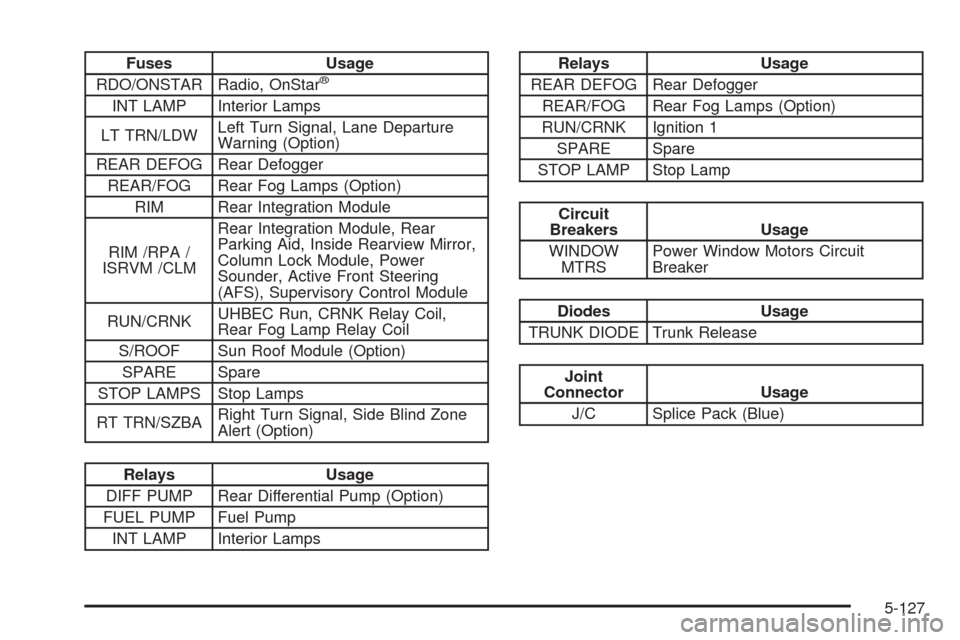
Fuses Usage
RDO/ONSTAR Radio, OnStar®
INT LAMP Interior Lamps
LT TRN/LDWLeft Turn Signal, Lane Departure
Warning (Option)
REAR DEFOG Rear Defogger
REAR/FOG Rear Fog Lamps (Option)
RIM Rear Integration Module
RIM /RPA /
ISRVM /CLMRear Integration Module, Rear
Parking Aid, Inside Rearview Mirror,
Column Lock Module, Power
Sounder, Active Front Steering
(AFS), Supervisory Control Module
RUN/CRNKUHBEC Run, CRNK Relay Coil,
Rear Fog Lamp Relay Coil
S/ROOF Sun Roof Module (Option)
SPARE Spare
STOP LAMPS Stop Lamps
RT TRN/SZBARight Turn Signal, Side Blind Zone
Alert (Option)
Relays Usage
DIFF PUMP Rear Differential Pump (Option)
FUEL PUMP Fuel Pump
INT LAMP Interior Lamps
Relays Usage
REAR DEFOG Rear Defogger
REAR/FOG Rear Fog Lamps (Option)
RUN/CRNK Ignition 1
SPARE Spare
STOP LAMP Stop Lamp
Circuit
Breakers Usage
WINDOW
MTRSPower Window Motors Circuit
Breaker
Diodes Usage
TRUNK DIODE Trunk Release
Joint
Connector Usage
J/C Splice Pack (Blue)
5-127
Page 456 of 500
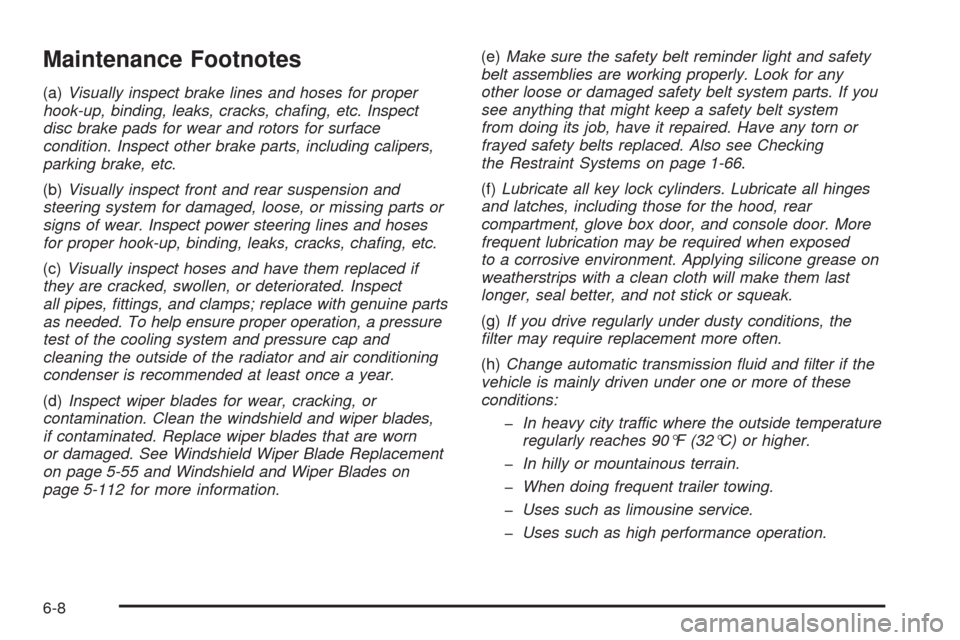
Maintenance Footnotes
(a)Visually inspect brake lines and hoses for proper
hook-up, binding, leaks, cracks, chafing, etc. Inspect
disc brake pads for wear and rotors for surface
condition. Inspect other brake parts, including calipers,
parking brake, etc.
(b)Visually inspect front and rear suspension and
steering system for damaged, loose, or missing parts or
signs of wear. Inspect power steering lines and hoses
for proper hook-up, binding, leaks, cracks, chafing, etc.
(c)Visually inspect hoses and have them replaced if
they are cracked, swollen, or deteriorated. Inspect
all pipes, fittings, and clamps; replace with genuine parts
as needed. To help ensure proper operation, a pressure
test of the cooling system and pressure cap and
cleaning the outside of the radiator and air conditioning
condenser is recommended at least once a year.
(d)Inspect wiper blades for wear, cracking, or
contamination. Clean the windshield and wiper blades,
if contaminated. Replace wiper blades that are worn
or damaged. See Windshield Wiper Blade Replacement
on page 5-55 and Windshield and Wiper Blades on
page 5-112 for more information.(e)Make sure the safety belt reminder light and safety
belt assemblies are working properly. Look for any
other loose or damaged safety belt system parts. If you
see anything that might keep a safety belt system
from doing its job, have it repaired. Have any torn or
frayed safety belts replaced. Also see Checking
the Restraint Systems on page 1-66.
(f)Lubricate all key lock cylinders. Lubricate all hinges
and latches, including those for the hood, rear
compartment, glove box door, and console door. More
frequent lubrication may be required when exposed
to a corrosive environment. Applying silicone grease on
weatherstrips with a clean cloth will make them last
longer, seal better, and not stick or squeak.
(g)If you drive regularly under dusty conditions, the
filter may require replacement more often.
(h)Change automatic transmission fluid and filter if the
vehicle is mainly driven under one or more of these
conditions:
In heavy city traffic where the outside temperature
regularly reaches 90°F (32°C) or higher.
In hilly or mountainous terrain.
When doing frequent trailer towing.
Uses such as limousine service.
Uses such as high performance operation.
6-8
Page 459 of 500
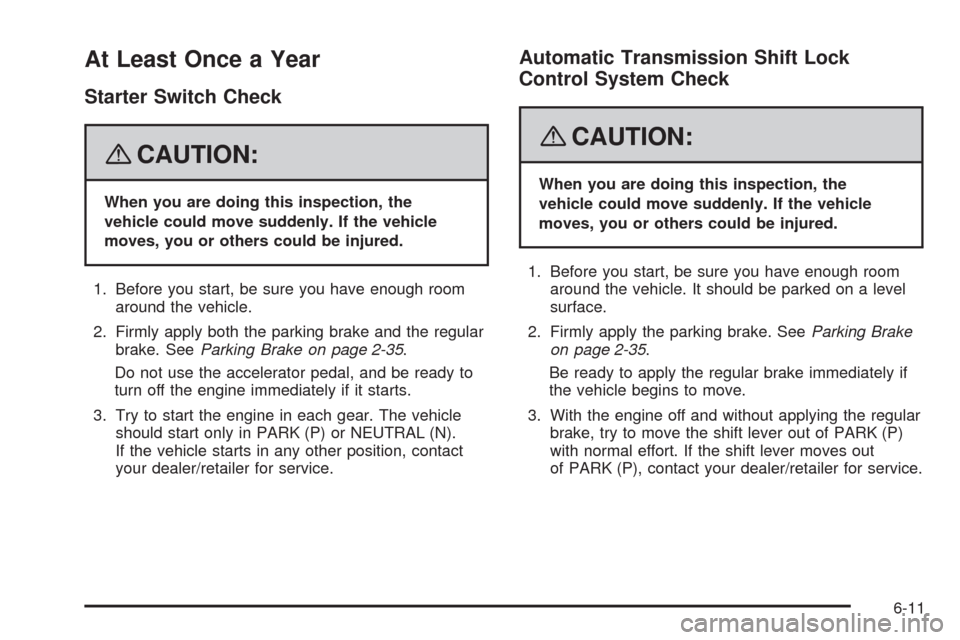
At Least Once a Year
Starter Switch Check
{CAUTION:
When you are doing this inspection, the
vehicle could move suddenly. If the vehicle
moves, you or others could be injured.
1. Before you start, be sure you have enough room
around the vehicle.
2. Firmly apply both the parking brake and the regular
brake. SeeParking Brake on page 2-35.
Do not use the accelerator pedal, and be ready to
turn off the engine immediately if it starts.
3. Try to start the engine in each gear. The vehicle
should start only in PARK (P) or NEUTRAL (N).
If the vehicle starts in any other position, contact
your dealer/retailer for service.
Automatic Transmission Shift Lock
Control System Check
{CAUTION:
When you are doing this inspection, the
vehicle could move suddenly. If the vehicle
moves, you or others could be injured.
1. Before you start, be sure you have enough room
around the vehicle. It should be parked on a level
surface.
2. Firmly apply the parking brake. SeeParking Brake
on page 2-35.
Be ready to apply the regular brake immediately if
the vehicle begins to move.
3. With the engine off and without applying the regular
brake, try to move the shift lever out of PARK (P)
with normal effort. If the shift lever moves out
of PARK (P), contact your dealer/retailer for service.
6-11
Page 462 of 500
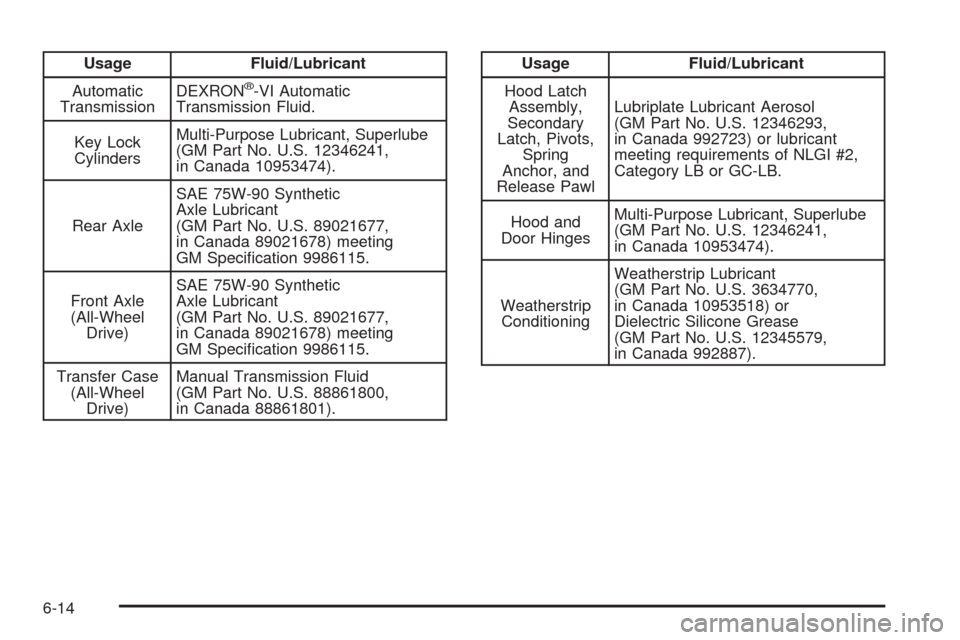
Usage Fluid/Lubricant
Automatic
TransmissionDEXRON
®-VI Automatic
Transmission Fluid.
Key Lock
CylindersMulti-Purpose Lubricant, Superlube
(GM Part No. U.S. 12346241,
in Canada 10953474).
Rear AxleSAE 75W-90 Synthetic
Axle Lubricant
(GM Part No. U.S. 89021677,
in Canada 89021678) meeting
GM Specication 9986115.
Front Axle
(All-Wheel
Drive)SAE 75W-90 Synthetic
Axle Lubricant
(GM Part No. U.S. 89021677,
in Canada 89021678) meeting
GM Specication 9986115.
Transfer Case
(All-Wheel
Drive)Manual Transmission Fluid
(GM Part No. U.S. 88861800,
in Canada 88861801).
Usage Fluid/Lubricant
Hood Latch
Assembly,
Secondary
Latch, Pivots,
Spring
Anchor, and
Release PawlLubriplate Lubricant Aerosol
(GM Part No. U.S. 12346293,
in Canada 992723) or lubricant
meeting requirements of NLGI #2,
Category LB or GC-LB.
Hood and
Door HingesMulti-Purpose Lubricant, Superlube
(GM Part No. U.S. 12346241,
in Canada 10953474).
Weatherstrip
ConditioningWeatherstrip Lubricant
(GM Part No. U.S. 3634770,
in Canada 10953518) or
Dielectric Silicone Grease
(GM Part No. U.S. 12345579,
in Canada 992887).
6-14
Page 475 of 500
Emergency Road Service is performed on site for the
following situations:
Fuel Delivery:Delivery of enough fuel for the vehicle
to get to the nearest service station (approximately
$5 in Canada). In Canada, for safety reasons,
propane and other alternative fuels will not be
provided through this service.
Lock-out Service:Lock-out service will be covered
at no charge if you are unable to gain entry into your
vehicle. A remote unlock may be available if you
have an active OnStar
®subscription. To ensure
security, the driver must present personal
identication before lock-out service is provided.
In Canada, the vehicle registration is also required.
Emergency Tow From a Public Roadway or
Highway:Tow to the nearest dealership for warranty
service or in the event of a vehicle-disabling crash.
Winch-out assistance is provided when the vehicle is
mired in sand, mud, or snow.
Flat Tire Change:Installation of a spare tire in good
condition, when equipped and properly inated, is
covered at no charge. The customer is responsible
for the repair or replacement of the tire if not covered
by a warrantable failure.
Jump Start:A battery jump start is covered at no
charge if the vehicle does not start.
Trip Routing Service:Upon request, Cadillac
Roadside Service will send you detailed, computer
personalized maps, highlighting your choice of either
the most direct route or the most scenic route to your
destination, anywhere in North America, along with
helpful travel information pertaining to your trip.
Please allow three weeks before your planned
departure date. In Canada, trip routing requests will
be limited to six per calendar year.
Trip Interruption Benets and Assistance:If your
trip is interrupted due to a warranty failure, incidental
expenses may be reimbursed during the 60 months/
100,000 miles (160 000 km) warranty period. Items
covered are hotel, meals, and rental car.
Alternative Service (Canada only):There may be
times when Roadside Service cannot provide timely
assistance. Your advisor may authorize you to
secure local emergency road service, and you will be
reimbursed up to $100 upon submission of the
original receipt to Cadillac Roadside Service
®.
Cadillac and General Motors of Canada Limited reserve
the right to limit services or reimbursement to an
owner or driver when, in their sole discretion, the claims
become excessive in frequency or type of occurrence.
7-7
Page 484 of 500
Vehicle Data Recording and
Privacy
Your GM vehicle has a number of sophisticated
computers that record information about the vehicle’s
performance and how it is driven. For example,
your vehicle uses computer modules to monitor and
control engine and transmission performance, to monitor
the conditions for airbag deployment and deploy
airbags in a crash and, if so equipped, to provide
antilock braking to help the driver control the vehicle.
These modules may store data to help your
dealer/retailer technician service your vehicle.
Some modules may also store data about how you
operate the vehicle, such as rate of fuel consumption or
average speed. These modules may also retain the
owner’s personal preferences, such as radio pre-sets,
seat positions, and temperature settings.
Event Data Recorders
This vehicle has an Event Data Recorder (EDR).
The main purpose of an EDR is to record, in certain
crash or near crash-like situations, such as an air bag
deployment or hitting a road obstacle, data that will
assist in understanding how a vehicle’s systems
performed. The EDR is designed to record data related
to vehicle dynamics and safety systems for a short
period of time, typically 30 seconds or less. The EDR in
this vehicle is designed to record such data as:
How various systems in your vehicle were operating
Whether or not the driver and passenger safety
belts were buckled/fastened
How far, if at all, the driver was pressing the
accelerator and/or brake pedal
How fast the vehicle was traveling
This data can help provide a better understanding of the
circumstances in which crashes and injuries occur.
Important:EDR data is recorded by your vehicle only
if a non-trivial crash situation occurs; no data is
recorded by the EDR under normal driving conditions
and no personal data (e.g., name, gender, age, and
crash location) is recorded. However, other parties,
such as law enforcement, could combine the EDR data
with the type of personally identifying data routinely
acquired during a crash investigation.
7-16