low beam CADILLAC STS 2008 1.G User Guide
[x] Cancel search | Manufacturer: CADILLAC, Model Year: 2008, Model line: STS, Model: CADILLAC STS 2008 1.GPages: 500, PDF Size: 5.81 MB
Page 196 of 500
Reading Lamps
The reading lamps are located on the overhead console.
These lamps come on automatically when any door is
opened.
For manual operation, press the button next to each
lamp to turn it on or off.
If the reading lamps are left on, they automatically shut
off 10 minutes after the ignition has been turned off.
Battery Load Management
The battery load management feature is designed to
monitor the vehicle’s electrical load and determine when
the battery is in a heavy discharge condition. During
times of high electrical loading, the engine may idle
at a higher revolutions per minute (rpm) setting
than normal to make sure the battery charges.
High electrical loads may occur when several of the
following are on: headlamps, high beams, fog lamps,
rear window defogger, the climate control fan at
high speeds, heated seats and engine cooling fans.If the battery continues to discharge, even with the
engine idling at a higher rpm setting, some electrical
loads will automatically be reduced. When this occurs,
the rear window defogger may take slightly longer
to clear the glass and the fan may cut back to a lower
speed. For more battery saving information, see
“Battery Saver Active Message” underDIC Warnings
and Messages on page 3-80.
Electric Power Management
The vehicle has Electric Power Management (EPM)
that estimates the battery’s temperature and state
of charge. It then adjusts the voltage for best
performance and extended life of the battery.
When the battery’s state of charge is low, the voltage
is raised slightly to quickly put the charge back in.
When the state of charge is high, the voltage is lowered
slightly to prevent overcharging. If the vehicle has a
voltmeter gage or a voltage display on the Driver
Information Center (DIC), you may see the voltage
move up or down. This is normal. If there is a problem,
an alert will be displayed.
3-42
Page 197 of 500
The battery can be discharged at idle if the electrical
loads are very high. This is true for all vehicles.
This is because the generator (alternator) may not be
spinning fast enough at idle to produce all the power
that is needed for very high electrical loads.
A high electrical load occurs when several of the
following loads are on: headlamps, high beams, fog
lamps, rear window defogger, climate control fan at
high speed, heated seats, engine cooling fans, trailer
loads, and loads plugged into accessory power outlets.
EPM works to prevent excessive discharge of the
battery. It does this by balancing the generator’s output
and the vehicle’s electrical needs. It can increase
engine idle speed to generate more power, whenever
needed. It can temporarily reduce the power demands
of some accessories.
Normally, these actions occur in steps or levels, without
being noticeable. In rare cases at the highest levels
of corrective action, this action may be noticeable to
the driver. If so, a Driver Information Center (DIC)
message might be displayed, such as Battery Saver
Active or Service Battery Charging System. If this
message is displayed, it is recommended that the
driver reduce the electrical loads as much as possible.
SeeDIC Warnings and Messages on page 3-80.Inadvertent Power Battery Saver
This feature is designed to protect your vehicle’s battery
against drainage from the interior lamps, trunk lamp,
glove box lamp, or the garage door opener. When the
ignition is turned off, the power to these features will
automatically turn off after 10 minutes (three minutes if
a new car has 15 miles (24 km) or less). Power will
be restored for an additional 10 minutes if any door is
opened, the trunk is opened or the courtesy lamp switch
is turned on.
Head-Up Display (HUD)
{CAUTION:
If the HUD image is too bright, or too high in
your eld of view, it may take you more time
to see things you need to see when it is dark
outside. Be sure to keep the HUD image dim
and placed low in your eld of view.
For vehicles with the Head-Up Display (HUD), it projects
some of the driver information that appears on the
instrument panel cluster onto the windshield.
3-43
Page 198 of 500
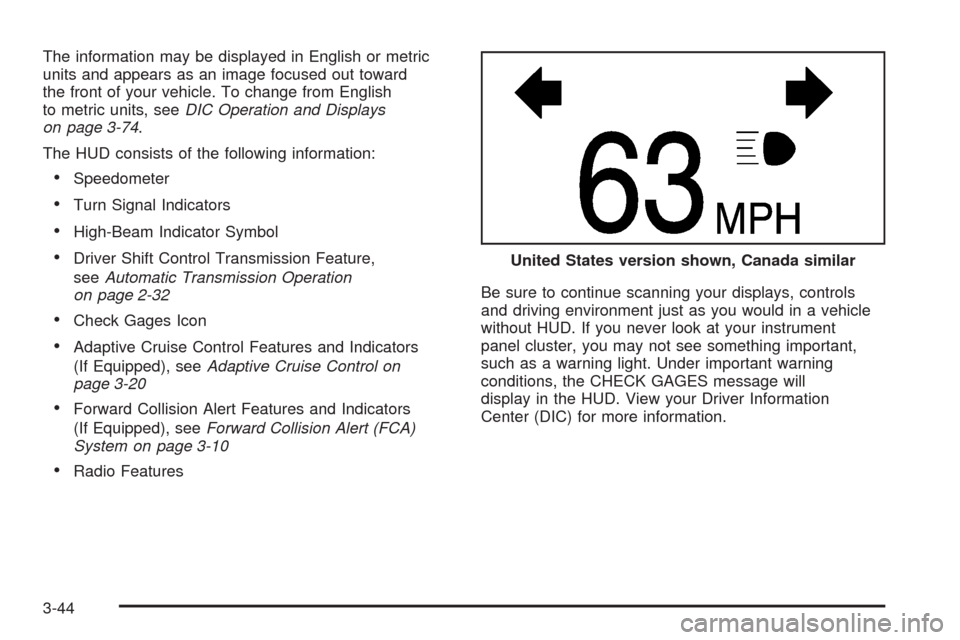
The information may be displayed in English or metric
units and appears as an image focused out toward
the front of your vehicle. To change from English
to metric units, seeDIC Operation and Displays
on page 3-74.
The HUD consists of the following information:
Speedometer
Turn Signal Indicators
High-Beam Indicator Symbol
Driver Shift Control Transmission Feature,
seeAutomatic Transmission Operation
on page 2-32
Check Gages Icon
Adaptive Cruise Control Features and Indicators
(If Equipped), seeAdaptive Cruise Control on
page 3-20
Forward Collision Alert Features and Indicators
(If Equipped), seeForward Collision Alert (FCA)
System on page 3-10
Radio FeaturesBe sure to continue scanning your displays, controls
and driving environment just as you would in a vehicle
without HUD. If you never look at your instrument
panel cluster, you may not see something important,
such as a warning light. Under important warning
conditions, the CHECK GAGES message will
display in the HUD. View your Driver Information
Center (DIC) for more information.United States version shown, Canada similar
3-44
Page 226 of 500
Fog Lamp Light
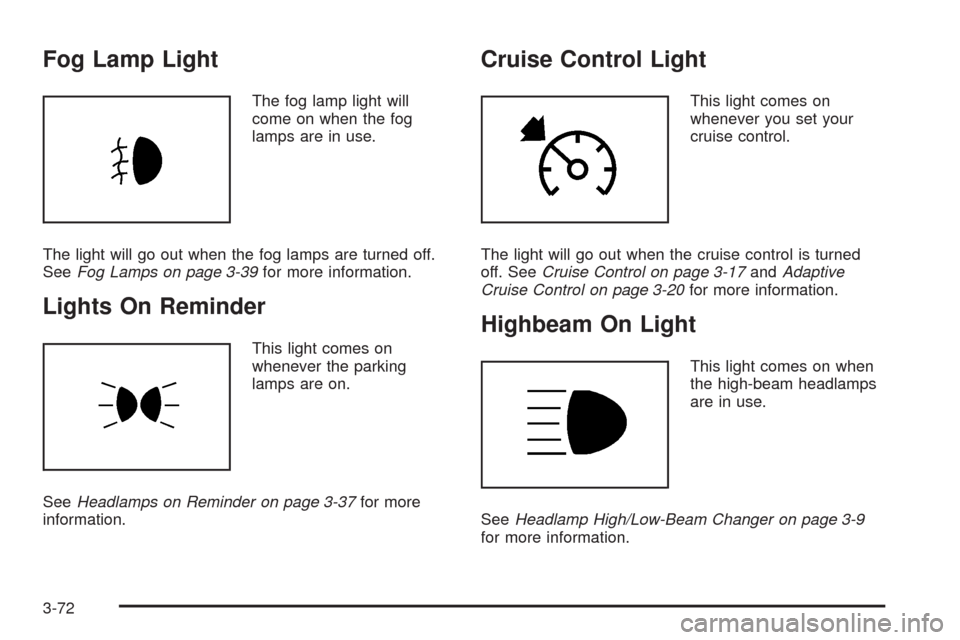
The fog lamp light will
come on when the fog
lamps are in use.
The light will go out when the fog lamps are turned off.
SeeFog Lamps on page 3-39for more information.
Lights On Reminder
This light comes on
whenever the parking
lamps are on.
SeeHeadlamps on Reminder on page 3-37for more
information.
Cruise Control Light
This light comes on
whenever you set your
cruise control.
The light will go out when the cruise control is turned
off. SeeCruise Control on page 3-17andAdaptive
Cruise Control on page 3-20for more information.
Highbeam On Light
This light comes on when
the high-beam headlamps
are in use.
SeeHeadlamp High/Low-Beam Changer on page 3-9
for more information.
3-72
Page 371 of 500
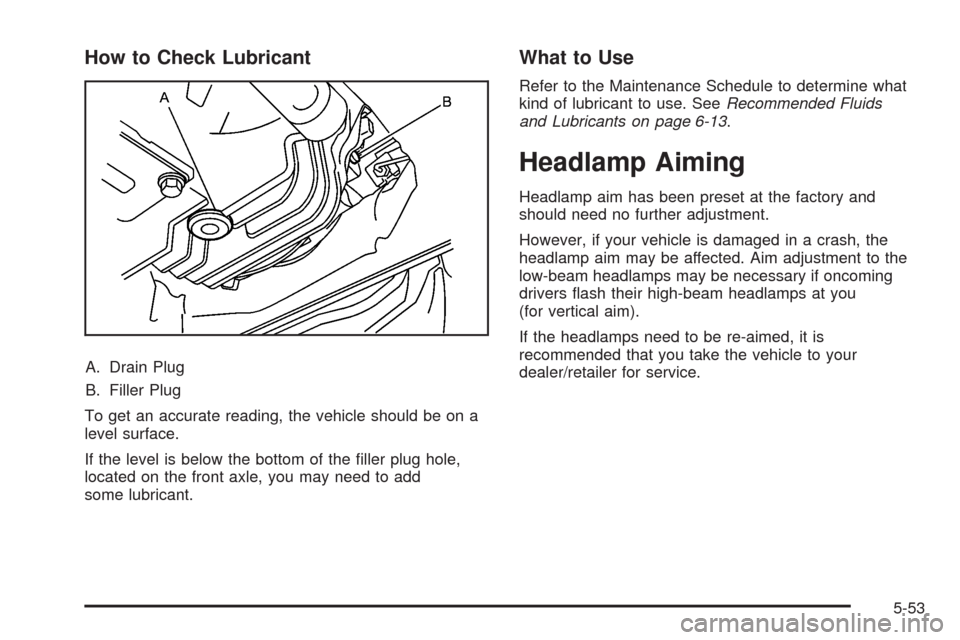
How to Check Lubricant
A. Drain Plug
B. Filler Plug
To get an accurate reading, the vehicle should be on a
level surface.
If the level is below the bottom of the ller plug hole,
located on the front axle, you may need to add
some lubricant.
What to Use
Refer to the Maintenance Schedule to determine what
kind of lubricant to use. SeeRecommended Fluids
and Lubricants on page 6-13.
Headlamp Aiming
Headlamp aim has been preset at the factory and
should need no further adjustment.
However, if your vehicle is damaged in a crash, the
headlamp aim may be affected. Aim adjustment to the
low-beam headlamps may be necessary if oncoming
drivers ash their high-beam headlamps at you
(for vertical aim).
If the headlamps need to be re-aimed, it is
recommended that you take the vehicle to your
dealer/retailer for service.
5-53
Page 372 of 500
Bulb Replacement
For the proper type of replacement bulbs, see
Replacement Bulbs on page 5-55.
For any bulb changing procedure not listed in this
section, contact your dealer/retailer.
High Intensity Discharge (HID)
Lighting
{CAUTION:
The low beam high intensity discharge lighting
system operates at a very high voltage. If you
try to service any of the system components,
you could be seriously injured. Have your
dealer/retailer or a qualied technician
service them.
Your vehicle has HID headlamps. After your vehicle’s
HID headlamp bulb has been replaced, you may notice
that the beam is a slightly different shade than it was
originally. This is normal.
Halogen Bulbs
{CAUTION:
Halogen bulbs have pressurized gas inside and
can burst if you drop or scratch the bulb. You or
others could be injured. Be sure to read and
follow the instructions on the bulb package.
Back-Up Lamps
To replace a back-up lamp bulb:
1. Open the trunk. SeeTrunk on page 2-16for more
information.
5-54
Page 438 of 500
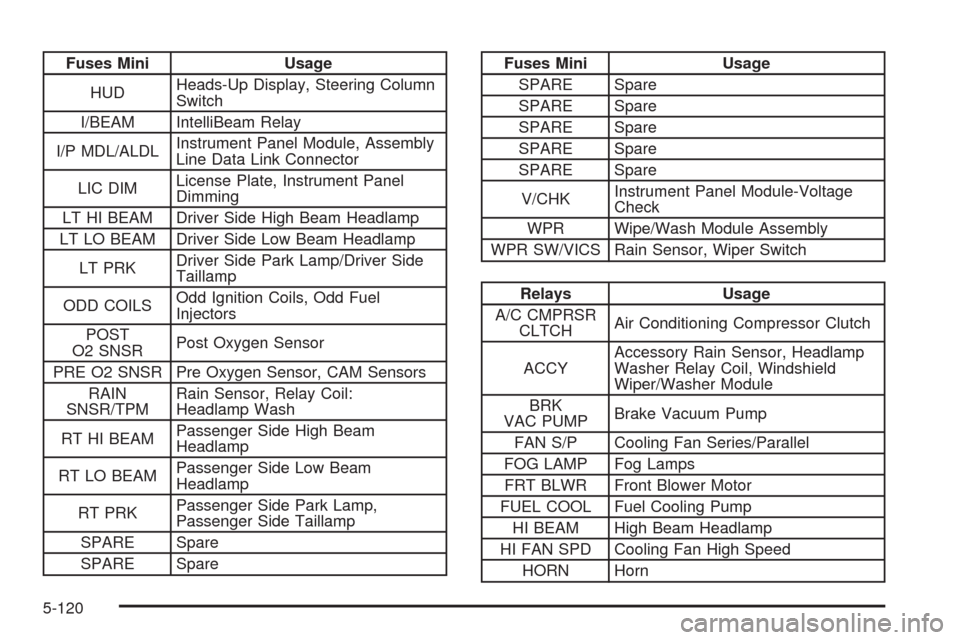
Fuses Mini Usage
HUDHeads-Up Display, Steering Column
Switch
I/BEAM IntelliBeam Relay
I/P MDL/ALDLInstrument Panel Module, Assembly
Line Data Link Connector
LIC DIMLicense Plate, Instrument Panel
Dimming
LT HI BEAM Driver Side High Beam Headlamp
LT LO BEAM Driver Side Low Beam Headlamp
LT PRKDriver Side Park Lamp/Driver Side
Taillamp
ODD COILSOdd Ignition Coils, Odd Fuel
Injectors
POST
O2 SNSRPost Oxygen Sensor
PRE O2 SNSR Pre Oxygen Sensor, CAM Sensors
RAIN
SNSR/TPMRain Sensor, Relay Coil:
Headlamp Wash
RT HI BEAMPassenger Side High Beam
Headlamp
RT LO BEAMPassenger Side Low Beam
Headlamp
RT PRKPassenger Side Park Lamp,
Passenger Side Taillamp
SPARE Spare
SPARE SpareFuses Mini Usage
SPARE Spare
SPARE Spare
SPARE Spare
SPARE Spare
SPARE Spare
V/CHKInstrument Panel Module-Voltage
Check
WPR Wipe/Wash Module Assembly
WPR SW/VICS Rain Sensor, Wiper Switch
Relays Usage
A/C CMPRSR
CLTCHAir Conditioning Compressor Clutch
ACCYAccessory Rain Sensor, Headlamp
Washer Relay Coil, Windshield
Wiper/Washer Module
BRK
VAC PUMPBrake Vacuum Pump
FAN S/P Cooling Fan Series/Parallel
FOG LAMP Fog Lamps
FRT BLWR Front Blower Motor
FUEL COOL Fuel Cooling Pump
HI BEAM High Beam Headlamp
HI FAN SPD Cooling Fan High Speed
HORN Horn
5-120
Page 439 of 500
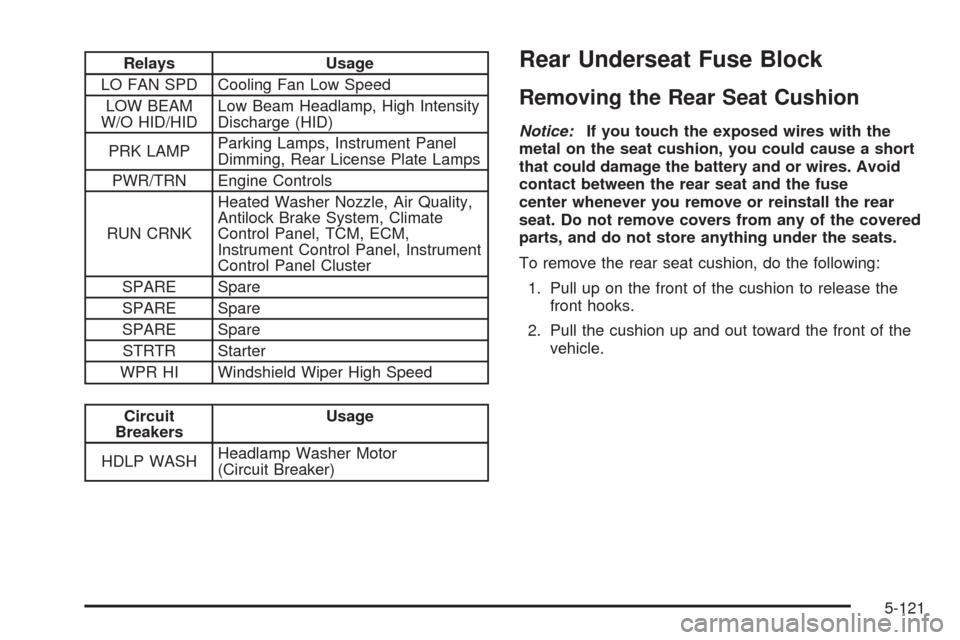
Relays Usage
LO FAN SPD Cooling Fan Low Speed
LOW BEAM
W/O HID/HIDLow Beam Headlamp, High Intensity
Discharge (HID)
PRK LAMPParking Lamps, Instrument Panel
Dimming, Rear License Plate Lamps
PWR/TRN Engine Controls
RUN CRNKHeated Washer Nozzle, Air Quality,
Antilock Brake System, Climate
Control Panel, TCM, ECM,
Instrument Control Panel, Instrument
Control Panel Cluster
SPARE Spare
SPARE Spare
SPARE Spare
STRTR Starter
WPR HI Windshield Wiper High Speed
Circuit
BreakersUsage
HDLP WASHHeadlamp Washer Motor
(Circuit Breaker)
Rear Underseat Fuse Block
Removing the Rear Seat Cushion
Notice:If you touch the exposed wires with the
metal on the seat cushion, you could cause a short
that could damage the battery and or wires. Avoid
contact between the rear seat and the fuse
center whenever you remove or reinstall the rear
seat. Do not remove covers from any of the covered
parts, and do not store anything under the seats.
To remove the rear seat cushion, do the following:
1. Pull up on the front of the cushion to release the
front hooks.
2. Pull the cushion up and out toward the front of the
vehicle.
5-121
Page 492 of 500
HHazard Warning Flashers................................... 3-6
Head Restraints............................................... 1-6
Headlamp
Aiming.......................................................5-53
Headlamp Wiring...........................................5-117
Headlamps....................................................3-33
Bulb Replacement.......................................5-54
Daytime Running Lamps...............................3-37
Flash-to-Pass..............................................3-13
Halogen Bulbs............................................5-54
High Intensity Discharge (HID) Lighting...........5-54
High/Low Beam Changer................................ 3-9
On Reminder..............................................3-37
Washer......................................................3-16
Wiper Activated...........................................3-37
Head-Up Display (HUD)...................................3-43
Heated Seats................................................... 1-3
Heated Steering Wheel..................................... 3-7
Heater...........................................................3-48
Highbeam On Light.........................................3-72
High-Speed Operation, Tires.............................5-68
Highway Hypnosis...........................................4-20
Hill and Mountain Roads..................................4-21
Hood
Checking Things Under................................5-10
Release.....................................................5-10
Horn............................................................... 3-6
How to Wear Safety Belts Properly...................1-13I
Ignition Positions.............................................2-28
Immobilizer....................................................2-26
Immobilizer Operation......................................2-26
Inadvertent Power Battery Saver.......................3-43
Infants and Young Children, Restraints...............1-30
Ination - Tire Pressure...................................5-66
Inator Kit, Tire...............................................5-87
Instrument Panel
Overview..................................................... 3-4
Instrument Panel (I/P)
Brightness..................................................3-41
Cluster.......................................................3-58
J
Jump Starting.................................................5-45
K
Keyless Access System..................................... 2-5
Keyless Access System, Operation...................... 2-6
Keys............................................................... 2-3
6
Page 493 of 500
L
Labeling, Tire Sidewall.....................................5-59
Lamps
Exterior Lighting Battery Saver......................3-40
Inadvertent Power Battery Saver....................3-43
Reading.....................................................3-42
Twilight Sentinel
®........................................3-39
Lane Departure Warning..................................2-47
Lane Departure Warning Light..........................3-66
Lap-Shoulder Belt...........................................1-21
LATCH System
Child Restraints...........................................1-37
Lifting Your Vehicle, Tires.................................5-83
Light
Airbag Readiness........................................3-60
Antilock Brake System Warning.....................3-65
Brake System Warning.................................3-64
Charging System.........................................3-63
Cruise Control.............................................3-72
Engine Coolant Temperature Warning.............3-66
Fog Lamp..................................................3-72
Highbeam On.............................................3-72
Lane Departure Warning...............................3-66
Lights On Reminder.....................................3-72
Malfunction Indicator....................................3-68
Oil Pressure...............................................3-70Light (cont.)
Passenger Airbag Status Indicator..................3-61
Safety Belt Reminders..................................3-59
Security.....................................................3-71
TCS Warning Light......................................3-65
Tire Pressure..............................................3-67
Traction Control System (TCS) Warning..........3-65
Lighting
Entry.........................................................3-41
Parade Dimming..........................................3-41
Lights............................................................3-33
Flash-to-Pass..............................................3-13
High/Low Beam Changer................................ 3-9
On Reminder..............................................3-37
Limited-Slip Rear Axle....................................... 4-8
Loading Your Vehicle.......................................4-26
Lockout Protection..........................................2-16
Locks
Door..........................................................2-14
Lockout Protection.......................................2-16
Power Door................................................2-14
Programmable Automatic Door Locks.............2-15
Rear Door Security Locks.............................2-15
Loss of Control...............................................4-16
Lumbar
Power Controls............................................. 1-2
7