power steering CADILLAC STS 2008 1.G Owners Manual
[x] Cancel search | Manufacturer: CADILLAC, Model Year: 2008, Model line: STS, Model: CADILLAC STS 2008 1.GPages: 500, PDF Size: 5.81 MB
Page 6 of 500
Front Seats
Power Seats
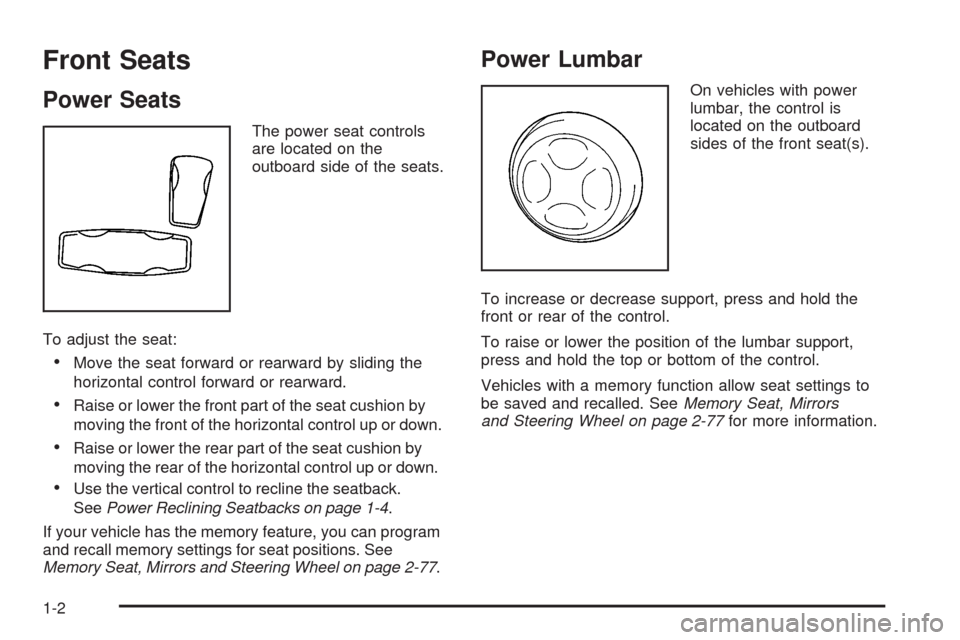
The power seat controls
are located on the
outboard side of the seats.
To adjust the seat:
Move the seat forward or rearward by sliding the
horizontal control forward or rearward.
Raise or lower the front part of the seat cushion by
moving the front of the horizontal control up or down.
Raise or lower the rear part of the seat cushion by
moving the rear of the horizontal control up or down.
Use the vertical control to recline the seatback.
SeePower Reclining Seatbacks on page 1-4.
If your vehicle has the memory feature, you can program
and recall memory settings for seat positions. See
Memory Seat, Mirrors and Steering Wheel on page 2-77.
Power Lumbar
On vehicles with power
lumbar, the control is
located on the outboard
sides of the front seat(s).
To increase or decrease support, press and hold the
front or rear of the control.
To raise or lower the position of the lumbar support,
press and hold the top or bottom of the control.
Vehicles with a memory function allow seat settings to
be saved and recalled. SeeMemory Seat, Mirrors
and Steering Wheel on page 2-77for more information.
1-2
Page 74 of 500
Automatic Dimming Rearview Mirror
with OnStar®and Compass........................2-41
Outside Power Heated Mirrors........................2-43
Outside Automatic Dimming Mirror..................2-44
Outside Convex Mirror...................................2-44
Outside Parallel Park Assist Mirror..................2-44
Object Detection Systems...............................2-45
Ultrasonic Rear Parking Assist (URPA)............2-45
Side Blind Zone Alert....................................2-47
Lane Departure Warning................................2-47
OnStar
®System.............................................2-48
Universal Home Remote System......................2-51
Universal Home Remote System.....................2-51
Universal Home Remote System Operation
(With Three Round LED)............................2-52Storage Areas................................................2-58
Glove Box...................................................2-58
Cupholder(s)................................................2-58
Center Console Storage.................................2-58
Convenience Net..........................................2-58
Sunroof.........................................................2-58
Vehicle Personalization...................................2-60
Memory Seat, Mirrors and Steering Wheel.......2-77
Section 2 Features and Controls
2-2
Page 101 of 500
Retained Accessory Power (RAP)
These vehicle accessories can be used for up to
20 minutes after the engine is turned off:
Audio System
Audio Steering Wheel Controls
Power Windows
Power to these accessories will work up to 20 minutes
or until one of the front doors is opened. For an
additional 20 minutes of operation, close all the doors
and press Acc. to place the vehicle in accessory mode.
Press the button again to return to RAP.
Starting the Engine
To place the transmission in the proper gear:
Move the shift lever to PARK (P) or NEUTRAL (N).
To restart when you are already moving, use
NEUTRAL (N).
Notice:Do not try to shift to PARK (P) if your
vehicle is moving. If you do, you could damage the
transmission. Shift to PARK (P) only when your
vehicle is stopped.
The keyless access transmitter must be inside the
vehicle for the ignition to work.Cell phone chargers can interfere with the operation of
the Keyless Access System. Battery chargers should
not be plugged in when starting or turning off the engine.
To start your vehicle, do the following:
Starting Procedure
1. With your foot on the brake pedal, press the
START button located on the instrument panel.
If there is not a keyless access transmitter in
the vehicle or if there is something causing
interference with it, the DIC will display NO FOBS
DETECTED. SeeDIC Warnings and Messages
on page 3-80for more information.
2. When the engine begins cranking, let go of the
button and the engine cranks automatically until
it starts. If the battery in the keyless access
transmitter is weak, the DIC displays KEY FOB
BATTERY LOW. You can still drive the vehicle.
See “Battery Replacement” underKeyless Access
System Operation on page 2-6for more information.
If the fob battery is dead, you need to insert the
fob into the fob slot to enable engine starting.
See “No Fobs Detected” underDIC Warnings and
Messages on page 3-80.
3. Do not race the engine immediately after starting it.
Operate the engine and transmission gently until
the oil warms up and lubricates all moving parts.
2-29
Page 107 of 500
The transmission will only allow you to shift into gears
appropriate for the vehicle speed and engine
Revolutions Per Minute (RPM). The transmission will
not automatically shift to the next higher gear if the
engine RPM is too high.
If shifting is prevented for any reason, the selected gear
will ash multiple times, indicating that the transmission
has not shifted gears.
The transmission will allow you to shift to the gear
selected and will automatically downshift when
the vehicle comes to a stop. This will allow for more
power during take-off and passing.
Parking Brake
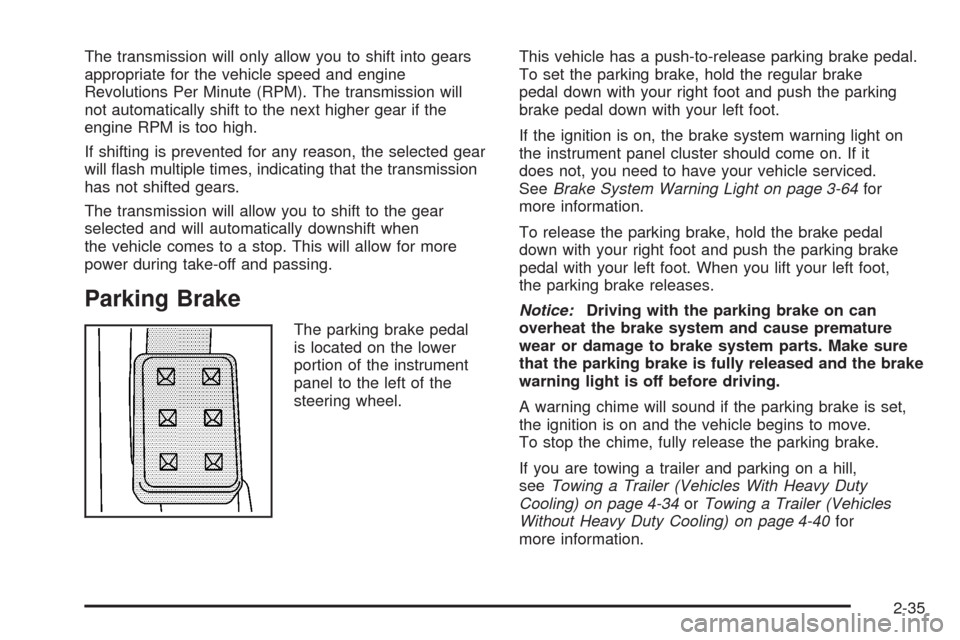
The parking brake pedal
is located on the lower
portion of the instrument
panel to the left of the
steering wheel.This vehicle has a push-to-release parking brake pedal.
To set the parking brake, hold the regular brake
pedal down with your right foot and push the parking
brake pedal down with your left foot.
If the ignition is on, the brake system warning light on
the instrument panel cluster should come on. If it
does not, you need to have your vehicle serviced.
SeeBrake System Warning Light on page 3-64for
more information.
To release the parking brake, hold the brake pedal
down with your right foot and push the parking brake
pedal with your left foot. When you lift your left foot,
the parking brake releases.
Notice:Driving with the parking brake on can
overheat the brake system and cause premature
wear or damage to brake system parts. Make sure
that the parking brake is fully released and the brake
warning light is off before driving.
A warning chime will sound if the parking brake is set,
the ignition is on and the vehicle begins to move.
To stop the chime, fully release the parking brake.
If you are towing a trailer and parking on a hill,
seeTowing a Trailer (Vehicles With Heavy Duty
Cooling) on page 4-34orTowing a Trailer (Vehicles
Without Heavy Duty Cooling) on page 4-40for
more information.
2-35
Page 115 of 500
Cleaning the Mirror
When cleaning the mirror, use a paper towel or similar
material dampened with glass cleaner. Do not spray
glass cleaner directly on the mirror as that may cause
the liquid cleaner to enter the mirror housing.
Outside Power Heated Mirrors
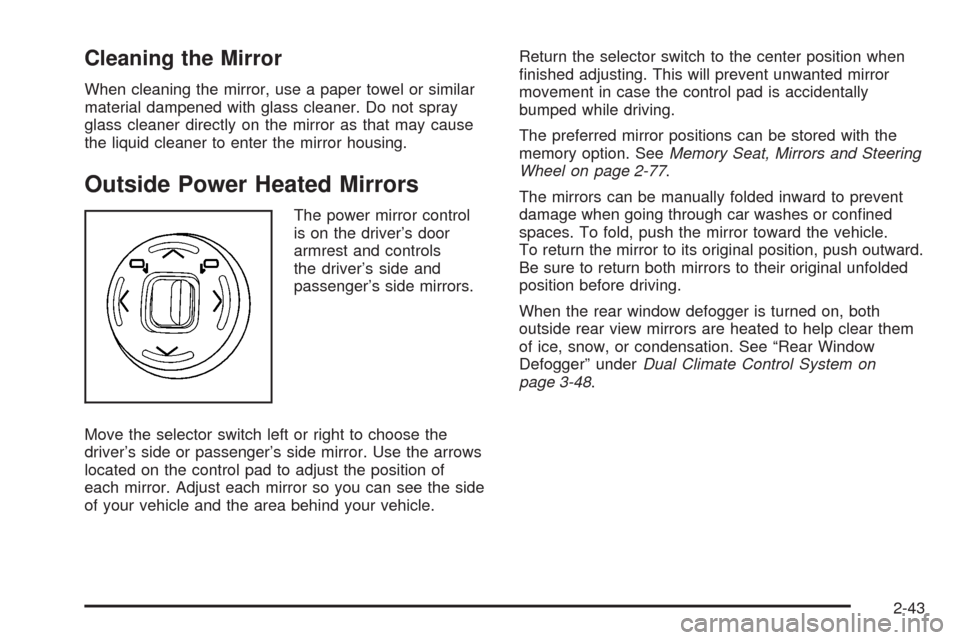
The power mirror control
is on the driver’s door
armrest and controls
the driver’s side and
passenger’s side mirrors.
Move the selector switch left or right to choose the
driver’s side or passenger’s side mirror. Use the arrows
located on the control pad to adjust the position of
each mirror. Adjust each mirror so you can see the side
of your vehicle and the area behind your vehicle.Return the selector switch to the center position when
nished adjusting. This will prevent unwanted mirror
movement in case the control pad is accidentally
bumped while driving.
The preferred mirror positions can be stored with the
memory option. SeeMemory Seat, Mirrors and Steering
Wheel on page 2-77.
The mirrors can be manually folded inward to prevent
damage when going through car washes or conned
spaces. To fold, push the mirror toward the vehicle.
To return the mirror to its original position, push outward.
Be sure to return both mirrors to their original unfolded
position before driving.
When the rear window defogger is turned on, both
outside rear view mirrors are heated to help clear them
of ice, snow, or condensation. See “Rear Window
Defogger” underDual Climate Control System on
page 3-48.
2-43
Page 149 of 500
3. Press the tune/select knob to enter the
SUSPENSION MODE submenu.
4. Turn the tune/select knob to highlight TOURING or
PERFORMANCE.
5. Press the tune/select knob to select the setting.
The mode you selected is now set. You can either exit
the programming mode by following the instructions
later in this section or program the next feature available
on your vehicle by pressing the F6 (BACK) button,
located on the radio, to return to the PERSONAL
SETTINGS MENU.
Exiting the Personal Settings Menu
Once you have nished making your selections on the
base audio system, you will automatically return to
the main audio screen after 15 seconds. You can also
press the F6 (BACK) button, located on the radio,
to return to the main audio screen.
Memory Seat, Mirrors and
Steering Wheel
If your vehicle has the memory feature, you can
program and recall memory settings for the following
features for up to two drivers:
The driver’s seat position
The outside rearview mirrors position
The power tilt wheel and telescopic steering column
position
The following settings and presets are set automatically:
The language, radio and XM™ presets, tone,
volume, playback mode (AM/FM or CD), last
displayed stations, and compact disc position
The last climate control setting
The Head-Up Display (HUD) position, if your
vehicle has this feature
Other personalization settings, for example,
remote start settings
SeeVehicle Personalization on page 2-60.
2-77
Page 152 of 500
STORE DRIVER SETTINGS
To store driver settings:
1. Adjust your settings for the driver’s seat, the outside
rearview mirrors, and the steering column to a
comfortable driving position.
2. Enter the memory programming mode for your
driver settings by following the instructions listed
previously under “Entering the Driver Selection
Submenu.”
3. From the DRIVER SELECTION submenu, turn the
tune/select knob to scroll to STORE DRIVER
SETTINGS and press in the knob. Two beeps will
sound to conrm that your driver settings are saved.
4. Set the HUD position, if your vehicle has this
feature, the climate control temperature, fan
speed and mode settings, the radio presets, tone,
volume, playback mode (AM/FM, XM™, or CD), and
compact disc position.
Your memory settings are now programmed.
Any changes that are made to the HUD, audio
system, and climate controls while driving will be
automatically stored when the ignition is turned off.
5. Repeat the procedure for a second driver by
programming the other driver number.
Entering the Driver Exit Settings
Submenu
To enter the memory programming mode for your
exit settings:
1. Be sure the ignition is either on, in ACCESSORY,
or in RAP and place the transmission in PARK (P)
or make sure that the vehicle speed is less than
6 mph (9 km/h).
2. Press any button on the appropriate keyless access
transmitter to identify yourself as Driver 1 or Driver 2.
3. Turn on the radio by pressing the
power/volume knob.
4. Press the CNFG radio button to enter the main
menu of the radio.
5. Turn the tune/select knob and scroll to SETUP.
6. Press the tune/select knob to enter the SETUP menu.
7. Turn the tune/select knob and scroll to DRIVER
EXIT SETTINGS.
8. Press the tune/select knob to enter the DRIVER
EXIT SETTINGS submenu. The following items
will appear:
RECALL EXIT SETTINGS
STORE EXIT SETTINGS
2-80
Page 155 of 500
Instrument Panel Overview...............................3-4
Hazard Warning Flashers................................3-6
Other Warning Devices...................................3-6
Horn.............................................................3-6
Power Tilt Wheel and Telescopic
Steering Column.........................................3-7
Heated Steering Wheel...................................3-7
Turn Signal/Multifunction Lever.........................3-8
Turn and Lane-Change Signals........................3-8
Headlamp High/Low-Beam Changer..................3-9
Forward Collision Alert (FCA) System..............3-10
Flash-to-Pass...............................................3-13
Windshield Wipers........................................3-14
Rainsense™ II Wipers...................................3-15
Windshield Washer.......................................3-16
Headlamp Washer........................................3-16
Cruise Control..............................................3-17
Adaptive Cruise Control.................................3-20
Headlamps..................................................3-33
Wiper Activated Headlamps............................3-37Headlamps on Reminder................................3-37
Daytime Running Lamps (DRL).......................3-37
Fog Lamps..................................................3-39
Twilight Sentinel
®..........................................3-39
Exterior Lighting Battery Saver........................3-40
Instrument Panel Brightness...........................3-41
Entry Lighting...............................................3-41
Parade Dimming...........................................3-41
Reading Lamps............................................3-42
Battery Load Management.............................3-42
Electric Power Management...........................3-42
Inadvertent Power Battery Saver.....................3-43
Head-Up Display (HUD).................................3-43
Accessory Power Outlet(s).............................3-46
Ashtray(s) and Cigarette Lighter......................3-47
Climate Controls............................................3-48
Dual Climate Control System..........................3-48
Outlet Adjustment.........................................3-54
Rear Climate Control System.........................3-54
Passenger Compartment Air Filter...................3-55
Section 3 Instrument Panel
3-1
Page 159 of 500
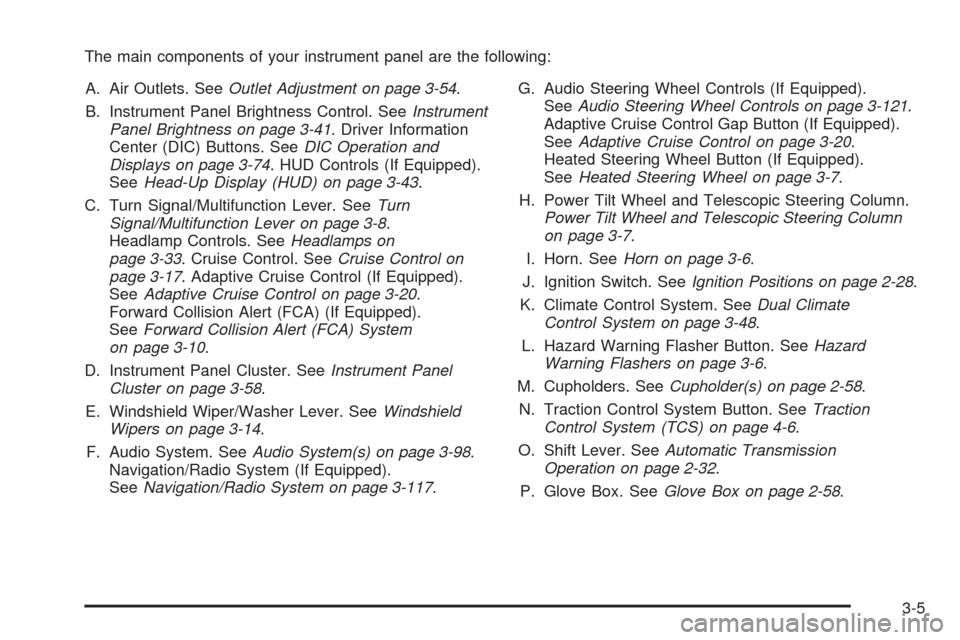
The main components of your instrument panel are the following:
A. Air Outlets. SeeOutlet Adjustment on page 3-54.
B. Instrument Panel Brightness Control. SeeInstrument
Panel Brightness on page 3-41. Driver Information
Center (DIC) Buttons. SeeDIC Operation and
Displays on page 3-74. HUD Controls (If Equipped).
SeeHead-Up Display (HUD) on page 3-43.
C. Turn Signal/Multifunction Lever. SeeTurn
Signal/Multifunction Lever on page 3-8.
Headlamp Controls. SeeHeadlamps on
page 3-33. Cruise Control. SeeCruise Control on
page 3-17. Adaptive Cruise Control (If Equipped).
SeeAdaptive Cruise Control on page 3-20.
Forward Collision Alert (FCA) (If Equipped).
SeeForward Collision Alert (FCA) System
on page 3-10.
D. Instrument Panel Cluster. SeeInstrument Panel
Cluster on page 3-58.
E. Windshield Wiper/Washer Lever. SeeWindshield
Wipers on page 3-14.
F. Audio System. SeeAudio System(s) on page 3-98.
Navigation/Radio System (If Equipped).
SeeNavigation/Radio System on page 3-117.G. Audio Steering Wheel Controls (If Equipped).
SeeAudio Steering Wheel Controls on page 3-121.
Adaptive Cruise Control Gap Button (If Equipped).
SeeAdaptive Cruise Control on page 3-20.
Heated Steering Wheel Button (If Equipped).
SeeHeated Steering Wheel on page 3-7.
H. Power Tilt Wheel and Telescopic Steering Column.
Power Tilt Wheel and Telescopic Steering Column
on page 3-7.
I. Horn. SeeHorn on page 3-6.
J. Ignition Switch. SeeIgnition Positions on page 2-28.
K. Climate Control System. SeeDual Climate
Control System on page 3-48.
L. Hazard Warning Flasher Button. SeeHazard
Warning Flashers on page 3-6.
M. Cupholders. SeeCupholder(s) on page 2-58.
N. Traction Control System Button. SeeTraction
Control System (TCS) on page 4-6.
O. Shift Lever. SeeAutomatic Transmission
Operation on page 2-32.
P. Glove Box. SeeGlove Box on page 2-58.
3-5
Page 161 of 500
Power Tilt Wheel and Telescopic
Steering Column
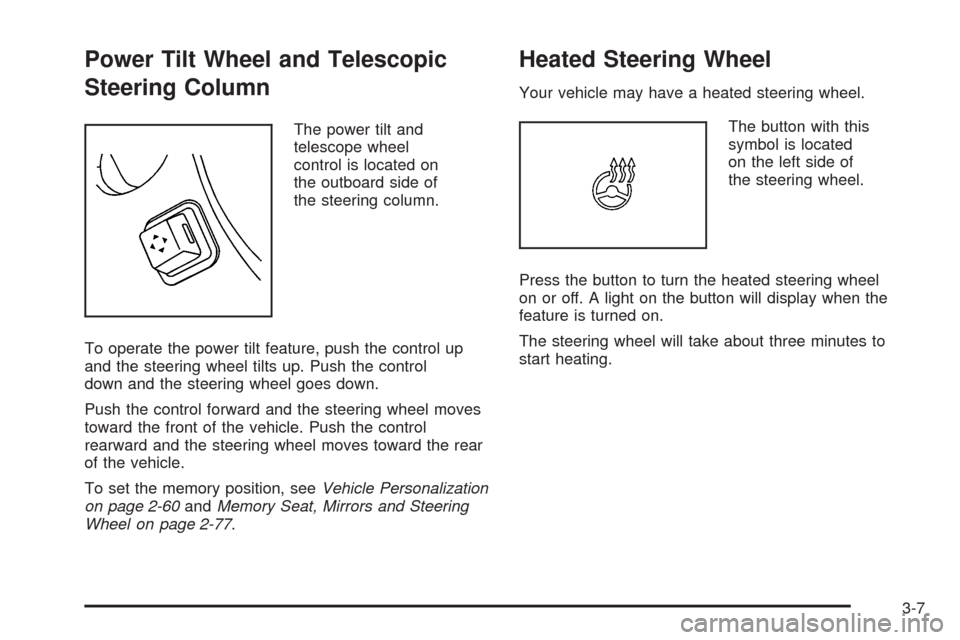
The power tilt and
telescope wheel
control is located on
the outboard side of
the steering column.
To operate the power tilt feature, push the control up
and the steering wheel tilts up. Push the control
down and the steering wheel goes down.
Push the control forward and the steering wheel moves
toward the front of the vehicle. Push the control
rearward and the steering wheel moves toward the rear
of the vehicle.
To set the memory position, seeVehicle Personalization
on page 2-60andMemory Seat, Mirrors and Steering
Wheel on page 2-77.
Heated Steering Wheel
Your vehicle may have a heated steering wheel.
The button with this
symbol is located
on the left side of
the steering wheel.
Press the button to turn the heated steering wheel
on or off. A light on the button will display when the
feature is turned on.
The steering wheel will take about three minutes to
start heating.
3-7