climate control CADILLAC STS 2009 1.G User Guide
[x] Cancel search | Manufacturer: CADILLAC, Model Year: 2009, Model line: STS, Model: CADILLAC STS 2009 1.GPages: 514, PDF Size: 2.73 MB
Page 159 of 514
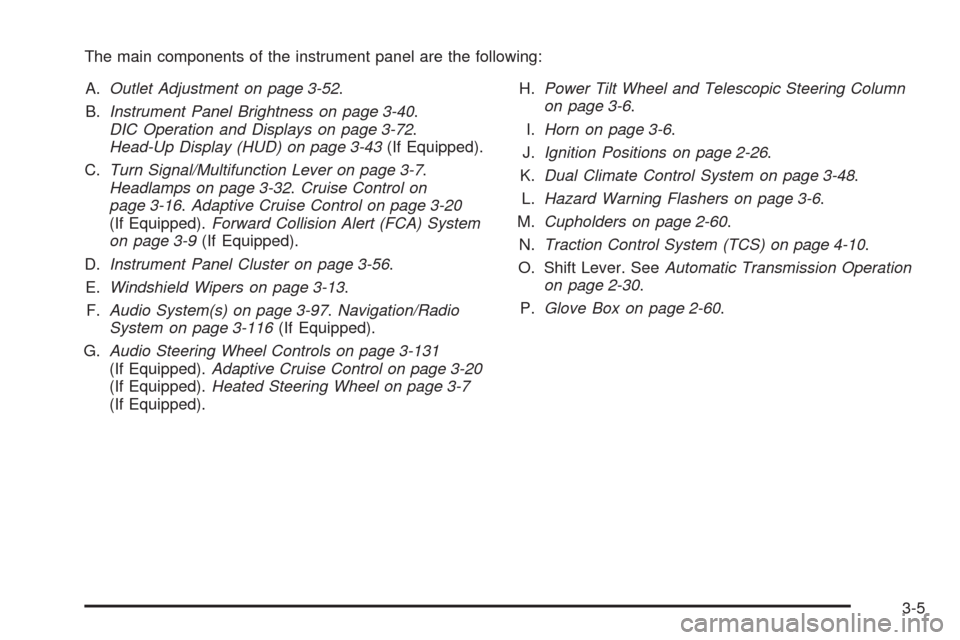
The main components of the instrument panel are the following:
A.Outlet Adjustment on page 3-52.
B.Instrument Panel Brightness on page 3-40.
DIC Operation and Displays on page 3-72.
Head-Up Display (HUD) on page 3-43(If Equipped).
C.Turn Signal/Multifunction Lever on page 3-7.
Headlamps on page 3-32.Cruise Control on
page 3-16.Adaptive Cruise Control on page 3-20
(If Equipped).Forward Collision Alert (FCA) System
on page 3-9(If Equipped).
D.Instrument Panel Cluster on page 3-56.
E.Windshield Wipers on page 3-13.
F.Audio System(s) on page 3-97.Navigation/Radio
System on page 3-116(If Equipped).
G.Audio Steering Wheel Controls on page 3-131
(If Equipped).Adaptive Cruise Control on page 3-20
(If Equipped).Heated Steering Wheel on page 3-7
(If Equipped).H.Power Tilt Wheel and Telescopic Steering Column
on page 3-6.
I.Horn on page 3-6.
J.Ignition Positions on page 2-26.
K.Dual Climate Control System on page 3-48.
L.Hazard Warning Flashers on page 3-6.
M.Cupholders on page 2-60.
N.Traction Control System (TCS) on page 4-10.
O. Shift Lever. SeeAutomatic Transmission Operation
on page 2-30.
P.Glove Box on page 2-60.
3-5
Page 195 of 514

Entry Lighting
The entry lighting system turns on the reading and
dome lamps and the backlighting to the exterior lamp
control when a door is opened or if you press the remote
keyless entry transmitter unlock button. If activated by
the transmitter, the lighting will remain active for about
25 seconds. The entry lighting system uses the light
sensor; it must be dark outside in order for the lamps to
turn on. The lamps turn off about 25 seconds after the
last door is closed. They will dim to off if the ignition is
on, or immediately deactivate if the power locks are
activated.
Parade Dimming
This feature prohibits dimming of the instrument panel
displays and backlighting during daylight hours when
the key is in the ignition and the headlamps are on.
This feature operates with the light sensor and is fully
automatic. When the light sensor reads darkness outside
and the parking lamps are active, the instrument panel
displays can be adjusted by turning the instrument panel
brightness knob. SeeInstrument Panel Brightness on
page 3-40for additional information.
Reading Lamps
The reading lamps are located on the overhead console.
These lamps come on automatically when any door is
opened.
For manual operation, press the button next to each
lamp to turn it on or off.
If the reading lamps are left on, they automatically shut
off 10 minutes after the ignition has been turned off.
Battery Load Management
The battery load management feature is designed to
monitor the vehicle’s electrical load and determine when
the battery is in a heavy discharge condition. During
times of high electrical loading, the engine may idle at a
higher revolutions per minute (rpm) setting than normal to
make sure the battery charges. High electrical loads may
occur when several of the following are on: headlamps,
high beams, fog lamps, rear window defogger, the
climate control fan at high speeds, heated seats and
engine cooling fans.
If the battery continues to discharge, even with the
engine idling at a higher rpm setting, some electrical
loads will automatically be reduced. When this occurs,
the rear window defogger may take slightly longer to clear
the glass and the fan may cut back to a lower speed.
For more battery saving information, see “Battery Saver
Active Message” underDIC Warnings and Messages on
page 3-79.
3-41
Page 196 of 514

Electric Power Management
The vehicle has Electric Power Management (EPM) that
estimates the battery’s temperature and state of charge.
It then adjusts the voltage for best performance and
extended life of the battery.
When the battery’s state of charge is low, the voltage is
raised slightly to quickly bring the charge back up. When
the state of charge is high, the voltage is lowered slightly
to prevent overcharging. If the vehicle has a voltmeter
gage or a voltage display on the Driver Information
Center (DIC), you may see the voltage move up or
down. This is normal. If there is a problem, an alert
will be displayed.
The battery can be discharged at idle if the electrical
loads are very high. This is true for all vehicles. This is
because the generator (alternator) may not be spinning
fast enough at idle to produce all the power that is
needed for very high electrical loads.
A high electrical load occurs when several of the
following are on: headlamps, high beams, fog lamps,
rear window defogger, climate control fan at high speed,
heated seats, engine cooling fans, trailer loads, and
loads plugged into accessory power outlets.EPM works to prevent excessive discharge of the
battery. It does this by balancing the generator’s output
and the vehicle’s electrical needs. It can increase
engine idle speed to generate more power, whenever
needed. It can temporarily reduce the power demands
of some accessories.
Normally, these actions occur in steps or levels, without
being noticeable. In rare cases at the highest levels of
corrective action, this action may be noticeable to the
driver. If so, a Driver Information Center (DIC) message
might be displayed, such as Battery Saver Active or
Service Battery Charging System. If this message is
displayed, it is recommended that the driver reduce the
electrical loads as much as possible. SeeDIC Warnings
and Messages on page 3-79.
Inadvertent Power Battery Saver
This feature is designed to protect the vehicle’s battery
against drainage from the interior lamps, trunk lamp,
glove box lamp, or the garage door opener. When the
ignition is turned off, the power to these features will
automatically turn off after 10 minutes (three minutes
if a new car has 15 miles (24 km) or less). Power will
be restored for an additional 10 minutes if any door
is opened, the trunk is opened or the courtesy lamp
switch is turned on.
3-42
Page 201 of 514
use equipment exceeding maximum amperage
rating of 20 amperes. Check with your dealer/retailer
before adding electrical equipment.
Follow the proper installation instructions that are
included with any electrical equipment you install.
Notice:Improper use of the power outlet can cause
damage not covered by the warranty. Do not hang
any type of accessory or accessory bracket from
the plug because the power outlets are designed
for accessory power plugs only.
Ashtray(s) and Cigarette Lighter
The vehicle may have an ashtray and cigarette lighter.
Notice:If papers, pins, or other ammable items
are put in the ashtray, hot cigarettes or other
smoking materials could ignite them and possibly
damage the vehicle. Never put ammable items
in the ashtray.
Ashtray
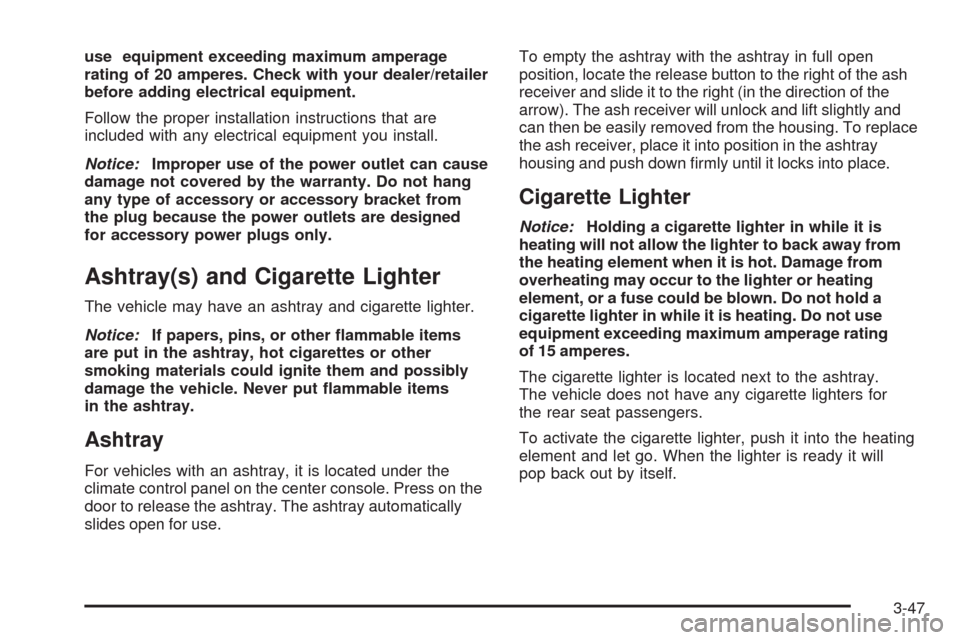
For vehicles with an ashtray, it is located under the
climate control panel on the center console. Press on the
door to release the ashtray. The ashtray automatically
slides open for use.To empty the ashtray with the ashtray in full open
position, locate the release button to the right of the ash
receiver and slide it to the right (in the direction of the
arrow). The ash receiver will unlock and lift slightly and
can then be easily removed from the housing. To replace
the ash receiver, place it into position in the ashtray
housing and push down rmly until it locks into place.
Cigarette Lighter
Notice:Holding a cigarette lighter in while it is
heating will not allow the lighter to back away from
the heating element when it is hot. Damage from
overheating may occur to the lighter or heating
element, or a fuse could be blown. Do not hold a
cigarette lighter in while it is heating. Do not use
equipment exceeding maximum amperage rating
of 15 amperes.
The cigarette lighter is located next to the ashtray.
The vehicle does not have any cigarette lighters for
the rear seat passengers.
To activate the cigarette lighter, push it into the heating
element and let go. When the lighter is ready it will
pop back out by itself.
3-47
Page 202 of 514
Climate Controls
Dual Climate Control System
The heating, cooling, and ventilation can be controlled
for the vehicle with this system.
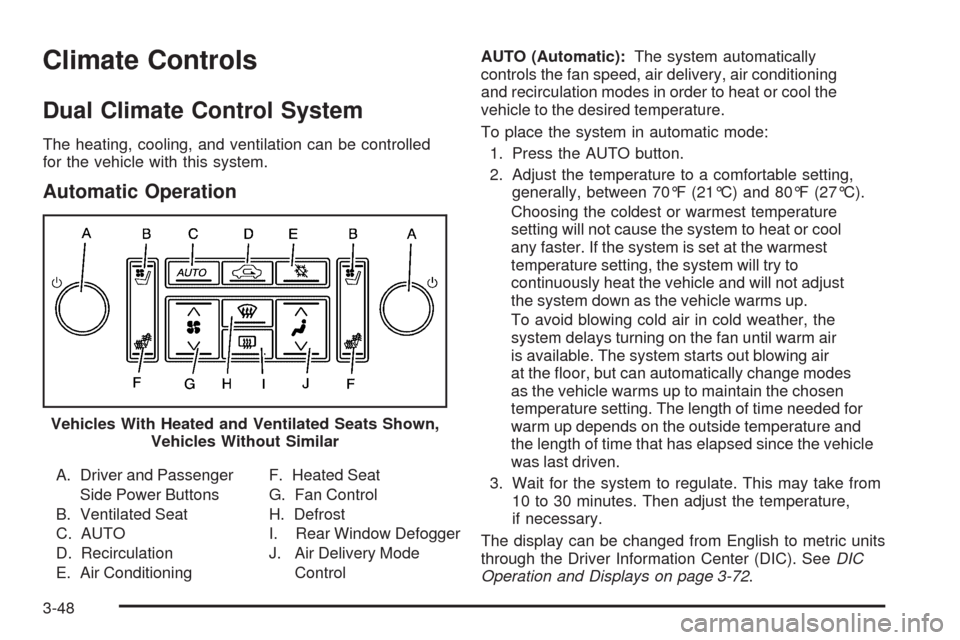
Automatic Operation
A. Driver and Passenger
Side Power Buttons
B. Ventilated Seat
C. AUTO
D. Recirculation
E. Air ConditioningF. Heated Seat
G. Fan Control
H. Defrost
I. Rear Window Defogger
J. Air Delivery Mode
ControlAUTO (Automatic):The system automatically
controls the fan speed, air delivery, air conditioning
and recirculation modes in order to heat or cool the
vehicle to the desired temperature.
To place the system in automatic mode:
1. Press the AUTO button.
2. Adjust the temperature to a comfortable setting,
generally, between 70°F (21°C) and 80°F (27°C).
Choosing the coldest or warmest temperature
setting will not cause the system to heat or cool
any faster. If the system is set at the warmest
temperature setting, the system will try to
continuously heat the vehicle and will not adjust
the system down as the vehicle warms up.
To avoid blowing cold air in cold weather, the
system delays turning on the fan until warm air
is available. The system starts out blowing air
at the oor, but can automatically change modes
as the vehicle warms up to maintain the chosen
temperature setting. The length of time needed for
warm up depends on the outside temperature and
the length of time that has elapsed since the vehicle
was last driven.
3. Wait for the system to regulate. This may take from
10 to 30 minutes. Then adjust the temperature,
if necessary.
The display can be changed from English to metric units
through the Driver Information Center (DIC). SeeDIC
Operation and Displays on page 3-72. Vehicles With Heated and Ventilated Seats Shown,
Vehicles Without Similar
3-48
Page 203 of 514
Manual Operation
O(Driver’s Temperature Control):Press to turn the
entire climate control system on or off. Turn the knob to
increase or decrease the temperature inside the vehicle.
O(Passenger’s Temperature Control):Press to turn
the passenger climate control system on. Turn the knob
to increase or decrease the temperature for the front
passenger only. The passenger side power button does
not turn off the climate control system. The system is set
to the same setting as the driver.
yAz(Fan Control):Press to increase or decrease
the fan speed. This cancels automatic operation and
lets the amount of airow be adjusted manually.
Press AUTO to return to automatic operation.
If the airow seems low when the fan speed is at the
highest setting, the passenger compartment air lter
may need to be replaced. For more information,
seePassenger Compartment Air Filter on page 3-54
andScheduled Maintenance on page 6-4.
yNz(Air Delivery Mode):Press to change the
direction of the airow in the vehicle. This cancels
automatic operation and lets the air delivery mode be
adjusted manually. Press AUTO to return to automatic
operation.
The outboard air outlets always receive airow
regardless of the mode selected. SeeOutlet Adjustment
on page 3-52to change this airow from the outboard
outlets.
To change the current mode, select one of the following:
Y(Vent):Air is directed to the instrument panel
outlets.
\(Bi-Level):Air is divided between the instrument
panel outlets and the oor outlets. In automatic operation,
cooler air is directed to the upper outlets and warmer air
to the oor outlets.
[(Floor):Air is directed to the oor outlets, with
some air directed to the windshield and side windows.
3-49
Page 206 of 514

Sensors
The solar sensor located on the instrument panel, near
the windshield, monitors the solar heat.
The interior temperature sensor located on the
instrument panel to the right of the steering wheel,
measures the temperature of the air inside the vehicle.
The climate control system uses the information
from these sensors to adjust the temperature, the fan
speed and the air delivery, in order to maintain the
selected temperature. The system may also supply
cooler air to the side of the vehicle facing the sun.
Do not cover the sensors or the automatic climate
control system will not work properly.
Outlet Adjustment
Use the lever located in the center of each outlet to
change the direction of the airow, either side-to-side or
up and down. Use the thumbwheels to open or close
the outlets to adjust the airow.
Turn the thumbwheel towards the vehicle door to open
the outlets and allow the maximum amount of air to
enter your vehicle. Turn the thumbwheel towards
the center console to close the outlets and minimize
the amount of air entering the vehicle.
Operation Tips
Clear away any ice, snow or leaves from the air
inlets at the base of the windshield that may
block the ow of air into your vehicle.
Use of non-GM approved hood deectors may
adversely affect the performance of the system.
Keep the path under the front seats clear of objects
to help circulate the air inside of your vehicle more
effectively.
If the airow seems low when the fan speed is at
the highest setting, the passenger compartment air
lter may need to be replaced. For more information,
seePassenger Compartment Air Filter on page 3-54.
3-52
Page 207 of 514
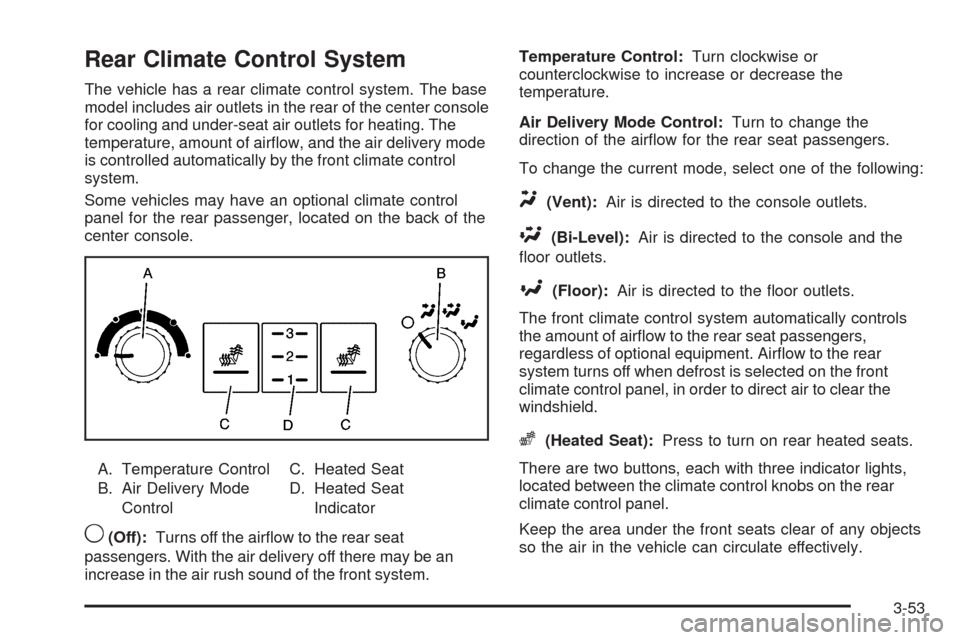
Rear Climate Control System
The vehicle has a rear climate control system. The base
model includes air outlets in the rear of the center console
for cooling and under-seat air outlets for heating. The
temperature, amount of airow, and the air delivery mode
is controlled automatically by the front climate control
system.
Some vehicles may have an optional climate control
panel for the rear passenger, located on the back of the
center console.
A. Temperature Control
B. Air Delivery Mode
ControlC. Heated Seat
D. Heated Seat
Indicator
9(Off):Turns off the airow to the rear seat
passengers. With the air delivery off there may be an
increase in the air rush sound of the front system.Temperature Control:Turn clockwise or
counterclockwise to increase or decrease the
temperature.
Air Delivery Mode Control:Turn to change the
direction of the airow for the rear seat passengers.
To change the current mode, select one of the following:
Y(Vent):Air is directed to the console outlets.
\(Bi-Level):Air is directed to the console and the
oor outlets.
[(Floor):Air is directed to the oor outlets.
The front climate control system automatically controls
the amount of airow to the rear seat passengers,
regardless of optional equipment. Airow to the rear
system turns off when defrost is selected on the front
climate control panel, in order to direct air to clear the
windshield.
z(Heated Seat):Press to turn on rear heated seats.
There are two buttons, each with three indicator lights,
located between the climate control knobs on the rear
climate control panel.
Keep the area under the front seats clear of any objects
so the air in the vehicle can circulate effectively.
3-53
Page 208 of 514
Passenger Compartment Air Filter
Your vehicle may be equipped with a passenger
compartment air lter. There are two types of lters
available. There is a standard dust lter that traps small
particles including pollen. There is, also, a dust/odor lter
available that traps dust and pollen and uses a charcoal
element to help reduce many offensive odors from
entering your vehicle. The lter will need to be changed
periodically. For information on when to change the
passenger compartment air lter, seeScheduled
Maintenance on page 6-4.
Notice:Driving without a passenger compartment
air lter in place can cause water and small particles,
like paper and leaves, to be pulled into your climate
control system which may cause damage to it. Make
sure you always replace the old lter with a new one.The access panel for the passenger compartment air
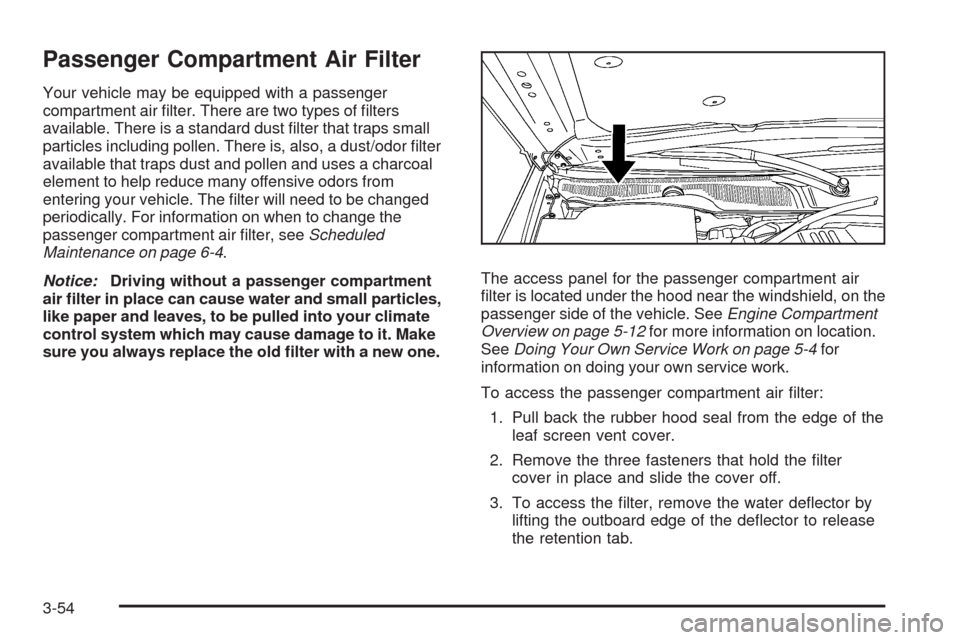
lter is located under the hood near the windshield, on the
passenger side of the vehicle. SeeEngine Compartment
Overview on page 5-12for more information on location.
SeeDoing Your Own Service Work on page 5-4for
information on doing your own service work.
To access the passenger compartment air lter:
1. Pull back the rubber hood seal from the edge of the
leaf screen vent cover.
2. Remove the three fasteners that hold the lter
cover in place and slide the cover off.
3. To access the lter, remove the water deector by
lifting the outboard edge of the deector to release
the retention tab.
3-54
Page 234 of 514
BATTERY NOT CHARGING SERVICE
CHARGING SYS (System)
This symbol appears with
this message.
This message displays when a problem with the
charging system has been detected. Have your
vehicle serviced by your dealer/retailer.
BATTERY SAVER ACTIVE
This message displays when the system detects that the
battery voltage is dropping beyond a reasonable level.
The battery saver system starts reducing certain features
of the vehicle that may be noticeable. At the point that
the features are disabled, this message is displayed.
It means that the vehicle is trying to save the charge
in the battery.
Turn off all unnecessary accessories to allow the battery
to recharge.
The normal battery voltage range is 11.5 to 15.5 volts.
To monitor battery voltage on the DIC, press the
information button until BATTERY VOLTS displays.
BATTERY VOLTAGE HIGH
This symbol appears with
this message.
This message displays when the electrical charging
system is overcharging the battery. When the system
detects that the battery voltage is above an estimated
16 volts, this message displays.
To reduce the charging overload, use the vehicle’s
accessories:
Turn on the exterior lamps and radio.
Set the climate control on AUTO and the fan speed
on the highest setting.
Turn the rear window defogger on.
The normal battery voltage range is 11.5 to 15.5 volts
when the engine is running. To monitor battery voltage
on the DIC, press the information button until
BATTERY VOLTS displays.
3-80