engine oil CADILLAC STS 2011 1.G Owner's Manual
[x] Cancel search | Manufacturer: CADILLAC, Model Year: 2011, Model line: STS, Model: CADILLAC STS 2011 1.GPages: 528, PDF Size: 4.96 MB
Page 362 of 528
Black plate (12,1)Cadillac STS Owner Manual - 2011
Checking Things Under
the Hood
{WARNING:
An electric fan under the hood can start up and
injure you even when the engine is not running.
Keep hands, clothing, and tools away from any
underhood electric fan.
{WARNING:
Things that burn can get on hot engine parts and
start a fire. These include liquids like fuel, oil,
coolant, brake fluid, windshield washer and other
fluids, and plastic or rubber. You or others could
be burned. Be careful not to drop or spill things
that will burn onto a hot engine.
Hood Release
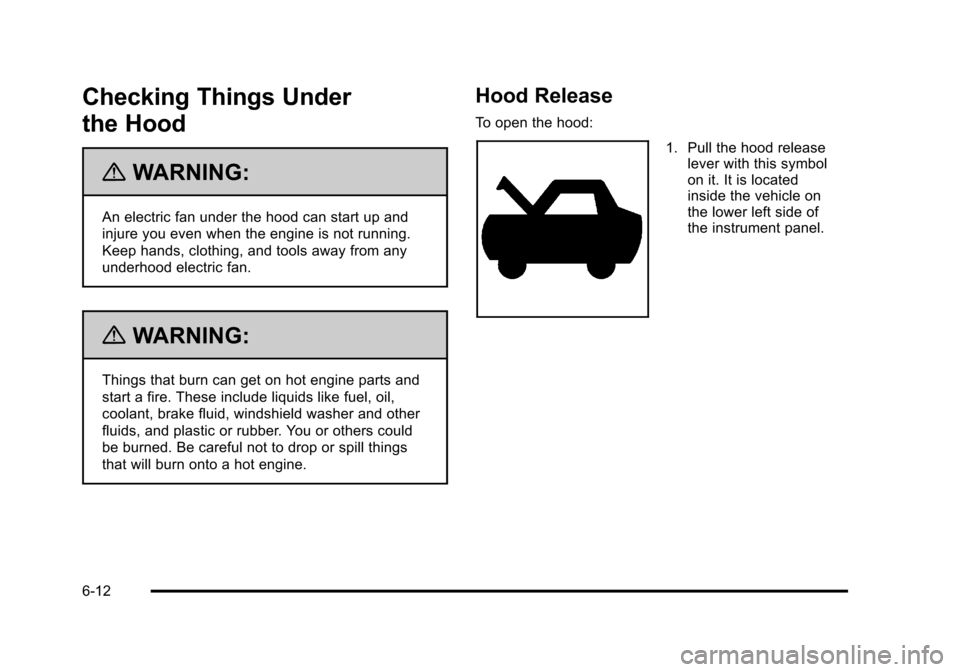
To open the hood:
1. Pull the hood releaselever with this symbol
on it. It is located
inside the vehicle on
the lower left side of
the instrument panel.
6-12
Page 365 of 528
Black plate (15,1)Cadillac STS Owner Manual - 2011
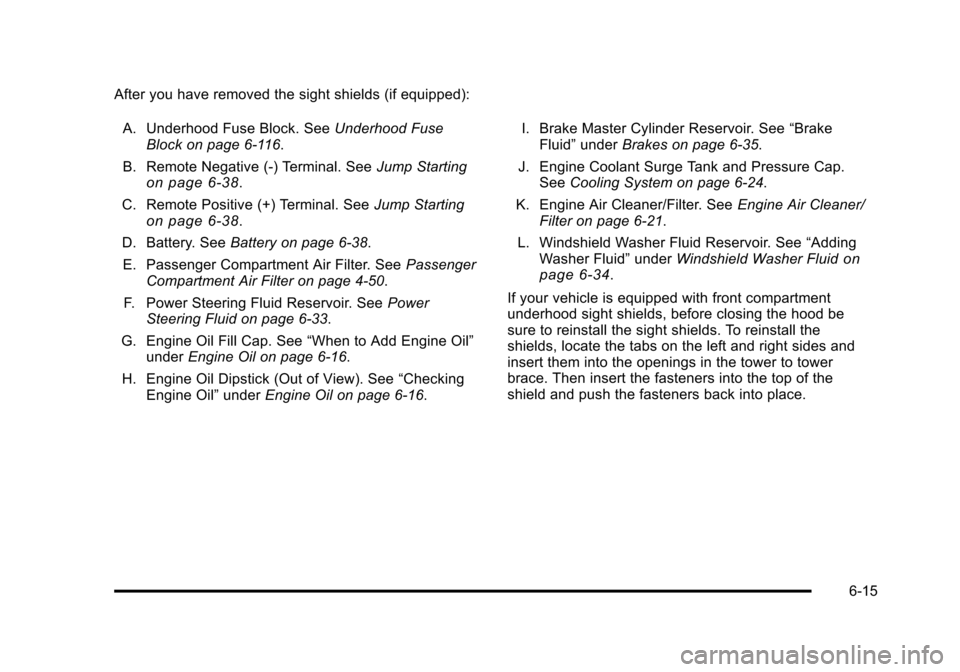
After you have removed the sight shields (if equipped):A. Underhood Fuse Block. See Underhood Fuse
Block on page 6‑116.
B. Remote Negative (-) Terminal. See Jump Starting
on page 6‑38.
C. Remote Positive (+) Terminal. See Jump Starting
on page 6‑38.
D. Battery. See Battery on page 6‑38.
E. Passenger Compartment Air Filter. See Passenger
Compartment Air Filter on page 4‑50.
F. Power Steering Fluid Reservoir. See Power
Steering Fluid on page 6‑33.
G. Engine Oil Fill Cap. See “When to Add Engine Oil”
under Engine Oil on page 6‑16.
H. Engine Oil Dipstick (Out of View). See “Checking
Engine Oil” underEngine Oil on page 6‑16. I. Brake Master Cylinder Reservoir. See
“Brake
Fluid” under Brakes on page 6‑35.
J. Engine Coolant Surge Tank and Pressure Cap. See Cooling System on page 6‑24.
K. Engine Air Cleaner/Filter. See Engine Air Cleaner/
Filter on page 6‑21.
L. Windshield Washer Fluid Reservoir. See “Adding
Washer Fluid” underWindshield Washer Fluid
on
page 6‑34.
If your vehicle is equipped with front compartment
underhood sight shields, before closing the hood be
sure to reinstall the sight shields. To reinstall the
shields, locate the tabs on the left and right sides and
insert them into the openings in the tower to tower
brace. Then insert the fasteners into the top of the
shield and push the fasteners back into place.
6-15
Page 366 of 528
Black plate (16,1)Cadillac STS Owner Manual - 2011
Engine Oil
To ensure proper engine performance and long life,
careful attention must be paid to engine oil. Following
these simple, but important steps will help protect your
investment:
.Always use engine oil approved to the proper
specification and of the proper viscosity grade. See
“Selecting the Right Engine Oil.”
.Check the engine oil level regularly and maintain
the proper oil level. See“Checking Engine Oil”and
“When to Add Engine Oil.”
.Change the engine oil at the appropriate time. See
Engine Oil Life System on page 6‑20.
.Always dispose of engine oil properly. See “What
to Do With Used Oil.”
Checking Engine Oil
It is a good idea to check the engine oil level at each
fuel fill. In order to get an accurate reading, the vehicle
must be on level ground. The engine oil dipstick handle
is a yellow loop. See Engine Compartment Overview
on
page 6‑13for the location of the engine oil dipstick.
Obtaining an accurate oil level reading is essential: 1. If the engine has been running recently, turn off the engine and allow several minutes for the oil to
drain back into the oil pan. Checking your oil level
too soon after engine shut off will not provide an
accurate oil level reading.
2. Pull out the dipstick and clean it with a paper towel or cloth, then push it back in all the way. Remove it
again, keeping the tip down, and check the level.
6-16
Page 367 of 528
Black plate (17,1)Cadillac STS Owner Manual - 2011
When to Add Engine Oil
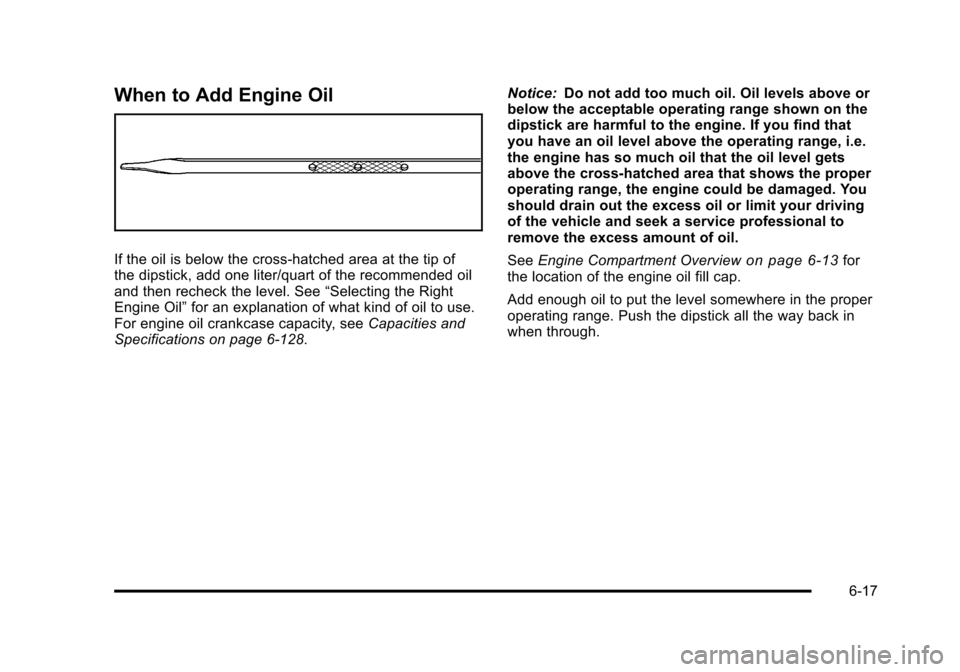
If the oil is below the cross-hatched area at the tip of
the dipstick, add one liter/quart of the recommended oil
and then recheck the level. See“Selecting the Right
Engine Oil” for an explanation of what kind of oil to use.
For engine oil crankcase capacity, see Capacities and
Specifications on page 6‑128. Notice:
Do not add too much oil. Oil levels above or
below the acceptable operating range shown on the
dipstick are harmful to the engine. If you find that
you have an oil level above the operating range, i.e.
the engine has so much oil that the oil level gets
above the cross-hatched area that shows the proper
operating range, the engine could be damaged. You
should drain out the excess oil or limit your driving
of the vehicle and seek a service professional to
remove the excess amount of oil.
See Engine Compartment Overviewon page 6‑13for
the location of the engine oil fill cap.
Add enough oil to put the level somewhere in the proper
operating range. Push the dipstick all the way back in
when through.
6-17
Page 368 of 528
Black plate (18,1)Cadillac STS Owner Manual - 2011
Selecting the Right Engine Oil
Selecting the right engine oil depends on both the
proper oil specification and viscosity grade:
Specification
Use and ask for engine oils with the dexos™
certification mark. Oils meeting the requirements of your
vehicle should have the dexos™certification mark on
the container. This certification mark indicates that the
oil has been approved to the dexos™ specification.
Your vehicle was filled at the factory with dexos™
approved engine oil. Notice:
Use only engine oil that is approved to the
dexos™ specification or an equivalent engine oil
of the appropriate viscosity grade. Engine oils
approved to the dexos™ specification will show the
dexos™ symbol on the container. Failure to use the
recommended engine oil or equivalent can result in
engine damage not covered by the vehicle warranty.
If you are unsure whether your oil is approved to
the dexos™ specification, ask your service provider.
Use of Substitute Engine Oils if dexos™ is unavailable:
In the event that dexos™ approved engine oil is not
available at an oil change or for maintaining proper oil
level, you may use substitute engine oil displaying the
API Starburst symbol and of SAE 5W-30 viscosity
grade. Use of oils that do not meet the dexos™
specification, however, may result in reduced
performance under certain circumstances.
6-18
Page 369 of 528
Black plate (19,1)Cadillac STS Owner Manual - 2011
Viscosity Grade
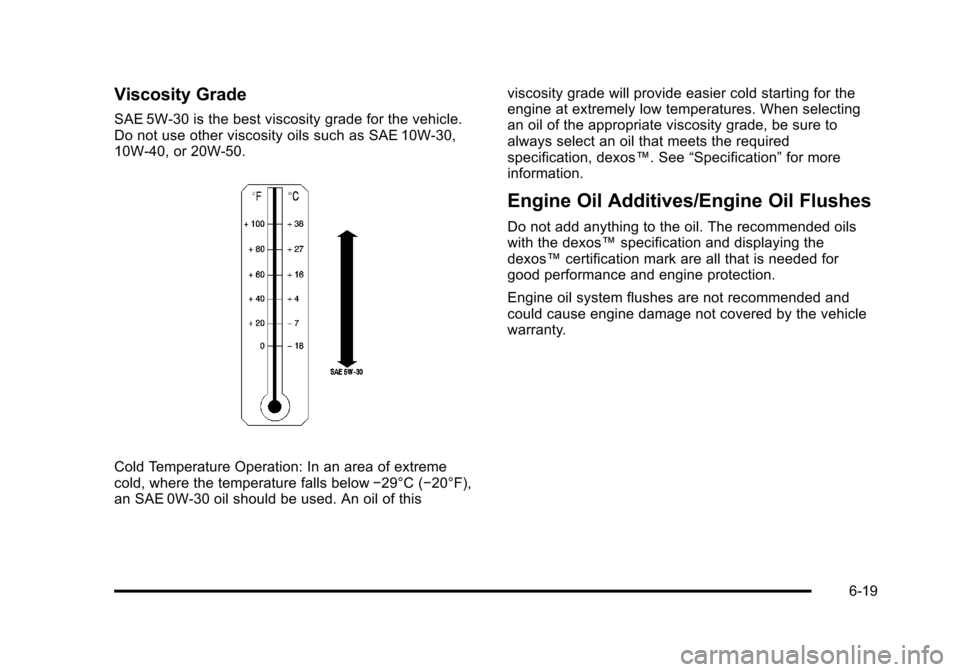
SAE 5W-30 is the best viscosity grade for the vehicle.
Do not use other viscosity oils such as SAE 10W‐30,
10W‐40, or 20W-50.
Cold Temperature Operation: In an area of extreme
cold, where the temperature falls below−29°C (−20°F),
an SAE 0W-30 oil should be used. An oil of this viscosity grade will provide easier cold starting for the
engine at extremely low temperatures. When selecting
an oil of the appropriate viscosity grade, be sure to
always select an oil that meets the required
specification, dexos™. See
“Specification”for more
information.
Engine Oil Additives/Engine Oil Flushes
Do not add anything to the oil. The recommended oils
with the dexos™ specification and displaying the
dexos™ certification mark are all that is needed for
good performance and engine protection.
Engine oil system flushes are not recommended and
could cause engine damage not covered by the vehicle
warranty.
6-19
Page 370 of 528
Black plate (20,1)Cadillac STS Owner Manual - 2011
What to Do with Used Oil
Used engine oil contains certain elements that can be
unhealthy for your skin and could even cause cancer.
Do not let used oil stay on your skin for very long. Clean
your skin and nails with soap and water, or a good hand
cleaner. Wash or properly dispose of clothing or rags
containing used engine oil. See the manufacturer's
warnings about the use and disposal of oil products.
Used oil can be a threat to the environment. If you
change your own oil, be sure to drain all the oil from
the filter before disposal. Never dispose of oil by putting
it in the trash or pouring it on the ground, into sewers,
or into streams or bodies of water. Recycle it by taking it
to a place that collects used oil.
Engine Oil Life System
When to Change Engine Oil
This vehicle has a computer system that indicates when
to change the engine oil and filter. This is based on
engine revolutions and engine temperature, and not on
mileage. Based on driving conditions, the mileage at
which an oil change is indicated can vary considerably.
For the oil life system to work properly, the system must
be reset every time the oil is changed.When the system has calculated that oil life has been
diminished, it indicates that an oil change is necessary.
A CHANGE ENGINE OIL SOON message in the DIC
comes on. See
DIC Warnings and Messages
on
page 4‑76. Change the oil as soon as possible within
the next 600 miles (1 000 km). It is possible that,
if driving under the best conditions, the oil life system
might indicate that an oil change is not necessary for up
to a year. The engine oil and filter must be changed at
least once a year and, at this time, the system must be
reset. Your dealer has trained service people who will
perform this work and reset the system. It is also
important to check the oil regularly over the course of
an oil drain interval and keep it at the proper level.
If the system is ever reset accidentally, the oil must be
changed at 3,000 miles (5 000 km) since the last oil
change. Remember to reset the oil life system
whenever the oil is changed.
6-20
Page 371 of 528
Black plate (21,1)Cadillac STS Owner Manual - 2011
How to Reset the Engine Oil Life
System
Reset the system whenever the engine oil is changed
so that the system can calculate the next engine oil
change. To reset the system:1. Press the up or down arrow to scroll the DIC to show OIL LIFE.
2. Once the XXX% ENGINE OIL LIFE menu item is highlighted, press and hold the RESET button until
the percentage shows 100%.
If the percentage does not return to 100% or if the
CHANGE ENGINE OIL SOON message comes back on
when the vehicle is started, the engine oil life system
has not been reset. Repeat the procedure.
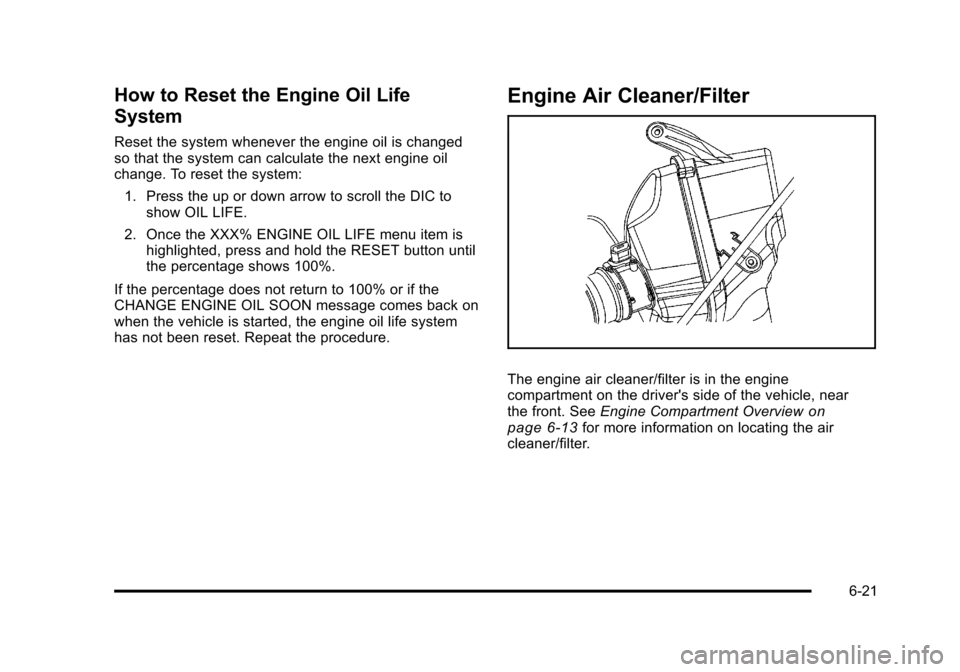
Engine Air Cleaner/Filter
The engine air cleaner/filter is in the engine
compartment on the driver's side of the vehicle, near
the front. See Engine Compartment Overview
on
page 6‑13for more information on locating the air
cleaner/filter.
6-21
Page 372 of 528
Black plate (22,1)Cadillac STS Owner Manual - 2011
When to Inspect the Engine Air
Cleaner/Filter
Inspect the air cleaner/filter at the scheduled
maintenance intervals and replace it at the first oil
change after each 80 000 km (50,000 mile) interval. See
Scheduled Maintenance
on page 7‑3for more
information. If you are driving in dusty/dirty conditions,
inspect the filter at each engine oil change.
How to Inspect the Engine Air
Cleaner/Filter
To inspect the air cleaner/filter remove the filter from the
vehicle and lightly shake the filter to release loose dust
and dirt. If the filter remains caked with dirt, a new filter
is required.
To inspect or replace the filter:
1. Remove the two screws located on the top of the cover.
2. Disconnect the coolant recovery hose so that it is not going across the top of the engine air cleaner/
filter.
3. Loosen the clamp and remove the duct from the passenger's side of the engine air cleaner/filter. 4. The two sides of the airbox are hinged at the
bottom. Open the airbox by pushing the top of the
airbox cover toward the engine.
5. Remove the air filter by lifting it straight up through the opening in the airbox.
6. Inspect or replace the engine air cleaner/filter. See Maintenance Replacement Parts
on page 7‑11for
the correct part number for the filter.
7. Reinstall the cover by reversing Steps 1 through 4.
{WARNING:
Operating the engine with the air cleaner/filter off
can cause you or others to be burned. The air
cleaner not only cleans the air; it helps to stop
flames if the engine backfires. Use caution when
working on the engine and do not drive with the
air cleaner/filter off.
Notice: If the air cleaner/filter is off, dirt can easily
get into the engine, which could damage it. Always
have the air cleaner/filter in place when you are
driving.
6-22
Page 376 of 528
Black plate (26,1)Cadillac STS Owner Manual - 2011
What to Use
{WARNING:
Adding only plain water or some other liquid to the
cooling system can be dangerous. Plain water
and other liquids, can boil before the proper
coolant mixture will. The vehicle's coolant warning
system is set for the proper coolant mixture. With
plain water or the wrong mixture, the engine could
get too hot but you would not get the overheat
warning. The engine could catch fire and you or
others could be burned. Use a 50/50 mixture of
clean, drinkable water and DEX-COOL coolant.
Use a 50/50 mixture of clean, drinkable water and
DEX-COOL
®coolant. If using this mixture, nothing else
needs to be added. This mixture:
.Gives freezing protection down to −34°F (−37°C),
outside temperature.
.Gives boiling protection up to 265°F (129°C),
engine temperature.
.Protects against rust and corrosion.
.Will not damage aluminum parts.
.Helps keep the proper engine temperature.
Notice: If an improper coolant mixture is used, the
engine could overheat and be badly damaged. The
repair cost would not be covered by the vehicle
warranty. Too much water in the mixture can freeze
and crack the engine, radiator, heater core, and
other parts.
Notice: If extra inhibitors and/or additives are used
in the vehicle's cooling system, the vehicle could be
damaged. Use only the proper mixture of the engine
coolant listed in this manual for the cooling system.
See Recommended Fluids and Lubricants
on
page 7‑9for more information.
6-26