fuel cap CADILLAC XLR 2004 1.G Owners Manual
[x] Cancel search | Manufacturer: CADILLAC, Model Year: 2004, Model line: XLR, Model: CADILLAC XLR 2004 1.GPages: 356, PDF Size: 2.36 MB
Page 1 of 356

Seats and Restraint Systems........................... 1-1
Front Seats
............................................... 1-2
Safety Belts
.............................................. 1-4
Child Restraints
.......................................1-18
Air Bag Systems
......................................1-36
Restraint System Check
............................1-48
Features and Controls..................................... 2-1
Keys
........................................................ 2-2
Doors and Locks
....................................... 2-8
Windows
.................................................2-14
Theft-Deterrent Systems
............................2-17
Starting and Operating Your Vehicle
...........2-19
Mirrors
....................................................2-33
OnStar
žSystem
......................................2-35
HomeLinkžTransmitter
.............................2-37
Storage Areas
.........................................2-41
Retractable Hardtop
..................................2-44
Vehicle Personalization
.............................2-53
Instrument Panel............................................. 3-1
Instrument Panel Overview
.......................... 3-2
Climate Controls
......................................3-33
Warning Lights, Gages, and Indicators
........3-39
Driver Information Center (DIC)
..................3-55Trip Computer
.........................................3-70
Audio System(s)
.......................................3-70
Driving Your Vehicle....................................... 4-1
Your Driving, the Road, and Your Vehicle
..... 4-2
Towing
...................................................4-32
Service and Appearance Care.......................... 5-1
Service
..................................................... 5-3
Fuel
......................................................... 5-5
Checking Things Under the Hood
...............5-10
Rear Axle
...............................................5-45
Headlamp Aiming
.....................................5-46
Bulb Replacement
....................................5-49
Windshield Wiper Blade Replacement
.........5-49
Tires
......................................................5-50
Appearance Care
.....................................5-75
Vehicle Identi®cation
.................................5-83
Electrical System
......................................5-84
Capacities and Speci®cations
.....................5-91
Maintenance Schedule..................................... 6-1
Maintenance Schedule
................................ 6-2
Customer Assistance and Information.............. 7-1
Customer Assistance and Information
........... 7-2
Reporting Safety Defects
...........................7-10
Index................................................................ 1
2004 Cadillac XLR Owner ManualM
Page 160 of 356

If the Light Is On Steady
You also may be able to correct the emission system
malfunction by considering the following:
Did you recently put fuel into your vehicle?
If so, reinstall the fuel cap, making sure to fully install
the cap. See
Filling Your Tank on page 5-7. The
diagnostic system can determine if the fuel cap has
been left off or improperly installed. A loose or missing
fuel cap will allow fuel to evaporate into the atmosphere.
A few driving trips with the cap properly installed
should turn the light off.
Did you just drive through a deep puddle of water?
If so, your electrical system may be wet. The condition
will usually be corrected when the electrical system
dries out. A few driving trips should turn the light off.Have you recently changed brands of fuel?
If so, be sure to fuel your vehicle with quality fuel. See
Gasoline Octane on page 5-5. Poor fuel quality will
cause your engine not to run as efficiently as designed.
You may notice this as stalling after start-up, stalling
when you put the vehicle into gear, mis®ring, hesitation
on acceleration or stumbling on acceleration. (These
conditions may go away once the engine is warmed up.)
This will be detected by the system and cause the
light to turn on.
If you experience one or more of these conditions,
change the fuel brand you use. It will require at least
one full tank of the proper fuel to turn the light off.
If none of the above steps have made the light turn off,
your dealer can check the vehicle. Your dealer has
the proper test equipment and diagnostic tools to ®x any
mechanical or electrical problems that may have
developed.
3-50
Page 164 of 356

Fuel Gage
Your fuel gage tells you
about how much fuel you
have left when the
ignition is on.
When the needle approaches the low fuel symbol, LOW
FUEL will appear on the Driver Information Center (DIC)
display. At this time, you still have a little fuel left, but
you should get more soon.
Press RESET to acknowledge a DIC message(s).
Pressing RESET will also turn off a DIC message but
the LOW FUEL message will come on again in
10 minutes if you have not added fuel to the vehicle.Here are ®ve things that some owners ask about. All
these things are normal and do not indicate that
anything is wrong with the fuel gage.·At the gas station, the gas pump shuts off before
the gage reads the full symbol.
·It takes more (or less) fuel to ®ll up than the gage
reads. For example, the gage reads half full, but it
took more (or less) than half of the tank's
capacity to ®t it.
·The gage pointer may move while cornering,
braking or speeding up.
·The gage may not indicate the tank is empty when
the ignition is turned off.
·The gage reading may change slightly within the
®rst several minutes after starting the vehicle.
3-54
Page 220 of 356

Loading Your Vehicle
Item Description Total
AVehicle Capacity Weight
for Example 3=400 lbs (181 kg)
BSubtract Occupant
Weight @ 200 lbs
(91kg)x2=400 lbs (181 kg)
CAvailable Cargo
Weight =0 lbs (0 kg)
Refer to your vehicle's tire and loading information label
for speci®c information about your vehicle's capacity
weight and seating positions. The combined weight of
the driver, passengers and cargo should never
exceed your vehicle's capacity weight.
Certi®cation Label
The other label is the Certi®cation label, found on the
rear edge of the driver's door. It tells you the gross
weight capacity of your vehicle, called the Gross Vehicle
Weight Rating (GVWR). The GVWR includes the
weight of the vehicle, all occupants, fuel and cargo.
Never exceed the GVWR for your vehicle, or the Gross
Axle Weight Rating (GAWR) for either the front or
rear axle. Example 3
4-36
Page 223 of 356

Service............................................................5-3
Doing Your Own Service Work.........................5-4
Adding Equipment to the Outside of
Your Vehicle..............................................5-4
Fuel................................................................5-5
Gasoline Octane............................................5-5
Gasoline Speci®cations....................................5-5
California Fuel...............................................5-6
Additives.......................................................5-6
Fuels in Foreign Countries...............................5-7
Filling Your Tank............................................5-7
Filling a Portable Fuel Container.....................5-10
Checking Things Under
the Hood....................................................5-10
Hood Release..............................................5-11
Engine Compartment Overview.......................5-12
Engine Oil...................................................5-13
Engine Air Cleaner/Filter................................5-18
Automatic Transmission Fluid.........................5-19
Engine Coolant.............................................5-20
Coolant Surge Tank Pressure Cap..................5-23
Engine Overheating.......................................5-23
Cooling System............................................5-26
Power Steering Fluid.....................................5-32Windshield Washer Fluid................................5-33
Brakes........................................................5-35
Battery........................................................5-38
Jump Starting...............................................5-39
Rear Axle.......................................................5-45
Headlamp Aiming...........................................5-46
Headlamp Vertical Aiming..............................5-47
Bulb Replacement..........................................5-49
Windshield Wiper Blade Replacement..............5-49
Tires..............................................................5-50
Run-Flat Tires..............................................5-56
In¯ation - Tire Pressure.................................5-57
Tire Pressure Monitor System.........................5-58
Tire Inspection and Rotation...........................5-60
When It Is Time for New Tires.......................5-62
Buying New Tires.........................................5-63
Uniform Tire Quality Grading..........................5-64
Wheel Alignment and Tire Balance..................5-65
Wheel Replacement......................................5-66
Tire Chains..................................................5-68
Lifting Your Vehicle.......................................5-69
If a Tire Goes Flat........................................5-73
Section 5 Service and Appearance Care
5-1
Page 229 of 356

Fuels in Foreign Countries
If you plan on driving in another country outside the
United States or Canada, the proper fuel may be hard
to ®nd. Never use leaded gasoline or any other fuel
not recommended in the previous text on fuel. Costly
repairs caused by use of improper fuel would not
be covered by your warranty.
To check the fuel availability, ask an auto club, or
contact a major oil company that does business in the
country where you will be driving.
Filling Your Tank
{CAUTION:
Fuel vapor burns violently and a fuel ®re can
cause bad injuries. To help avoid injuries to
you and others, read and follow all the
instructions on the pump island. Turn off your
engine when you are refueling. Do not smoke
CAUTION: (Continued)
CAUTION: (Continued)
if you are near fuel or refueling your vehicle.
Keep sparks, ¯ames and smoking materials
away from fuel. Do not leave the fuel pump
unattended when refueling your vehicle Ð this
is against the law in some places. Keep
children away from the fuel pump; never let
children pump fuel.
The fuel cap is located behind a hinged door on the
driver's side of your vehicle.
5-7
Page 231 of 356

While refueling, hang the fuel cap by the tether from the
hook on the fuel door.
To remove the fuel cap, turn it slowly to the left
(counterclockwise). The fuel cap has a spring in it; if
you let go of the cap too soon, it will spring back to
the right.
{CAUTION:
If you spill fuel and then something ignites it,
you could be badly burned. Fuel can spray out
on you if you open the fuel cap too quickly.
This spray can happen if your tank is nearly
full, and is more likely in hot weather. Open
the fuel cap slowly and wait for any ªhissº
noise to stop. Then unscrew the cap all
the way.
Be careful not to spill fuel. Do not top off or over®ll your
tank, and wait a few seconds after you have ®nished
pumping before you remove the nozzle. Clean fuel from
painted surfaces as soon as possible. See
Cleaning
the Outside of Your Vehicle on page 5-78.
When you put the fuel cap back on, turn it to the right
(clockwise) until you hear a clicking sound. Make
sure you fully install the cap. The diagnostic system can
determine if the fuel cap has been left off or improperly
installed. This would allow fuel to evaporate into the
atmosphere. See
Malfunction Indicator Lamp on
page 3-48.
5-9
Page 232 of 356
The CHECK GAS CAP message in the Driver
Information Center (DIC) will come on if the fuel cap is
not properly reinstalled.
Notice:If you need a new fuel cap, be sure to get
the right type. Your dealer can get one for you.
If you get the wrong type, it may not ®t properly.
This may cause your malfunction indicator lamp to
light and may damage your fuel tank and emissions
system. See
Malfunction Indicator Lamp on
page 3-48.
Filling a Portable Fuel Container
{CAUTION:
Never ®ll a portable fuel container while it is in
your vehicle. Static electricity discharge from
the container can ignite the gasoline vapor.
You can be badly burned and your vehicle
damaged if this occurs. To help avoid injury to
you and others:
·Dispense gasoline only into approved
containers.
CAUTION: (Continued)
CAUTION: (Continued)
·
Do not ®ll a container while it is inside a
vehicle, in a vehicle's trunk, pickup bed or
on any surface other than the ground.
·Bring the ®ll nozzle in contact with the
inside of the ®ll opening before operating
the nozzle. Contact should be maintained
until the ®lling is complete.
·Do not smoke while pumping gasoline.
Checking Things Under
the Hood
{CAUTION:
An electric fan under the hood can start up
and injure you even when the engine is not
running. Keep hands, clothing and tools away
from any underhood electric fan.
5-10
Page 233 of 356
{CAUTION:
Things that burn can get on hot engine parts
and start a ®re. These include liquids like fuel,
oil, coolant, brake ¯uid, windshield washer and
other ¯uids, and plastic or rubber. You or
others could be burned. Be careful not to drop
or spill things that will burn onto a hot engine.
Hood Release
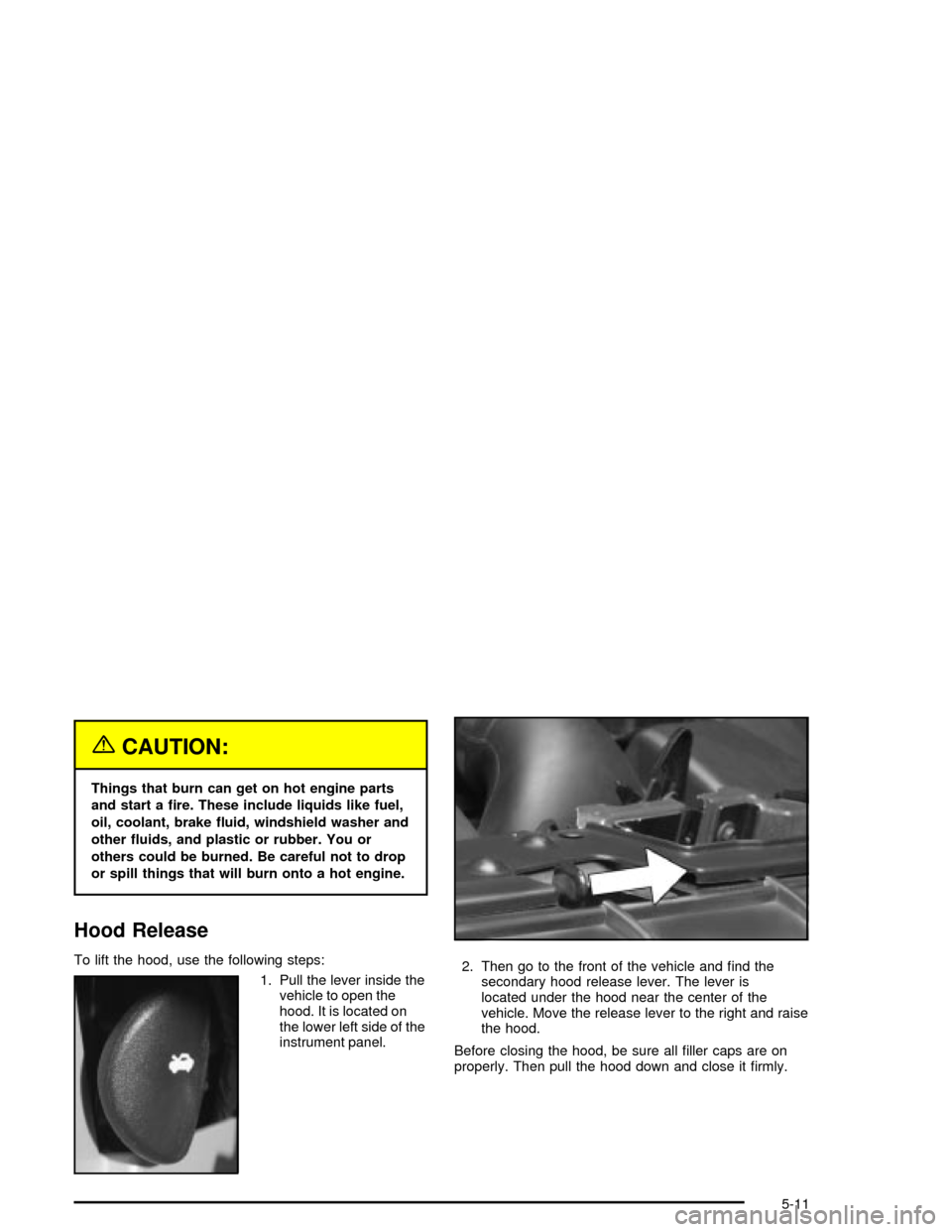
To lift the hood, use the following steps:
1. Pull the lever inside the
vehicle to open the
hood. It is located on
the lower left side of the
instrument panel.2. Then go to the front of the vehicle and ®nd the
secondary hood release lever. The lever is
located under the hood near the center of the
vehicle. Move the release lever to the right and raise
the hood.
Before closing the hood, be sure all ®ller caps are on
properly. Then pull the hood down and close it ®rmly.
5-11
Page 235 of 356

A. Battery. SeeBattery on page 5-38.
B. Passenger Compartment Air Filter. See
Passenger
Compartment Air Filter on page 3-38.
C. Underhood Fuse Block. See
Fuses and Circuit
Breakers on page 5-85.
D. Power Steering Fluid. See
Power Steering Fluid on
page 5-32.
E. Engine Air Cleaner/Filter. See
Engine Air
Cleaner/Filter on page 5-18.
F. Engine Oil Fill Cap. See
Engine Oil on page 5-13.
G. Engine Oil Dipstick. See
Engine Oil on page 5-13.
H. Brake Master Cylinder Reservoir. See
Brakes
on page 5-35.
I. Engine Coolant Surge Tank and Pressure Cap. See
Coolant Surge Tank Pressure Cap on page 5-23.
J. Windshield Washer Fluid Reservoir. See
Windshield
Washer Fluid on page 5-33.
Engine Oil
If the LOW OIL LEVEL or LOW OIL PRESSURE
message on the Driver Information Center appears, it
means you need to check your engine oil level right
away. For more information, see ªLOW OIL LEVELº and
ªLOW OIL PRESSUREº under
DIC Warnings and
Messages on page 3-57.You should check your engine oil level regularly; this is
an added reminder.
Checking Engine Oil
It is a good idea to check your engine oil every time you
get fuel. In order to get an accurate reading, the oil
must be warm and the vehicle must be on level ground.
The engine oil dipstick handle is a yellow loop. See
Engine Compartment Overview on page 5-12for
the location of the engine oil dipstick.
Turn off the engine and give the oil several minutes to
drain back into the oil pan. If you don't, the oil
dipstick might not show the actual level.
Pull out the dipstick and clean it with a paper towel or
cloth, then push it back in all the way. Remove it again,
keeping the tip down, and check the level.
5-13