phone CADILLAC XLR 2007 1.G User Guide
[x] Cancel search | Manufacturer: CADILLAC, Model Year: 2007, Model line: XLR, Model: CADILLAC XLR 2007 1.GPages: 512, PDF Size: 3.84 MB
Page 230 of 512

Care of the CD Player
Do not use CD lens cleaners for CD players
because the lens of the CD optics can become
contaminated by lubricants.
Diversity Antenna System
The AM-FM antennas are located under the
decklid surface in the trunk compartment. The
antennas are hidden from view and are not
accessible.If adding an aftermarket cellular telephone to your
vehicle, do not attach the antenna to the rear
glass. This would interfere with the convertible top
retraction operation and could cause damage to
the nished/painted surfaces.
XM™ Satellite Radio Antenna
System
Your vehicle may have the XM™ Satellite Radio
antennas that are located in the outside rear
view mirrors. These antennas are hidden from
view and are not accessible.
230
Page 246 of 512

Removing Quick POI Icons
To remove POI icons from the map screen, do the
following:
1. Touch the map screen once.
2. Touch the POI OFF screen button. The
current POI icons will be removed from
the map screen.
Setting a Destination Using Quick POI
This feature will allow you to choose a POI as your
destination. To set a destination using a POI, do
the following:
1. Touch the POI icon on the map screen that
you wish to set as a destination.
The selected icon will be surrounded by a
blinking box, and the name of the icon will be
displayed. You may also touch INFO to
view the POI name, address, city, and phone
number, if available.2. Touch the ENT DEST screen button.
If a nal destination has already been entered,
you can add the POI as a waypoint. See
Edit Waypoint on page 254for more
information.
3. Touch Enter to start planning your route.
4. To start route guidance, touch Start or begin
driving the vehicle. Route guidance will
automatically begin after a short distance.
If you wish to cancel the route you have just set,
do the following:
1. Press the ROUTE hard key.
2. Touch the Route Preference screen button.
3. Touch the Cancel Route screen button.
4. Select YES to cancel or NO to continue.
246
Page 252 of 512

Adjusting a Memory Point
To relocate a memory point’s location, do the
following:
1. Select the category of the memory point.
2. Select the memory point you want to edit.
3. Touch POSITION. A map screen with
the position of this memory point will appear.
4. Touch anywhere on the screen to activate the
scroll feature and relocate the memory point.
SeeMaps on page 271.
5. Touch Enter to save the memory point’s new
location.
6. Touch Return to go back to the previous
screen.
Changing the Phone Number of a Memory
Point
To edit or add the phone number of a memory
point, do the following:
1. Select the category of the memory point.
2. Select the memory point you want to edit.3. Touch PHONE and use the numeric keypad
to edit or add the number.
4. Touch the RETURN button to take you back
to the previous screen when you have
nished.
Deleting Single Memory Points
To delete a single memory point, do the following:
1. Press the ROUTE key.
2. Touch EDIT MEMORY POINT.
3. Select the category of the memory point.
4. Touch DELETE.
5. Select the memory point you want to delete. A
conrmation window will appear.
6. Touch YES to delete the memory point or NO
to return to the previous menu.
7. Touch Return to go back to the previous
screen.
252
Page 263 of 512
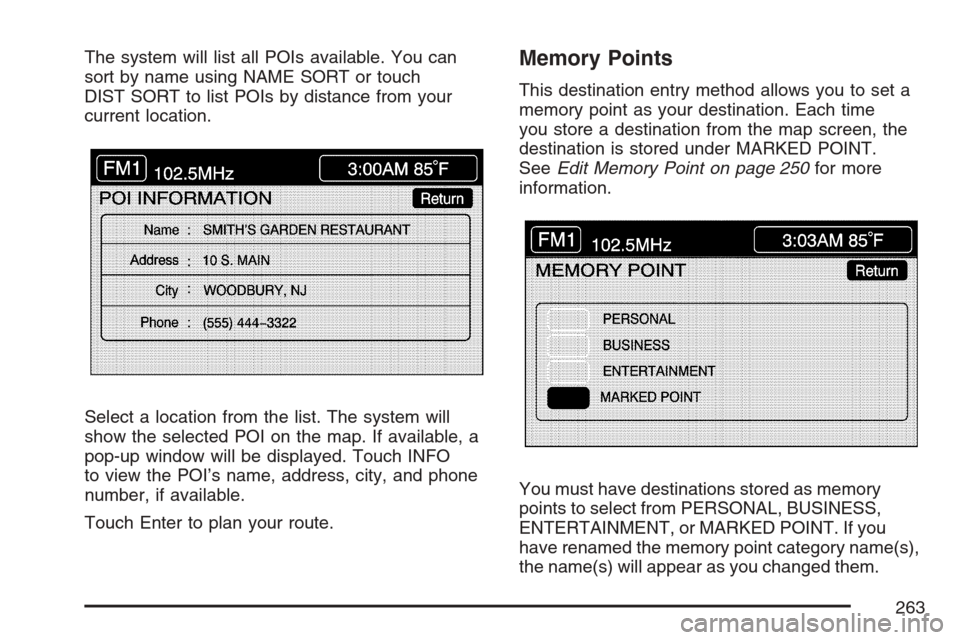
The system will list all POIs available. You can
sort by name using NAME SORT or touch
DIST SORT to list POIs by distance from your
current location.
Select a location from the list. The system will
show the selected POI on the map. If available, a
pop-up window will be displayed. Touch INFO
to view the POI’s name, address, city, and phone
number, if available.
Touch Enter to plan your route.Memory Points
This destination entry method allows you to set a
memory point as your destination. Each time
you store a destination from the map screen, the
destination is stored under MARKED POINT.
SeeEdit Memory Point on page 250for more
information.
You must have destinations stored as memory
points to select from PERSONAL, BUSINESS,
ENTERTAINMENT, or MARKED POINT. If you
have renamed the memory point category name(s),
the name(s) will appear as you changed them.
263
Page 285 of 512
Navigation Audio System
Notice:Before adding any sound equipment
to your vehicle, such as an audio system,
CD player, CB radio, mobile telephone,
or two-way radio, make sure that it can be
added by checking with your dealer. Also,
check federal rules covering mobile radio and
telephone units. If sound equipment can be
added, it is very important to do it properly.
Added sound equipment may interfere with the
operation of your vehicle’s engine, radio, or
other systems, and even damage them.
Your vehicle’s systems may interfere with the
operation of sound equipment that has
been added.
Your vehicle has a feature called Retained
Accessory Power (RAP). With RAP, the audio
system can be played even after the ignition
is turned off. SeeRetained Accessory Power
(RAP) on page 89for more information.
The audio system is operated using navigation
system menus. The audio menus are explained in
this section.
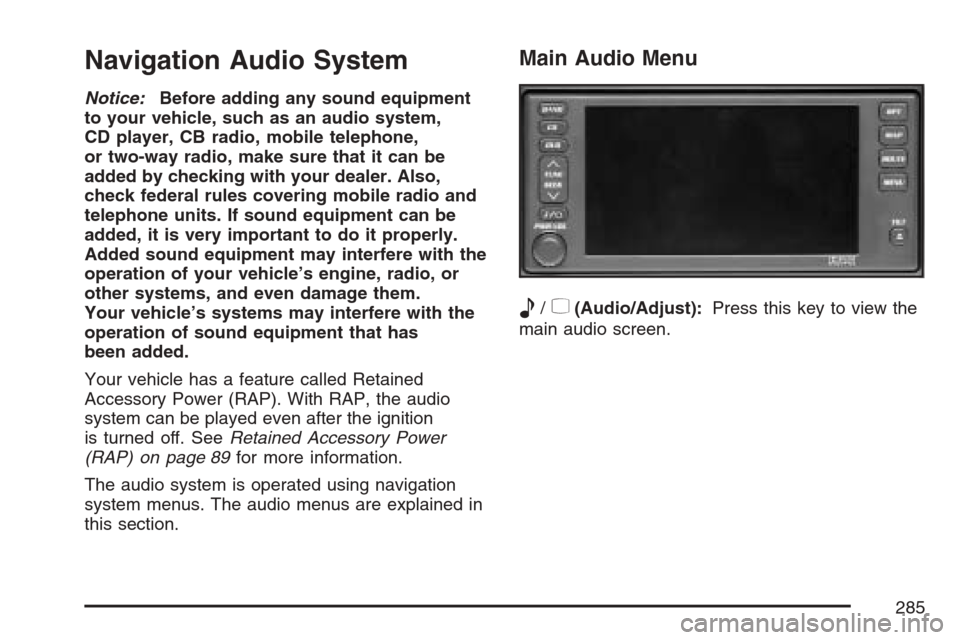
Main Audio Menu
e
/z(Audio/Adjust):Press this key to view the
main audio screen.
285
Page 341 of 512
The heavier the rain, the harder it is to see. Even
if your windshield wiper blades are in good
shape, a heavy rain can make it harder to see
road signs and traffic signals, pavement markings,
the edge of the road, and even people walking.
It is wise to keep your windshield wiping equipment
in good shape and keep your windshield washer
uid reservoir lled with washer uid. Replace your
windshield wiper inserts when they show signs
of streaking or missing areas on the windshield, or
when strips of rubber start to separate from the
inserts.
{CAUTION:
Wet brakes can cause accidents. They
may not work as well in a quick stop and
may cause pulling to one side. You could
lose control of the vehicle.
After driving through a large puddle of
water or a car wash, apply your brake
pedal lightly until your brakes work
normally.Driving too fast through large water puddles or
even going through some car washes can cause
problems, too. The water may affect your
brakes. Try to avoid puddles. But if you cannot, try
to slow down before you hit them.
Hydroplaning
Hydroplaning is dangerous. So much water can
build up under your tires that they can actually ride
on the water. This can happen if the road is wet
enough and you are going fast enough. When your
vehicle is hydroplaning, it has little or no contact
with the road.
Hydroplaning does not happen often. But it can if
your tires do not have much tread or if the
pressure in one or more is low. It can happen if a
lot of water is standing on the road. If you can
see reections from trees, telephone poles,
or other vehicles, and raindrops dimple the water’s
surface, there could be hydroplaning.
Hydroplaning usually happens at higher speeds.
There just is not a hard and fast rule about
hydroplaning. The best advice is to slow down
when it is raining.
341
Page 421 of 512
Some road hazards can damage a tire beyond
repair. This damage could occur even before you
have driven on the tire in a deated condition.
When a tire has been damaged, or if you
have driven any distance on a run-at tire, check
with an authorized run-at tire service center
to determine whether the tire can be repaired or
should be replaced. To maintain your vehicle’s
run-at feature, all replacement tires must
be self-supporting tires. As soon as possible,
contact the nearest authorized GM or run-at
servicing facility for inspection and repair or
replacement. To locate the nearest GM or run-at
servicing facility, call Roadside Assistance. For
phone numbers and Roadside Service details see
Roadside Service on page 487.
{CAUTION:
Run-at tires are constructed differently
than other tires and could explode during
improper service. You or others could be
injured or killed if you attempt to repair,
replace, dismount, or mount a run-at tire.
Let only an authorized run-at service
center repair, replace, dismount, and
mount run-at tires.
The valve stems on your run-at tires have
sensors that are part of the Tire Pressure Monitor
System (TPMS). SeeTire Pressure Monitor
System on page 423. These sensors contain
batteries which are designed to last for 10 years
under normal driving conditions. See your dealer if
you ever need to have a wheel replaced, or if
the sensors ever need replacement.
Notice:Using liquid sealants can damage the
tire valves and tire pressure monitor sensors in
your vehicle’s run-at tires. This damage would
not be covered by warranty. Do not use liquid
sealants in your vehicle’s run-at tires.
421
Page 481 of 512
Customer Assistance and Information....... 482
Customer Satisfaction Procedure............... 482
Online Owner Center................................. 484
Customer Assistance for Text
Telephone (TTY) Users.......................... 485
Customer Assistance Offices..................... 485
GM Mobility Reimbursement Program........ 486
Roadside Service...................................... 487
Courtesy Transportation............................. 488
Vehicle Data Collection and Event Data
Recorders.............................................. 491
Collision Damage Repair........................... 492Reporting Safety Defects............................ 496
Reporting Safety Defects to the
United States Government..................... 496
Reporting Safety Defects to the
Canadian Government............................ 496
Reporting Safety Defects to
General Motors...................................... 497
Service Publications Ordering
Information............................................. 497
Section 8 Customer Assistance Information
481
Page 483 of 512
STEP THREE:Both General Motors and your
dealer are committed to making sure you are
completely satised with your new vehicle.
However, if you continue to remain unsatised
after following the procedure outlined in Steps One
and Two, you should le with the BBB Auto Line
Program to enforce any additional rights you
may have. Canadian owners refer to your
Warranty and Owner Assistance Information
booklet for information on the Canadian Motor
Vehicle Arbitration Plan (CAMVAP).
The BBB Auto Line Program is an out of court
program administered by the Council of Better
Business Bureaus to settle automotive disputes
regarding vehicle repairs or the interpretation
of the New Vehicle Limited Warranty. Although you
may be required to resort to this informal dispute
resolution program prior to ling a court action,
use of the program is free of charge and your case
will generally be heard within 40 days. If you do
not agree with the decision given in your case, you
may reject it and proceed with any other venue
for relief available to you.You may contact the BBB Auto Line Program
using the toll-free telephone number or write them
at the following address:
BBB Auto Line Program
Council of Better Business Bureaus, Inc.
4200 Wilson Boulevard
Suite 800
Arlington, VA 22203-1838
Telephone: 1-800-955-5100
This program is available in all 50 states and the
District of Columbia. Eligibility is limited by
vehicle age, mileage and other factors. General
Motors reserves the right to change eligibility
limitations and/or discontinue its participation in
this program.
483
Page 484 of 512
Online Owner Center
Online Owner Center
(United States only)
The Owner Center is a resource for your GM
ownership needs. Specic vehicle information can
be found in one place.
The Online Owner Center allows you to:
Get e-mail service reminders.
Access information about your specic
vehicle, including tips and videos and
an electronic version of this owner manual.
Keep track of your vehicle’s service history
and maintenance schedule.
Find GM dealers for service nationwide.
Receive special promotions and privileges
only available to members.
Refer to www.MyGMLink.com on the web for
updated information and to register your vehicle.
My GM Canada (Canada only)
My GM Canada is a password-protected section
of gmcanada.com where you can save information
on GM vehicles, get personalized offers, and
use handy tools and forms with greater ease.
Here are a few of the valuable tools and services
you will have access to:
My Showroom: Find and save information on
vehicles and current offers in your area.
My Dealers/Retailers: Save details such as
address and phone number for each of
your preferred GM Dealers or Retailers.
My Driveway: Receive service reminders and
helpful advice on owning and maintaining
your vehicle.
My Preferences: Manage your prole,
subscribe to E-News and use tools and forms
with greater ease.
To sign up to My GM Canada, visit the My GM
Canada section within www.gmcanada.com.
484