instrument cluster CADILLAC XLR 2007 1.G Owners Manual
[x] Cancel search | Manufacturer: CADILLAC, Model Year: 2007, Model line: XLR, Model: CADILLAC XLR 2007 1.GPages: 512, PDF Size: 3.84 MB
Page 57 of 512
{CAUTION:
If the airbag readiness light in the
instrument panel cluster ever comes on
and stays on, it means that something
may be wrong with the airbag system. If
this ever happens, have the vehicle
serviced promptly, because an adult-size
person sitting in the right front
passenger’s seat may not have the
protection of an airbag. SeeAirbag
Readiness Light on page 188for more on
this, including important safety
information.Aftermarket equipment, such as seat covers, can
affect how well the passenger sensing system
operates. You may want to consider not using seat
covers or other aftermarket equipment if your
vehicle has the passenger sensing system. See
Adding Equipment to Your Airbag-Equipped
Vehicle on page 59for more information about
modications that can affect how the system
operates.
{CAUTION:
Stowing of articles under the passenger’s
seat or between the passenger’s seat
cushion and seatback may interfere with
the proper operation of the passenger
sensing system.
57
Page 97 of 512
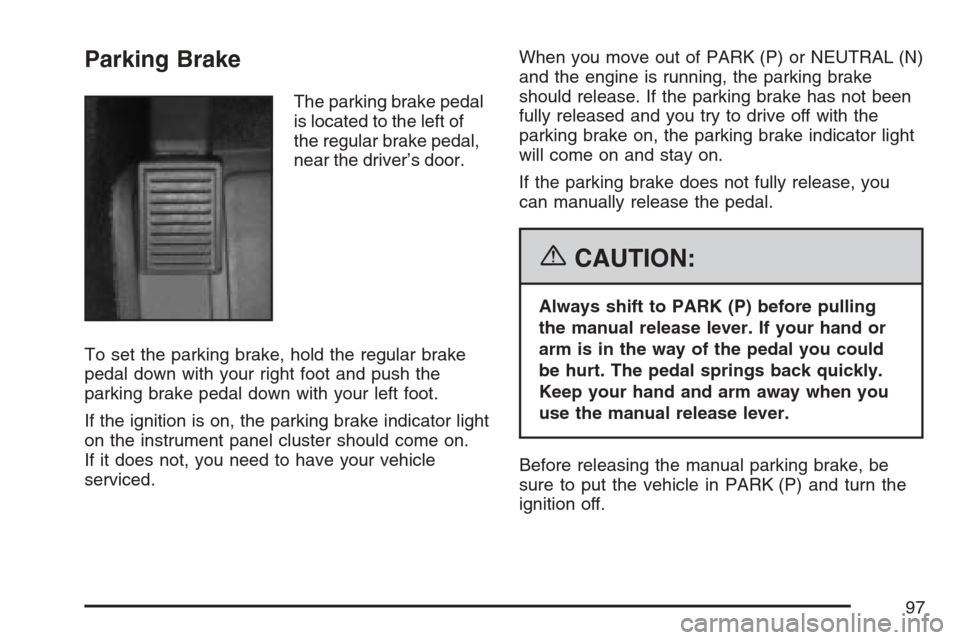
Parking Brake
The parking brake pedal
is located to the left of
the regular brake pedal,
near the driver’s door.
To set the parking brake, hold the regular brake
pedal down with your right foot and push the
parking brake pedal down with your left foot.
If the ignition is on, the parking brake indicator light
on the instrument panel cluster should come on.
If it does not, you need to have your vehicle
serviced.When you move out of PARK (P) or NEUTRAL (N)
and the engine is running, the parking brake
should release. If the parking brake has not been
fully released and you try to drive off with the
parking brake on, the parking brake indicator light
will come on and stay on.
If the parking brake does not fully release, you
can manually release the pedal.
{CAUTION:
Always shift to PARK (P) before pulling
the manual release lever. If your hand or
arm is in the way of the pedal you could
be hurt. The pedal springs back quickly.
Keep your hand and arm away when you
use the manual release lever.
Before releasing the manual parking brake, be
sure to put the vehicle in PARK (P) and turn the
ignition off.
97
Page 135 of 512
Instrument Panel Overview........................ 138
Hazard Warning Flashers.......................... 140
Other Warning Devices............................. 140
Horn.......................................................... 140
Power Tilt Wheel and Telescopic
Steering Column.................................... 141
Turn Signal/Multifunction Lever.................. 141
Turn and Lane-Change Signals................. 142
Headlamp High/Low-Beam Changer.......... 143
Flash-to-Pass............................................ 143
Windshield Wipers..................................... 144
Rainsense™ Wipers.................................. 145
Windshield Washer.................................... 146
Headlamp Washer..................................... 146
Cruise Control........................................... 147
Adaptive Cruise Control............................. 150
Exterior Lamps.......................................... 164
Wiper Activated Headlamps....................... 166
Headlamps on Reminder........................... 166
Daytime Running Lamps (DRL)................. 166
Adaptive Forward Lighting System............. 167
Fog Lamps................................................ 168
Twilight Sentinel
®...................................... 168Exterior Lighting Battery Saver.................. 169
Instrument Panel Brightness...................... 170
Courtesy Lamps........................................ 170
Entry/Exit Lighting...................................... 170
Reading Lamps......................................... 171
Battery Run-Down Protection..................... 171
Head-Up Display (HUD)............................ 171
Ultrasonic Rear Parking
Assist (URPA)........................................ 175
Accessory Power Outlet(s)........................ 177
Ashtray(s) and Cigarette Lighter................ 178
Climate Controls......................................... 178
Dual Climate Control System..................... 178
Outlet Adjustment...................................... 184
Passenger Compartment Air Filter............. 184
Warning Lights, Gages, and Indicators..... 185
Instrument Panel Cluster........................... 186
Speedometer and Odometer...................... 187
Trip Odometer........................................... 187
Tachometer............................................... 187
Safety Belt Reminder Light........................ 187
Airbag Readiness Light............................. 188
Section 3 Instrument Panel
135
Page 139 of 512
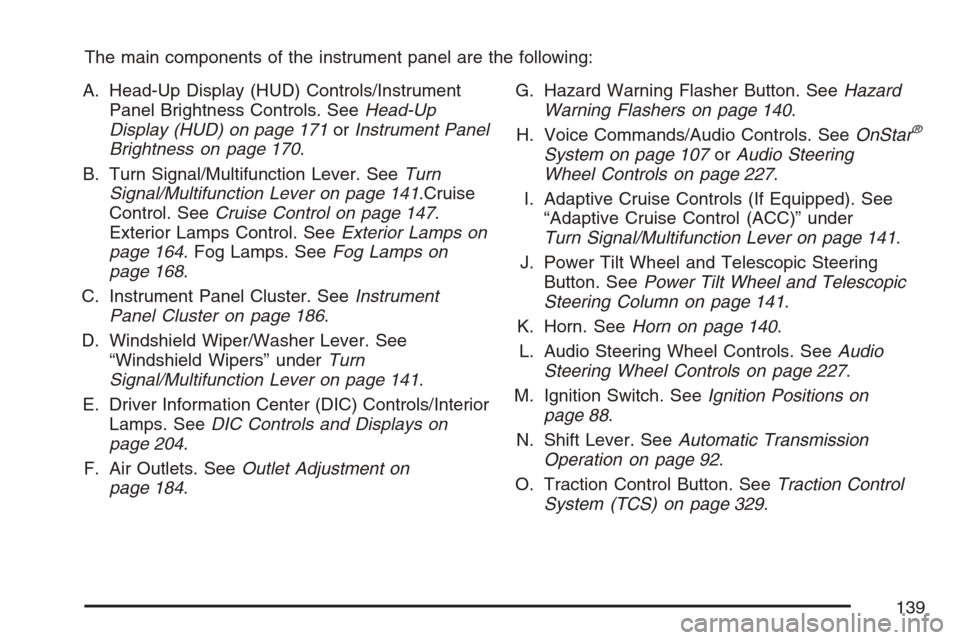
The main components of the instrument panel are the following:
A. Head-Up Display (HUD) Controls/Instrument
Panel Brightness Controls. SeeHead-Up
Display (HUD) on page 171orInstrument Panel
Brightness on page 170.
B. Turn Signal/Multifunction Lever. SeeTurn
Signal/Multifunction Lever on page 141.Cruise
Control. SeeCruise Control on page 147.
Exterior Lamps Control. SeeExterior Lamps on
page 164. Fog Lamps. SeeFog Lamps on
page 168.
C. Instrument Panel Cluster. SeeInstrument
Panel Cluster on page 186.
D. Windshield Wiper/Washer Lever. See
“Windshield Wipers” underTurn
Signal/Multifunction Lever on page 141.
E. Driver Information Center (DIC) Controls/Interior
Lamps. SeeDIC Controls and Displays on
page 204.
F. Air Outlets. SeeOutlet Adjustment on
page 184.G. Hazard Warning Flasher Button. SeeHazard
Warning Flashers on page 140.
H. Voice Commands/Audio Controls. SeeOnStar
®
System on page 107orAudio Steering
Wheel Controls on page 227.
I. Adaptive Cruise Controls (If Equipped). See
“Adaptive Cruise Control (ACC)” under
Turn Signal/Multifunction Lever on page 141.
J. Power Tilt Wheel and Telescopic Steering
Button. SeePower Tilt Wheel and Telescopic
Steering Column on page 141.
K. Horn. SeeHorn on page 140.
L. Audio Steering Wheel Controls. SeeAudio
Steering Wheel Controls on page 227.
M. Ignition Switch. SeeIgnition Positions on
page 88.
N. Shift Lever. SeeAutomatic Transmission
Operation on page 92.
O. Traction Control Button. SeeTraction Control
System (TCS) on page 329.
139
Page 142 of 512
Flash-to-Pass Feature. SeeFlash-to-Pass on
page 143.
ICruise Control. SeeCruise Control on
page 147.
PExterior Lamps Control. SeeExterior
Lamps on page 164.
Turn and Lane-Change Signals
The turn signal has two upward (for right) and two
downward (for left) positions. These positions
allow you to signal a turn or a lane change.
To signal a turn, move the multifunction lever all
the way up or down. When the turn is nished, the
lever will return automatically.
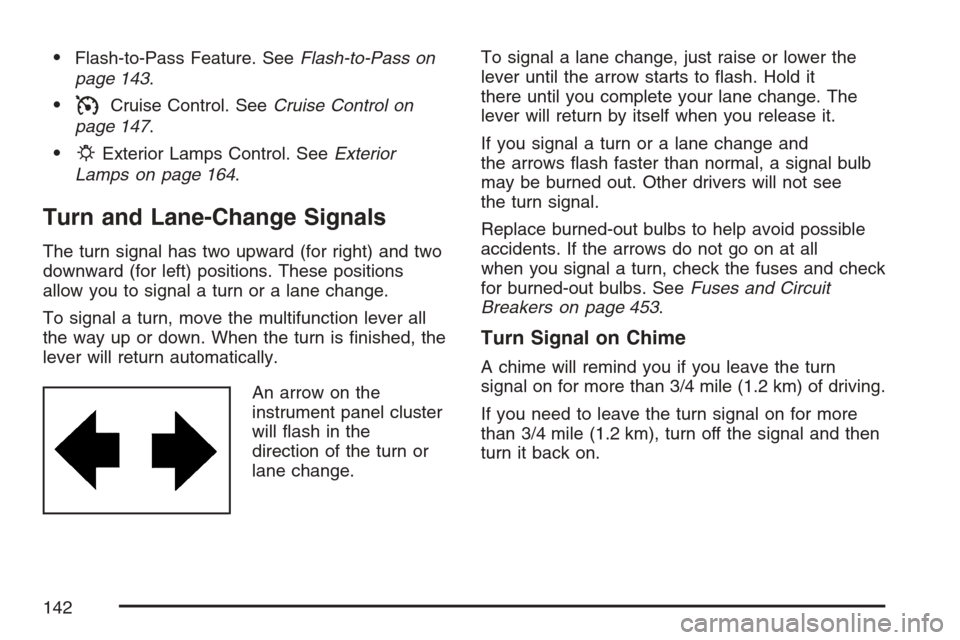
An arrow on the
instrument panel cluster
will ash in the
direction of the turn or
lane change.To signal a lane change, just raise or lower the
lever until the arrow starts to ash. Hold it
there until you complete your lane change. The
lever will return by itself when you release it.
If you signal a turn or a lane change and
the arrows ash faster than normal, a signal bulb
may be burned out. Other drivers will not see
the turn signal.
Replace burned-out bulbs to help avoid possible
accidents. If the arrows do not go on at all
when you signal a turn, check the fuses and check
for burned-out bulbs. SeeFuses and Circuit
Breakers on page 453.
Turn Signal on Chime
A chime will remind you if you leave the turn
signal on for more than 3/4 mile (1.2 km) of driving.
If you need to leave the turn signal on for more
than 3/4 mile (1.2 km), turn off the signal and then
turn it back on.
142
Page 143 of 512
Headlamp High/Low-Beam Changer
To change the headlamps from low beam to
high, push the turn signal lever all the way forward.
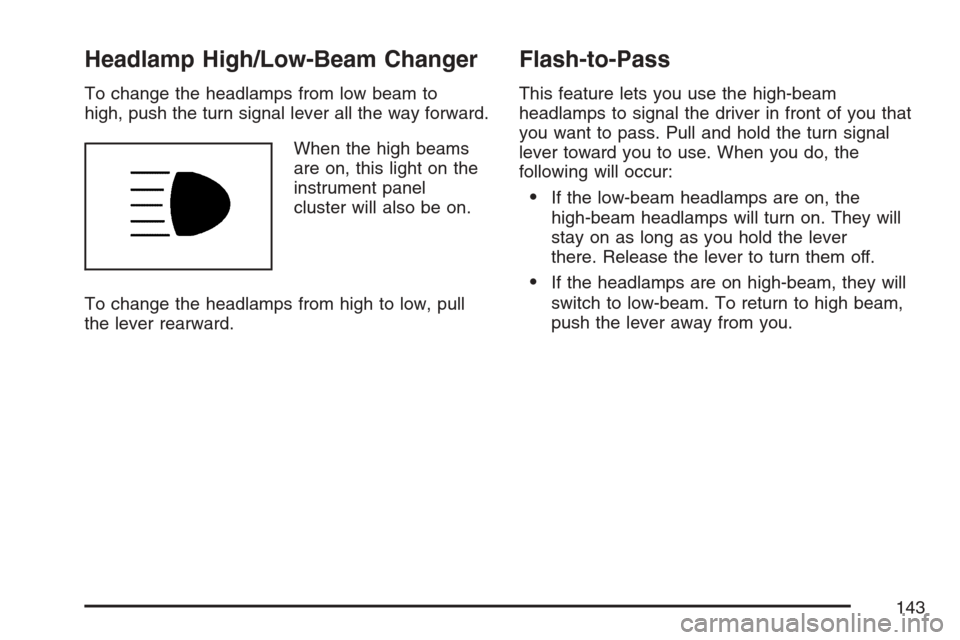
When the high beams
are on, this light on the
instrument panel
cluster will also be on.
To change the headlamps from high to low, pull
the lever rearward.
Flash-to-Pass
This feature lets you use the high-beam
headlamps to signal the driver in front of you that
you want to pass. Pull and hold the turn signal
lever toward you to use. When you do, the
following will occur:
If the low-beam headlamps are on, the
high-beam headlamps will turn on. They will
stay on as long as you hold the lever
there. Release the lever to turn them off.
If the headlamps are on high-beam, they will
switch to low-beam. To return to high beam,
push the lever away from you.
143
Page 148 of 512
Setting Cruise Control
{CAUTION:
If you leave your cruise control on when
you are not using cruise, you might hit a
button and go into cruise when you do
not want to. You could be startled and
even lose control. Keep the cruise control
switch off until you want to use cruise
control.
1. Move the cruise control switch to on.
2. Get up to the speed desired.
3. Press the set button at the end of the lever
and release it.
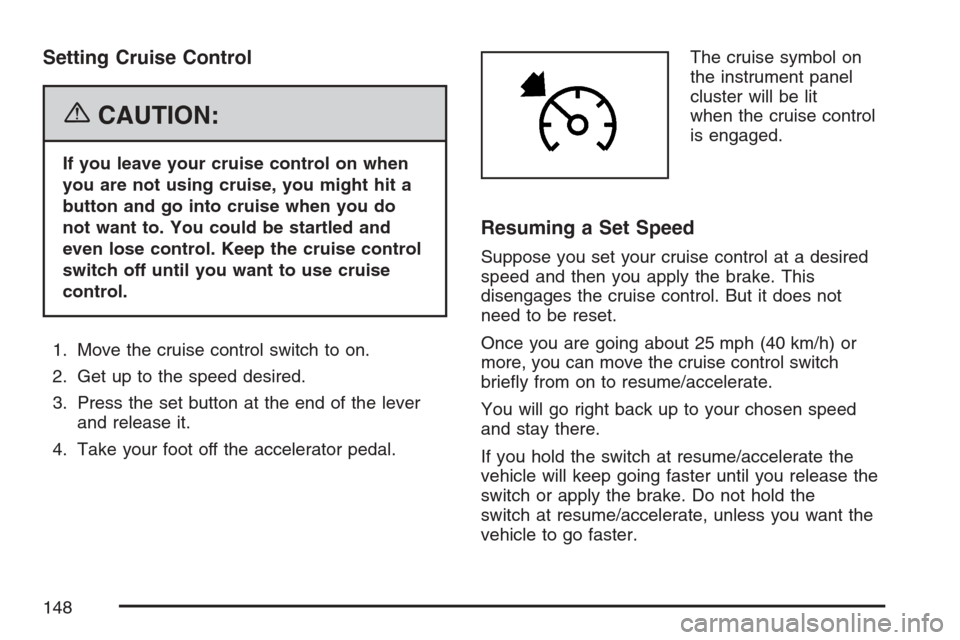
4. Take your foot off the accelerator pedal.The cruise symbol on
the instrument panel
cluster will be lit
when the cruise control
is engaged.
Resuming a Set Speed
Suppose you set your cruise control at a desired
speed and then you apply the brake. This
disengages the cruise control. But it does not
need to be reset.
Once you are going about 25 mph (40 km/h) or
more, you can move the cruise control switch
briey from on to resume/accelerate.
You will go right back up to your chosen speed
and stay there.
If you hold the switch at resume/accelerate the
vehicle will keep going faster until you release the
switch or apply the brake. Do not hold the
switch at resume/accelerate, unless you want the
vehicle to go faster.
148
Page 167 of 512
When it is bright enough outside, the regular
lamps go off, and the front turn signal lamps take
over. If you start your vehicle in a dark garage,
the automatic headlamp system comes on
immediately. Once you leave the garage, it takes
about one minute for the automatic headlamp
system to change to DRL if it is light outside.
During that delay, the instrument panel cluster
might not be as bright as usual. Make sure
the instrument panel brightness knob is in the full
bright position. SeeInstrument Panel Brightness
on page 170for more information.
If it is dark enough outside and the exterior lamp
control is off, a HEADLAMPS SUGGESTED
message displays on the Driver’s Information
Center (DIC). This message informs the driver that
turning on the exterior lamps is recommended.
SeeDIC Warnings and Messages on page 206.Turn the exterior lamp control off a second time,
or turn on the headlamps to turn off the
HEADLAMPS SUGGESTED message in the DIC.
If the parking lamps or the fog lamps were
turned on instead, the HEADLAMPS SUGGESTED
message continues to display.
As with any vehicle, you should turn on the
regular headlamp system when needed.
Adaptive Forward Lighting System
The Adaptive Forward Lighting System (AFS)
swivels the headlamps horizontally to provide
greater road illumination while turning. AFS will
operate when the vehicle speed is greater than
2 mph (3 km/h). AFS will not operate when
the transmission is in REVERSE (R). AFS is not
immediately operable after starting the vehicle;
driving a short distance is required to calibrate the
AFS. To enable AFS, set the exterior lamp
switch on the multifunction lever to the AUTO
position. Moving the switch out of the AUTO
position will deactivate the system. SeeExterior
Lamps on page 164.
167
Page 168 of 512
Fog Lamps
Use fog lamps for better vision in foggy or misty
conditions.
The fog lamps control is located on the
multifunction lever next to the exterior lamp
control.
-(Fog Lamps):Turning the band to this
position will turn the fog lamps on.
When you turn the fog lamps on, the fog lamp
light will appear on the instrument panel cluster to
indicate that the fog lamps and the parking
lamps are on.
If you turn the high-beam headlamps on, the fog
lamps will turn off. They will turn on again
when you switch to low-beam headlamps.
The ignition must be on for the fog lamps to
operate. The fog lamps will turn off when the
ignition is turned off.
Some localities have laws that require the
headlamps to be on along with the fog lamps.
Twilight Sentinel®
Twilight Sentinel®can turn your lamps on and off
for you. A light sensor on top of the instrument
panel makes the Twilight Sentinel
®work, so
be sure it is not covered.
With Twilight Sentinel
®you will see the following
happen:
When it is dark enough outside, the front turn
signal lamps (DRL) will go off, and the
headlamps and parking lamps will come on.
The other lamps that come on with headlamps
will also come on.
When it is bright enough outside, the
headlamps will go off, and the front turn signal
lamps (DRL) will come on, as long as the
exterior lamp switch is in the AUTO position.
If you start your vehicle in a dark garage,
the automatic headlamp system will come on
immediately. Once you leave the garage, it will
take about one minute for the automatic headlamp
system to change to DRL if it is light outside.
168
Page 169 of 512

During that delay, your instrument panel cluster
may not be as bright as usual. Make sure
your instrument panel brightness control is in full
bright position. SeeInstrument Panel Brightness
on page 170for more information.
You can idle the vehicle with the lamps off, even
when it is dark outside. After starting the
vehicle, turn the exterior lamp control band to off,
then release it. The lamps will remain off until
you turn the control band to off again.
Twilight Sentinel
®also provides exterior
illumination as you leave the vehicle. If Twilight
Sentinel
®has turned on the lamps when you turn
off the ignition, your lamps will remain on until:
The exterior lamp switch is moved from OFF to
the parking lamp position, or
a delay time that you select has elapsed.
SeeDriver Information Center (DIC) on page 203
to select the delay time that you want. You
can also select no delay time.If you turn off the ignition with the exterior lamp
switch in the parking lamp or headlamp position, the
Twilight Sentinel
®delay will not occur. The lamps
will turn off as soon as the switch is turned off.
As with any vehicle, you should turn on the regular
headlamp system when you need it.
Exterior Lighting Battery Saver
If the manual parking lamps or headlamps have
been left on, the exterior lamps will turn off as soon
as the ignition is turned off or RAP is active.
This protects against draining the battery in case
you have accidentally left the headlamps or
parking lamps on. The battery saver does not work
if the headlamps are turned on after the ignition
switch is turned to off.
If you need to leave the lamps on, use the exterior
lamp control to turn the lamps back on.
169