parking brake CADILLAC XLR V 2006 1.G User Guide
[x] Cancel search | Manufacturer: CADILLAC, Model Year: 2006, Model line: XLR V, Model: CADILLAC XLR V 2006 1.GPages: 456, PDF Size: 3.74 MB
Page 164 of 456
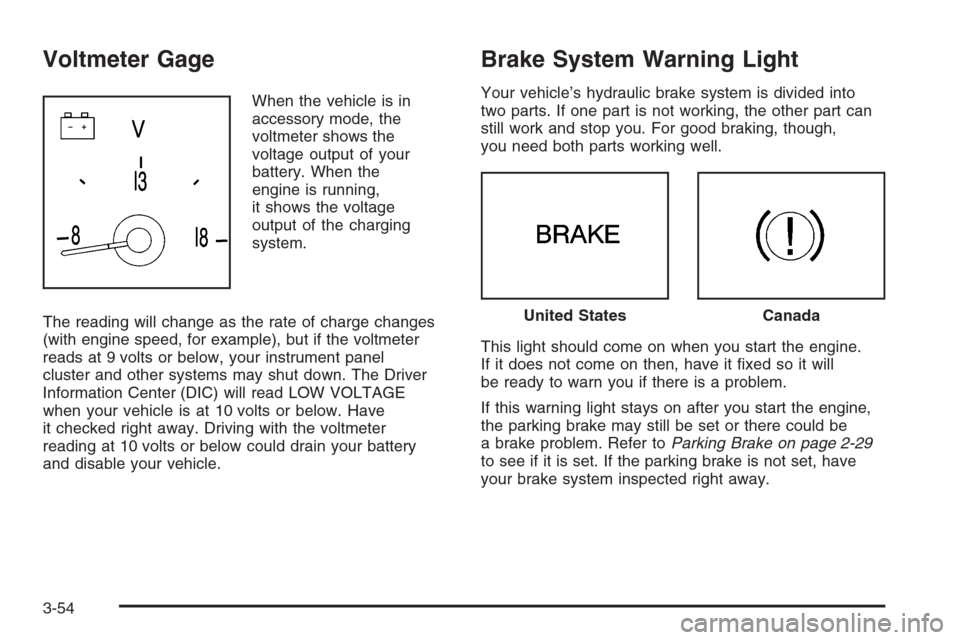
Voltmeter Gage
When the vehicle is in
accessory mode, the
voltmeter shows the
voltage output of your
battery. When the
engine is running,
it shows the voltage
output of the charging
system.
The reading will change as the rate of charge changes
(with engine speed, for example), but if the voltmeter
reads at 9 volts or below, your instrument panel
cluster and other systems may shut down. The Driver
Information Center (DIC) will read LOW VOLTAGE
when your vehicle is at 10 volts or below. Have
it checked right away. Driving with the voltmeter
reading at 10 volts or below could drain your battery
and disable your vehicle.
Brake System Warning Light
Your vehicle’s hydraulic brake system is divided into
two parts. If one part is not working, the other part can
still work and stop you. For good braking, though,
you need both parts working well.
This light should come on when you start the engine.
If it does not come on then, have it xed so it will
be ready to warn you if there is a problem.
If this warning light stays on after you start the engine,
the parking brake may still be set or there could be
a brake problem. Refer toParking Brake on page 2-29
to see if it is set. If the parking brake is not set, have
your brake system inspected right away.
United StatesCanada
3-54
Page 356 of 456
Notice:If you try to start your vehicle by pushing
or pulling it, you could damage your vehicle. Do not
push or pull your vehicle to start it; instead, use
the jump starting procedure in this manual to start
your vehicle when the battery has run down.
1. Check the other vehicle. It must have a 12-volt
battery with a negative ground system.
Notice:If the other vehicle’s system is not a 12-volt
system with a negative ground, both vehicles can
be damaged. Only use vehicles with 12-volt systems
with negative grounds to jump start your vehicle.
2. Get the vehicles close enough so the jumper cables
can reach, but be sure the vehicles are not touching
each other. If they are, it could cause a ground
connection you do not want. You would not be able
to start your vehicle, and the bad grounding
could damage the electrical systems.
To avoid the possibility of the vehicles rolling, set
the parking brake rmly on both vehicles involved
in the jump start procedure. Put an automatic
transmission in PARK (P) or a manual transmission
in NEUTRAL before setting the parking brake.Notice:If you leave your radio or other accessories
on during the jump starting procedure, they could
be damaged. The repairs would not be covered
by your warranty. Always turn off your radio and
other accessories when jump starting your vehicle.
3. Turn off the ignition on both vehicles. Unplug
unnecessary accessories plugged into the cigarette
lighter or the accessory power outlet. Turn off
the radio and all lamps that are not needed.
This will avoid sparks and help save both batteries.
And it could save the radio!
4. Open the hoods and locate the batteries. Find the
positive (+) and negative (−) terminal locations on
each vehicle. SeeEngine Compartment Overview
on page 6-12for more information on location.
{CAUTION:
An electric fan can start up even when the
engine is not running and can injure you.
Keep hands, clothing and tools away from
any underhood electric fan.
6-40
Page 386 of 456
Tire Chains
{CAUTION:
Do not use tire chains. There is not enough
clearance. Tire chains used on a vehicle
without the proper amount of clearance can
cause damage to the brakes, suspension, or
other vehicle parts. The area damaged by the
tire chains could cause you to lose control of
your vehicle and you or others may be injured
in a crash. Use another type of traction device
only if its manufacturer recommends it for use
on your vehicle and tire size combination and
road conditions. Follow that manufacturer’s
instructions. To help avoid damage to your
vehicle, drive slowly, re-adjust or remove
the device if it is contacting your vehicle,
and do not spin your wheels. If you do nd
traction devices that will t, install them on
the rear tires.
Lifting Your Vehicle
{CAUTION:
Lifting a vehicle can cause an injury. The
vehicle can slip off the jack and roll over you
or other people. You and they could be badly
injured. Find a level place to lift your vehicle.
To help prevent the vehicle from moving:
1. Set the parking brake rmly.
2. Put an automatic transmission shift lever
in PARK (P).
3. Turn off the engine.
To be even more certain the vehicle won’t
move, you can put blocks in front of and
behind the wheels.
6-70
Page 403 of 456

Instrument Panel Fuse Block
The panel fuse block is located on the passenger’s side
of the vehicle, under the instrument panel and under
the toe-board.
Remove the carpet and toe-board covering to access
the fuse block by pulling at the top of each corner
of the panel. Then turn the fuse block door knob
counterclockwise and pull the door to access the fuses.
Fuses Usage
1 Spare Fuse
2 Spare Fuse
3 Spare Fuse
4 Spare Fuse
5 Fuse Pull
6 Reverse Lamp
7 Starter/Crank
8 Parking Brake Solenoid A
9 Reverse Lamps
10 BTSI Solenoid, Column Lock
11 Not Used
12 Not Used
13 GMLAN Devices
14Rear Park Aid, Heated/Cooled
Seats, Windshield Wiper Relays
15 Door Locks
16 Engine Control Module
17 Interior Lights
18 Airbags
19 Not Used
6-87
Page 404 of 456
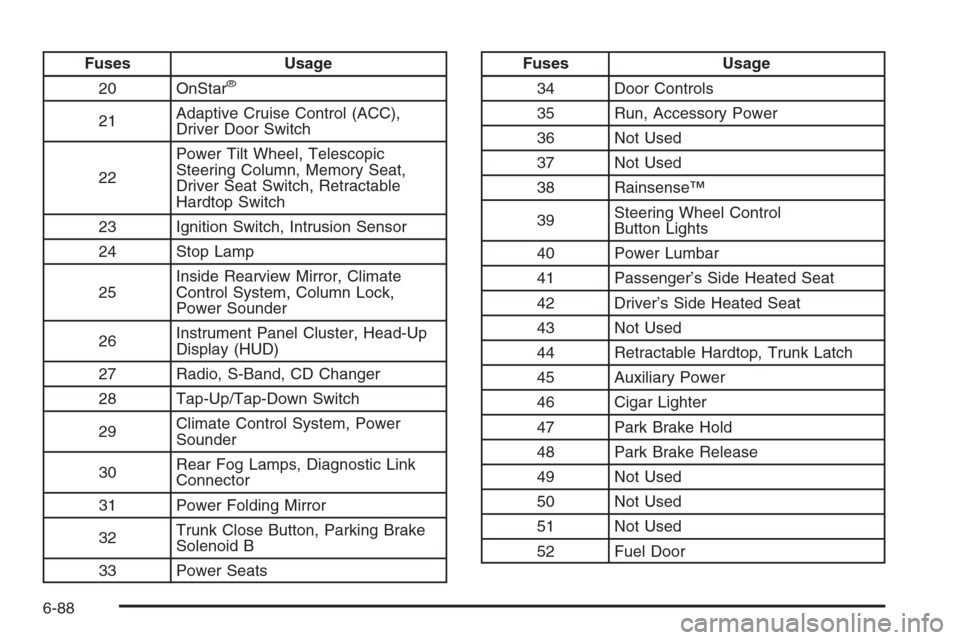
Fuses Usage
20 OnStar
®
21Adaptive Cruise Control (ACC),
Driver Door Switch
22Power Tilt Wheel, Telescopic
Steering Column, Memory Seat,
Driver Seat Switch, Retractable
Hardtop Switch
23 Ignition Switch, Intrusion Sensor
24 Stop Lamp
25Inside Rearview Mirror, Climate
Control System, Column Lock,
Power Sounder
26Instrument Panel Cluster, Head-Up
Display (HUD)
27 Radio, S-Band, CD Changer
28 Tap-Up/Tap-Down Switch
29Climate Control System, Power
Sounder
30Rear Fog Lamps, Diagnostic Link
Connector
31 Power Folding Mirror
32Trunk Close Button, Parking Brake
Solenoid B
33 Power Seats
Fuses Usage
34 Door Controls
35 Run, Accessory Power
36 Not Used
37 Not Used
38 Rainsense™
39Steering Wheel Control
Button Lights
40 Power Lumbar
41 Passenger’s Side Heated Seat
42 Driver’s Side Heated Seat
43 Not Used
44 Retractable Hardtop, Trunk Latch
45 Auxiliary Power
46 Cigar Lighter
47 Park Brake Hold
48 Park Brake Release
49 Not Used
50 Not Used
51 Not Used
52 Fuel Door
6-88
Page 406 of 456
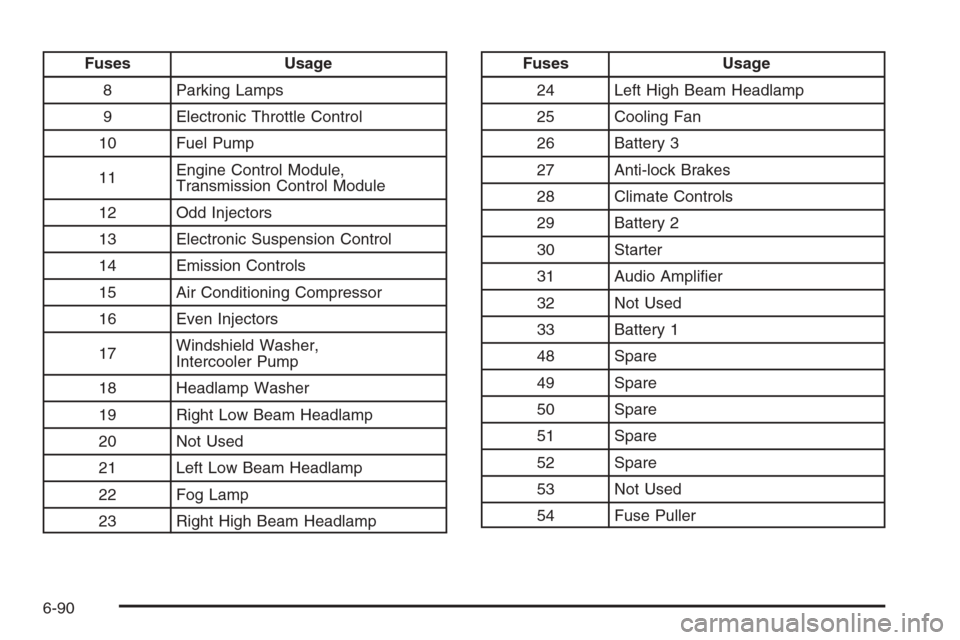
Fuses Usage
8 Parking Lamps
9 Electronic Throttle Control
10 Fuel Pump
11Engine Control Module,
Transmission Control Module
12 Odd Injectors
13 Electronic Suspension Control
14 Emission Controls
15 Air Conditioning Compressor
16 Even Injectors
17Windshield Washer,
Intercooler Pump
18 Headlamp Washer
19 Right Low Beam Headlamp
20 Not Used
21 Left Low Beam Headlamp
22 Fog Lamp
23 Right High Beam HeadlampFuses Usage
24 Left High Beam Headlamp
25 Cooling Fan
26 Battery 3
27 Anti-lock Brakes
28 Climate Controls
29 Battery 2
30 Starter
31 Audio Amplier
32 Not Used
33 Battery 1
48 Spare
49 Spare
50 Spare
51 Spare
52 Spare
53 Not Used
54 Fuse Puller
6-90
Page 417 of 456
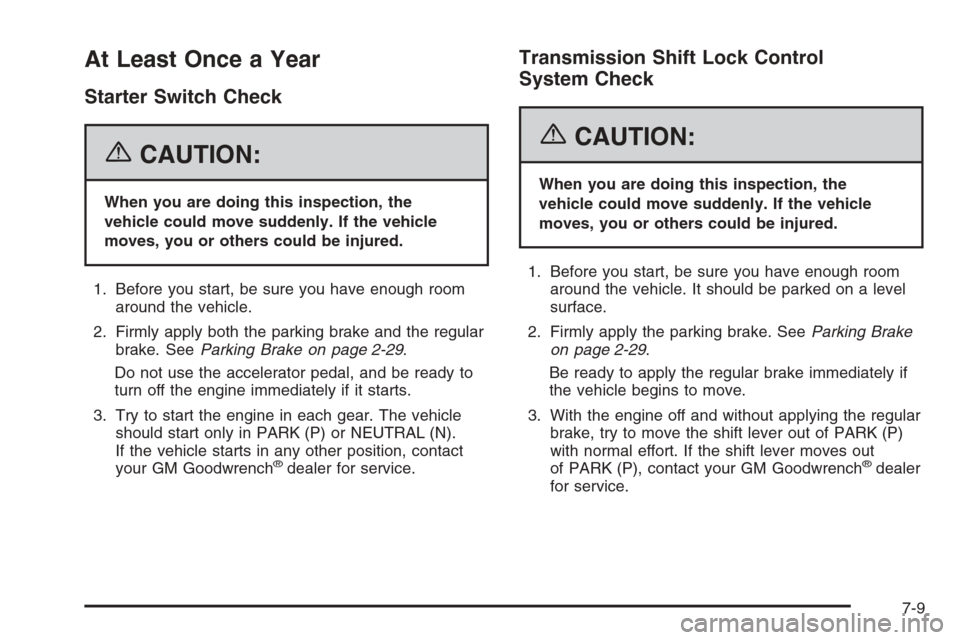
At Least Once a Year
Starter Switch Check
{CAUTION:
When you are doing this inspection, the
vehicle could move suddenly. If the vehicle
moves, you or others could be injured.
1. Before you start, be sure you have enough room
around the vehicle.
2. Firmly apply both the parking brake and the regular
brake. SeeParking Brake on page 2-29.
Do not use the accelerator pedal, and be ready to
turn off the engine immediately if it starts.
3. Try to start the engine in each gear. The vehicle
should start only in PARK (P) or NEUTRAL (N).
If the vehicle starts in any other position, contact
your GM Goodwrench
®dealer for service.
Transmission Shift Lock Control
System Check
{CAUTION:
When you are doing this inspection, the
vehicle could move suddenly. If the vehicle
moves, you or others could be injured.
1. Before you start, be sure you have enough room
around the vehicle. It should be parked on a level
surface.
2. Firmly apply the parking brake. SeeParking Brake
on page 2-29.
Be ready to apply the regular brake immediately if
the vehicle begins to move.
3. With the engine off and without applying the regular
brake, try to move the shift lever out of PARK (P)
with normal effort. If the shift lever moves out
of PARK (P), contact your GM Goodwrench
®dealer
for service.
7-9
Page 418 of 456
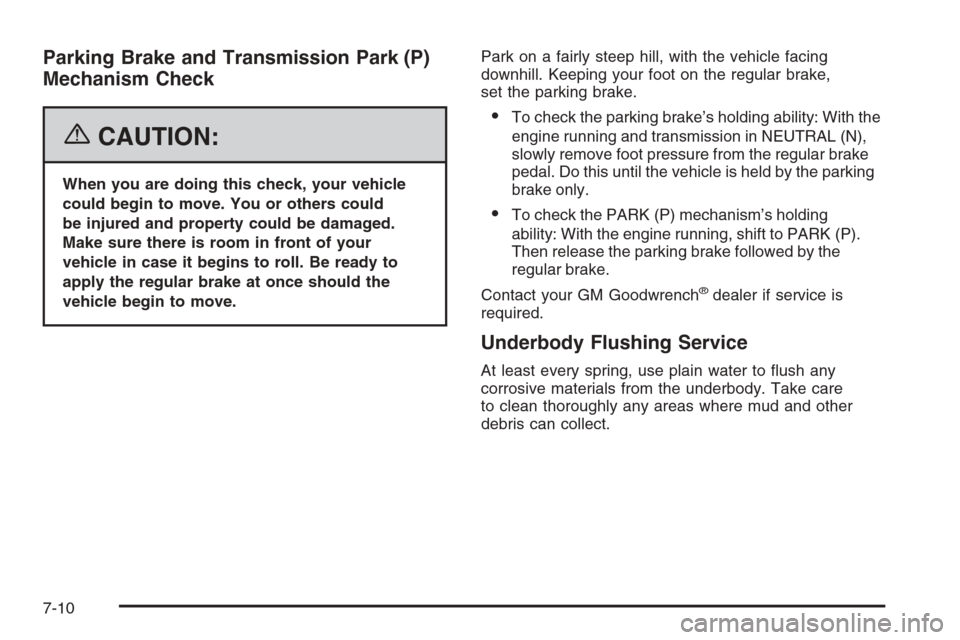
Parking Brake and Transmission Park (P)
Mechanism Check
{CAUTION:
When you are doing this check, your vehicle
could begin to move. You or others could
be injured and property could be damaged.
Make sure there is room in front of your
vehicle in case it begins to roll. Be ready to
apply the regular brake at once should the
vehicle begin to move.Park on a fairly steep hill, with the vehicle facing
downhill. Keeping your foot on the regular brake,
set the parking brake.
To check the parking brake’s holding ability: With the
engine running and transmission in NEUTRAL (N),
slowly remove foot pressure from the regular brake
pedal. Do this until the vehicle is held by the parking
brake only.
To check the PARK (P) mechanism’s holding
ability: With the engine running, shift to PARK (P).
Then release the parking brake followed by the
regular brake.
Contact your GM Goodwrench
®dealer if service is
required.
Underbody Flushing Service
At least every spring, use plain water to ush any
corrosive materials from the underbody. Take care
to clean thoroughly any areas where mud and other
debris can collect.
7-10
Page 444 of 456
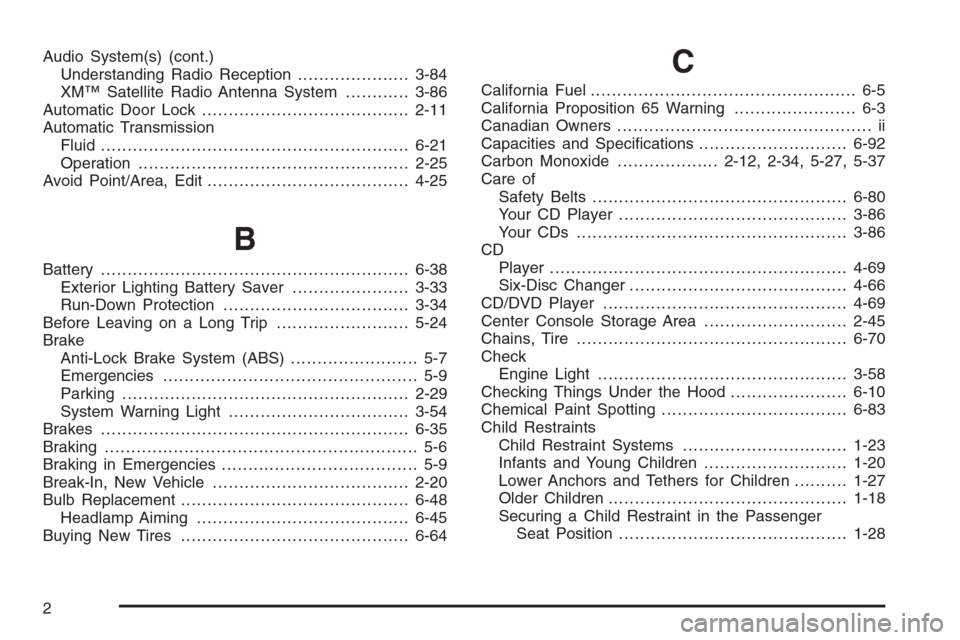
Audio System(s) (cont.)
Understanding Radio Reception.....................3-84
XM™ Satellite Radio Antenna System............3-86
Automatic Door Lock.......................................2-11
Automatic Transmission
Fluid..........................................................6-21
Operation...................................................2-25
Avoid Point/Area, Edit......................................4-25
B
Battery..........................................................6-38
Exterior Lighting Battery Saver......................3-33
Run-Down Protection...................................3-34
Before Leaving on a Long Trip.........................5-24
Brake
Anti-Lock Brake System (ABS)........................ 5-7
Emergencies................................................ 5-9
Parking......................................................2-29
System Warning Light..................................3-54
Brakes..........................................................6-35
Braking........................................................... 5-6
Braking in Emergencies..................................... 5-9
Break-In, New Vehicle.....................................2-20
Bulb Replacement...........................................6-48
Headlamp Aiming........................................6-45
Buying New Tires...........................................6-64
C
California Fuel.................................................. 6-5
California Proposition 65 Warning....................... 6-3
Canadian Owners................................................ ii
Capacities and Specications............................6-92
Carbon Monoxide...................2-12, 2-34, 5-27, 5-37
Care of
Safety Belts................................................6-80
Your CD Player...........................................3-86
Your CDs ...................................................3-86
CD
Player........................................................4-69
Six-Disc Changer.........................................4-66
CD/DVD Player..............................................4-69
Center Console Storage Area...........................2-45
Chains, Tire...................................................6-70
Check
Engine Light...............................................3-58
Checking Things Under the Hood......................6-10
Chemical Paint Spotting...................................6-83
Child Restraints
Child Restraint Systems...............................1-23
Infants and Young Children...........................1-20
Lower Anchors and Tethers for Children..........1-27
Older Children.............................................1-18
Securing a Child Restraint in the Passenger
Seat Position...........................................1-28
2
Page 451 of 456
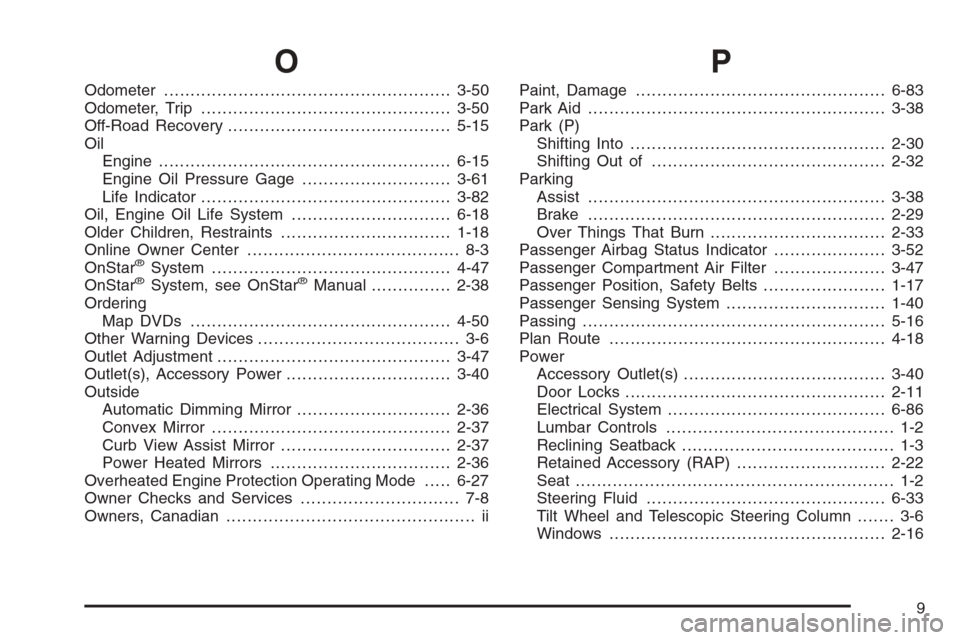
O
Odometer......................................................3-50
Odometer, Trip...............................................3-50
Off-Road Recovery..........................................5-15
Oil
Engine.......................................................6-15
Engine Oil Pressure Gage............................3-61
Life Indicator...............................................3-82
Oil, Engine Oil Life System..............................6-18
Older Children, Restraints................................1-18
Online Owner Center........................................ 8-3
OnStar
®System.............................................4-47
OnStar®System, see OnStar®Manual...............2-38
Ordering
Map DVDs .................................................4-50
Other Warning Devices...................................... 3-6
Outlet Adjustment............................................3-47
Outlet(s), Accessory Power...............................3-40
Outside
Automatic Dimming Mirror.............................2-36
Convex Mirror.............................................2-37
Curb View Assist Mirror................................2-37
Power Heated Mirrors..................................2-36
Overheated Engine Protection Operating Mode.....6-27
Owner Checks and Services.............................. 7-8
Owners, Canadian............................................... ii
P
Paint, Damage...............................................6-83
Park Aid........................................................3-38
Park (P)
Shifting Into................................................2-30
Shifting Out of............................................2-32
Parking
Assist........................................................3-38
Brake........................................................2-29
Over Things That Burn.................................2-33
Passenger Airbag Status Indicator.....................3-52
Passenger Compartment Air Filter.....................3-47
Passenger Position, Safety Belts.......................1-17
Passenger Sensing System..............................1-40
Passing.........................................................5-16
Plan Route....................................................4-18
Power
Accessory Outlet(s)......................................3-40
Door Locks.................................................2-11
Electrical System.........................................6-86
Lumbar Controls........................................... 1-2
Reclining Seatback........................................ 1-3
Retained Accessory (RAP)............................2-22
Seat............................................................ 1-2
Steering Fluid.............................................6-33
Tilt Wheel and Telescopic Steering Column....... 3-6
Windows....................................................2-16
9