seats CADILLAC XLR V 2007 1.G User Guide
[x] Cancel search | Manufacturer: CADILLAC, Model Year: 2007, Model line: XLR V, Model: CADILLAC XLR V 2007 1.GPages: 512, PDF Size: 3.84 MB
Page 28 of 512
Child Restraints
Older Children
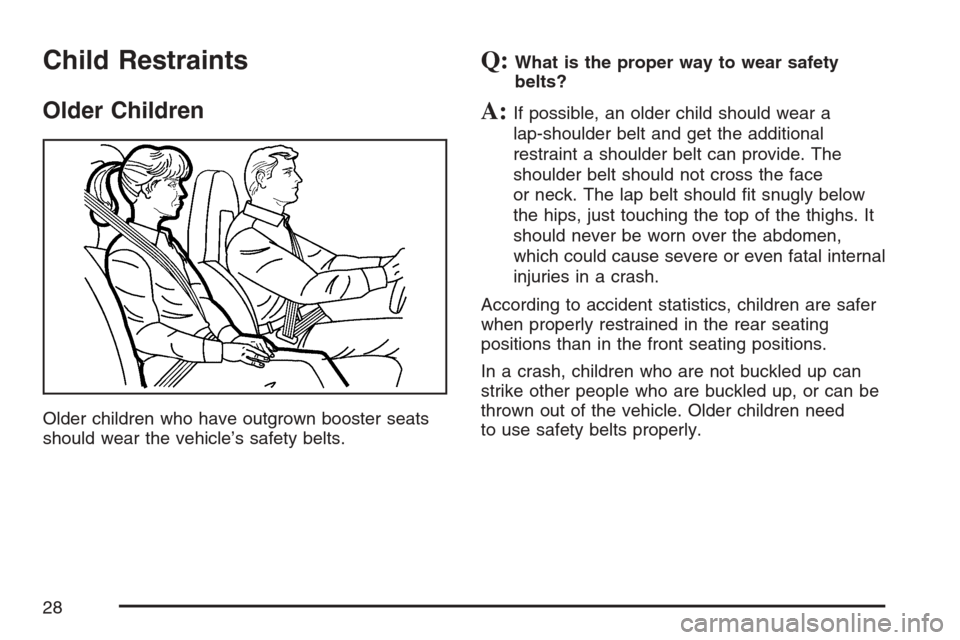
Older children who have outgrown booster seats
should wear the vehicle’s safety belts.
Q:What is the proper way to wear safety
belts?
A:If possible, an older child should wear a
lap-shoulder belt and get the additional
restraint a shoulder belt can provide. The
shoulder belt should not cross the face
or neck. The lap belt should t snugly below
the hips, just touching the top of the thighs. It
should never be worn over the abdomen,
which could cause severe or even fatal internal
injuries in a crash.
According to accident statistics, children are safer
when properly restrained in the rear seating
positions than in the front seating positions.
In a crash, children who are not buckled up can
strike other people who are buckled up, or can be
thrown out of the vehicle. Older children need
to use safety belts properly.
28
Page 36 of 512
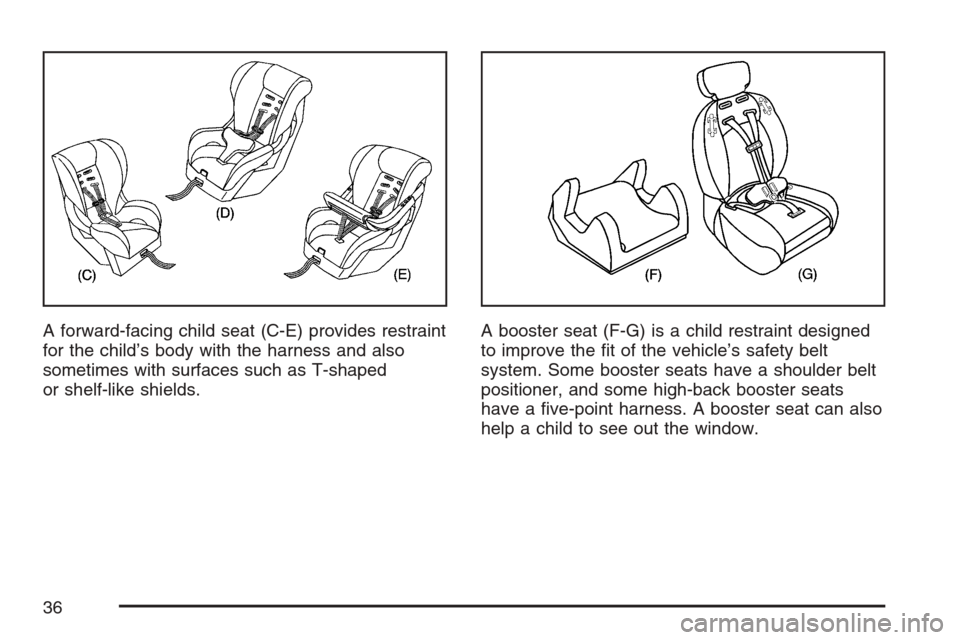
A forward-facing child seat (C-E) provides restraint
for the child’s body with the harness and also
sometimes with surfaces such as T-shaped
or shelf-like shields.A booster seat (F-G) is a child restraint designed
to improve the t of the vehicle’s safety belt
system. Some booster seats have a shoulder belt
positioner, and some high-back booster seats
have a ve-point harness. A booster seat can also
help a child to see out the window.
36
Page 37 of 512
Q:How Should I Use a Child Restraint?
A:A child restraint system is any device designed
for use in a motor vehicle to restrain, seat, or
position children. A built-in child restraint
system is a permanent part of the motor
vehicle. An add-on child restraint system is a
portable one, which is purchased by the
vehicle’s owner. To help reduce injuries, an
add-on child restraint must be secured in
the vehicle. With built-in or add-on child
restraints, the child has to be secured within
the child restraint.
When choosing an add-on child restraint, be
sure the child restraint is designed to be
used in a vehicle. If it is, it will have a label
saying that it meets federal motor vehicle
safety standards. Then follow the instructions
for the restraint. You may nd these
instructions on the restraint itself or in a
booklet, or both.
Securing an Add-on Child Restraint in
the Vehicle
{CAUTION:
A child can be seriously injured or killed
in a crash if the child restraint is not
properly secured in the vehicle. Make sure
the child restraint is properly installed in
the vehicle using the vehicle’s safety belt,
following the instructions that came with
that restraint, and also the instructions in
this manual.
To help reduce the chance of injury, the child
restraint must be secured in the vehicle. Child
restraint systems must be secured in vehicle seats
by lap belts or the lap belt portion of a lap-shoulder
belt. A child can be endangered in a crash if the
child restraint is not properly secured in the
vehicle.
37
Page 41 of 512
CAUTION: (Continued)
no system is fail-safe, and no one can
guarantee that an airbag will not deploy
under some unusual circumstance, even
though it is turned off. We recommend
that rear-facing child restraints be
transported in vehicles with a rear seat
that will accommodate a rear-facing child
restraint, whenever possible.
If you need to secure a forward-facing child
restraint in the passenger’s position, move the
seat as far back as it will go before securing the
forward-facing child restraint. SeePower Seats on
page 8.
There is no top tether anchor at the passenger’s
seating position. Do not secure a child seat in this
position if a national or local law requires that
the top tether be anchored or if the instructions
that come with the child restraint say that the top
tether must be anchored. SeeLower Anchors
and Tethers for Children (LATCH) on page 39.You will be using the lap-shoulder belt to secure
the child restraint in this position. Be sure to follow
the instructions that came with the child restraint.
Secure the child in the child restraint when and as
the instructions say.
1. Your vehicle has a right front passenger’s
frontal airbag. SeePassenger Sensing
System on page 53. We recommend that
rear-facing child restraints not be transported
in your vehicle, even if the airbags are off.
If your child restraint is forward-facing, move
the seat as far back as it will go before
securing the child restraint in this seat. See
Power Seats on page 8.
When the passenger sensing system has
turned off the right front passenger’s frontal
airbag and side impact airbag, the off indicator
in the passenger airbag status indicator
should light and stay lit when the vehicle is
started. SeePassenger Airbag Status Indicator
on page 189.
2. Put the child restraint on the seat.
41
Page 50 of 512
Frontal airbags may inate at different crash
speeds. For example:
If the vehicle hits a stationary object, the
airbags could inate at a different crash speed
than if the vehicle hits a moving object.
If the vehicle hits an object that deforms, the
airbags could inate at a different crash
speed than if the vehicle hits an object that
does not deform.
If the vehicle hits a narrow object (like a pole),
the airbags could inate at a different crash
speed than if the vehicle hits a wide object
(like a wall).
If the vehicle goes into an object at an angle,
the airbags could inate at a different crash
speed than if the vehicle goes straight into the
object.
Frontal airbags (driver and right front passenger)
are not intended to inate during vehicle
rollovers, rear impacts, or in many side impacts.The side impact airbags are intended to inate in
moderate to severe side crashes. A side impact
airbag will inate if the crash severity is above the
system’s designed “threshold level.” The
threshold level can vary with specic vehicle
design. Side impact airbags are not intended to
inate in frontal or near-frontal impacts, rollovers or
rear impacts. A side impact airbag is intended to
deploy on the side of the vehicle that is struck.
Your vehicle also has seat position sensors which
enables the sensing system to monitor the
position of the driver’s and passenger’s seats. The
seat position sensor provides information which
is used to determine if the airbags should deploy at
a reduced level or at full deployment.
In any particular crash, no one can say whether
an airbag should have inated simply because
of the damage to a vehicle or because of what the
repair costs were. For frontal airbags, ination is
determined by what the vehicle hits, the angle
of the impact, and how quickly the vehicle slows
down. For side impact airbags, ination is
determined by the location and severity of
the impact.
50
Page 59 of 512
Adding Equipment to Your
Airbag-Equipped Vehicle
Q:Is there anything I might add to the front
or sides of the vehicle that could keep the
airbags from working properly?
A:Yes. If you add things that change your
vehicle’s frame, bumper system, height,
front end or side sheet metal, they may keep
the airbag system from working properly.
Also, the airbag system may not work properly
if you relocate any of the airbag sensors. If
you have any questions about this, you should
contact Customer Assistance before you
modify your vehicle. The phone numbers and
addresses for Customer Assistance are in
Step Two of the Customer Satisfaction
Procedure in this manual. SeeCustomer
Satisfaction Procedure on page 482.
Q:Because I have a disability, I have to get
my vehicle modied. How can I nd out
whether this will affect my advanced airbag
system?
A:Changing or moving any parts of the front
seats, safety belts, the airbag sensing and
diagnostic module, steering wheel, instrument
panel, the inside review mirror, or airbag
wiring can affect the operation of the airbag
system. If you have questions, call Customer
Assistance. The phone numbers and
addresses for Customer Assistance are in
Step Two of the Customer Satisfaction
Procedure in this manual. SeeCustomer
Satisfaction Procedure on page 482.
59
Page 122 of 512

Cupholder(s)
The cupholders are located under a lid in the front
console to the right of the shift lever. Press the
left side of the lid and it will open automatically.
Center Console Storage Area
There is a center console storage area located
between the seats. To open this storage area,
push the latch button and lift the lid.
There is also an upright center console storage
area between the seatbacks. To open the storage
area, press and release the button near the top
so it extends out. Then, turn the button in
either direction to unlatch the lid and pull the
console lid down. After you close the lid, press the
release button back in.
Map Pocket
The map/storage pockets are located on each
door behind a cover.
Floor Mats
The driver’s side oor mat is held in place by
two snaps and the passenger’s side is held
in place by one.
Remove and Replace the Floor Mats
To remove the oor
mats, pull up on the
rear of the mat to
disconnect from the
snaps.
To reinstall the oor mats, line up the openings in
the oor mat over the snaps and push down
into place.
Be sure that the driver’s side oor mat is properly
placed on the oor so that it does not block the
movement of the accelerator pedal.
122
Page 184 of 512
Outlet Adjustment
Use the thumbwheel to open or close the outlets.
Operation Tips
Clear away any ice, snow or leaves from the
air inlets at the base of the windshield that
may block the ow of air into your vehicle.
Use of non-GM approved hood deectors may
adversely affect the performance of the
system.
Keep the area around the base of the
instrument panel console and air path under
the seats clear of objects to help circulate
the air inside of your vehicle more effectively.
Passenger Compartment Air Filter
The passenger compartment air lter removes
certain particles from the air, including pollen and
dust particles. Reductions in airow, which
may occur more often in dusty areas, indicate that
the lter may need to be replaced early.
The lter should be replaced as part of the routine
scheduled maintenance. SeeScheduled
Maintenance on page 465for more information.
To check or replace the air lter, do the following:
1. With the hood open, unlatch and remove
the access panel.
The passenger compartment air lter and
access panel are located on the passenger’s
side of the engine compartment near the
battery. SeeEngine Compartment Overview
on page 374for more information on location.
2. Pull the old lter out of the housing.
3. Insert the new lter into the housing.
4. Reinstall the air lter access panel.
184
Page 359 of 512

{CAUTION:
Things you put inside your vehicle can
strike and injure people in a sudden stop
or turn, or in a crash.
Put things in the rear area of your
vehicle. Try to spread the weight
evenly.
Never stack heavier things, like
suitcases, inside the vehicle so that
some of them are above the tops of
the seats.
Do not leave an unsecured child
restraint in your vehicle.
When you carry something inside the
vehicle, secure it whenever you can.
Towing
Towing Your Vehicle
Consult your dealer or a professional towing
service if you need to have your disabled vehicle
towed. SeeRoadside Service on page 487.
Recreational Vehicle Towing
Recreational vehicle towing means towing your
vehicle behind another vehicle — such as behind
a motorhome. The two most common types of
recreational vehicle towing are known as “dinghy
towing”, towing your vehicle with all four wheels
on the ground, and “dolly towing”, towing your
vehicle with two wheels on the ground and
two wheels up on a device known as a “dolly”.
Your vehicle was not designed to be towed
with any of its wheels on the ground. If your
vehicle must be towed, see “Towing Your Vehicle”
earlier in this section.
Towing a Trailer
Your XLR is neither designed nor intended to tow
a trailer.
359
Page 417 of 512
(E) Rim Diameter:Diameter of the wheel in
inches.
(F) Service Description:These characters
represent the load range and speed rating of the
tire. The load index represents the load carry
capacity a tire is certied to carry. The load index
can range from 1 to 279. The speed rating is
the maximum speed a tire is certied to carry a
load. Speed ratings range from A to Z.
Tire Terminology and Denitions
Air Pressure:The amount of air inside the tire
pressing outward on each square inch of the
tire. Air pressure is expressed in pounds
per square inch (psi) or kilopascal (kPa).
Accessory Weight:This means the combined
weight of optional accessories. Some examples of
optional accessories are, automatic
transmission/transaxle, power steering, power
brakes, power windows, power seats, and
air conditioning.Aspect Ratio:The relationship of a tire’s height
to its width.
Belt:A rubber coated layer of cords that is located
between the plies and the tread. Cords may be
made from steel or other reinforcing materials.
Bead:The tire bead contains steel wires wrapped
by steel cords that hold the tire onto the rim.
Bias Ply Tire:A pneumatic tire in which the plies
are laid at alternate angles less than 90 degrees
to the centerline of the tread.
Cold Tire Pressure:The amount of air pressure
in a tire, measured in pounds per square inch
(psi) or kilopascals (kPa) before a tire has built up
heat from driving. SeeInation - Tire Pressure
on page 422.
Curb Weight:This means the weight of a motor
vehicle with standard and optional equipment
including the maximum capacity of fuel, oil, and
coolant, but without passengers and cargo.
417