inflation pressure CADILLAC XT4 2023 User Guide
[x] Cancel search | Manufacturer: CADILLAC, Model Year: 2023, Model line: XT4, Model: CADILLAC XT4 2023Pages: 476, PDF Size: 5.37 MB
Page 376 of 476

Cadillac XT4 Owner Manual (GMNA-Localizing-U.S./Canada/Mexico-
16412876) - 2023 - CRC - 3/25/22
Vehicle Care 375
High Speed Operation Inflation Pressures
Tire Size Cold Inflation Pressure kPa (psi)
235/55R18 260 kPa (38 psi)
245/45R20 260 kPa (38 psi)
Return the tires to the
recommended cold tire
inflation pressure when
high-speed driving has ended.
See Vehicle Load Limits 0242
and Tire Pressure 0372.
Tire Pressure Monitor
System
The Tire Pressure Monitor
System (TPMS) uses radio and
sensor technology to check
tire pressure levels. The TPMS
sensors monitor the air
pressure in your tires and
transmit tire pressure
readings to a receiver located
in the vehicle.
Each tire, including the spare
(if provided), should be
checked monthly when cold and inflated to the inflation
pressure recommended by the
vehicle manufacturer on the
vehicle placard or tire inflation
pressure label. (If your vehicle
has tires of a different size
than the size indicated on the
vehicle placard or tire inflation
pressure label, you should
determine the proper tire
inflation pressure for those
tires.)
As an added safety feature,
your vehicle has been
equipped with a tire pressure
monitoring system (TPMS)
that illuminates a low tire
pressure telltale when one or
more of your tires is
significantly under-inflated.
Accordingly, when the low tire
pressure telltale illuminates,
you should stop and check
your tires as soon as possible,
and inflate them to the proper
pressure. Driving on a
significantly under-inflated tire
causes the tire to overheat
and can lead to tire failure.
Under-inflation also reduces
energy efficiency and tire
tread life, and may affect the
vehicle's handling and
stopping ability.
Please note that the TPMS is
not a substitute for proper tire
maintenance, and it is the
driver's responsibility to
maintain correct tire pressure,
even if under-inflation has not
Page 377 of 476
Cadillac XT4 Owner Manual (GMNA-Localizing-U.S./Canada/Mexico-
16412876) - 2023 - CRC - 3/25/22
376 Vehicle Care
reached the level to trigger
illumination of the TPMS low
tire pressure telltale.
Your vehicle has also been
equipped with a TPMS
malfunction indicator to
indicate when the system is
not operating properly. The
TPMS malfunction indicator is
combined with the low tire
pressure telltale. When the
system detects a malfunction,
the telltale will flash for
approximately one minute and
then remain continuously
illuminated. This sequence will
continue upon subsequent
vehicle start-ups as long as
the malfunction exists.
When the malfunction
indicator is illuminated, the
system may not be able to
detect or signal low tire
pressure as intended. TPMS
malfunctions may occur for a
variety of reasons, including
the installation of replacement
or alternate tires or wheels on
the vehicle that prevent theTPMS from functioning
properly. Always check the
TPMS malfunction telltale
after replacing one or more
tires or wheels on your vehicle
to ensure that the
replacement or alternate tires
and wheels allow the TPMS to
continue to function properly.
See Tire Pressure Monitor
Operation
0376.
See Radio Frequency
Statement 0446.
Tire Pressure Monitor
Operation
This vehicle may have a Tire
Pressure Monitor System
(TPMS). The TPMS is designed
to warn the driver when a low
tire pressure condition exists.
TPMS sensors are mounted
onto each tire and wheel
assembly, excluding the spare
tire and wheel assembly. The
TPMS sensors monitor the air
pressure in the tires and transmit the tire pressure
readings to a receiver located
in the vehicle.
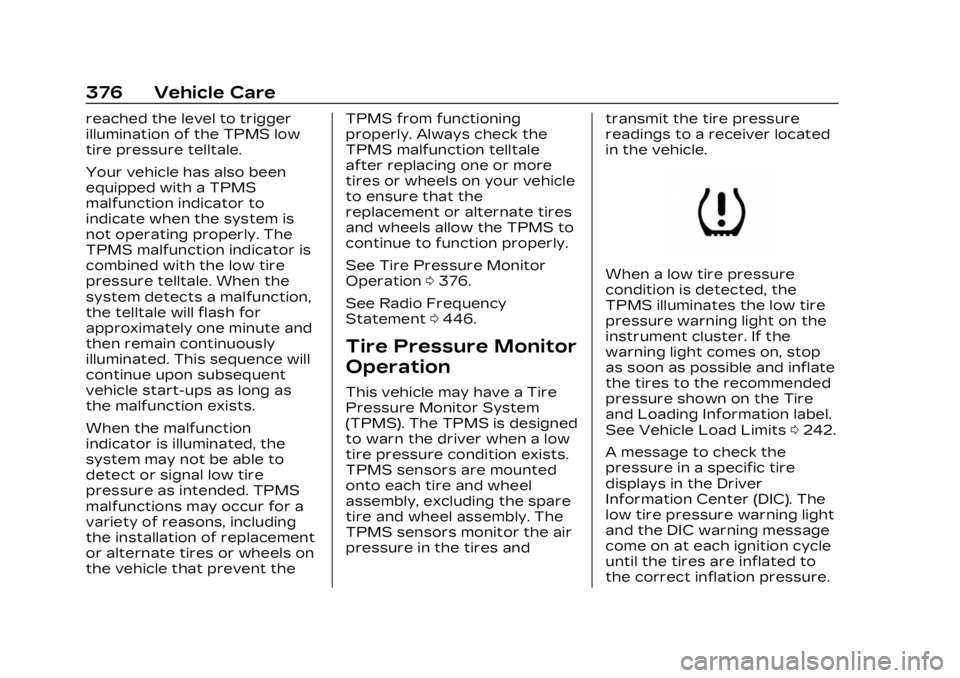
When a low tire pressure
condition is detected, the
TPMS illuminates the low tire
pressure warning light on the
instrument cluster. If the
warning light comes on, stop
as soon as possible and inflate
the tires to the recommended
pressure shown on the Tire
and Loading Information label.
See Vehicle Load Limits
0242.
A message to check the
pressure in a specific tire
displays in the Driver
Information Center (DIC). The
low tire pressure warning light
and the DIC warning message
come on at each ignition cycle
until the tires are inflated to
the correct inflation pressure.
Page 378 of 476

Cadillac XT4 Owner Manual (GMNA-Localizing-U.S./Canada/Mexico-
16412876) - 2023 - CRC - 3/25/22
Vehicle Care 377
Using the DIC, tire pressure
levels can be viewed. For
additional information and
details about the DIC
operation and displays see
Driver Information Center
(DIC)0136.
The low tire pressure warning
light may come on in cool
weather when the vehicle is
first started, and then turn off
as the vehicle is driven. This
could be an early indicator
that the air pressure is getting
low and needs to be inflated to
the proper pressure.
A Tire and Loading
Information label, attached to
your vehicle, shows the size of
the original equipment tires
and the correct inflation
pressure for the tires when
they are cold. See Vehicle
Load Limits 0242, for an
example of the Tire and
Loading Information label and
its location. Also see Tire
Pressure 0372. The TPMS can warn about a
low tire pressure condition but
it does not replace normal tire
maintenance. See Tire
Inspection
0380, Tire
Rotation 0381, and Tires
0 364.
Caution
Tire sealant materials are
not all the same.
A non-approved tire sealant
could damage the TPMS
sensors. TPMS sensor
damage caused by using an
incorrect tire sealant is not
covered by the vehicle
warranty. Always use only
the GM approved tire
sealant available through
your dealer or included in
the vehicle.
Factory-installed Tire Inflator
Kits use a GM approved liquid
tire sealant. Using
non-approved tire sealants
could damage the TPMS sensors. See Tire Sealant and
Compressor Kit
0390 for
information regarding the
inflator kit materials and
instructions.
TPMS Malfunction Light
and Message
The TPMS will not function
properly if one or more of the
TPMS sensors are missing or
inoperable. When the system
detects a malfunction, the low
tire pressure warning light
flashes for about one minute
and then stays on for the
remainder of the ignition cycle.
A DIC warning message also
displays. The malfunction light
and DIC warning message
come on at each ignition cycle
until the problem is corrected.
Some of the conditions that
can cause these to come
on are:
.One of the road tires has
been replaced with the
spare tire. The spare tire
does not have a TPMS
sensor. The malfunction light
Page 380 of 476

Cadillac XT4 Owner Manual (GMNA-Localizing-U.S./Canada/Mexico-
16412876) - 2023 - CRC - 3/25/22
Vehicle Care 379
If the tire is overinflated by
more than 35 kPa (5 psi), the
horn will sound multiple times
and the turn signal lamp will
continue to flash for several
seconds after filling stops. To
release and correct the
pressure, while the turn signal
lamp is still flashing, briefly
press the center of the valve
stem. When the recommended
pressure is reached, the horn
sounds once.
If the turn signal lamp does
not flash within 15 seconds
after starting to inflate the
tire, the tire fill alert has not
been activated or is not
working.
If the hazard warning flashers
are on, the tire fill alert visual
feedback will not work
properly.
The TPMS will not activate the
tire fill alert properly under the
following conditions:
.There is interference from
an external device or
transmitter.
.The air pressure from the
inflation device is not
sufficient to inflate the tire.
.There is a malfunction in
the TPMS.
.There is a malfunction in the
horn or turn signal lamps.
.The identification code of
the TPMS sensor is not
registered to the system.
.The battery of the TPMS
sensor is low.
If the tire fill alert does not
operate due to TPMS
interference, move the vehicle
about 1 m (3 ft) back or
forward and try again. If the
tire fill alert feature is not
working, use a tire pressure
gauge.
TPMS Sensor Matching
Process
Each TPMS sensor has a
unique identification code. The
identification code needs to be
matched to a new tire/wheel
position after rotating the
vehicle’s tires or replacing one or more of the TPMS sensors.
The TPMS sensor matching
process should also be
performed after replacing a
spare tire with a road tire
containing the TPMS sensor.
The malfunction light and the
DIC message should go off at
the next ignition cycle. The
sensors are matched to the
tire/wheel positions, using a
TPMS relearn tool, in the
following order: driver side
front tire, passenger side front
tire, passenger side rear tire,
and driver side rear. See your
dealer for service or to
purchase a relearn tool.
A TPMS relearn tool can also
be purchased. See Tire
Pressure Monitor Sensor
Activation Tool at www.
gmtoolsandequipment.com or
call 1-800-GM TOOLS
(1-800-468-6657).
There are two minutes to
match the first tire/wheel
position, and five minutes
overall to match all four tire/
Page 382 of 476

Cadillac XT4 Owner Manual (GMNA-Localizing-U.S./Canada/Mexico-
16412876) - 2023 - CRC - 3/25/22
Vehicle Care 381
.There is cord or fabric
showing through the
tire's rubber.
.The tread or sidewall is
cracked, cut, or snagged
deep enough to show
cord or fabric.
.The tire has a bump,
bulge, or split.
.The tire has a puncture,
cut, or other damage that
cannot be repaired well
because of the size or
location of the damage.
Tire Rotation
Tires should be rotated
according to the interval
specified in the
Maintenance Schedule. See
Maintenance Schedule
0425. Tires are rotated to
achieve a more uniform
wear for all tires. The first
rotation is the most
important.
Anytime unusual wear is
noticed, rotate the tires as
soon as possible, check for
proper tire inflation
pressure, and check for
damaged tires or wheels.
If the unusual wear
continues after the
rotation, check the wheel
alignment. See When It Is
Time for New Tires
0382
and Wheel Replacement
0 387.
Use this rotation pattern
when rotating the tires.
Do not include the compact
spare tire in the tire
rotation.
Adjust the front and rear
tires to the recommended
inflation pressure on the
Tire and Loading
Information label after the
tires have been rotated.
See Tire Pressure 0372
and Vehicle Load Limits
0 242.
Page 384 of 476

Cadillac XT4 Owner Manual (GMNA-Localizing-U.S./Canada/Mexico-
16412876) - 2023 - CRC - 3/25/22
Vehicle Care 383
The rubber in tires ages over
time. This also applies to the
spare tire, if the vehicle has
one, even if it is never used.
Multiple factors including
temperatures, loading
conditions, and inflation
pressure maintenance affect
how fast aging takes place.
GM recommends that tires,
including the spare if
equipped, be replaced after six
years, regardless of tread
wear. To identify the age of a
tire, use the tire manufacture
date, which is the last four
digits of the DOT Tire
Identification Number (TIN)
molded into one side of the
tire sidewall. The last four
digits of the TIN indicate the
tire manufactured date. The
first two digits represent the
week and the last two digits,
the year. For example, the
third week of the year 2020
would have a 4-digit DOT date
of 0320. Week 01 is the first
full week (Sunday through
Saturday) of each year.Vehicle Storage
Tires age when stored
normally mounted on a parked
vehicle. Park a vehicle that will
be stored for at least a month
in a cool, dry, clean area away
from direct sunlight to slow
aging. This area should be free
of grease, gasoline, or other
substances that can
deteriorate rubber.
Parking for an extended
period can cause flat spots on
the tires that may result in
vibrations while driving. When
storing a vehicle for at least a
month, remove the tires or
raise the vehicle to reduce the
weight from the tires.
Buying New Tires
GM has developed and
matched specific tires for
the vehicle. The original
equipment tires installed
were designed to meet
General Motors Tire
Performance CriteriaSpecification (TPC Spec)
system rating. When
replacement tires are
needed, GM strongly
recommends buying tires
with the same TPC Spec
rating.
GM's exclusive TPC Spec
system considers over a
dozen critical specifications
that impact the overall
performance of the vehicle,
including brake system
performance, ride and
handling, traction control,
and tire pressure
monitoring performance.
GM's TPC Spec number is
molded onto the tire's
sidewall near the tire size.
If the tires have an
all-season tread design, the
TPC Spec number will be
followed by MS for mud
and snow. See Tire
Sidewall Labeling
0367 for
additional information.
Page 388 of 476

Cadillac XT4 Owner Manual (GMNA-Localizing-U.S./Canada/Mexico-
16412876) - 2023 - CRC - 3/25/22
Vehicle Care 387
represent higher levels of
performance on the
laboratory test wheel than
the minimum required by
law. Warning: The
temperature grade for this
tire is established for a tire
that is properly inflated and
not overloaded. Excessive
speed, underinflation,
or excessive loading, either
separately or in
combination, can cause
heat buildup and possible
tire failure.
Wheel Alignment and
Tire Balance
The tires and wheels were
aligned and balanced at the
factory to provide the longest
tire life and best overall
performance. Adjustments to
wheel alignment and tire
balancing are not necessary
on a regular basis. Consider an
alignment check if there is
unusual tire wear or thevehicle is significantly pulling
to one side or the other. Some
slight pull to the left or right,
depending on the crown of the
road and/or other road
surface variations such as
troughs or ruts, is normal.
If the vehicle is vibrating when
driving on a smooth road, the
tires and wheels may need to
be rebalanced. See your
dealer for proper diagnosis.
Wheel Replacement
Replace any wheel that is
bent, cracked, or badly rusted
or corroded. If wheel nuts
keep coming loose, the wheel,
wheel bolts, and wheel nuts
should be replaced. If the
wheel leaks air, replace it.
Some aluminum wheels can be
repaired. See your dealer if
any of these conditions exist.
Your dealer will know the kind
of wheel that is needed.
Each new wheel should have
the same load-carrying
capacity, diameter, width,
offset, and be mounted the
same way as the one it
replaces.
Replace wheels, wheel bolts,
wheel nuts, or Tire Pressure
Monitor System (TPMS)
sensors with new GM original
equipment parts.
{Warning
Using the wrong
replacement wheels, wheel
bolts, or wheel nuts can be
dangerous. It could affect
the braking and handling of
the vehicle. Tires can lose air
and cause loss of control,
resulting in a crash. Always
use the correct wheel, wheel
bolts, and wheel nuts for
replacement.
{Warning
Replacing a wheel with a
used one is dangerous. How
it has been used or how far
(Continued)
Page 395 of 476

Cadillac XT4 Owner Manual (GMNA-Localizing-U.S./Canada/Mexico-
16412876) - 2023 - CRC - 3/25/22
394 Vehicle Care
and start to rise again as
the tire inflates with
air only.
11. Inflate the tire to the recommended inflation
pressure using the
pressure gauge (8). The
recommended inflation
pressure can be found on
the Tire and Loading
Information label. See Tire
Pressure 0372.
The pressure gauge (8)
may read higher than the
actual tire pressure while
the compressor is on. Turn
the compressor off to get
an accurate pressure
reading. The compressor
may be turned on/off until
the correct pressure is
reached.
Caution
If the recommended
pressure cannot be reached
after approximately
25 minutes, the vehicle (Continued)
Caution (Continued)
should not be driven farther.
The tire is too severely
damaged and the tire
sealant and compressor kit
cannot inflate the tire.
Remove the power plug
from the accessory power
outlet and unscrew the
inflating hose from the tire
valve. See Roadside
Assistance Program 0439.
12. Press the on/off button (5) to turn the tire sealant and
compressor kit off.
The tire is not sealed and
will continue to leak air
until the vehicle is driven
and the sealant is
distributed in the tire.
Therefore, Steps 13–
21 must be done
immediately after Step 12.
Be careful while handling
the tire sealant and
compressor kit as it could
be warm after usage. 13. Unplug the power plug (9)
from the accessory power
outlet in the vehicle.
14. Turn the sealant/air hose (2) counterclockwise
to remove it from the tire
valve stem.
15. Replace the tire valve stem cap.
16. Remove the tire sealant canister (4) from the slot
on top of the
compressor (6).
17. Turn the air only hose (10) counterclockwise to
remove it from the tire
sealant canister inlet
valve (1).
18. Turn the sealant/air hose (2) clockwise onto the
sealant canister inlet
valve (1) to prevent sealant
leakage.
19. Return the air only hose (10) and power plug (9)
back to their original
storage location.
Page 396 of 476
Cadillac XT4 Owner Manual (GMNA-Localizing-U.S./Canada/Mexico-
16412876) - 2023 - CRC - 3/25/22
Vehicle Care 395
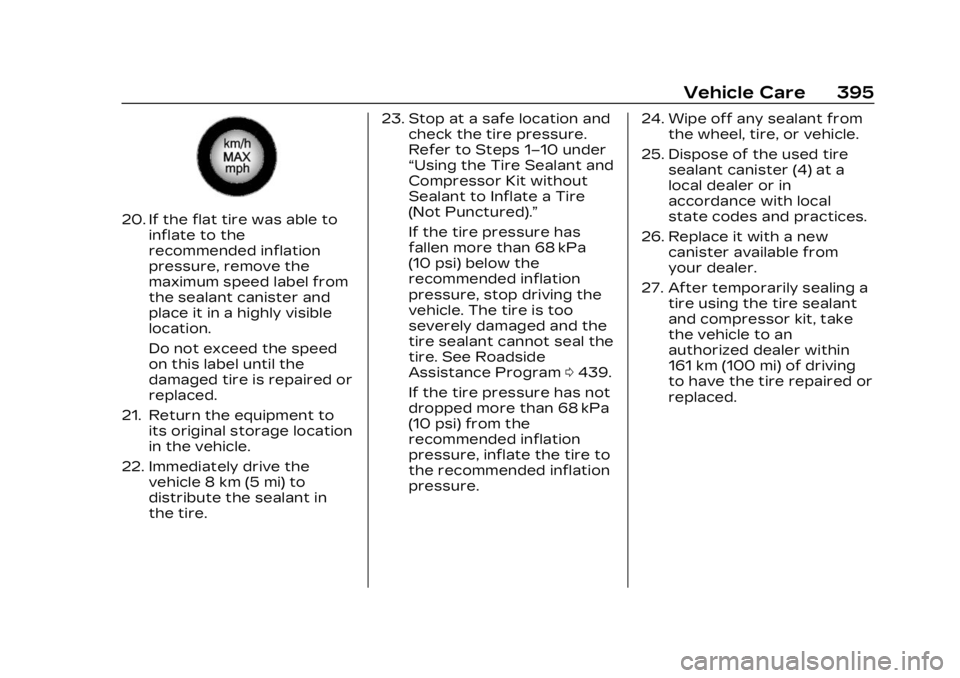
20. If the flat tire was able toinflate to the
recommended inflation
pressure, remove the
maximum speed label from
the sealant canister and
place it in a highly visible
location.
Do not exceed the speed
on this label until the
damaged tire is repaired or
replaced.
21. Return the equipment to its original storage location
in the vehicle.
22. Immediately drive the vehicle 8 km (5 mi) to
distribute the sealant in
the tire. 23. Stop at a safe location and
check the tire pressure.
Refer to Steps 1–10 under
“Using the Tire Sealant and
Compressor Kit without
Sealant to Inflate a Tire
(Not Punctured).”
If the tire pressure has
fallen more than 68 kPa
(10 psi) below the
recommended inflation
pressure, stop driving the
vehicle. The tire is too
severely damaged and the
tire sealant cannot seal the
tire. See Roadside
Assistance Program 0439.
If the tire pressure has not
dropped more than 68 kPa
(10 psi) from the
recommended inflation
pressure, inflate the tire to
the recommended inflation
pressure. 24. Wipe off any sealant from
the wheel, tire, or vehicle.
25. Dispose of the used tire sealant canister (4) at a
local dealer or in
accordance with local
state codes and practices.
26. Replace it with a new canister available from
your dealer.
27. After temporarily sealing a tire using the tire sealant
and compressor kit, take
the vehicle to an
authorized dealer within
161 km (100 mi) of driving
to have the tire repaired or
replaced.
Page 398 of 476

Cadillac XT4 Owner Manual (GMNA-Localizing-U.S./Canada/Mexico-
16412876) - 2023 - CRC - 3/25/22
Vehicle Care 397
If the vehicle only has a
cigarette lighter, use the
cigarette lighter.
Do not pinch the power
plug cord in the door or
window.
7. Start the vehicle. The vehicle must be running
while using the air
compressor.
8. Press the on/off button (5) to turn the tire sealant and
compressor kit on.
The compressor will inflate
the tire with air only.
9. Inflate the tire to the recommended inflation
pressure using the
pressure gauge (8). The
recommended inflation
pressure can be found on
the Tire and Loading
Information label. See Tire
Pressure 0372.
The pressure gauge (8)
may read higher than the
actual tire pressure while
the compressor is on. Turn
the compressor off to get an accurate pressure
reading. The compressor
may be turned on/off until
the correct pressure is
reached.
Caution
If the recommended
pressure cannot be reached
after approximately
25 minutes, the vehicle
should not be driven farther.
The tire is too severely
damaged and the tire
sealant and compressor kit
cannot inflate the tire.
Remove the power plug
from the accessory power
outlet and unscrew the
inflating hose from the tire
valve. See Roadside
Assistance Program
0439.
10. Press the on/off button (5) to turn the tire sealant and
compressor kit off.
Be careful while handling
the compressor as it could
be warm after usage. 11. Unplug the power plug (9)
from the accessory power
outlet in the vehicle.
12. Turn the air only hose (10) counterclockwise to
remove it from the tire
valve stem.
13. Replace the tire valve stem cap.
14. Return the air only hose (10) and power plug (9)
back to their original
storage location.
15. Return the equipment to its original storage location
in the vehicle.
The tire sealant and
compressor kit has accessory
adapters located in a
compartment on the bottom
of its housing that can be used
to inflate air mattresses,
balls, etc.