climate CADILLAC XT6 2021 Owner's Guide
[x] Cancel search | Manufacturer: CADILLAC, Model Year: 2021, Model line: XT6, Model: CADILLAC XT6 2021Pages: 431, PDF Size: 8.29 MB
Page 220 of 431

Cadillac XT6 Owner Manual (GMNA-Localizing-U.S./Canada-14574701) -
2021 - CRC - 2/8/21
DRIVING AND OPERATING 219
.Become familiar with vehicle
features before driving, such as
programming favorite radio stations
and adjusting climate control and
seat settings. Program all trip
information into any navigation
device prior to driving.
.Wait until the vehicle is parked to
retrieve items that have fallen to
the floor.
.Stop or park the vehicle to tend to
children.
.Keep pets in an appropriate carrier
or restraint.
.Avoid stressful conversations while
driving, whether with a passenger or
on a cell phone.
{Warning
Taking your eyes off the road too
long or too often could cause a
crash resulting in injury or death.
Focus your attention on driving.
Refer to the infotainment section for
more information on using that
system and the navigation system,
if equipped, including pairing and
using a cell phone.
Defensive Driving
Defensive driving means “always
expect the unexpected.” The first step
in driving defensively is to wear the
seat belt. See Seat Belts053.
.Assume that other road users
(pedestrians, bicyclists, and other
drivers) are going to be careless and
make mistakes. Anticipate what
they may do and be ready.
.Allow enough following distance
between you and the driver in front
of you.
.Focus on the task of driving.
Impaired Driving
Death and injury associated with
impaired driving is a global tragedy.
{Warning
Drinking alcohol or taking drugs
and then driving is very dangerous.
Your reflexes, perceptions,
attentiveness, and judgment can be
affected by even a small amount of
alcohol or drugs. You can have a
(Continued)
Warning (Continued)
serious—or even fatal —collision
if you drive after drinking or taking
drugs.
Do not drive while under the
influence of alcohol or drugs,
or ride with a driver who has been
drinking or is impaired by drugs.
Find alternate transportation home;
or if you are with a group, designate
a driver who will remain sober.
Control of a Vehicle
Braking, steering, and accelerating are
important factors in helping to control
a vehicle while driving.
Braking
Braking action involves perception
time and reaction time. Deciding to
push the brake pedal is perception
time. Actually doing it is
reaction time.
Average driver reaction time is about
three-quarters of a second. In that
time, a vehicle moving at 100 km/h
Page 228 of 431

Cadillac XT6 Owner Manual (GMNA-Localizing-U.S./Canada-14574701) -
2021 - CRC - 2/8/21
DRIVING AND OPERATING 227
begins to fall. Avoid driving on wet ice
or in freezing rain until roads can be
treated.
For Slippery Road Driving:
.Accelerate gently. Accelerating too
quickly causes the wheels to spin
and makes the surface under the
tires slick.
.Turn on Traction Control. See
Traction Control/Electronic Stability
Control0248.
.Antilock Brake System (ABS)
improves vehicle stability during
hard stops, but the brakes should be
applied sooner than when on dry
pavement. See Antilock Brake System
(ABS) 0246.
.Allow greater following distance and
watch for slippery spots. Icy patches
can occur on otherwise clear roads
in shaded areas. The surface of a
curve or an overpass can remain icy
when the surrounding roads are
clear. Avoid sudden steering
maneuvers and braking while
on ice.
.Turn off cruise control.
.Select All-Wheel Drive (AWD) mode.
See Driver Mode Control 0250 and
All-Wheel Drive 0245.
Blizzard Conditions
Stop the vehicle in a safe place and
signal for help. Stay with the vehicle
unless there is help nearby. If possible,
use Roadside Assistance. See Roadside
Service 0401. To get help and keep
everyone in the vehicle safe:
.Turn on the hazard warning
flashers.
.Tie a red cloth to an outside mirror.
{Warning
Snow can trap engine exhaust
under the vehicle. This may cause
exhaust gases to get inside. Engine
exhaust contains carbon monoxide
(CO), which cannot be seen or
smelled. It can cause
unconsciousness and even death.
If the vehicle is stuck in snow:
.Clear snow from the base of the
vehicle, especially any blocking
the exhaust pipe.
(Continued)
Warning (Continued)
.Open a window about 5 cm (2 in)
on the vehicle side that is away
from the wind, to bring in
fresh air.
.Fully open the air outlets on or
under the instrument panel.
.Adjust the climate control
system to circulate the air inside
the vehicle and set the fan speed
to the highest setting. See
“Climate Control Systems.”
For more information about CO, see
Engine Exhaust 0239.
To save fuel, run the engine for short
periods to warm the vehicle and then
shut the engine off and partially close
the window. Moving about to keep
warm also helps.
If it takes time for help to arrive,
when running the engine, push the
accelerator pedal slightly so the
engine runs faster than the idle speed.
This keeps the battery charged to
restart the vehicle and to signal for
help with the headlamps. Do this as
little as possible, to save fuel.
Page 236 of 431

Cadillac XT6 Owner Manual (GMNA-Localizing-U.S./Canada-14574701) -
2021 - CRC - 2/8/21
DRIVING AND OPERATING 235
Auto Engine Stop/Start
When the brakes are applied and the
vehicle is at a complete stop, the
engine may turn off. When stopped,
the tachometer displays AUTO STOP.
SeeTachometer 0112. When the brake
pedal is released or the accelerator
pedal is pressed, the engine will
restart.
To maintain vehicle performance,
other conditions may cause the engine
to automatically restart before the
brake pedal is released.
Auto Stops may not occur and/or auto
restarts may occur because:
.The climate control settings require
the engine to be running to cool or
heat the vehicle interior.
.The vehicle battery charge is low.
.The vehicle battery has recently
been disconnected.
.Minimum vehicle speed has not
been reached since the last
Auto Stop.
.The accelerator pedal is pressed.
.The engine or transmission is not at
the required operating temperature.
.The outside temperature is not in
the required operating range.
.The vehicle transmission is shifted
out of D (Drive) to any gear other
than P (Park).
.Tow/Haul Mode or other driver
modes have been selected.
.The vehicle is on a steep hill or
grade.
.The driver door has been opened or
the driver seat belt has been
unbuckled.
.The hood has been opened.
.The Auto Stop has reached the
maximum allowed time. Auto Stop Disable Switch
The automatic engine Stop/Start
feature can be disabled and enabled
by touching the
hsymbol. Auto Stop
is enabled each time you start the
vehicle.
When the light next to the
his
illuminated, the system is enabled.
Engine Heater
The engine heater, if available, can
help in cold weather conditions at or
below −18 °C (0 °F) for easier starting
and better fuel economy during
engine warm-up. Plug in the engine
heater at least four hours before
Page 292 of 431
Cadillac XT6 Owner Manual (GMNA-Localizing-U.S./Canada-14574701) -
2021 - CRC - 2/8/21
DRIVING AND OPERATING 291
If equipped with Lane Change Alert
(LCA), the LCA detection zones that
extend back from the side of the
vehicle do not move further back
when a trailer is towed. Use caution
while changing lanes when towing a
trailer.
If equipped with Rear Cross Traffic
Alert (RCTA), use caution while
backing up when towing a trailer, as
the RCTA detection zones that extend
out from the back of the vehicle do
not move further back when a trailer
is towed.
{Warning
To prevent serious injury or death
from carbon monoxide (CO), when
towing a trailer:
.Do not drive with the liftgate,
trunk/hatch, or rear-most
window open.
.Fully open the air outlets on or
under the instrument panel.(Continued)
Warning (Continued)
.Adjust the climate control
system to a setting that brings in
only outside air. See“Climate
Control Systems” in the Index.
For more information about carbon
monoxide, see Engine Exhaust
0 239.
Towing a trailer requires experience.
The combination of the vehicle and
trailer is longer and not as responsive
as the vehicle itself. Get used to the
handling and braking of the
combination by driving on a level road
surface before driving on public roads.
The trailer structure, the tires, and the
brakes must be all be rated to carry
the intended cargo. Inadequate trailer
equipment can cause the combination
to operate in an unexpected or unsafe
manner. Before driving, inspect all
trailer hitch parts and attachments,
safety chains, electrical connectors,
lamps, tires, and mirrors. See Towing
Equipment 0297. If the trailer has
electric brakes, start the combination
moving and then manually apply the trailer brake controller to check the
trailer brakes work. During the trip,
occasionally check that the cargo and
trailer are secure and that the lamps
and any trailer brakes are working.
Towing with a Stability Control
System
When towing, the stability control
system might be heard. The system
reacts to vehicle movement caused by
the trailer, which mainly occurs
during cornering. This is normal when
towing heavier trailers.
Following Distance
Stay at least twice as far behind the
vehicle ahead as you would when
driving without a trailer. This can help
to avoid heavy braking and sudden
turns.
Passing
More passing distance is needed when
towing a trailer. The combination of
the vehicle and trailer will not
accelerate as quickly and is much
longer than the vehicle alone. It is
necessary to go much farther beyond
Page 323 of 431
Cadillac XT6 Owner Manual (GMNA-Localizing-U.S./Canada-14574701) -
2021 - CRC - 2/8/21
322 VEHICLE CARE
Brakes
Disc brake linings have built-in wear
indicators that make a high-pitched
warning sound when the brake linings
are worn and new linings are needed.
The sound can come and go or can be
heard all the time when the vehicle is
moving, except when applying the
brake pedal firmly.
{Warning
The brake wear warning sound
means that soon the brakes will not
work well. That could lead to a
crash. When the brake wear
warning sound is heard, have the
vehicle serviced.
Caution
Continuing to drive with worn-out
brake linings could result in costly
brake repairs.
Some driving conditions or climates
can cause a brake squeal when the
brakes are first applied, clearing up following several applications. This
does not mean something is wrong
with the brakes.
Properly torqued wheel nuts are
necessary to help prevent brake
pulsation. When tires are rotated,
inspect brake linings for wear and
evenly tighten wheel nuts in the
proper sequence to torque
specifications. See
Capacities and
Specifications 0394.
Brake pads should be replaced as
complete axle sets.
Brake Pedal Travel
See your dealer if the brake pedal does
not return to normal height, or if
there is a rapid increase in pedal
travel. This could be a sign that brake
service may be required.
Replacing Brake System Parts
Always replace brake system parts
with new, approved replacement parts.
If this is not done, the brakes may not
work properly. The braking
performance can change in many ways if the wrong brake parts are
installed or if parts are improperly
installed.
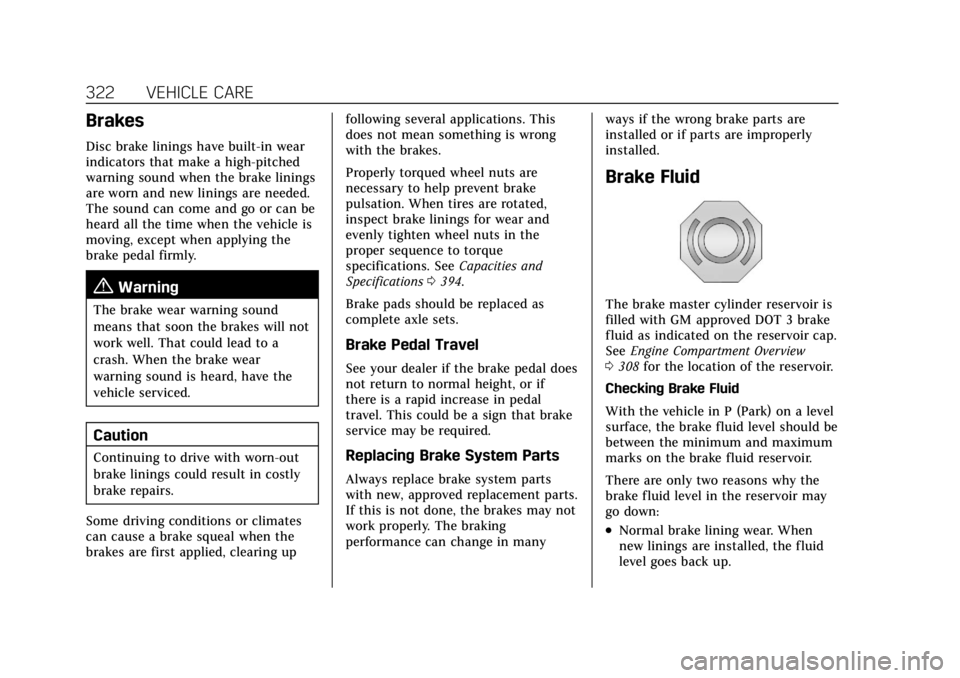
Brake Fluid
The brake master cylinder reservoir is
filled with GM approved DOT 3 brake
fluid as indicated on the reservoir cap.
See
Engine Compartment Overview
0 308 for the location of the reservoir.
Checking Brake Fluid
With the vehicle in P (Park) on a level
surface, the brake fluid level should be
between the minimum and maximum
marks on the brake fluid reservoir.
There are only two reasons why the
brake fluid level in the reservoir may
go down:
.Normal brake lining wear. When
new linings are installed, the fluid
level goes back up.
Page 339 of 431
Cadillac XT6 Owner Manual (GMNA-Localizing-U.S./Canada-14574701) -
2021 - CRC - 2/8/21
338 VEHICLE CARE
all-season tires can be identified by
the last two characters of this TPC
code, which will be“MS.”
Consider installing winter tires on the
vehicle if frequent driving on snow or
ice-covered roads is expected.
All-season tires provide adequate
performance for most winter driving
conditions, but they may not offer the
same level of traction or performance
as winter tires on snow or ice-covered
roads. See Winter Tires 0338.
Winter Tires
This vehicle was not originally
equipped with winter tires. Winter
tires are designed for increased
traction on snow and ice-covered
roads. Consider installing winter tires
on the vehicle if frequent driving on
ice or snow covered roads is expected.
See your dealer for details regarding
winter tire availability and proper tire
selection. Also, see Buying New Tires
0 353.
With winter tires, there may be
decreased dry road traction, increased
road noise, and shorter tread life. After changing to winter tires, be alert
for changes in vehicle handling and
braking.
If using winter tires:
.Use tires of the same brand and
tread type on all four wheel
positions.
.Use only radial ply tires of the same
size, load range, and speed rating as
the original equipment tires.
Winter tires with the same speed
rating as the original equipment tires
may not be available for H, V, W, Y,
and ZR speed rated tires. If winter
tires with a lower speed rating are
chosen, never exceed the tire's
maximum speed capability.
Summer Tires
This vehicle may come with 235/
65R18 or 235/55R20 high performance
summer tires. These tires have a
special tread and compound that are
optimized for maximum dry and wet
road performance. This special tread
and compound will have decreased
performance in cold climates, and on
ice and snow. It is recommended that
winter tires be installed on the vehicle if frequent driving at temperatures
below approximately 5 °C (40 °F) or on
ice or snow covered roads is expected.
See
Winter Tires 0338.
Caution
High performance summer tires
have rubber compounds that lose
flexibility and may develop surface
cracks in the tread area at
temperatures below −7 °C (20 °F).
Always store high performance
summer tires indoors and at
temperatures above −7 °C (20 °F)
when not in use. If the tires have
been subjected to −7 °C (20 °F) or
less, let them warm up in a heated
space to at least 5 °C (40 °F) for
24 hours or more before being
installed or driving a vehicle on
which they are installed. Do not
apply heat or blow heated air
directly on the tires. Always inspect
tires before use. See Tire Inspection
0 350.
Page 356 of 431
Cadillac XT6 Owner Manual (GMNA-Localizing-U.S./Canada-14574701) -
2021 - CRC - 2/8/21
VEHICLE CARE 355
also conform to federal safety
requirements and additional
General Motors Tire Performance
Criteria (TPC) standards.
Quality grades can be found where
applicable on the tire sidewall
between tread shoulder and
maximum section width. For
example:
Treadwear 200 Traction AA
Temperature A
All Passenger Car Tires Must
Conform to Federal Safety
Requirements In Addition To
These Grades.
Treadwear
The treadwear grade is a
comparative rating based on the
wear rate of the tire when tested
under controlled conditions on a
specified government test course.
For example, a tire graded
150 would wear one and one-half
(1½) times as well on the
government course as a tiregraded 100. The relative
performance of tires depends
upon the actual conditions of
their use, however, and may
depart significantly from the norm
due to variations in driving habits,
service practices and differences
in road characteristics and
climate.
Traction
The traction grades, from highest
to lowest, are AA, A, B, and C.
Those grades represent the tire's
ability to stop on wet pavement as
measured under controlled
conditions on specified
government test surfaces of
asphalt and concrete. A tire
marked C may have poor traction
performance. Warning: The
traction grade assigned to this tire
is based on straight-ahead braking
traction tests, and does not
include acceleration, cornering,
hydroplaning, or peak traction
characteristics.Temperature
The temperature grades are A (the
highest), B, and C, representing
the tire's resistance to the
generation of heat and its ability
to dissipate heat when tested
under controlled conditions on a
specified indoor laboratory test
wheel. Sustained high temperature
can cause the material of the tire
to degenerate and reduce tire life,
and excessive temperature can
lead to sudden tire failure. The
grade C corresponds to a level of
performance which all passenger
car tires must meet under the
Federal Motor Safety Standard
No. 109. Grades B and A represent
higher levels of performance on
the laboratory test wheel than the
minimum required by law.
Warning: The temperature grade
for this tire is established for a tire
that is properly inflated and not
overloaded. Excessive speed,
underinflation, or excessive
Page 374 of 431
Cadillac XT6 Owner Manual (GMNA-Localizing-U.S./Canada-14574701) -
2021 - CRC - 2/8/21
VEHICLE CARE 373
thoroughly when cleaning the blades.
Bugs, road grime, sap, and a buildup
of vehicle wash/wax treatments may
cause wiper streaking.
Replace the wiper blades if they are
worn or damaged. Damage can be
caused by extreme dusty conditions,
sand, salt, heat, sun, snow, and ice.
Weatherstrips
Apply weatherstrip lubricant on
weatherstrips to make them last
longer, seal better, and not stick or
squeak. Lubricate weatherstrips at
least once a year. Hot, dry climates
may require more frequent
application. Black marks from rubber
material on painted surfaces can be
removed by rubbing with a clean
cloth. SeeRecommended Fluids and
Lubricants 0389.
Tires
Use a stiff brush with tire cleaner to
clean the tires.
Caution
Using petroleum-based tire dressing
products on the vehicle may
damage the paint finish and/or
tires. When applying a tire dressing,
always wipe off any overspray from
all painted surfaces on the vehicle.
Wheels and Wheel Trim
Use a soft, clean cloth with mild soap
and water to clean the wheels. After
rinsing thoroughly with clean water,
dry with a soft, clean towel. A wax
may then be applied.
Caution
Chrome wheels and chrome wheel
trim may be damaged if the vehicle
is not washed after driving on roads
that have been sprayed with
magnesium chloride or calcium
chloride. These are used on roads
for conditions such as dust and ice.
Always wash the chrome with soap
and water after exposure.
Caution
To avoid surface damage on wheels
and wheel trim, do not use strong
soaps, chemicals, abrasive polishes,
cleaners, or brushes. Use only GM
approved cleaners. Do not drive the
vehicle through an automatic car
wash that uses silicon carbide tire/
wheel cleaning brushes. Damage
could occur and the repairs would
not be covered by the vehicle
warranty.
Brake System
Visually inspect brake lines and hoses
for proper hook-up, binding, leaks,
cracks, chafing, etc. Inspect disc brake
pads for wear and rotors for surface
condition. Inspect all other brake
parts.
Steering, Suspension, and
Chassis Components
Visually inspect steering, suspension,
and chassis components for damaged,
loose, or missing parts or signs of
wear at least once a year.
Page 421 of 431
Cadillac XT6 Owner Manual (GMNA-Localizing-U.S./Canada-14574701) -
2021 - CRC - 2/9/21
420 INDEX
Child RestraintsInfants and Young Children . . . . . . . 73
Lower Anchors and Tethers
for Children . . . . . . . . . . . . . . . . . . . . . . . 79
Older Children . . . . . . . . . . . . . . . . . . . . . 72
Securing . . . . . . . . . . . . . . . . . . . . . . . . 87, 89
Systems . . . . . . . . . . . . . . . . . . . . . . . . . . . . 76
Circuit Breakers . . . . . . . . . . . . . . . . . . . . . 328
Cleaning Exterior Care . . . . . . . . . . . . . . . . . . . . . . 370
Interior Care . . . . . . . . . . . . . . . . . . . . . . 374
Climate Control Systems Dual Automatic . . . . . . . . . . . . . . . . . . . 208
Rear . . . . . . . . . . . . . . . . . . . . . . . . . . . . . . . . 213
Clock . . . . . . . . . . . . . . . . . . . . . . . . . . . . . . . . . 105
Cluster, Instrument . . . . . . . . . . . . . . . . . 109
Collision Damage Repair . . . . . . . . . . . 404
Compact Spare Tire . . . . . . . . . . . . . . . . . 364
Compartments Storage . . . . . . . . . . . . . . . . . . . . . . . . . . . . . 92
Compass . . . . . . . . . . . . . . . . . . . . . . . . . . . . . 105
Connected Services
Connections . . . . . . . . . . . . . . . . . . . . . . . 416
Diagnostics . . . . . . . . . . . . . . . . . . . . . . . . 417
Navigation . . . . . . . . . . . . . . . . . . . . . . . . . 415
Connections Connected Services . . . . . . . . . . . . . . . 416 Control
Traction and Electronic
Stability . . . . . . . . . . . . . . . . . . . . . . . . . . 248
Control of a Vehicle . . . . . . . . . . . . . . . . 219
Controls Steering Wheel . . . . . . . . . . . . . . . . . . . . 149
Convenience Net . . . . . . . . . . . . . . . . . . . . . 98
Convex Mirrors . . . . . . . . . . . . . . . . . . . . . . 30
Coolant
Engine Temperature Gauge . . . . . . 113
Engine Temperature WarningLight . . . . . . . . . . . . . . . . . . . . . . . . . . . . . 121
Cooling . . . . . . . . . . . . . . . . . . . . . . . . .208, 213
Cooling System . . . . . . . . . . . . . . . . . . . . . 316
Cornering Lamps . . . . . . . . . . . . . . . . . . . 143
Courtesy Lamps . . . . . . . . . . . . . . . . . . . . . 143
Courtesy Transportation Program . . . . . . . . . . . . . . . . . . . . . . . . . . . . 403
Cover Cargo . . . . . . . . . . . . . . . . . . . . . . . . . . . . . . . 94
Coverage Explanations . . . . . . . . . . . . . 175
Cruise Control . . . . . . . . . . . . . . . . . . . . . . . 251
Light . . . . . . . . . . . . . . . . . . . . . . . . . . . . . . . 123
Cruise Control, Adaptive . . . . . . . . . . . 254
Cupholders . . . . . . . . . . . . . . . . . . . . . . . . . . . 92
Customer Assistance . . . . . . . . . . . . . . . 400 Offices . . . . . . . . . . . . . . . . . . . . . . . . . . . . . 399
Text Telephone (TTY) Users . . . . . 400 Customer Information
Publications Ordering
Information . . . . . . . . . . . . . . . . . . . . . . 406
Customer Satisfaction Procedure . . . . . . . . . . . . . . . . . . . . . . . . . . 397
Cybersecurity . . . . . . . . . . . . . . . . . . . . . . . . 408
D
Damage Repair, Collision . . . . . . . . . . . 404
Danger, Warning, and Caution . . . . . . . . 2
Data Collection Infotainment System . . . . . . . . . . . . . 409
OnStar . . . . . . . . . . . . . . . . . . . . . . . . . . . . . 409
Data Recorders, Event . . . . . . . . . . . . . . 408
Database Coverage Explanations . . . . . . . . . . . . . . . . . . . . . . 175
Daytime Running Lamps (DRL) . . . 141
Defensive Driving . . . . . . . . . . . . . . . . . . . 219
Delayed Locking . . . . . . . . . . . . . . . . . . . . . 18
Destination . . . . . . . . . . . . . . . . . . . . . . . . . . 167
Diagnostics
Connected Services . . . . . . . . . . . . . . . 417
Distracted Driving . . . . . . . . . . . . . . . . . . 218
Dome Lamps . . . . . . . . . . . . . . . . . . . . . . . . 143
Door Ajar Light . . . . . . . . . . . . . . . . . . . . . . . . . 124
Delayed Locking . . . . . . . . . . . . . . . . . . . 18
Locks . . . . . . . . . . . . . . . . . . . . . . . . . . . . . . . 15
Page 422 of 431

Cadillac XT6 Owner Manual (GMNA-Localizing-U.S./Canada-14574701) -
2021 - CRC - 2/9/21
INDEX 421
Door (cont'd)Power Locks . . . . . . . . . . . . . . . . . . . . . . . . 18
Drive Belt Routing, Engine . . . . . . . . . 396
Drive Systems All-Wheel Drive . . . . . . . . . . . . . 245, 324
Driver Teen . . . . . . . . . . . . . . . . . . . . . . . . . . . . . . . 196
Driver Assistance Systems . . . . . . . . . 263
Driver Information Center (DIC) . . . . . . . . . . . . . . . . . . . . . . . 124
Driver Mode Control . . . . . . . . . . . . . . . . 250
Driver Mode Control Light . . . . . . . . . 121
Driving Assistance Systems . . . . . . . . . . . . . . . 272
Better Fuel Economy . . . . . . . . . . . . . 218
Characteristics andTowing Tips . . . . . . . . . . . . . . . . . . . . . 290
Defensive . . . . . . . . . . . . . . . . . . . . . . . . . . 219
Hill and Mountain Roads . . . . . . . . 226
If the Vehicle is Stuck . . . . . . . . . . . . 228
Impaired . . . . . . . . . . . . . . . . . . . . . . . . . . . 219
Loss of Control . . . . . . . . . . . . . . . . . . . . 221
Off-Road . . . . . . . . . . . . . . . . . . . . . . . . . . . 222
Off-Road Recovery . . . . . . . . . . . . . . . . 221
Vehicle Load Limits . . . . . . . . . . . . . . 228
Wet Roads . . . . . . . . . . . . . . . . . . . . . . . . . 225
Winter . . . . . . . . . . . . . . . . . . . . . . . . . . . . . 226 Dual Automatic Climate
Control System . . . . . . . . . . . . . . . . . . . . 208
E
Electric Brake Boost . . . . . . . . . . . . . . . . 246
Electric Parking Brake . . . . . . . . . . . . . . 246
Electric Parking Brake Light . . . . . . . 117
Electrical Equipment, Add-On . . . . . 301
Electrical System
Engine Compartment FuseBlock . . . . . . . . . . . . . . . . . . . . . . . . . . . . . 329
Fuses and Circuit Breakers . . . . . . . 328
Instrument Panel Fuse Block . . . . 332
Overload . . . . . . . . . . . . . . . . . . . . . . . . . . . 327
Rear Compartment Fuse
Block . . . . . . . . . . . . . . . . . . . . . . . . . . . . . 335
Emergency
OnStar . . . . . . . . . . . . . . . . . . . . . . . . . . . . . 411
Engine Air Cleaner/Filter . . . . . . . . . . . . . . . . . 315
Check Light (MalfunctionIndicator) . . . . . . . . . . . . . . . . . . . . . . . . 115
Compartment Overview . . . . . . . . . . 308
Coolant Temperature Gauge . . . . . 113
Coolant Temperature Warning Light . . . . . . . . . . . . . . . . . . . 121
Cooling System . . . . . . . . . . . . . . . . . . . 316
Drive Belt Routing . . . . . . . . . . . . . . . . 396 Engine (cont'd)
Exhaust . . . . . . . . . . . . . . . . . . . . . . . . . . . . 239
Heater . . . . . . . . . . . . . . . . . . . . . . . . . . . . . 235
Oil Life System . . . . . . . . . . . . . . . . . . . . 313
Oil Pressure Light . . . . . . . . . . . . . . . . . 122
Overheating . . . . . . . . . . . . . . . . . . . . . . . 320
Power Messages . . . . . . . . . . . . . . . . . . 130
Running While Parked . . . . . . . . . . . 239
Starting . . . . . . . . . . . . . . . . . . . . . . . . . . . . 233
Engine Air Filter Life System . . . . . . 314
Entry Lighting . . . . . . . . . . . . . . . . . . . . . . 144
Equipment, Towing . . . . . . . . . . . . . . . . . 297
Event Data Recorders . . . . . . . . . . . . . . 408
Exit Lighting . . . . . . . . . . . . . . . . . . . . . . . . 145
Extended Parking . . . . . . . . . . . . . . . . . . . 239
Extender, Seat Belt . . . . . . . . . . . . . . . . . . 59
Exterior Lamp Controls . . . . . . . . . . . . 139
Exterior Lamps Off Reminder . . . . . . 141
Exterior Lighting Battery Saver . . . . 145
F
Filter, Engine Air Cleaner . . . . . . . . . . . . . . . . 315
Flash-to-Pass . . . . . . . . . . . . . . . . . . . . . . . . 141
Flashers, Hazard Warning . . . . . . . . . . 142
Flat Tire . . . . . . . . . . . . . . . . . . . . . . . . . . . . . 357 Changing . . . . . . . . . . . . . . . . . . . . . . . . . . 358
Floor Mats . . . . . . . . . . . . . . . . . . . . . . . . . . . 377