light CADILLAC XTS 2013 1.G Owners Manual
[x] Cancel search | Manufacturer: CADILLAC, Model Year: 2013, Model line: XTS, Model: CADILLAC XTS 2013 1.GPages: 438, PDF Size: 7.4 MB
Page 256 of 438
Black plate (28,1)Cadillac XTS Owner Manual - 2013 - 1st - 4/13/12
9-28 Driving and Operating
brake pedal is released or brake
pedal pressure is quickly
decreased.
Hill Start Assist (HSA)
This vehicle has a Hill Start Assist
(HSA) feature, which may be useful
when the vehicle is stopped on a
grade. This feature is designed to
prevent the vehicle from rolling,
either forward or rearward, during
vehicle drive off. After the driver
completely stops and holds the
vehicle in a complete standstill on a
grade, HSA will be automatically
activated. During the transition
period between when the driver
releases the brake pedal and starts
to accelerate to drive off on a grade,
HSA holds the braking pressure to
ensure that there is no rolling. The
brakes will automatically release
when the accelerator pedal is
applied within the two‐second
window. It will not activate if the
vehicle is in a drive gear and facing
downhill or if the vehicle is facing
uphill and in R (Reverse).
Ride Control Systems
Traction Control
System (TCS)
The vehicle has a TCS that limits
wheel spin. This is especially useful
in slippery road conditions. The
system operates if it senses that
one or both of the front wheels are
spinning or beginning to lose
traction. On an All-Wheel-Drive
(AWD) vehicle, the system will
operate if it senses that any of the
wheels are spinning or beginning to
lose traction. When this happens,
the system brakes the spinning
wheel(s) and/or reduces engine
power to limit wheel spin.
The system may be heard or felt
while it is working, but this is
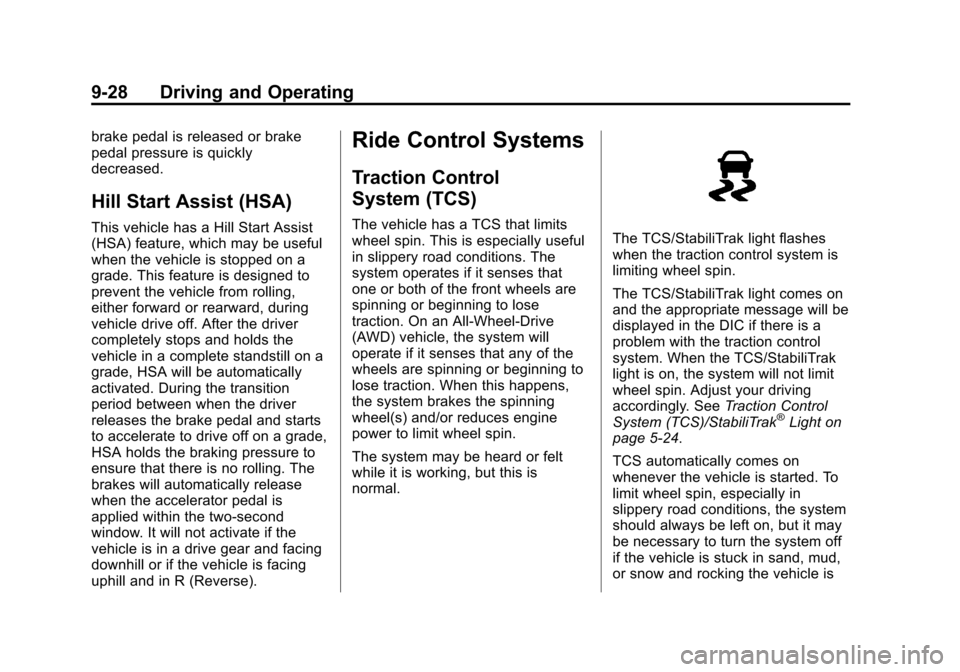
normal.The TCS/StabiliTrak light flashes
when the traction control system is
limiting wheel spin.
The TCS/StabiliTrak light comes on
and the appropriate message will be
displayed in the DIC if there is a
problem with the traction control
system. When the TCS/StabiliTrak
light is on, the system will not limit
wheel spin. Adjust your driving
accordingly. SeeTraction Control
System (TCS)/StabiliTrak
®Light on
page 5‑24.
TCS automatically comes on
whenever the vehicle is started. To
limit wheel spin, especially in
slippery road conditions, the system
should always be left on, but it may
be necessary to turn the system off
if the vehicle is stuck in sand, mud,
or snow and rocking the vehicle is
Page 257 of 438
Black plate (29,1)Cadillac XTS Owner Manual - 2013 - 1st - 4/13/12
Driving and Operating 9-29
required. SeeIf the Vehicle Is Stuck
on page 9‑9. See Winter Driving on
page 9‑7 for information on using
TCS when driving in snowy or icy
conditions.
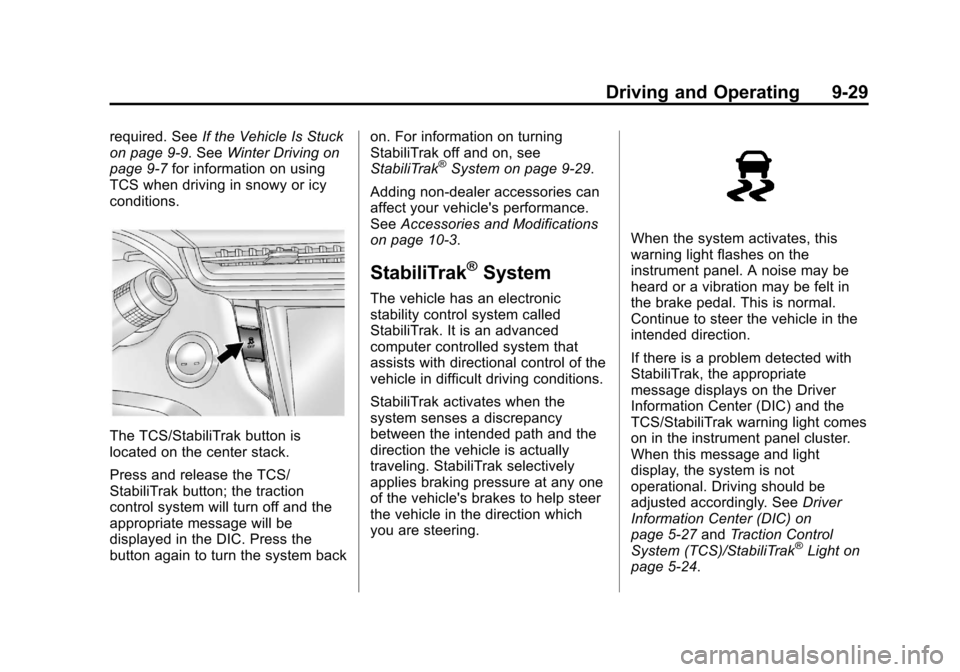
The TCS/StabiliTrak button is
located on the center stack.
Press and release the TCS/
StabiliTrak button; the traction
control system will turn off and the
appropriate message will be
displayed in the DIC. Press the
button again to turn the system back on. For information on turning
StabiliTrak off and on, see
StabiliTrak
®System on page 9‑29.
Adding non-dealer accessories can
affect your vehicle's performance.
See Accessories and Modifications
on page 10‑3.
StabiliTrak®System
The vehicle has an electronic
stability control system called
StabiliTrak. It is an advanced
computer controlled system that
assists with directional control of the
vehicle in difficult driving conditions.
StabiliTrak activates when the
system senses a discrepancy
between the intended path and the
direction the vehicle is actually
traveling. StabiliTrak selectively
applies braking pressure at any one
of the vehicle's brakes to help steer
the vehicle in the direction which
you are steering.
When the system activates, this
warning light flashes on the
instrument panel. A noise may be
heard or a vibration may be felt in
the brake pedal. This is normal.
Continue to steer the vehicle in the
intended direction.
If there is a problem detected with
StabiliTrak, the appropriate
message displays on the Driver
Information Center (DIC) and the
TCS/StabiliTrak warning light comes
on in the instrument panel cluster.
When this message and light
display, the system is not
operational. Driving should be
adjusted accordingly. See Driver
Information Center (DIC) on
page 5‑27 andTraction Control
System (TCS)/StabiliTrak
®Light on
page 5‑24.
Page 258 of 438
Black plate (30,1)Cadillac XTS Owner Manual - 2013 - 1st - 4/13/12
9-30 Driving and Operating
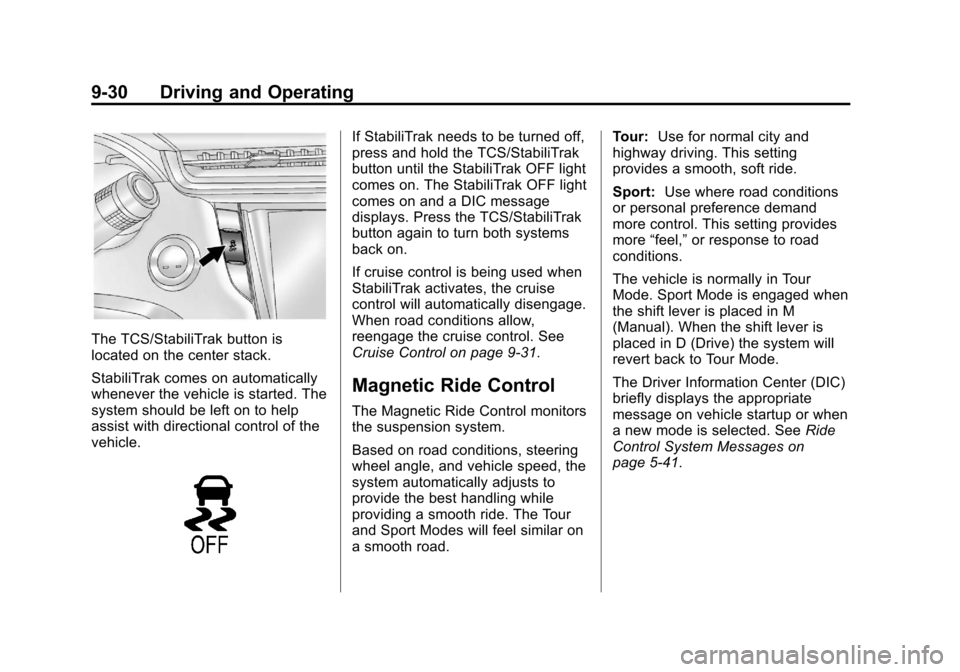
The TCS/StabiliTrak button is
located on the center stack.
StabiliTrak comes on automatically
whenever the vehicle is started. The
system should be left on to help
assist with directional control of the
vehicle.
If StabiliTrak needs to be turned off,
press and hold the TCS/StabiliTrak
button until the StabiliTrak OFF light
comes on. The StabiliTrak OFF light
comes on and a DIC message
displays. Press the TCS/StabiliTrak
button again to turn both systems
back on.
If cruise control is being used when
StabiliTrak activates, the cruise
control will automatically disengage.
When road conditions allow,
reengage the cruise control. See
Cruise Control on page 9‑31.
Magnetic Ride Control
The Magnetic Ride Control monitors
the suspension system.
Based on road conditions, steering
wheel angle, and vehicle speed, the
system automatically adjusts to
provide the best handling while
providing a smooth ride. The Tour
and Sport Modes will feel similar on
a smooth road.Tour:
Use for normal city and
highway driving. This setting
provides a smooth, soft ride.
Sport: Use where road conditions
or personal preference demand
more control. This setting provides
more “feel,” or response to road
conditions.
The vehicle is normally in Tour
Mode. Sport Mode is engaged when
the shift lever is placed in M
(Manual). When the shift lever is
placed in D (Drive) the system will
revert back to Tour Mode.
The Driver Information Center (DIC)
briefly displays the appropriate
message on vehicle startup or when
a new mode is selected. See Ride
Control System Messages on
page 5‑41.
Page 262 of 438
Black plate (34,1)Cadillac XTS Owner Manual - 2013 - 1st - 4/13/12
9-34 Driving and Operating
Ending Cruise Control
There are three ways to end cruise
control:
.Step lightly on the brake pedal.
.Press*.
.PressJ.
Erasing Speed Memory
The cruise control set speed is
erased from memory if
Jis
pressed or if the ignition is
turned off.
Adaptive Cruise Control
For vehicles with Adaptive Cruise
Control (ACC), it allows the driver to
select the cruise control set speed
and following gap. Read this entire
section before using this system.
The following gap is the distance
between your vehicle and a
vehicle-detected directly ahead in
your path. If no vehicle is detected
in your path, ACC works like regular
cruise control. ACC uses camera and radar sensors. See
Radio
Frequency Statement on
page 13‑15 for information
regarding Part 15 of the Federal
Communications Commission (FCC)
rules and Industry Canada
Standards RSS-GEN/210/220/310.
If a vehicle is detected in your path,
ACC can apply acceleration or
limited, moderate braking to
maintain the selected following gap.
To disengage ACC, apply the brake.
If ACC is controlling your vehicle
speed when the traction control
system (TCS) activates, the ACC
will automatically disengage. See
Traction Control System (TCS) on
page 9‑28. When road conditions
allow ACC to be safely used, the
ACC can be turned back on.
{WARNING
ACC has limited braking ability
and may not have time to slow
the vehicle down enough to avoid
(Continued)
WARNING (CONTINUED)
a collision with another vehicle
you are following. This can occur
when vehicles suddenly slow or
stop ahead, enter your lane,
or cross the vehicle’s path. Also
see“Alerting the Driver” in this
section. Complete attention is
always required while driving and
you should be ready to take
action and apply the brakes. See
Defensive Driving on page 9‑3.
{WARNING
Adaptive Cruise Control will not
detect or brake for children,
pedestrians, animals, or other
objects.
(Continued)
Page 266 of 438
Black plate (38,1)Cadillac XTS Owner Manual - 2013 - 1st - 4/13/12
9-38 Driving and Operating
Alerting the Driver
If ACC is engaged, driver action
may be required when:
.ACC cannot apply sufficient
braking because of approaching
a vehicle too rapidly.
.A temporary condition prohibits
ACC from operating. See
Vehicle Messages on page 5‑34.
.A malfunction is detected in the
system. SeeVehicle Messages
on page 5‑34.
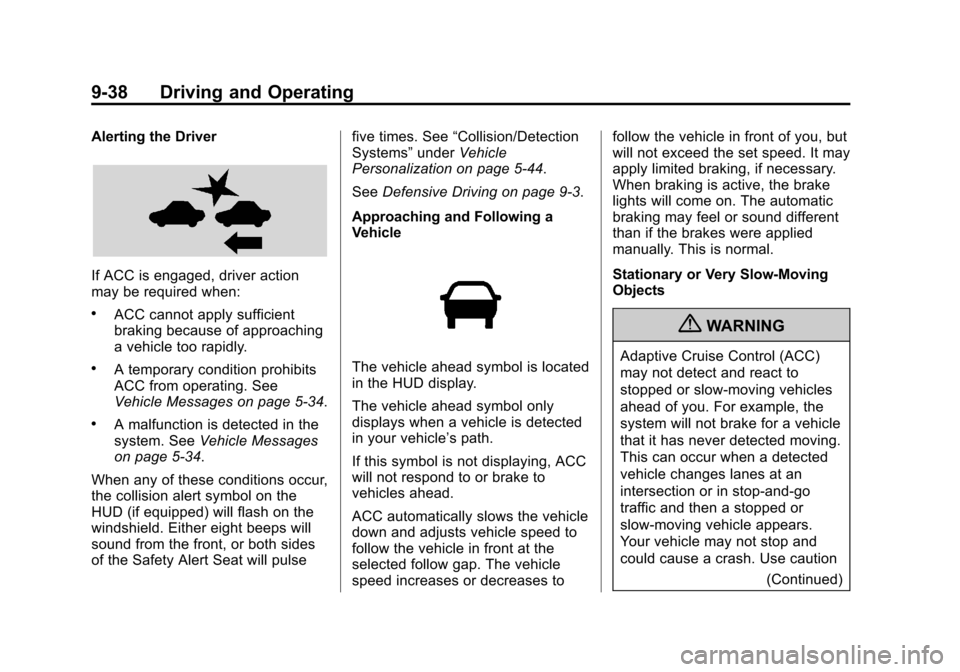
When any of these conditions occur,
the collision alert symbol on the
HUD (if equipped) will flash on the
windshield. Either eight beeps will
sound from the front, or both sides
of the Safety Alert Seat will pulse five times. See
“Collision/Detection
Systems” underVehicle
Personalization on page 5‑44.
See Defensive Driving on page 9‑3.
Approaching and Following a
Vehicle
The vehicle ahead symbol is located
in the HUD display.
The vehicle ahead symbol only
displays when a vehicle is detected
in your vehicle’s path.
If this symbol is not displaying, ACC
will not respond to or brake to
vehicles ahead.
ACC automatically slows the vehicle
down and adjusts vehicle speed to
follow the vehicle in front at the
selected follow gap. The vehicle
speed increases or decreases to follow the vehicle in front of you, but
will not exceed the set speed. It may
apply limited braking, if necessary.
When braking is active, the brake
lights will come on. The automatic
braking may feel or sound different
than if the brakes were applied
manually. This is normal.
Stationary or Very Slow-Moving
Objects
{WARNING
Adaptive Cruise Control (ACC)
may not detect and react to
stopped or slow-moving vehicles
ahead of you. For example, the
system will not brake for a vehicle
that it has never detected moving.
This can occur when a detected
vehicle changes lanes at an
intersection or in stop-and-go
traffic and then a stopped or
slow-moving vehicle appears.
Your vehicle may not stop and
could cause a crash. Use caution
(Continued)
Page 267 of 438
Black plate (39,1)Cadillac XTS Owner Manual - 2013 - 1st - 4/13/12
Driving and Operating 9-39
WARNING (CONTINUED)
when using ACC. Your complete
attention is always required while
driving and you should be ready
to take action and apply the
brakes.
ACC Automatically Disengages
ACC may automatically disengage
and the driver will need to manually
apply the brakes to slow the
vehicle when:
.The sensors are blocked.
.There is no traffic or other
objects to detect.
.There is a fault in the system.
The ACC active symbol will not be
displayed when ACC is no longer
active. Notification to Resume ACC
ACC will maintain a follow gap
behind a detected vehicle and slow
your vehicle to a stop behind that
vehicle.
If the vehicle ahead has driven
away and ACC has not resumed,
the vehicle ahead symbol will flash
as a reminder. In addition, the left
and right sides of the Safety Alert
Seat will pulse three times, or three
beeps will sound. See
”Alert Type”
and “Go Notifier” in“Collision/
Detection Systems” underVehicle
Personalization on page 5‑44.
When the vehicle ahead drives
away, press RES+ or the
accelerator pedal to resume cruise
control. If stopped for more than
two minutes or if the driver door is
opened and the driver safety belt is
unbuckled, the ACC automatically
applies the electric parking brake to
hold the vehicle. The electric
parking brake status light will turn
on. See Electric Parking Brake on
page 9‑26. To resume ACC and release the electric parking brake,
press the accelerator pedal and
then RES+.
{WARNING
If ACC has stopped the vehicle,
and if ACC is disengaged, turned
off, or canceled, the vehicle will
no longer be held at a stop. The
vehicle can move. When ACC is
holding the vehicle at a stop,
always be prepared to manually
apply the brakes.
{WARNING
Leaving the vehicle without
placing it in P (Park) can be
dangerous. Do not leave the
vehicle while it is being held at a
stop by ACC. Always place the
vehicle in P (Park) and turn off
the ignition before leaving the
vehicle.
Page 269 of 438
Black plate (41,1)Cadillac XTS Owner Manual - 2013 - 1st - 4/13/12
Driving and Operating 9-41
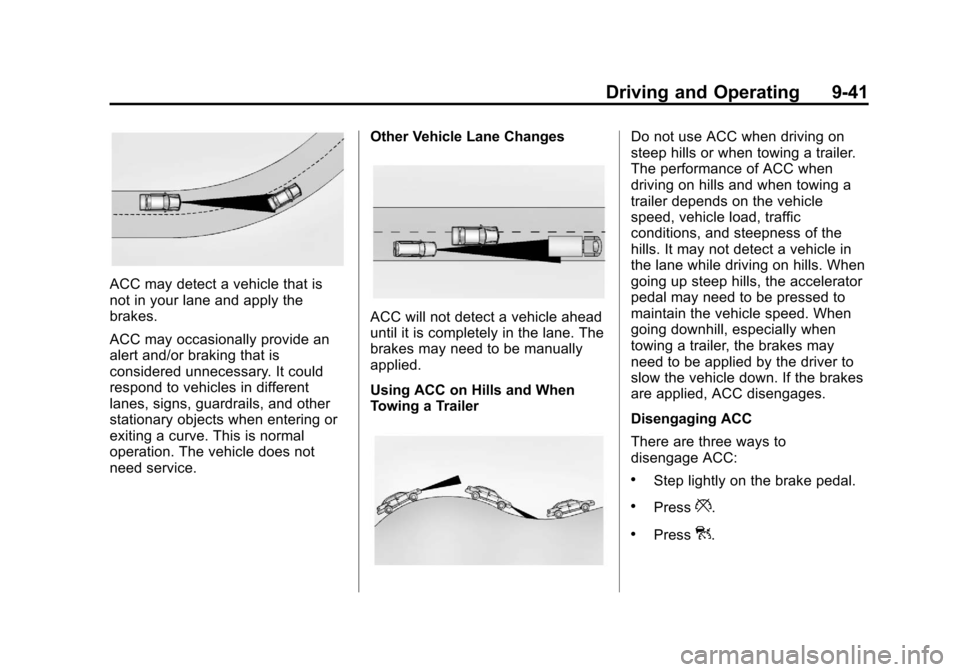
ACC may detect a vehicle that is
not in your lane and apply the
brakes.
ACC may occasionally provide an
alert and/or braking that is
considered unnecessary. It could
respond to vehicles in different
lanes, signs, guardrails, and other
stationary objects when entering or
exiting a curve. This is normal
operation. The vehicle does not
need service.Other Vehicle Lane Changes
ACC will not detect a vehicle ahead
until it is completely in the lane. The
brakes may need to be manually
applied.
Using ACC on Hills and When
Towing a Trailer
Do not use ACC when driving on
steep hills or when towing a trailer.
The performance of ACC when
driving on hills and when towing a
trailer depends on the vehicle
speed, vehicle load, traffic
conditions, and steepness of the
hills. It may not detect a vehicle in
the lane while driving on hills. When
going up steep hills, the accelerator
pedal may need to be pressed to
maintain the vehicle speed. When
going downhill, especially when
towing a trailer, the brakes may
need to be applied by the driver to
slow the vehicle down. If the brakes
are applied, ACC disengages.
Disengaging ACC
There are three ways to
disengage ACC:
.Step lightly on the brake pedal.
.Press*.
.Press].
Page 272 of 438
Black plate (44,1)Cadillac XTS Owner Manual - 2013 - 1st - 4/13/12
9-44 Driving and Operating
Displayed images may be farther or
closer than they appear. The area
displayed is limited and objects that
are close to either corner of the
bumper or under the bumper do not
display.
A warning triangle may display on
the RVC screen to show where the
Ultrasonic Rear Parking Assist
(URPA) has detected an object. This
triangle changes from amber to red
and increases in size the closer the
object.
On vehicles with the Rear Cross
Traffic Alert (RCTA), this triangle
with an arrow may also display on
the RVC screen to warn of traffic
coming from either direction. This
system detects objects coming from
up to 30 m (98 ft) from the left or
right side of the vehicle. When an
object is detected, either three
beeps sound or three Safety Alert
Seat pulses occur on the left or right
side, depending on the direction of
the detected vehicle.With URPA, as the vehicle backs up
at speeds of less than 8 km/h
(5 mph), the sensors on the rear
bumper detect objects up to 2.5 m
(8 ft) behind the vehicle that are
within a zone 25 cm (10 in) high off
the ground and below bumper level.
{WARNING
The parking assist system does
not detect children, pedestrians,
bicyclists, animals, or objects
located below the bumper or that
are too close or too far from the
vehicle. It is not available at
speeds greater than 8 km/h
(5 mph). To prevent injury, death,
or vehicle damage, even with
parking assist, always check the
area around the vehicle and
check all mirrors before moving
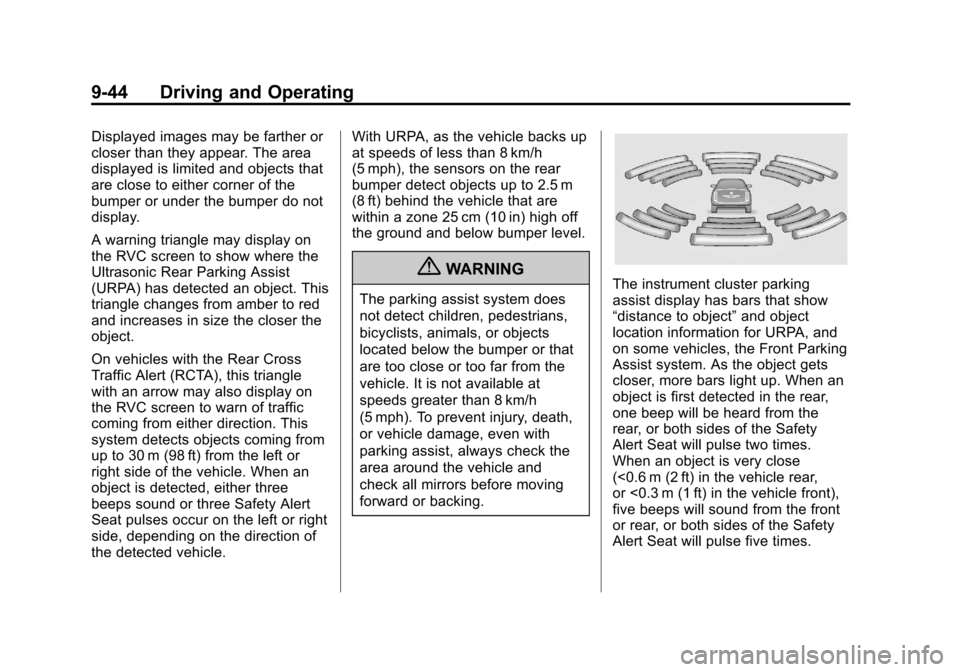
forward or backing.The instrument cluster parking
assist display has bars that show
“distance to object”
and object
location information for URPA, and
on some vehicles, the Front Parking
Assist system. As the object gets
closer, more bars light up. When an
object is first detected in the rear,
one beep will be heard from the
rear, or both sides of the Safety
Alert Seat will pulse two times.
When an object is very close
(<0.6 m (2 ft) in the vehicle rear,
or <0.3 m (1 ft) in the vehicle front),
five beeps will sound from the front
or rear, or both sides of the Safety
Alert Seat will pulse five times.
Page 274 of 438
Black plate (46,1)Cadillac XTS Owner Manual - 2013 - 1st - 4/13/12
9-46 Driving and Operating
Pressing the brake pedal after the
vehicle comes to a stop will release
the Rear Automatic Braking. If the
brake pedal is not pressed within
two seconds after the stop, the
electric parking brake is set. When it
is safe, pressing the accelerator
pedal firmly at any time will override
the Rear Automatic Braking.
{WARNING
There may be instances where
unexpected or undesired
automatic braking occurs. If this
happens, either press the brake
pedal or firmly press the
accelerator pedal to release the
brakes from the Rear Automatic
Braking system. Check the RVC
screen and check the area
around the vehicle before
proceeding.
Turning the Features On or Off
TheXbutton on the center stack
is used to turn on or off the Front
and Rear Parking Assist, Rear
Automatic Braking, and Backing
Warning System at the same time.
The indicator light next to the button
comes on when the features are on
and turns off when the features
have been disabled. The Rear Vision Camera (RVC) can
be turned on or off through the
Settings menu on the infotainment
system. The parking assist symbols,
guidance lines, and Rear Cross
Traffic Alert (RCTA) can also be
turned off. To turn the RVC system,
symbols, guidance lines, or RCTA
on or off:
1. On the infotainment system,
press the Settings screen
button, or turn the MENU knob
to highlight Settings and
press MENU.
2. Select Rear Camera.
3. Press Rear Camera Display, Park Assist Symbols, Guidance
Lines, or Rear Cross Traffic Alert
and then select OFF or ON.
Assistance Systems for
Driving
If equipped, when driving the
vehicle, Forward Collision Alert
(FCA), Lane Departure Warning
(LDW), Side Blind Zone Alert
Page 276 of 438
Black plate (48,1)Cadillac XTS Owner Manual - 2013 - 1st - 4/13/12
9-48 Driving and Operating
WARNING (CONTINUED)
or ice, or if the windshield is
damaged. It may also not detect a
vehicle on winding or hilly roads,
or in conditions that can limit
visibility such as fog, rain,
or snow, or if the headlamps or
windshield are not cleaned or in
proper condition. Keep the
windshield, headlamps, and FCA
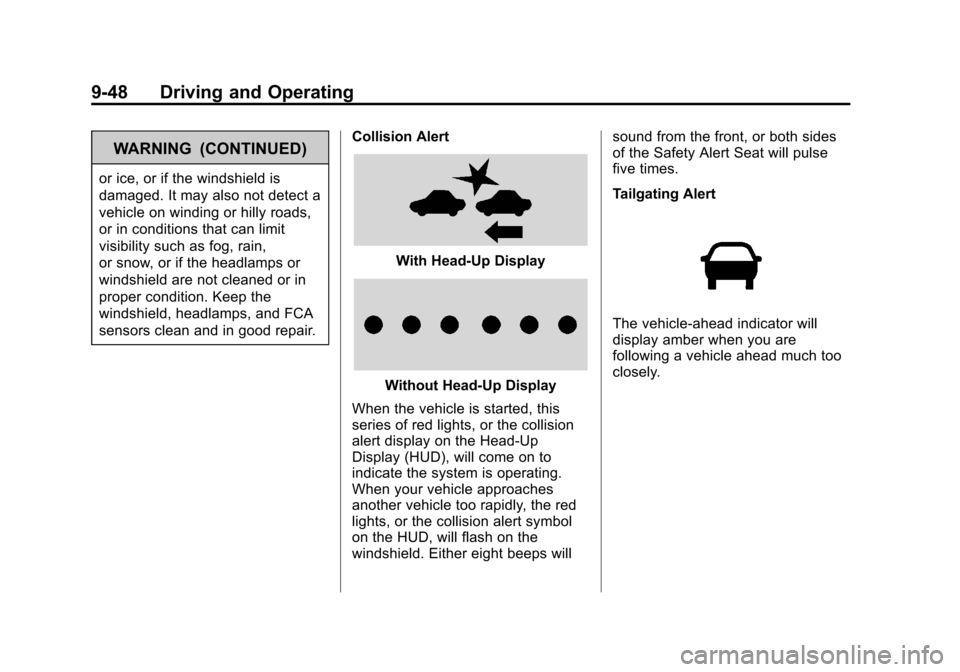
sensors clean and in good repair.Collision Alert
With Head-Up Display
Without Head-Up Display
When the vehicle is started, this
series of red lights, or the collision
alert display on the Head-Up
Display (HUD), will come on to
indicate the system is operating.
When your vehicle approaches
another vehicle too rapidly, the red
lights, or the collision alert symbol
on the HUD, will flash on the
windshield. Either eight beeps will sound from the front, or both sides
of the Safety Alert Seat will pulse
five times.
Tailgating Alert
The vehicle-ahead indicator will
display amber when you are
following a vehicle ahead much too
closely.