trunk CADILLAC XTS 2013 1.G User Guide
[x] Cancel search | Manufacturer: CADILLAC, Model Year: 2013, Model line: XTS, Model: CADILLAC XTS 2013 1.GPages: 438, PDF Size: 7.4 MB
Page 120 of 438
Black plate (4,1)Cadillac XTS Owner Manual - 2013 - 1st - 4/13/12
4-4 Storage
There is storage in the rear of the
center console; lift the cover to
access.
The center console has a storage
area in the rear of the console.
Press and release the door to
access. Push the door to close.
There is a power outlet inside the
storage areas. SeePower Outlets
on page 5‑6.Additional Storage
Features
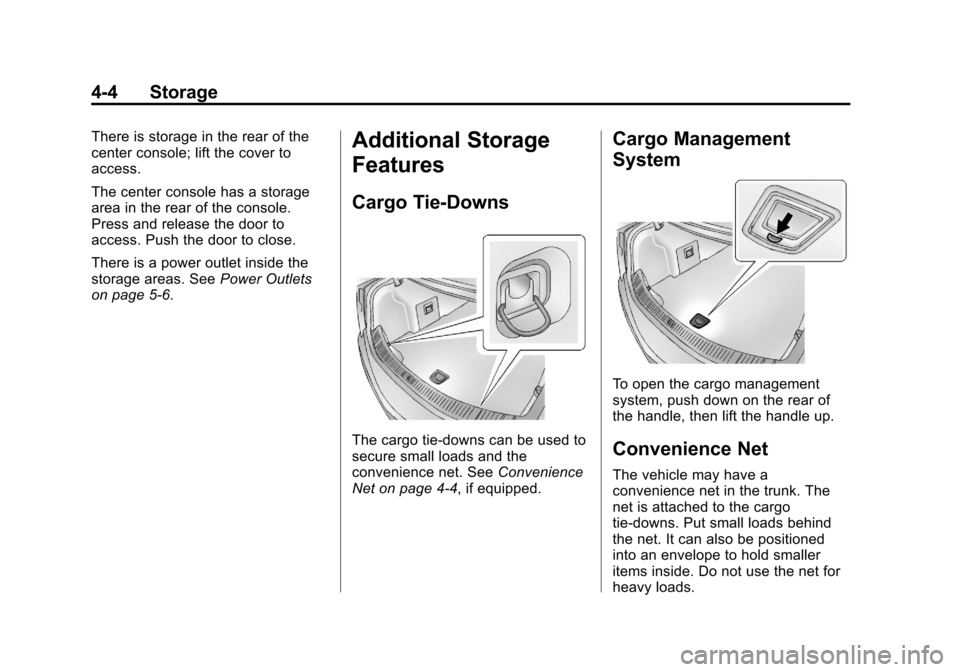
Cargo Tie-Downs
The cargo tie-downs can be used to
secure small loads and the
convenience net. See Convenience
Net on page 4‑4, if equipped.
Cargo Management
System
To open the cargo management
system, push down on the rear of
the handle, then lift the handle up.
Convenience Net
The vehicle may have a
convenience net in the trunk. The
net is attached to the cargo
tie-downs. Put small loads behind
the net. It can also be positioned
into an envelope to hold smaller
items inside. Do not use the net for
heavy loads.
Page 156 of 438
Black plate (36,1)Cadillac XTS Owner Manual - 2013 - 1st - 4/13/12
5-36 Instruments and Controls
NO CRUISE BRAKING GAS
PEDAL APPLIED
This message displays when
Adaptive Cruise Control (ACC) is
active and the driver is pressing the
gas pedal. When this occurs, ACC
will not brake. SeeAdaptive Cruise
Control on page 9‑34.
Door Ajar Messages
DOOR OPEN
A door open symbol will be
displayed on the DIC showing which
door is open. If the vehicle has been
shifted out of P (Park), a DOOR
OPEN message will also be
displayed. If the vehicle is in manual
shift mode, the DOOR OPEN
message will be displayed if the
vehicle starts to move. Close the
door completely.
HOOD OPEN
This message will display along with
a hood open symbol when the hood
is open. Close the hood completely.
TRUNK OPEN
This message will display along with
a symbol when the trunk is open.
Close the trunk completely.
Engine Cooling System
Messages
A/C OFF DUE TO HIGH
ENGINE TEMP
This message displays when the
engine coolant becomes hotter than
the normal operating temperature.
To avoid added strain on a hot
engine, the air conditioning
compressor automatically turns off.
When the coolant temperature
returns to normal, the air
conditioning compressor turns back
on. The vehicle can continue to be
driven.
If this message continues to appear,
have the system repaired by your
dealer as soon as possible to avoid
damage to the engine.
COOLANT LEVEL LOW ADD
COOLANT
This message will display if the
coolant is low. See Engine Coolant
on page 10‑12.
ENGINE OVERHEATED —
IDLE ENGINE
This message displays when the
engine coolant temperature is too
hot. Stop and allow the vehicle to
idle until it cools down.
ENGINE OVERHEATED —
STOP ENGINE
This message displays and a
continuous chime sounds if the
engine cooling system reaches
unsafe temperatures for operation.
Stop and turn off the vehicle as
soon as it is safe to do so to avoid
severe damage. This message
clears when the engine has cooled
to a safe operating temperature.
Page 286 of 438
Black plate (58,1)Cadillac XTS Owner Manual - 2013 - 1st - 4/13/12
9-58 Driving and Operating
WARNING (CONTINUED)
.Fuel can spray out if the
refueling nozzle is inserted
too quickly. This spray can
happen if the tank is nearly
full, and is more likely in hot
weather. Insert the refueling
nozzle slowly and wait for
any hiss noise to stop prior to
beginning to flow fuel
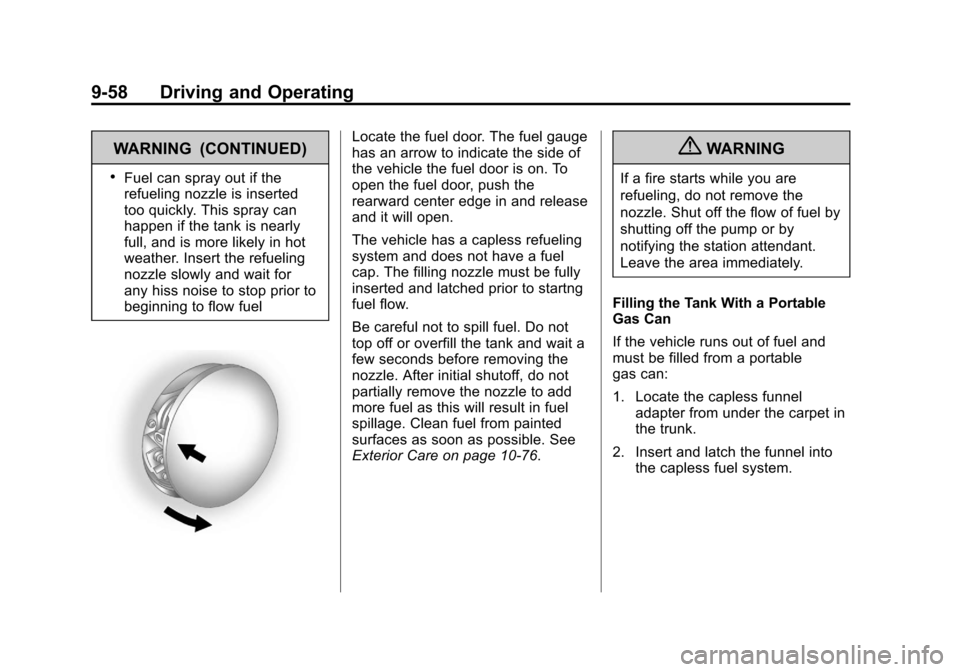
Locate the fuel door. The fuel gauge
has an arrow to indicate the side of
the vehicle the fuel door is on. To
open the fuel door, push the
rearward center edge in and release
and it will open.
The vehicle has a capless refueling
system and does not have a fuel
cap. The filling nozzle must be fully
inserted and latched prior to startng
fuel flow.
Be careful not to spill fuel. Do not
top off or overfill the tank and wait a
few seconds before removing the
nozzle. After initial shutoff, do not
partially remove the nozzle to add
more fuel as this will result in fuel
spillage. Clean fuel from painted
surfaces as soon as possible. See
Exterior Care on page 10‑76.{WARNING
If a fire starts while you are
refueling, do not remove the
nozzle. Shut off the flow of fuel by
shutting off the pump or by
notifying the station attendant.
Leave the area immediately.
Filling the Tank With a Portable
Gas Can
If the vehicle runs out of fuel and
must be filled from a portable
gas can:
1. Locate the capless funnel adapter from under the carpet in
the trunk.
2. Insert and latch the funnel into the capless fuel system.
Page 287 of 438
Black plate (59,1)Cadillac XTS Owner Manual - 2013 - 1st - 4/13/12
Driving and Operating 9-59
{WARNING
Attempting to refuel without using
the funnel adapter may cause fuel
spillage and damage the capless
fuel system. This could cause a
fire and you or others could be
badly burned and the vehicle
could be damaged.
3. Remove and clean the funnel adapter and return to the storage
location.
Filling a Portable Fuel
Container
{WARNING
Filling a portable fuel container
while it is in the vehicle can cause
fuel vapors that can ignite either
by static electricity or other
means. You or others could be
badly burned and the vehicle
could be damaged. Always:
.Use approved fuel
containers.
.Remove container from
vehicle, trunk, or pickup bed
before filling.
.Place container on the
ground.
.Place the nozzle inside the fill
opening of the container
before dispensing fuel, and
(Continued)
WARNING (CONTINUED)
keep it in contact with the fill
opening until filling is
complete.
.Do not smoke while
pumping fuel.
Page 288 of 438
Black plate (60,1)Cadillac XTS Owner Manual - 2013 - 1st - 4/13/12
9-60 Driving and Operating
Towing
General Towing
Information
Only use towing equipment that has
been designed for the vehicle.
Contact your dealer or trailering
dealer for assistance with preparing
the vehicle for towing a trailer. Read
the entire section before towing a
trailer.
For towing a disabled vehicle, see
Towing the Vehicle on page 10‑74.
For towing the vehicle behind
another vehicle such as a motor
home, seeRecreational Vehicle
Towing on page 10‑74.
Driving Characteristics
and Towing Tips
Driving with a Trailer
When towing a trailer:
.Become familiar with the state
and local laws that apply
specifically to trailer towing.
.Do not tow a trailer during the
first 800 km (500 miles), to
prevent damage to the engine,
axle or other parts.
.Then, during the first 800 km
(500 miles) trailer towing, do not
drive over 80 km/h (50 mph) and
do not make starts at full throttle.
.The vehicle can tow in D (Drive)
but M (Manual Mode) is
recommended. See Manual
Mode on page 9‑24. Use a lower
gear if the transmission shifts
too often.
{WARNING
When towing a trailer, exhaust
gases may collect at the rear of
the vehicle and enter if the
liftgate, trunk/hatch, or rear-most
window is open.
(Continued)
WARNING (CONTINUED)
When towing a trailer:
.Do not drive with the liftgate,
trunk/hatch, or rear-most
window open.
.Fully open the air outlets on
or under the instrument
panel.
.Also adjust the Climate
Control system to a setting
that brings in only outside air.
See Climate Control System
in the Index.
For more information about
Carbon Monoxide, see Engine
Exhaust on page 9‑21.
Towing a trailer requires a certain
amount of experience. The
combination you are driving is
longer and not as responsive as the
vehicle itself. Get acquainted with
the handling and braking of the rig
before setting out for the open road.
Page 323 of 438
Black plate (29,1)Cadillac XTS Owner Manual - 2013 - 1st - 4/13/12
Vehicle Care 10-29
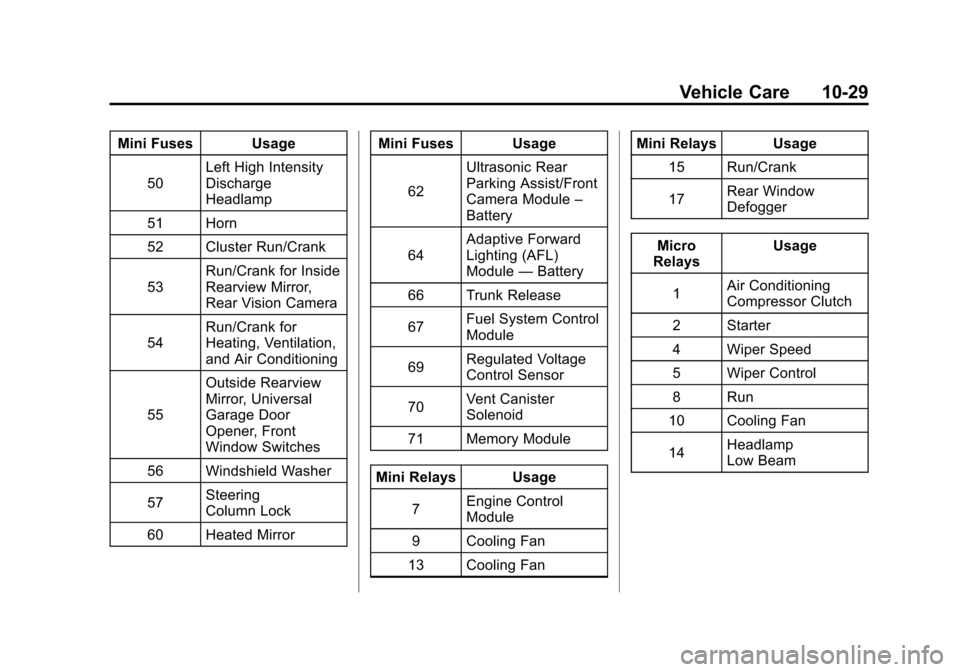
Mini Fuses Usage50 Left High Intensity
Discharge
Headlamp
51 Horn
52 Cluster Run/Crank
53 Run/Crank for Inside
Rearview Mirror,
Rear Vision Camera
54 Run/Crank for
Heating, Ventilation,
and Air Conditioning
55 Outside Rearview
Mirror, Universal
Garage Door
Opener, Front
Window Switches
56 Windshield Washer
57 Steering
Column Lock
60 Heated Mirror Mini Fuses Usage
62 Ultrasonic Rear
Parking Assist/Front
Camera Module
–
Battery
64 Adaptive Forward
Lighting (AFL)
Module
—Battery
66 Trunk Release
67 Fuel System Control
Module
69 Regulated Voltage
Control Sensor
70 Vent Canister
Solenoid
71 Memory Module
Mini Relays Usage 7 Engine Control
Module
9 Cooling Fan
13 Cooling Fan Mini Relays Usage
15 Run/Crank
17 Rear Window
Defogger
Micro
Relays Usage
1 Air Conditioning
Compressor Clutch
2 Starter
4 Wiper Speed
5 Wiper Control
8 Run
10 Cooling Fan
14 Headlamp
Low Beam
Page 326 of 438
Black plate (32,1)Cadillac XTS Owner Manual - 2013 - 1st - 4/13/12
10-32 Vehicle Care
Rear Compartment Fuse
Block
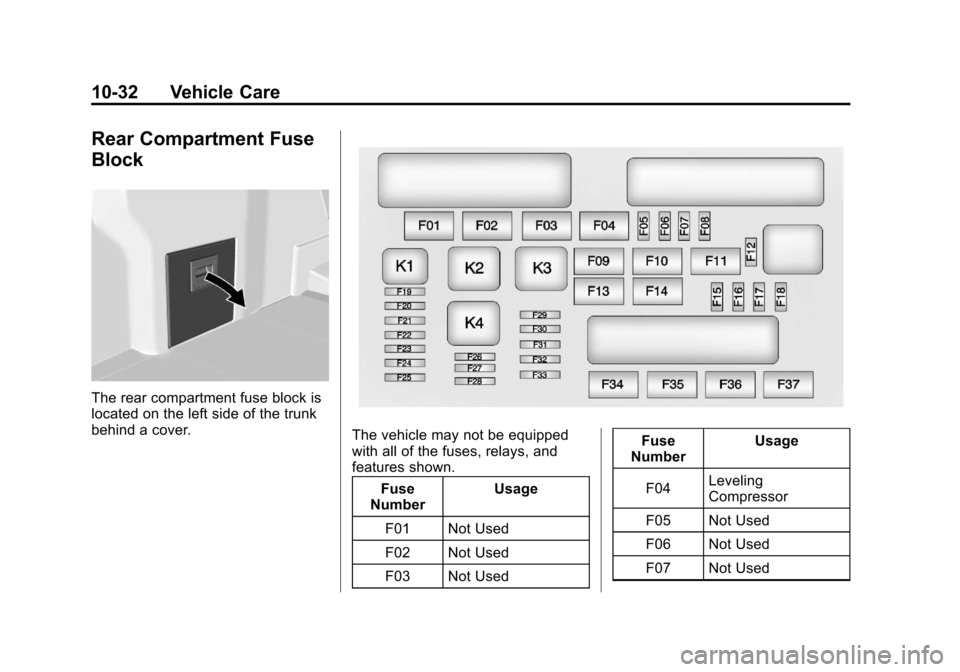
The rear compartment fuse block is
located on the left side of the trunk
behind a cover.
The vehicle may not be equipped
with all of the fuses, relays, and
features shown.Fuse
Number Usage
F01 Not Used
F02 Not Used
F03 Not Used Fuse
Number Usage
F04 Leveling
Compressor
F05 Not Used
F06 Not Used
F07 Not Used
Page 359 of 438
Black plate (65,1)Cadillac XTS Owner Manual - 2013 - 1st - 4/13/12
Vehicle Care 10-65
Removal and Installation of the
Sealant Canister
To remove the sealant canister:
1. Unwrap the sealant hose.
2. Press the canister releasebutton.
3. Pull up and remove the canister.
4. Replace with a new canister which is available from your
dealer.
5. Push the new canister into place.
Storing the Tire Sealant
and Compressor Kit
To access the tire sealant and
compressor kit:
1. Open the trunk. See Trunk on
page 2‑14.
2. Lift the cover.
3. Turn the wing nut counterclockwise to remove it.
4. Remove the tire sealant and compressor kit.
To store the tire sealant and
compressor kit, reverse the steps.
Tire Changing
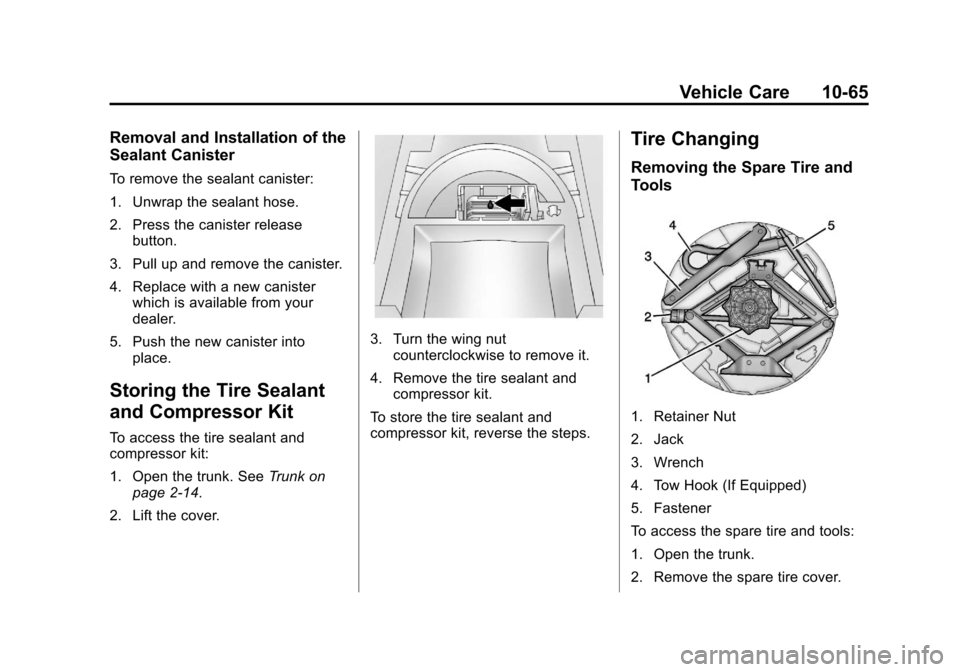
Removing the Spare Tire and
Tools
1. Retainer Nut
2. Jack
3. Wrench
4. Tow Hook (If Equipped)
5. Fastener
To access the spare tire and tools:
1. Open the trunk.
2. Remove the spare tire cover.
Page 360 of 438
Black plate (66,1)Cadillac XTS Owner Manual - 2013 - 1st - 4/13/12
10-66 Vehicle Care
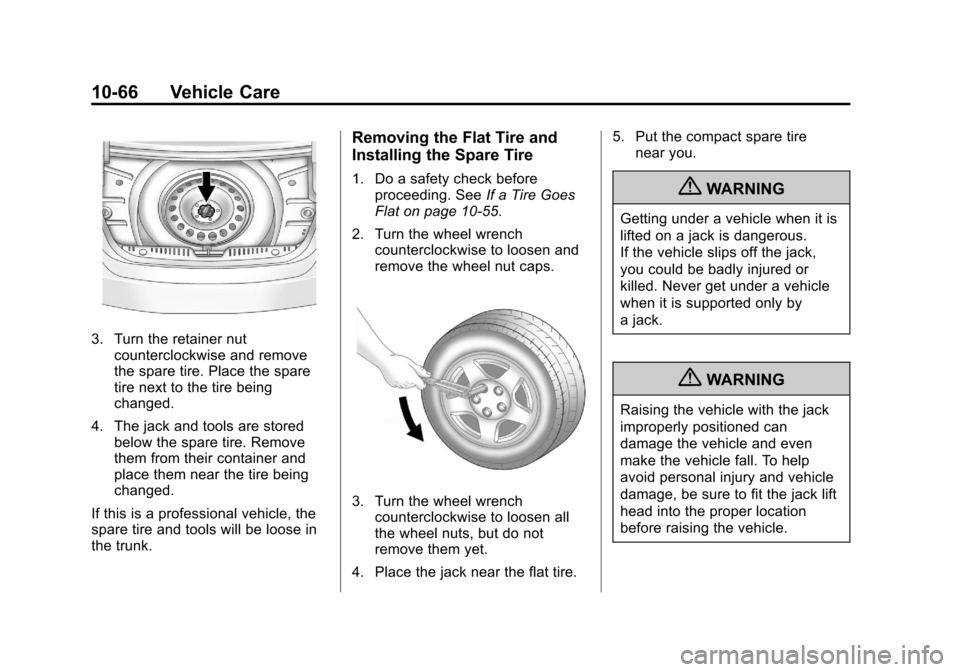
3. Turn the retainer nutcounterclockwise and remove
the spare tire. Place the spare
tire next to the tire being
changed.
4. The jack and tools are stored below the spare tire. Remove
them from their container and
place them near the tire being
changed.
If this is a professional vehicle, the
spare tire and tools will be loose in
the trunk.
Removing the Flat Tire and
Installing the Spare Tire
1. Do a safety check before proceeding. See If a Tire Goes
Flat on page 10‑55.
2. Turn the wheel wrench counterclockwise to loosen and
remove the wheel nut caps.
3. Turn the wheel wrenchcounterclockwise to loosen all
the wheel nuts, but do not
remove them yet.
4. Place the jack near the flat tire. 5. Put the compact spare tire
near you.
{WARNING
Getting under a vehicle when it is
lifted on a jack is dangerous.
If the vehicle slips off the jack,
you could be badly injured or
killed. Never get under a vehicle
when it is supported only by
a jack.
{WARNING
Raising the vehicle with the jack
improperly positioned can
damage the vehicle and even
make the vehicle fall. To help
avoid personal injury and vehicle
damage, be sure to fit the jack lift
head into the proper location
before raising the vehicle.
Page 395 of 438
Black plate (1,1)Cadillac XTS Owner Manual - 2013 - 1st - 4/13/12
Technical Data 12-1
Technical Data
Vehicle Identification
Vehicle IdentificationNumber (VIN) . . . . . . . . . . . . . . 12-1
Service Parts Identification Label . . . . . . . . . . . . . . . . . . . . . . . 12-1
Vehicle Data
Capacities andSpecifications . . . . . . . . . . . . . . 12-2
Engine Drive Belt Routing . . . 12-3
Vehicle Identification
Vehicle Identification
Number (VIN)
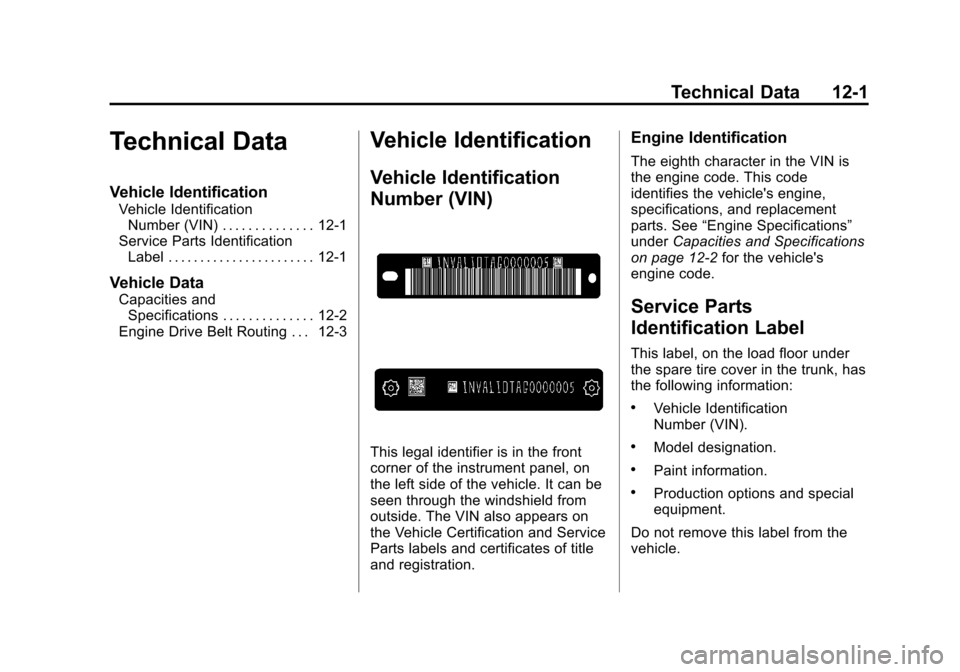
This legal identifier is in the front
corner of the instrument panel, on
the left side of the vehicle. It can be
seen through the windshield from
outside. The VIN also appears on
the Vehicle Certification and Service
Parts labels and certificates of title
and registration.
Engine Identification
The eighth character in the VIN is
the engine code. This code
identifies the vehicle's engine,
specifications, and replacement
parts. See “Engine Specifications”
under Capacities and Specifications
on page 12‑2 for the vehicle's
engine code.
Service Parts
Identification Label
This label, on the load floor under
the spare tire cover in the trunk, has
the following information:
.Vehicle Identification
Number (VIN).
.Model designation.
.Paint information.
.Production options and special
equipment.
Do not remove this label from the
vehicle.