battery CADILLAC XTS 2013 1.G Owner's Manual
[x] Cancel search | Manufacturer: CADILLAC, Model Year: 2013, Model line: XTS, Model: CADILLAC XTS 2013 1.GPages: 438, PDF Size: 7.4 MB
Page 246 of 438
Black plate (18,1)Cadillac XTS Owner Manual - 2013 - 1st - 4/13/12
9-18 Driving and Operating
after cranking has ended, can
overheat and damage the
cranking motor, and drain the
battery. Wait at least 15 seconds
between each try, to let the
cranking motor cool down.
2. If the engine does not start afterfive to 10 seconds, especially in
very cold weather (below −18°C
or 0°F), it could be flooded with
too much gasoline. Try pushing
the accelerator pedal all the way
to the floor and holding it there
as you press the START button,
for up to a maximum of
15 seconds. Wait at least
15 seconds between each try, to
allow the cranking motor to cool
down. When the engine starts,
let go of the button and the
accelerator. If the vehicle starts
briefly but then stops again, do
the same thing. This clears the
extra gasoline from the engine.
Do not race the engine
immediately after starting it.
Operate the engine and transmission gently until the oil
warms up and lubricates all
moving parts.
Engine Heater
The engine coolant heater,
if available, can help in cold weather
conditions at or below
−18°C (0°F)
for easier starting and better fuel
economy during engine warm-up.
Plug in the coolant heater at least
four hours before starting the
vehicle. An internal thermostat in
the plug end of the cord will prevent
engine coolant heater operation at
temperatures above −18°C (0°F).
To Use the Engine Coolant
Heater
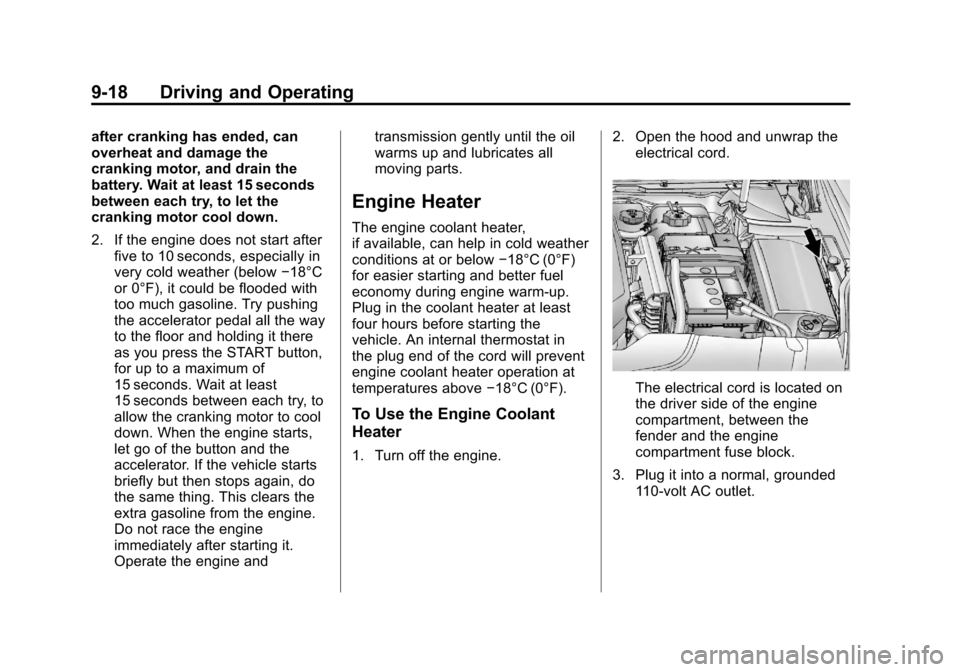
1. Turn off the engine. 2. Open the hood and unwrap the
electrical cord.
The electrical cord is located on
the driver side of the engine
compartment, between the
fender and the engine
compartment fuse block.
3. Plug it into a normal, grounded 110-volt AC outlet.
Page 248 of 438
Black plate (20,1)Cadillac XTS Owner Manual - 2013 - 1st - 4/13/12
9-20 Driving and Operating
WARNING (CONTINUED)
Do not leave the vehicle when the
engine is running. If you have left
the engine running, the vehicle
can move suddenly. You or others
could be injured. To be sure the
vehicle will not move, even when
you are on fairly level ground,
always set the parking brake and
move the shift lever to P (Park).
SeeShifting Into Park on
page 9‑19. If you are towing a
trailer, see Driving Characteristics
and Towing Tips on page 9‑60.
If you have to leave the vehicle with
the engine running, be sure the
vehicle is in P (Park) and the
parking brake is firmly set before
you leave it. After you have moved
the shift lever into P (Park), hold
down the regular brake pedal. See if
you can move the shift lever away
from P (Park) without first pulling it toward you. If you can, it means that
the shift lever was not fully locked
into P (Park).
Torque Lock
Torque lock is when the weight of
the vehicle puts too much force on
the parking pawl in the
transmission. This happens when
parking on a hill and shifting the
transmission into P (Park) is not
done properly and then it is difficult
to shift out of P (Park). To prevent
torque lock, set the parking brake
and then shift into P (Park). To find
out how, see "Shifting Into P (Park)"
listed previously.
If torque lock does occur, your
vehicle may need to be pushed
uphill by another vehicle to relieve
the parking pawl pressure, so you
can shift out of P (Park).
If you are towing a trailer and
parking on a hill, see
Driving
Characteristics and Towing Tips on
page 9‑60.
Shifting out of Park
This vehicle is equipped with an
automatic transmission shift lock
control system. The shift lock
control is designed to prevent
movement of the shift lever out of
P (Park), unless the ignition is in
ON/RUN and the brake pedal is
applied.
The shift lock control is always
functional except in the case of an
uncharged or low voltage (less than
9-volt) battery.
If the vehicle has an uncharged
battery or a battery with low voltage,
try charging or jump starting the
battery. See Jump Starting on
page 10‑71.
To shift out of P (Park):
1. Turn the ignition to ON/RUN.
2. Apply the brake pedal.
3. Press the shift lever button.
4. Move the shift lever to the desired position.
Page 254 of 438
Black plate (26,1)Cadillac XTS Owner Manual - 2013 - 1st - 4/13/12
9-26 Driving and Operating
Electric Parking Brake
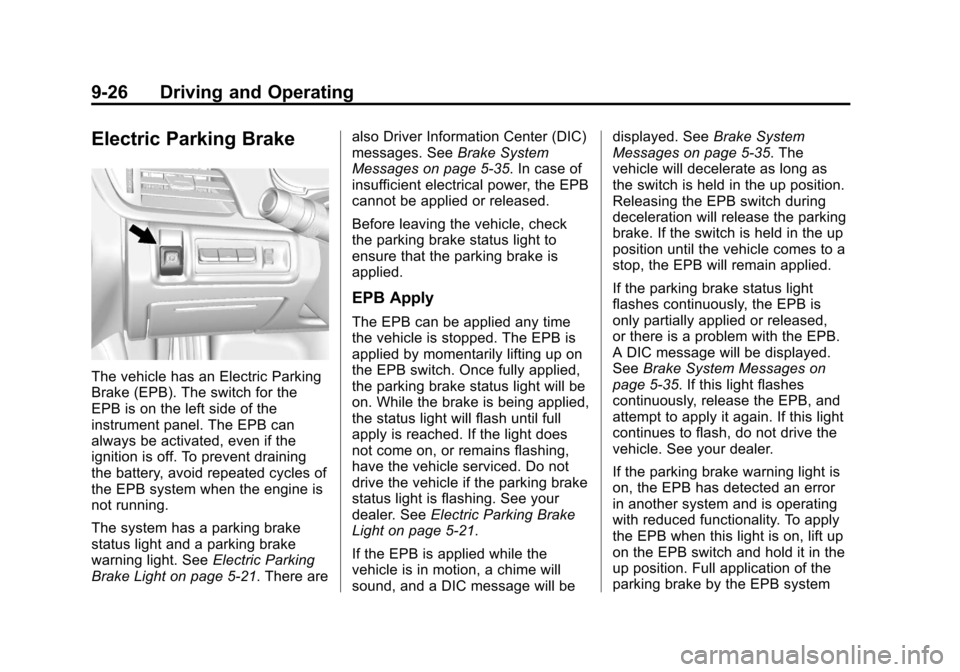
The vehicle has an Electric Parking
Brake (EPB). The switch for the
EPB is on the left side of the
instrument panel. The EPB can
always be activated, even if the
ignition is off. To prevent draining
the battery, avoid repeated cycles of
the EPB system when the engine is
not running.
The system has a parking brake
status light and a parking brake
warning light. SeeElectric Parking
Brake Light on page 5‑21. There are also Driver Information Center (DIC)
messages. See
Brake System
Messages on page 5‑35. In case of
insufficient electrical power, the EPB
cannot be applied or released.
Before leaving the vehicle, check
the parking brake status light to
ensure that the parking brake is
applied.
EPB Apply
The EPB can be applied any time
the vehicle is stopped. The EPB is
applied by momentarily lifting up on
the EPB switch. Once fully applied,
the parking brake status light will be
on. While the brake is being applied,
the status light will flash until full
apply is reached. If the light does
not come on, or remains flashing,
have the vehicle serviced. Do not
drive the vehicle if the parking brake
status light is flashing. See your
dealer. See Electric Parking Brake
Light on page 5‑21.
If the EPB is applied while the
vehicle is in motion, a chime will
sound, and a DIC message will be displayed. See
Brake System
Messages on page 5‑35. The
vehicle will decelerate as long as
the switch is held in the up position.
Releasing the EPB switch during
deceleration will release the parking
brake. If the switch is held in the up
position until the vehicle comes to a
stop, the EPB will remain applied.
If the parking brake status light
flashes continuously, the EPB is
only partially applied or released,
or there is a problem with the EPB.
A DIC message will be displayed.
See Brake System Messages on
page 5‑35. If this light flashes
continuously, release the EPB, and
attempt to apply it again. If this light
continues to flash, do not drive the
vehicle. See your dealer.
If the parking brake warning light is
on, the EPB has detected an error
in another system and is operating
with reduced functionality. To apply
the EPB when this light is on, lift up
on the EPB switch and hold it in the
up position. Full application of the
parking brake by the EPB system
Page 293 of 438
Black plate (65,1)Cadillac XTS Owner Manual - 2013 - 1st - 4/13/12
Driving and Operating 9-65
Conversions and
Add-Ons
Add-On Electrical
Equipment
Notice:Some electrical
equipment can damage the
vehicle or cause components to
not work and would not be
covered by the warranty. Always
check with your dealer before
adding electrical equipment.
Add-on equipment can drain the
vehicle's 12-volt battery, even if the
vehicle is not operating.
The vehicle has an airbag system.
Before attempting to add anything
electrical to the vehicle, see
Servicing the Airbag-Equipped
Vehicle on page 3‑38 andAdding
Equipment to the Airbag-Equipped
Vehicle on page 3‑39.
Page 295 of 438
Black plate (1,1)Cadillac XTS Owner Manual - 2013 - 1st - 4/13/12
Vehicle Care 10-1
Vehicle Care
General Information
General Information . . . . . . . . . . 10-2
California Proposition65 Warning . . . . . . . . . . . . . . . . . 10-2
California Perchlorate Materials Requirements . . . . 10-3
Accessories and Modifications . . . . . . . . . . . . . . . 10-3
Vehicle Checks
Doing Your OwnService Work . . . . . . . . . . . . . . . 10-3
Hood . . . . . . . . . . . . . . . . . . . . . . . . 10-4
Engine Compartment Overview . . . . . . . . . . . . . . . . . . . 10-5
Engine Cover . . . . . . . . . . . . . . . . 10-6
Engine Oil . . . . . . . . . . . . . . . . . . . 10-6
Engine Oil Life System . . . . . . 10-9
Automatic Transmission Fluid . . . . . . . . . . . . . . . . . . . . . . 10-10
Engine Air Cleaner/Filter . . . . 10-10
Cooling System . . . . . . . . . . . . . 10-11
Engine Coolant . . . . . . . . . . . . . 10-12
Engine Overheating . . . . . . . . 10-14 Overheated Engine
Protection
Operating Mode . . . . . . . . . . . 10-16
Power Steering Fluid . . . . . . . 10-16
Washer Fluid . . . . . . . . . . . . . . . 10-17
Brakes . . . . . . . . . . . . . . . . . . . . . 10-18
Brake Fluid . . . . . . . . . . . . . . . . . 10-19
Battery . . . . . . . . . . . . . . . . . . . . . 10-20
All-Wheel Drive . . . . . . . . . . . . . 10-20
Starter Switch Check . . . . . . . 10-20
Automatic Transmission Shift Lock Control Function
Check . . . . . . . . . . . . . . . . . . . . . 10-21
Park Brake and P (Park) Mechanism Check . . . . . . . . 10-21
Wiper Blade Replacement . . . . . . . . . . . . . . 10-22
Windshield Replacement . . . 10-22
Headlamp Aiming
Headlamp Aiming . . . . . . . . . . 10-23
Bulb Replacement
Bulb Replacement . . . . . . . . . . 10-23
High Intensity Discharge (HID) Lighting . . . . . . . . . . . . . 10-23
LED Lighting . . . . . . . . . . . . . . . 10-23 Back-Up Lamps . . . . . . . . . . . . 10-23
License Plate Lamp . . . . . . . . 10-24
Replacement Bulbs . . . . . . . . . 10-25
Electrical System
Electrical System
Overload . . . . . . . . . . . . . . . . . . 10-25
Fuses and Circuit Breakers . . . . . . . . . . . . . . . . . . 10-26
Engine Compartment Fuse Block . . . . . . . . . . . . . . . . . . . . . 10-26
Instrument Panel Fuse Block . . . . . . . . . . . . . . . . . . . . . 10-30
Rear Compartment Fuse Block . . . . . . . . . . . . . . . . . . . . . 10-32
Wheels and Tires
Tires . . . . . . . . . . . . . . . . . . . . . . . . 10-34
All-Season Tires . . . . . . . . . . . . 10-35
Winter Tires . . . . . . . . . . . . . . . . 10-35
Summer Tires . . . . . . . . . . . . . . 10-35
Tire Sidewall Labeling . . . . . . 10-36
Tire Designations . . . . . . . . . . . 10-38
Tire Terminology andDefinitions . . . . . . . . . . . . . . . . 10-38
Tire Pressure . . . . . . . . . . . . . . . 10-41
Tire Pressure for High-Speed Operation . . . . . . . . . . . . . . . . . 10-43
Page 300 of 438
Black plate (6,1)Cadillac XTS Owner Manual - 2013 - 1st - 4/13/12
10-6 Vehicle Care
1.Engine Air Cleaner/Filter on
page 10‑10.
2. Power Steering Fluid Reservoir (Under Engine Cover). See
Power Steering Fluid on
page 10‑16.
3. Engine Oil Fill Cap. See Engine
Oil on page 10‑6.
4. Engine Oil Dipstick (Out of View). See Engine Oil on
page 10‑6.
5. Engine Cover.
6. Engine Cooling Fans (Out of View). See Cooling System on
page 10‑11.
7. Brake Fluid Reservoir (Out of View). See Brakes on
page 10‑18.
8. Engine Coolant Surge Tank and Pressure Cap. See Engine
Coolant on page 10‑12.
9. Battery on page 10‑20.
10. Remote Positive (+) Terminal. SeeJump Starting on
page 10‑71. 11.
Engine Compartment Fuse
Block on page 10‑26.
12. Remote Negative (−) Terminal. SeeJump Starting on
page 10‑71.
13. Windshield Washer Fluid Reservoir. See Washer Fluid
on page 10‑17.
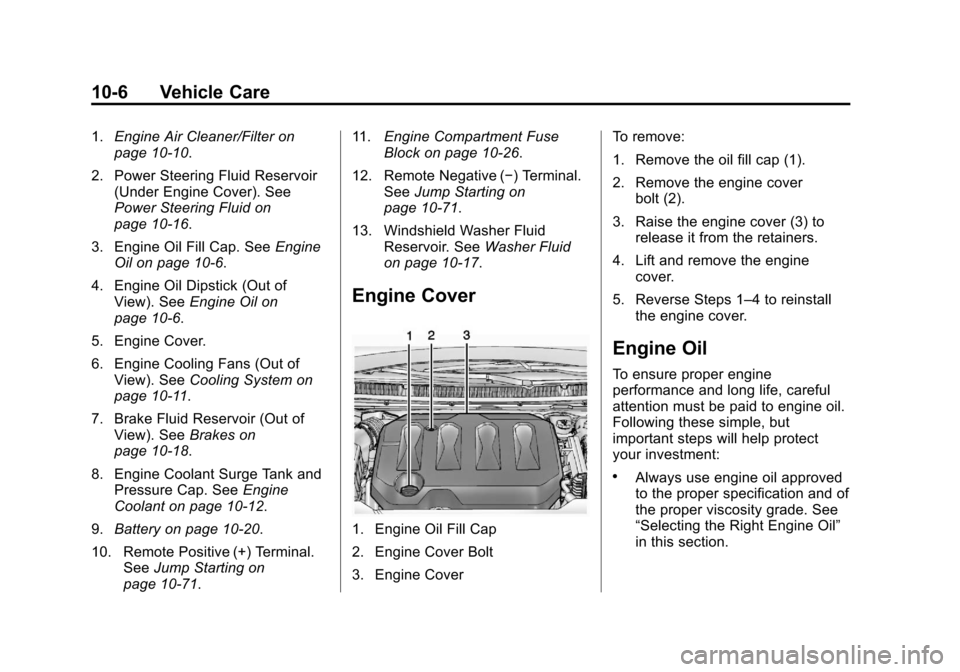
Engine Cover
1. Engine Oil Fill Cap
2. Engine Cover Bolt
3. Engine Cover To remove:
1. Remove the oil fill cap (1).
2. Remove the engine cover
bolt (2).
3. Raise the engine cover (3) to release it from the retainers.
4. Lift and remove the engine cover.
5. Reverse Steps 1–4 to reinstall the engine cover.
Engine Oil
To ensure proper engine
performance and long life, careful
attention must be paid to engine oil.
Following these simple, but
important steps will help protect
your investment:
.Always use engine oil approved
to the proper specification and of
the proper viscosity grade. See
“Selecting the Right Engine Oil”
in this section.
Page 314 of 438
Black plate (20,1)Cadillac XTS Owner Manual - 2013 - 1st - 4/13/12
10-20 Vehicle Care
hydraulic system can
damage brake hydraulic
system parts so badly that
they will have to be replaced.
Do not let someone put in
the wrong kind of fluid.
.If brake fluid is spilled on the
vehicle's painted surfaces,
the paint finish can be
damaged. Be careful not to
spill brake fluid on the
vehicle. If you do, wash it off
immediately.
Battery
Refer to the replacement number
shown on the original battery label
when a new battery is needed. See
Engine Compartment Overview on
page 10‑5for battery location.
{WARNING
Battery posts, terminals, and
related accessories contain lead
and lead compounds, chemicals
(Continued)
WARNING (CONTINUED)
known to the State of California to
cause cancer and reproductive
harm. Wash hands after handling.
Vehicle Storage
{WARNING
Batteries have acid that can burn
you and gas that can explode.
You can be badly hurt if you are
not careful. SeeJump Starting on
page 10‑71 for tips on working
around a battery without
getting hurt.
Infrequent Usage: Remove the
black, negative (−) cable from the
battery to keep the battery from
running down.
Extended Storage: Remove the
black, negative (−) cable from the
battery or use a battery trickle
charger.
All-Wheel Drive
Transfer Case
Under normal driving conditions,
transfer case fluid does not require
changing or checking unless there
is a fluid leak or unusual noise.
If required, have the transfer case
serviced by your dealer.
Starter Switch Check
{WARNING
When you are doing this
inspection, the vehicle could
move suddenly. If the vehicle
moves, you or others could be
injured.
1. Before starting this check, be sure there is enough room
around the vehicle.
Page 321 of 438

Black plate (27,1)Cadillac XTS Owner Manual - 2013 - 1st - 4/13/12
Vehicle Care 10-27
The vehicle may not be equipped
with all of the fuses, relays, and
features shown.J-CaseFuses Usage
6 Wiper
12 Starter J-Case
Fuses Usage
21 Rear Power
Windows
22 Sunroof
24 Front Power
Windows J-Case
Fuses Usage
25 Retained Accessory
Power
26 Antilock Brake
System Pump
27 Electric Parking
Brake
28 Rear Window
Defogger
41 Brake Vacuum
Assist Pump
42 Cooling Fan K2
44 Headlamp Washer
45 Cooling Fan K1
Mini Fuses Usage
1 Transmission
Control Module
—
Battery
2 Engine Control
Module Battery
Page 322 of 438
Black plate (28,1)Cadillac XTS Owner Manual - 2013 - 1st - 4/13/12
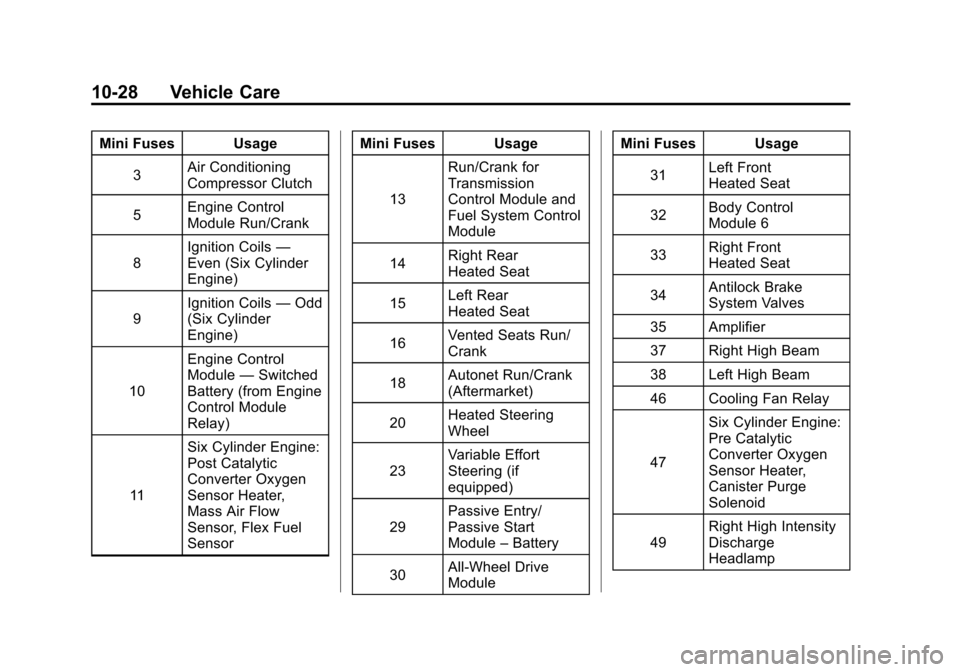
10-28 Vehicle Care
Mini Fuses Usage3 Air Conditioning
Compressor Clutch
5 Engine Control
Module Run/Crank
8 Ignition Coils
—
Even (Six Cylinder
Engine)
9 Ignition Coils
—Odd
(Six Cylinder
Engine)
10 Engine Control
Module
—Switched
Battery (from Engine
Control Module
Relay)
11 Six Cylinder Engine:
Post Catalytic
Converter Oxygen
Sensor Heater,
Mass Air Flow
Sensor, Flex Fuel
Sensor Mini Fuses Usage
13 Run/Crank for
Transmission
Control Module and
Fuel System Control
Module
14 Right Rear
Heated Seat
15 Left Rear
Heated Seat
16 Vented Seats Run/
Crank
18 Autonet Run/Crank
(Aftermarket)
20 Heated Steering
Wheel
23 Variable Effort
Steering (if
equipped)
29 Passive Entry/
Passive Start
Module
–Battery
30 All-Wheel Drive
Module Mini Fuses Usage
31 Left Front
Heated Seat
32 Body Control
Module 6
33 Right Front
Heated Seat
34 Antilock Brake
System Valves
35 Amplifier
37 Right High Beam
38 Left High Beam
46 Cooling Fan Relay
47 Six Cylinder Engine:
Pre Catalytic
Converter Oxygen
Sensor Heater,
Canister Purge
Solenoid
49 Right High Intensity
Discharge
Headlamp
Page 323 of 438
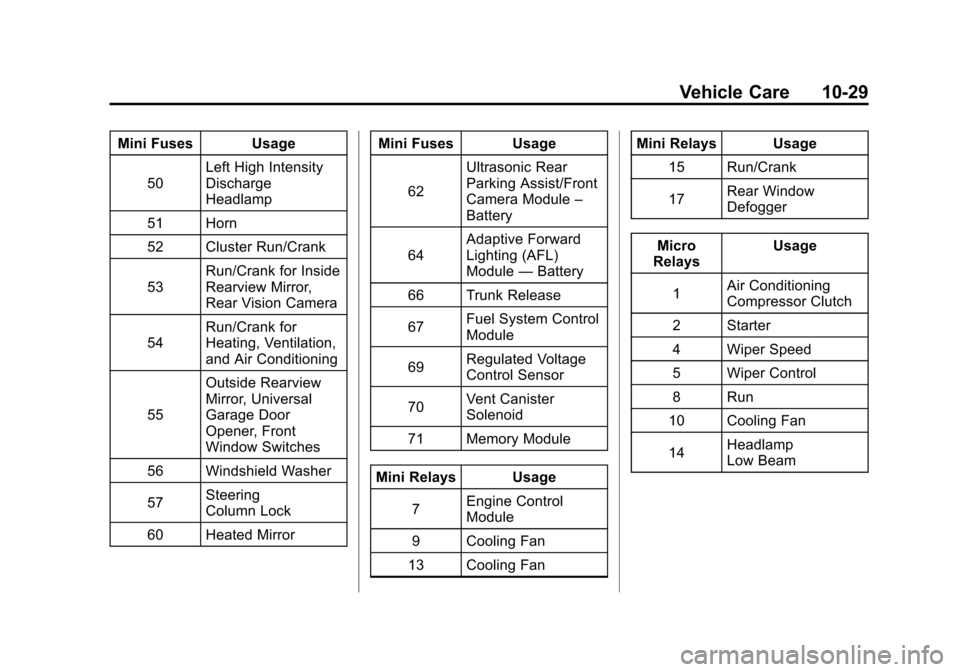
Black plate (29,1)Cadillac XTS Owner Manual - 2013 - 1st - 4/13/12
Vehicle Care 10-29
Mini Fuses Usage50 Left High Intensity
Discharge
Headlamp
51 Horn
52 Cluster Run/Crank
53 Run/Crank for Inside
Rearview Mirror,
Rear Vision Camera
54 Run/Crank for
Heating, Ventilation,
and Air Conditioning
55 Outside Rearview
Mirror, Universal
Garage Door
Opener, Front
Window Switches
56 Windshield Washer
57 Steering
Column Lock
60 Heated Mirror Mini Fuses Usage
62 Ultrasonic Rear
Parking Assist/Front
Camera Module
–
Battery
64 Adaptive Forward
Lighting (AFL)
Module
—Battery
66 Trunk Release
67 Fuel System Control
Module
69 Regulated Voltage
Control Sensor
70 Vent Canister
Solenoid
71 Memory Module
Mini Relays Usage 7 Engine Control
Module
9 Cooling Fan
13 Cooling Fan Mini Relays Usage
15 Run/Crank
17 Rear Window
Defogger
Micro
Relays Usage
1 Air Conditioning
Compressor Clutch
2 Starter
4 Wiper Speed
5 Wiper Control
8 Run
10 Cooling Fan
14 Headlamp
Low Beam