trailer CADILLAC XTS 2014 Owner's Guide
[x] Cancel search | Manufacturer: CADILLAC, Model Year: 2014, Model line: XTS, Model: CADILLAC XTS 2014Pages: 412, PDF Size: 4.65 MB
Page 279 of 412
Black plate (21,1)Cadillac XTS Owner Manual (GMNA-Localizing-U.S./Canada-6006999) -
2014 - CRC - 9/11/13
Vehicle Care 10-21
The engine coolant temperature
warning light comes on in the
instrument cluster, to indicate the
vehicle has entered overheated
engine protection operating mode.
The temperature gauge also
indicates an overheat condition
exists. Driving extended distances
and/or towing a trailer in the
overheat protection mode should be
avoided.
Power Steering Fluid
(LF3 and LFX with AWD)
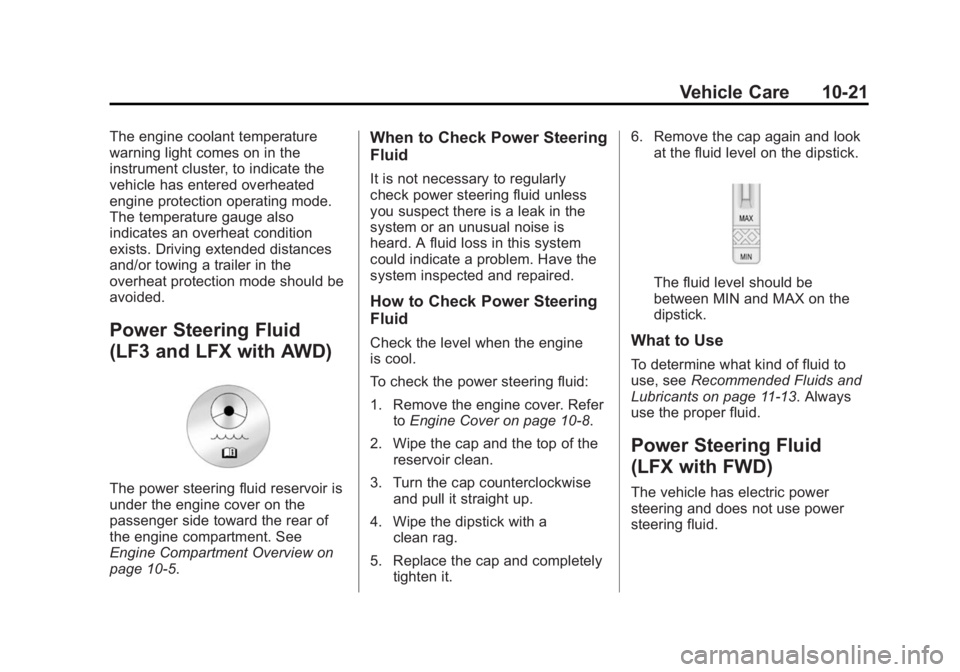
The power steering fluid reservoir is
under the engine cover on the
passenger side toward the rear of
the engine compartment. See
Engine Compartment Overview on
page 10-5.
When to Check Power Steering
Fluid
It is not necessary to regularly
check power steering fluid unless
you suspect there is a leak in the
system or an unusual noise is
heard. A fluid loss in this system
could indicate a problem. Have the
system inspected and repaired.
How to Check Power Steering
Fluid
Check the level when the engine
is cool.
To check the power steering fluid:
1. Remove the engine cover. RefertoEngine Cover on page 10-8.
2. Wipe the cap and the top of the reservoir clean.
3. Turn the cap counterclockwise and pull it straight up.
4. Wipe the dipstick with a clean rag.
5. Replace the cap and completely tighten it. 6. Remove the cap again and look
at the fluid level on the dipstick.
The fluid level should be
between MIN and MAX on the
dipstick.
What to Use
To determine what kind of fluid to
use, see Recommended Fluids and
Lubricants on page 11-13. Always
use the proper fluid.
Power Steering Fluid
(LFX with FWD)
The vehicle has electric power
steering and does not use power
steering fluid.
Page 338 of 412
Black plate (80,1)Cadillac XTS Owner Manual (GMNA-Localizing-U.S./Canada-6006999) -
2014 - CRC - 9/11/13
10-80 Vehicle Care
Towing the Vehicle
{Caution
Incorrectly towing a disabled
vehicle may cause damage. The
damage would not be covered by
the vehicle warranty. Do not lash
or hook to the chassis
components—including the front
and rear subframes, suspension
control arms, and links —during
towing and recovery of a disabled
vehicle, or when securing the
vehicle. Use the proper nylon
strap harnesses around the tires
to secure the vehicle.
Have the vehicle towed on a wheel
lift tow truck. A flatbed car carrier
could damage the vehicle. The
wheel lift tow truck must raise the
rear of the vehicle and wheel dollies
must be used to lift the front wheels
off the ground. Consult your dealer or a
professional towing service if the
disabled vehicle must be towed.
To tow the vehicle behind another
vehicle for recreational purposes,
such as behind a motor home, see
“Recreational Vehicle Towing”
following.
Recreational Vehicle
Towing
Recreational vehicle towing means
towing the vehicle behind another
vehicle such as a motor home. The
two most common types of
recreational vehicle towing are
known as dinghy towing and dolly
towing. Dinghy towing is towing the
vehicle with all four wheels on the
ground. Dolly towing is towing the
vehicle with two wheels on the
ground and two wheels up on a
device known as a dolly.
Here are some important things to
consider before recreational vehicle
towing:
.What is the towing capacity of
the towing vehicle? Be sure to
read the tow vehicle
manufacturer's
recommendations.
.What is the distance that will be
traveled? Some vehicles have
restrictions on how far and how
long they can tow.
.Is the proper towing equipment
going to be used? See your
dealer or trailering professional
for additional advice and
equipment recommendations.
.Is the vehicle ready to be
towed? Just as preparing the
vehicle for a long trip, make sure
the vehicle is prepared to be
towed.
Page 352 of 412
Black plate (2,1)Cadillac XTS Owner Manual (GMNA-Localizing-U.S./Canada-6006999) -
2014 - CRC - 9/11/13
11-2 Service and Maintenance
Your dealer recognizes the
importance of providing
competitively priced maintenance
and repair services. With trained
technicians, the dealer is the place
for routine maintenance such as oil
changes and tire rotations and
additional maintenance items like
tires, brakes, batteries, and wiper
blades.
{Caution
Damage caused by improper
maintenance can lead to costly
repairs and may not be covered
by the vehicle warranty.
Maintenance intervals, checks,
inspections, recommended fluids,
and lubricants are important to
keep the vehicle in good working
condition.The Tire Rotation and Required
Services are the responsibility of the
vehicle owner. It is recommended to
have your dealer perform these
services every 12 000 km/7,500 mi.
Proper vehicle maintenance helps to
keep the vehicle in good working
condition, improves fuel economy,
and reduces vehicle emissions.
Because of the way people use
vehicles, maintenance needs vary.
There may need to be more
frequent checks and services. The
Additional Required Services -
Normal are for vehicles that:
.Carry passengers and cargo
within recommended limits on
the Tire and Loading Information
label. See
Vehicle Load Limits
on page 9-10.
.Are driven on reasonable road
surfaces within legal driving
limits.
.Use the recommended fuel. See
Fuel on page 9-58. Refer to the information in the
Maintenance Schedule Additional
Required Services - Normal chart.
The Additional Required Services -
Severe are for vehicles that are:
.Mainly driven in heavy city traffic
in hot weather.
.Mainly driven in hilly or
mountainous terrain.
.Frequently towing a trailer.
.Used for high speed or
competitive driving.
.Used for taxi, police, or delivery
service.
Refer to the information in the
Maintenance Schedule Additional
Required Services - Severe chart.
Page 410 of 412
Black plate (12,1)Cadillac XTS Owner Manual (GMNA-Localizing-U.S./Canada-6006999) -
2014 - CRC - 9/11/13
i-12 INDEX
Towing (cont'd)Recreational Vehicle . . . . . . . . 10-80
Trailer . . . . . . . . . . . . . . . . . . . . . . . . 9-65
Vehicle . . . . . . . . . . . . . . . . . . . . . 10-80
Traction Control System (TCS)/StabiliTrak
®Light . . . . . . . . . . . . 5-25
Limited-Slip Rear Axle . . . . . . . . 9-31
Off Light . . . . . . . . . . . . . . . . . . . . . . 5-25
Traction Control/Electronic Stability Control . . . . . . . . . . . . . . 9-29
Trailer Towing . . . . . . . . . . . . . . . . . . . . . . . . 9-65
Transmission
Automatic . . . . . . . . . . . . . . . . . . . . . 9-23
Fluid, Automatic . . . . . . . . . . . . 10-13
Messages . . . . . . . . . . . . . . . . . . . . 5-47
Transportation Program,
Courtesy . . . . . . . . . . . . . . . . . . . . . 13-7
Trip Odometer . . . . . . . . . . . . . . . . . 5-14
Trunk . . . . . . . . . . . . . . . . . . . . . . . . . . 2-14
Turn and Lane-Change Signals . . . . . . . . . . . . . . . . . . . . . . . . 6-6
U
Uniform Tire Quality
Grading . . . . . . . . . . . . . . . . . . . . . 10-57
Universal Remote System . . . . . 5-53 Operation . . . . . . . . . . . . . . . . . . . . . 5-55
Programming . . . . . . . . . . . . . . . . . 5-53
Using This Manual . . . . . . . . . . . . . . . . iv
V
Vehicle
Alarm System . . . . . . . . . . . . . . . . 2-16
Canadian Owners . . . . . . . . . . . . . . . iii
Control . . . . . . . . . . . . . . . . . . . . . . . . 9-3
IdentificationNumber (VIN) . . . . . . . . . . . . . . . 12-1
Load Limits . . . . . . . . . . . . . . . . . . . 9-10
Messages . . . . . . . . . . . . . . . . . . . . 5-36
Personalization . . . . . . . . . . . . . . . 5-48
Reminder Messages . . . . . . . . . . 5-47
Remote Start . . . . . . . . . . . . . . . . . . 2-9
Security . . . . . . . . . . . . . . . . . . . . . . 2-16
Speed Messages . . . . . . . . . . . . . 5-47
Towing . . . . . . . . . . . . . . . . . . . . . . 10-80
Vehicle Ahead Indicator . . . . . . . 5-24 Vehicle Care
Storing the Tire Sealant
and Compressor Kit . . . . . . . 10-69
Tire Pressure . . . . . . . . . . . . . . . 10-46
Ventilation, Air . . . . . . . . . . . . . . . . . . 8-8
Visors . . . . . . . . . . . . . . . . . . . . . . . . . 2-23
W
Warning Brake System Light . . . . . . . . . . . 5-22
Lane Departure (LDW) . . . . . . . 9-56
Warning Lights, Gauges, and Indicators . . . . . . . . . . . . . . . . . . . . . 5-9
Warnings . . . . . . . . . . . . . . . . . . . . . . . . . iv Cautions and Danger . . . . . . . . . . . .iv
Hazard Flashers . . . . . . . . . . . . . . . 6-5
Washer Fluid . . . . . . . . . . . . . . . . . 10-22 Messages . . . . . . . . . . . . . . . . . . . . 5-47
Wheels Alignment and TireBalance . . . . . . . . . . . . . . . . . . . 10-59
Different Size . . . . . . . . . . . . . . . 10-57
Replacement . . . . . . . . . . . . . . . 10-59
When It Is Time for New Tires . . . . . . . . . . . . . . . . . . . . . . . . 10-54
Where to Put the Restraint . . . . 3-42