towing CADILLAC XTS 2016 1.G Owner's Manual
[x] Cancel search | Manufacturer: CADILLAC, Model Year: 2016, Model line: XTS, Model: CADILLAC XTS 2016 1.GPages: 320, PDF Size: 2.07 MB
Page 225 of 320
Cadillac XTS Owner Manual (GMNA-Localizing-MidEast-9369806) - 2016 -
crc - 6/24/15
224 Driving and Operating
lubricant, belts, cooling system, and
brake system. Inspect these before
and during the trip.
Check periodically to see that all
hitch nuts and bolts are tight.
Engine Cooling When Trailer
Towing
The cooling system may temporarily
overheat during severe operating
conditions. SeeEngine Overheating
0 243.
Trailer Towing
Before pulling a trailer, there are
three important considerations that
have to do with weight:
.
The weight of the trailer.
. The weight of the trailer tongue.
. The total weight on your
vehicle's tires.
Weight of the Trailer
How heavy can a trailer safely be?
It should never weigh more than
454 kg (1,000 lb). But even that can
be too heavy. It depends on how the rig is used.
For example, speed, altitude, road
grades, outside temperature, and
how much the vehicle is used to pull
a trailer are all important. It can
depend on any special equipment
on the vehicle, and the amount of
tongue weight the vehicle can carry.
See
“Weight of the Trailer Tongue”
later in this section.
Maximum trailer weight is calculated
assuming only the driver is in the
tow vehicle and it has all the
required trailering equipment. The
weight of additional optional
equipment, passengers, and cargo
in the tow vehicle must be
subtracted from the maximum trailer
weight.
Ask your dealer for trailering
information or advice.
Weight of the Trailer Tongue
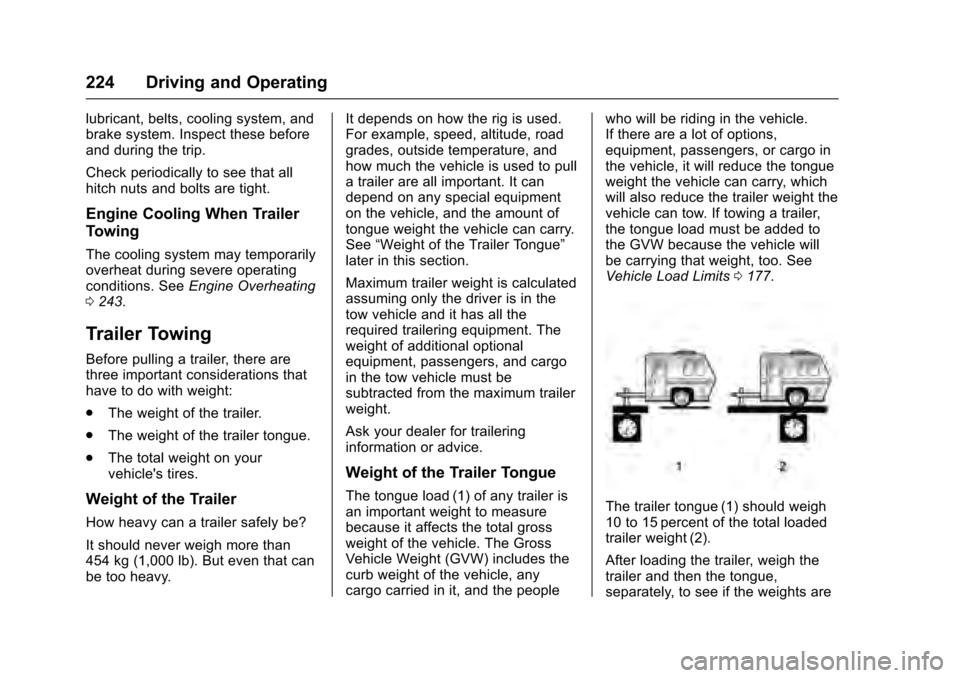
The tongue load (1) of any trailer is
an important weight to measure
because it affects the total gross
weight of the vehicle. The Gross
Vehicle Weight (GVW) includes the
curb weight of the vehicle, any
cargo carried in it, and the people who will be riding in the vehicle.
If there are a lot of options,
equipment, passengers, or cargo in
the vehicle, it will reduce the tongue
weight the vehicle can carry, which
will also reduce the trailer weight the
vehicle can tow. If towing a trailer,
the tongue load must be added to
the GVW because the vehicle will
be carrying that weight, too. See
Vehicle Load Limits
0177.The trailer tongue (1) should weigh
10 to 15 percent of the total loaded
trailer weight (2).
After loading the trailer, weigh the
trailer and then the tongue,
separately, to see if the weights are
Page 226 of 320
Cadillac XTS Owner Manual (GMNA-Localizing-MidEast-9369806) - 2016 -
crc - 6/24/15
Driving and Operating 225
proper. If they are not, adjustments
might be made by moving some
items around in the trailer.
Total Weight on Your Vehicle's
Tires
Be sure the vehicle's tires are
inflated to the upper limit for cold
tires. These numbers can be found
on the Tire and Loading Information
label. SeeVehicle Load Limits
0 177. Make sure not to go over the
GVW limit for the vehicle, including
the weight of the trailer tongue.
Towing Equipment
Hitches
Use the correct hitch equipment.
See your dealer or a hitch dealer for
assistance.
. The rear bumper on the vehicle
is not intended for hitches. Do
not attach rental hitches or other
bumper-type hitches to it. Use
only a frame-mounted hitch that
does not attach to the bumper. .
Will any holes be made in the
body of the vehicle when the
trailer hitch is installed? If so,
seal the holes when the hitch is
removed. If the holes are not
sealed, dirt, water, and deadly
carbon monoxide (CO) from the
exhaust can get into the vehicle.
See Engine Exhaust 0186.
Safety Chains
Always attach chains between the
vehicle and the trailer. Cross the
safety chains under the tongue of
the trailer to help prevent the tongue
from contacting the road if it
becomes separated from the hitch.
Leave enough slack so the rig can
turn. Never allow safety chains to
drag on the ground.
Trailer Brakes
Does the trailer have its own
brakes? Be sure to read and follow
the instructions for the trailer brakes
so they are installed, adjusted, and
maintained properly. Because the vehicle has antilock
brakes, do not tap into the vehicle's
brake system. If this is done, both
brake systems will not work well or
at all.
Page 229 of 320
Cadillac XTS Owner Manual (GMNA-Localizing-MidEast-9369806) - 2016 -
crc - 6/24/15
228 Vehicle Care
Jump Starting
Jump Starting . . . . . . . . . . . . . . . . 281
Towing the Vehicle
Towing the Vehicle . . . . . . . . . . . 284
Recreational VehicleTowing . . . . . . . . . . . . . . . . . . . . . . 284
Appearance Care
Exterior Care . . . . . . . . . . . . . . . . . 287
Interior Care . . . . . . . . . . . . . . . . . . 291
Floor Mats . . . . . . . . . . . . . . . . . . . . 294
General Information
For service and parts needs, visit
your dealer. You will receive
genuine parts and trained and
supported service people.
Accessories and
Modifications
Adding non-dealer accessories or
making modifications to the vehicle
can affect vehicle performance and
safety, including such things as
airbags, braking, stability, ride and
handling, emissions systems,
aerodynamics, durability, and
electronic systems like antilock
brakes, traction control, and stability
control. These accessories or
modifications could even cause
malfunction or damage not covered
by the vehicle warranty.
Damage to vehicle components
resulting from modifications or the
installation or use of non-GM
certified parts, including control
module or software modifications, is
not covered under the terms of the vehicle warranty and may affect
remaining warranty coverage for
affected parts.
GM Accessories are designed to
complement and function with other
systems on the vehicle. See your
dealer to accessorize the vehicle
using genuine GM Accessories
installed by a dealer technician.
Also, see
Adding Equipment to the
Airbag-Equipped Vehicle 078.
Page 245 of 320
Cadillac XTS Owner Manual (GMNA-Localizing-MidEast-9369806) - 2016 -
crc - 6/24/15
244 Vehicle Care
too serious. Sometimes the engine
can get a little too hot when the
vehicle:
.Climbs a long hill on a hot day.
. Stops after high-speed driving.
. Idles for long periods in traffic.
. Tows a trailer.
If the overheat warning is displayed
with no sign of steam: 1. Turn the air conditioning off.
2. Turn the heater on to the highest temperature and to the
highest fan speed. Open the
windows as necessary.
3. When it is safe to do so, pull off the road, shift to P (Park) or
N (Neutral), and let the
engine idle.
If the temperature overheat gauge is
no longer in the overheat zone or an
overheat warning no longer
displays, the vehicle can be driven.
Continue to drive the vehicle slow
for about 10 minutes. Keep a safe
vehicle distance from the car in front
of you. If the warning does not come back on, continue to drive normally
and have the cooling system
checked for proper fill and function.
If the warning continues, pull over,
stop, and park the vehicle
right away.
If there is no sign of steam, idle the
engine for three minutes while
parked. If the warning is still
displayed, turn off the engine until it
cools down. Also, see
“Overheated
Engine Protection Operating Mode”
next in this section.
Overheated Engine
Protection
Operating Mode
This emergency operating mode
allows the vehicle to be driven to a
safe place in an emergency
situation. If an overheated engine
condition exists, an overheat
protection mode, which alternates
firing groups of cylinders, helps
prevent engine damage. In this
mode, there is significant loss in
power and engine performance. The engine coolant temperature
warning light comes on in the
instrument cluster, to indicate the
vehicle has entered overheated
engine protection operating mode.
The temperature gauge also
indicates an overheat condition
exists. Driving extended distances
and/or towing a trailer in the
overheat protection mode should be
avoided.
Power Steering Fluid
(LFX with FWD)
The vehicle has electric power
steering and does not use power
steering fluid.
Power Steering Fluid
(LF3 and LFX with AWD)
Page 285 of 320
Cadillac XTS Owner Manual (GMNA-Localizing-MidEast-9369806) - 2016 -
crc - 6/24/15
284 Vehicle Care
Jumper Cable Removal
Reverse the sequence exactly when
removing the jumper cables.
After starting the disabled vehicle
and removing the jumper cables,
allow it to idle for several minutes.Towing the Vehicle
Caution
Incorrectly towing a disabled
vehicle may cause damage. The
damage would not be covered by
the vehicle warranty.
Do not lash or hook to
suspension components. Use the
proper straps around the tires to
secure the vehicle.
Have the vehicle towed on a wheel
lift tow truck. A flatbed car carrier
could damage the vehicle. The
wheel lift tow truck must raise the
rear of the vehicle and wheel dollies
must be used to lift the front wheels
off the ground.
Consult your dealer or a
professional towing service if the
disabled vehicle must be towed.
Recreational Vehicle
Towing
Recreational vehicle towing means
towing the vehicle behind another
vehicle such as a motor home. The
two most common types of
recreational vehicle towing are
known as dinghy towing and dolly
towing. Dinghy towing is towing the
vehicle with all four wheels on the
ground. Dolly towing is towing the
vehicle with two wheels on the
ground and two wheels up on a
device known as a dolly.
Here are some important things to
consider before recreational vehicle
towing:
. What is the towing capacity of
the towing vehicle? Be sure to
read the tow vehicle
manufacturer's
recommendations.
. What is the distance that will be
traveled? Some vehicles have
restrictions on how far and how
long they can tow.
Page 286 of 320
Cadillac XTS Owner Manual (GMNA-Localizing-MidEast-9369806) - 2016 -
crc - 6/24/15
Vehicle Care 285
.Is the proper towing equipment
going to be used? See your
dealer or trailering professional
for additional advice and
equipment recommendations.
. Is the vehicle ready to be
towed? Just as preparing the
vehicle for a long trip, make sure
the vehicle is prepared to be
towed.
Caution
Use of a shield mounted in front
of the vehicle grille could restrict
airflow and cause damage to the
transmission. The repairs would
not be covered by the vehicle
warranty. If using a shield, only
use one that attaches to the
towing vehicle.
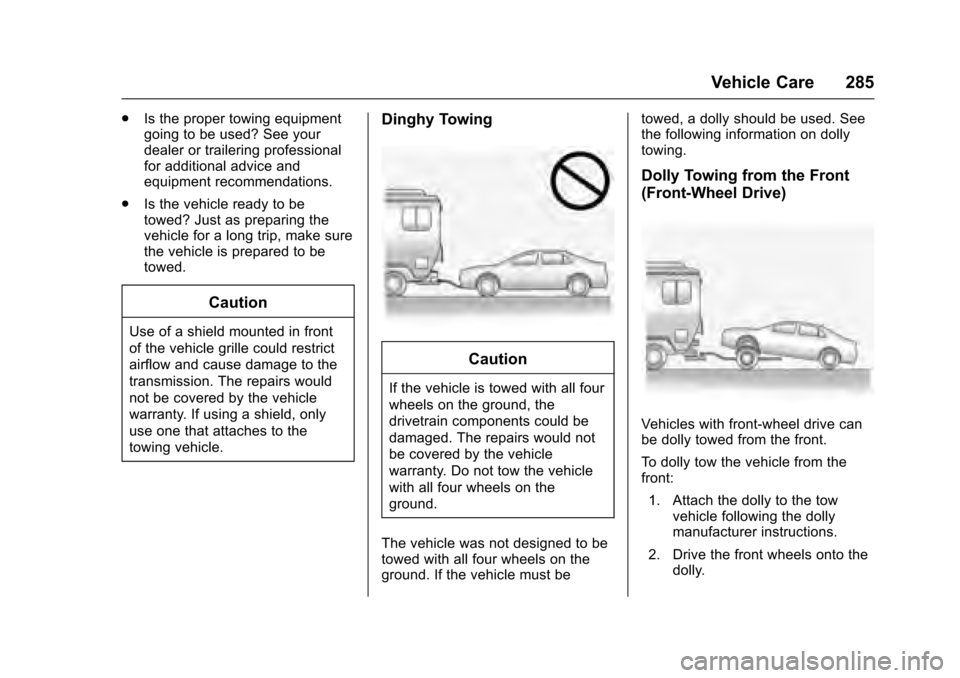
Dinghy Towing
Caution
If the vehicle is towed with all four
wheels on the ground, the
drivetrain components could be
damaged. The repairs would not
be covered by the vehicle
warranty. Do not tow the vehicle
with all four wheels on the
ground.
The vehicle was not designed to be
towed with all four wheels on the
ground. If the vehicle must be towed, a dolly should be used. See
the following information on dolly
towing.
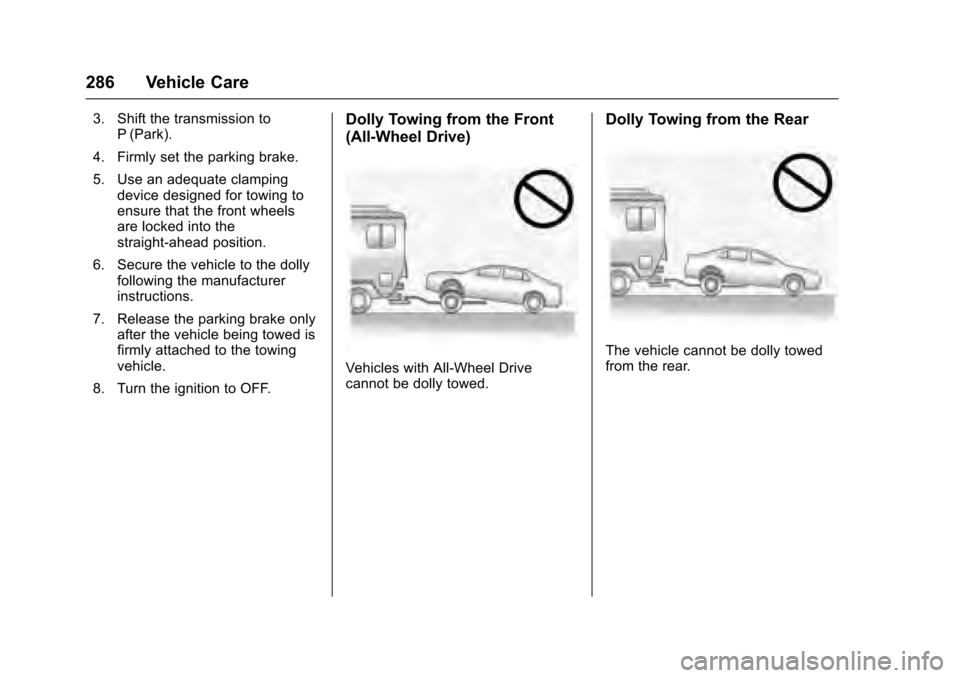
Dolly Towing from the Front
(Front-Wheel Drive)
Vehicles with front-wheel drive can
be dolly towed from the front.
To dolly tow the vehicle from the
front:
1. Attach the dolly to the tow vehicle following the dolly
manufacturer instructions.
2. Drive the front wheels onto the dolly.
Page 287 of 320
Cadillac XTS Owner Manual (GMNA-Localizing-MidEast-9369806) - 2016 -
crc - 6/24/15
286 Vehicle Care
3. Shift the transmission toP (Park).
4. Firmly set the parking brake.
5. Use an adequate clamping device designed for towing to
ensure that the front wheels
are locked into the
straight-ahead position.
6. Secure the vehicle to the dolly following the manufacturer
instructions.
7. Release the parking brake only after the vehicle being towed is
firmly attached to the towing
vehicle.
8. Turn the ignition to OFF.Dolly Towing from the Front
(All-Wheel Drive)
Vehicles with All-Wheel Drive
cannot be dolly towed.
Dolly Towing from the Rear
The vehicle cannot be dolly towed
from the rear.
Page 300 of 320
Cadillac XTS Owner Manual (GMNA-Localizing-MidEast-9369806) - 2016 -
crc - 6/24/15
Service and Maintenance 299
the hold open ability of the gas
strut. Contact your dealer if
service is required.
. Engine air cleaner filter
replacement or every 20 000 km/
12,500 Miles. See Engine Air
Cleaner/Filter 0237. If driving in
dusty conditions, inspect the
filter at each oil change or more
often as needed.
. Check automatic transmission
fluid level and condition.
Every 40 000 km/25,000 Miles
. Passenger compartment air filter
replacement (or every
24 months, whichever occurs
first). More frequent passenger
compartment air filter
replacement may be needed if
driving in areas with heavy
traffic, poor air quality, high dust
levels, or environmental
allergens. Passenger
compartment air filter
replacement may also be
needed if there is reduced
airflow, window fogging, or odors. Your GM dealer can
help determine when to replace
the filter.
Every 72 000 km/45,000 Miles
. Replace brake fluid (or every
three years, whichever occurs
first).
Every 80 000 km/50,000 Miles
. Spark plug replacement and
spark plug wire inspection (LF3
Twin Turbo Engine). An
Emission Control Service.
. Evaporative control system
inspection. Check all fuel and
vapor lines and hoses for proper
hook-up, routing, and condition.
Every 160 000 km/100,000 Miles
. Spark plug replacement and
spark plug wire inspection (LFX
Engine). An Emission Control
Service. Every 240 000 km/150,000 Miles
.
Engine cooling system drain and
refill (or every five years,
whichever occurs first). See
Cooling System 0239. An
Emission Control Service.
. Engine drive belts inspection for
fraying, excessive cracks,
or obvious damage (or every
10 years, whichever occurs
first). Replace, if needed.
Severe Conditions Requiring
More Frequent Maintenance*
.Public service, military,
or commercial use vehicles to
include the following:
‐Ambulances, police cars and
emergency rescue vehicles.
‐ Civilian vehicles such as light
duty pick-up trucks, SUVs and
passenger cars that are used
in military applications.
‐ Recovery vehicles such as
tow trucks and flatbed single
vehicle carriers or any vehicle
that is consistently used in
towing trailers or other loads.
Page 301 of 320
Cadillac XTS Owner Manual (GMNA-Localizing-MidEast-9369806) - 2016 -
crc - 6/24/15
300 Service and Maintenance
‐High use commercial vehicles
such as courier delivery
vehicles, private security patrol
vehicles or any vehicles that
operate on a 24 hour basis.
‐ Any vehicle consistently
operated in a high sand or
dust environment such as
those used on oil pipelines
and similar applications.
. Vehicles that are regularly used
for short trips of 6 kilometers
or less
If your vehicle has an Oil Life
Indicator, the indicator will show
you when to change the oil and
filter. Under severe conditions
the indicator may come on
before 10 000 km/6,000 mi. The
indicator won't detect dust in the
oil, so if you drive in a dusty
area you may have to change
the oil and filter sooner than
every 10 000 km/6,000 mi.
Note: All vehicles with
rear-wheel drive —change
driveline axle oil every
30 000 km/19,000 mi if vehicle is
used for towing purposes. * Footnote: Under extreme
driving conditions listed above, it
may be necessary to replace
your spark plugs at more
frequent intervals. For further
assistance in determining the
most suitable service
maintenance intervals for your
vehicle, please contact your
authorized GM Dealer.
Additional Required Services
–
Severe Service
Every 72 000 km/45,000 mi
. Automatic transmission fluid
change. See Automatic
Transmission Fluid 0237.
. Change rear axle fluid.
Page 313 of 320

Cadillac XTS Owner Manual (GMNA-Localizing-MidEast-9369806) - 2016 -
crc - 6/24/15
312 Index
ControlTraction and Electronic
Stability . . . . . . . . . . . . . . . . . . . . . 192
Control of a Vehicle . . . . . . . . . . . . . 171
Convenience Net . . . . . . . . . . . . . . . 101
Convex Mirrors . . . . . . . . . . . . . . . . . . 41
Coolant Engine . . . . . . . . . . . . . . . . . . . . . . . . 240
Engine Temperature Gauge . . .116
Engine TemperatureWarning Light . . . . . . . . . . . . . . . 124
Cooling System . . . . . . . . . . . . . . . . . 239 Engine Messages . . . . . . . . . . . . 137
Courtesy Lamps . . . . . . . . . . . . . . . . 157
Cover Engine . . . . . . . . . . . . . . . . . . . . . . . . 233
Cruise Control . . . . . . . . . . . . . . . . . . 195 Light . . . . . . . . . . . . . . . . . . . . . . . . . . 127
Messages . . . . . . . . . . . . . . . . . . . . 136
Cruise Control, Adaptive . . . . . . . . 198
D
Danger, Warning, and Caution . . . . 2
Data Recorders, Event . . . . . . . . . 308
Daytime Running Lamps (DRL) . . . . . . . . . . . . . . . . . . 154
Defensive Driving . . . . . . . . . . . . . . . 171
Delayed Locking . . . . . . . . . . . . . . . . . 35
Distracted Driving . . . . . . . . . . . . . . . 171 Dome Lamps . . . . . . . . . . . . . . . . . . . 157
Door
Ajar Light . . . . . . . . . . . . . . . . . . . . . 127
Ajar Messages . . . . . . . . . . . . . . . 136
Delayed Locking . . . . . . . . . . . . . . . . 35
Locks . . . . . . . . . . . . . . . . . . . . . . . . . . . 33
Power Locks . . . . . . . . . . . . . . . . . . . . 35
Rear Seat Pass-Through . . . . . . . 62
Drive Belt Routing, Engine . . . . . . 307
Drive Systems All-Wheel Drive . . . . . . . . . . 189, 249
Driver Assistance Systems . . . . . 205
Driver Information Center (DIC) . . . . . . . . . . . . . . . . . . 128
Driving Assistance Systems . . . . . . . . . . 210
Characteristics and
Towing Tips . . . . . . . . . . . . . . . . . 221
Defensive . . . . . . . . . . . . . . . . . . . . . 171
For Better Fuel Economy . . . . . . . 25
Hill and Mountain Roads . . . . . . 175
If the Vehicle is Stuck . . . . . . . . . 176
Loss of Control . . . . . . . . . . . . . . . 173
Off-Road Recovery . . . . . . . . . . . 173
Vehicle Load Limits . . . . . . . . . . . 177
Wet Roads . . . . . . . . . . . . . . . . . . . 174
Winter . . . . . . . . . . . . . . . . . . . . . . . . 175 Dual Automatic Climate
Control System . . . . . . . . . . . . . . . . 161
E
Electric Parking Brake . . . . . . . . . . 190
Electric Parking Brake Light . . . . 122
Electrical Equipment,
Add-On . . . . . . . . . . . . . . . . . . . . . . . 226
Electrical System Engine Compartment FuseBlock . . . . . . . . . . . . . . . . . . . . . . . . 254
Fuses and Circuit Breakers . . . 254
Instrument Panel Fuse
Block . . . . . . . . . . . . . . . . . . . . . . . . 257
Overload . . . . . . . . . . . . . . . . . . . . . 253
Rear Compartment Fuse Block . . . . . . . . . . . . . . . . . . . . . . . . 259
Engine Air Cleaner/Filter . . . . . . . . . . . . . 237
Check and Service EngineSoon Light . . . . . . . . . . . . . . . . . . .119
Compartment Overview . . . . . . . 230
Coolant . . . . . . . . . . . . . . . . . . . . . . . 240
Coolant Temperature Gauge . . . . . . . . . . . . . . . . . . . . . . .116
Coolant Temperature
Warning Light . . . . . . . . . . . . . . . 124
Cooling System . . . . . . . . . . . . . . . 239
Cooling System Messages . . . 137