service CHERY TIGGO 2009 Service Repair Manual
[x] Cancel search | Manufacturer: CHERY, Model Year: 2009, Model line: TIGGO, Model: CHERY TIGGO 2009Pages: 1903, PDF Size: 33.38 MB
Page 820 of 1903

Downloaded from www.Manualslib.com manuals search engine Camshaft Position (CMP) Sensor
Description
The Camshaft Position (CMP) sensor senses the protrusion of inlet valve cam sprocket to identify a particular cyl-
inder. The CMP sensor senses the piston position. When the Crankshaft Position (CKP) sensor becomes inoperative,
the CMP sensor provides various controls of engine parts instead, utilizing timing of cylinder identification signals.
The sensor consists of a permanent magnet and Hall IC.
Operation
When engine is running, the high and low parts of the teeth cause the gap with the sensor to change. The changing
gap cause the magnetic field near the sensor to change. Due to the changing magnetic field, the voltage from the
sensor changes. The Engine Control Module (ECM) detects the voltage signal and identify piston position and cyl-
inder timing.
Removal & Installation
1. Disconnect the negative battery cable.
2. Disconnect camshaft position sensor electrical connector from the wiring harness connector.
3. Remove the camshaft position sensor retaining bolt(1).
(Tighten: Camshaft position sensor retaining bolt to
10 N·m)
4. Remove camshaft position sensor.
5. Pull sensor up out of the cylinder head cover.
6. Installation is in the reverse order of the removal.
ON-VEHICLE SERVICE
LTSM030005
03–536Chery Automobile Co., Ltd.
Page 821 of 1903

Downloaded from www.Manualslib.com manuals search engine Air Flow Sensor
Description
The air flow sensor is placed in the air intake hose. The air flow sensor measures the intake flow rate by measuring
a part of the entire intake flow. The air flow sensor converts the amount of air drawn into the engine into a voltage
signal. The Engine Control Module (ECM) needs to know intake air volume to calculate engine load. This is neces-
sary to determine how much fuel to inject.
Operation
The air flow sensor controls the temperature of the hot wire to a certain amount. The heat generated by the hot wire
is reduced as the intake air flows around it. The more air, the greater the heat loss. Therefore, the electric current
supplied to the hot wire is changed to maintain the temperature of the hot wire as air flow increases. The ECM
detects the air flow by means of this voltage signal change.
Removal & Installation
1. Disconnect the negative battery cable.
2. Disconnect air flow sensor electrical connectorfrom the wiring harness connector.
3. Remove the air flow sensor retaining bolts (1). (Tighten: Air flow sensor retaining bolt to 8 N·m)
4. Remove the air flow sensor.
5. Installation is in the reverse order of removal.
ON-VEHICLE SERVICE
LTSM030006
03
03–537Chery Automobile Co., Ltd.
Page 822 of 1903

Downloaded from www.Manualslib.com manuals search engine Throttle Control Actuator
Description
The throttle body is located on the intake manifold. The throttle body meters air into the intake manifold.
Throttle control actuator consists of throttle control valve, throttle position sensor, idle air control motor, etc.
Operation
Filtered air from the air cleaner enters the intake manifold through the throttle body. A throttle valve (plate) is used to
supply air for idle and driving conditions. The throttle position sensor is part the throttle body. The throttle position
sensor signal is used by the ECM to determine throttle position. The ECM controls the throttle control to meter air
into the engine. This regulates engine power. The vehicle is in sense a “Drive by Wire” system.
Removal & Installation
1. Remove the engine cover.
2. Disconnect the negative battery cable.
3. Disconnect the throttle position sensor and idle air control motor electrical connect on the throttle control actua-tor.
4. Remove the accelerator cable on the throttle control actuator.
5. Remove three hoses on the throttle control actuator.
6. Remove four throttle control actuator mounting bolts (1).
(Tighten: Throttle control actuator bolts to 10 N·m)
7. Remove the throttle control actuator and gasket carefully.
8. Installation is in the reverse order of removal.
NOTE :
Replace a new throttle control actuator gasket when installing.
ON-VEHICLE SERVICE
LTSM030010
03–538Chery Automobile Co., Ltd.
Page 823 of 1903
Downloaded from www.Manualslib.com manuals search engine Engine Control Module (ECM)
Description
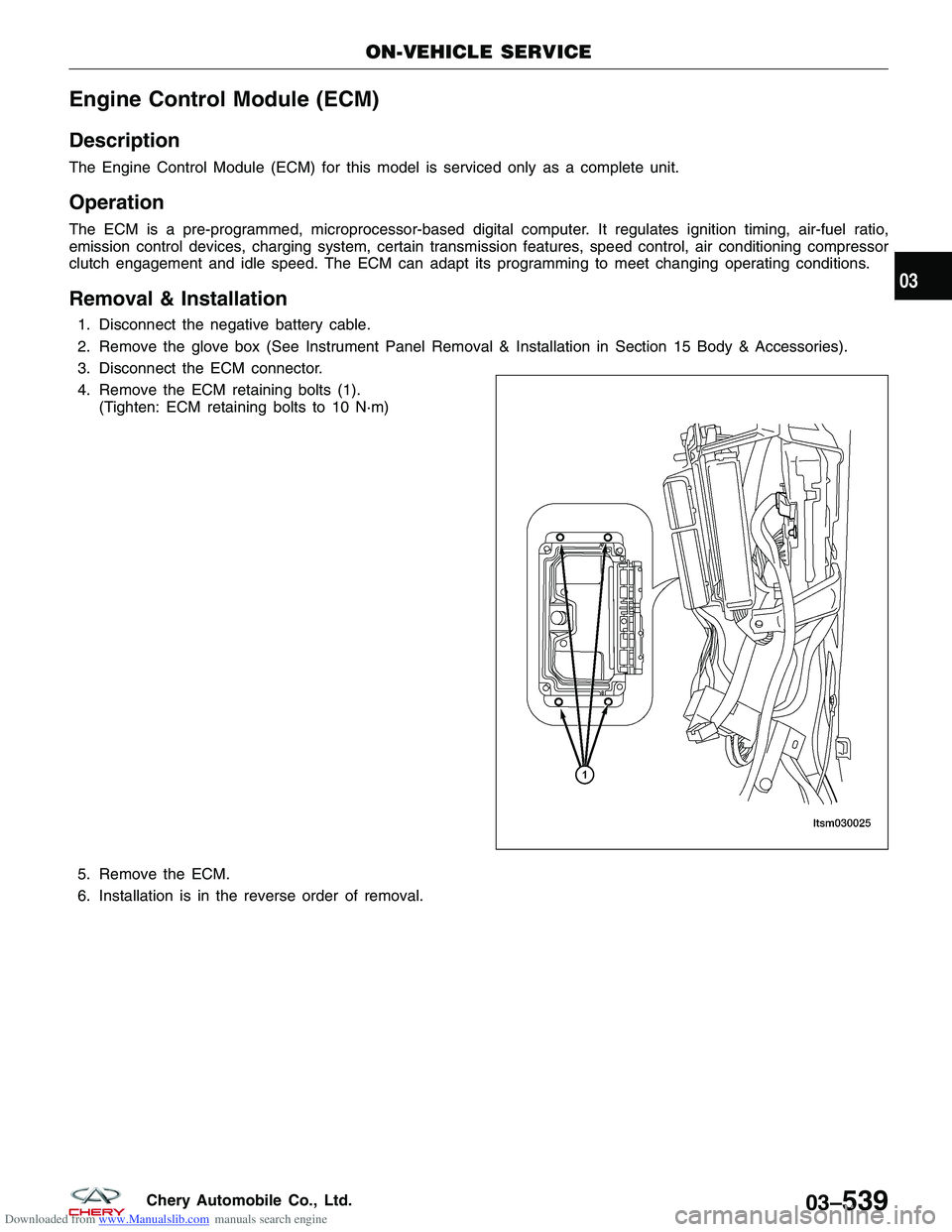
The Engine Control Module (ECM) for this model is serviced only as a complete unit.
Operation
The ECM is a pre-programmed, microprocessor-based digital computer. It regulates ignition timing, air-fuel ratio,
emission control devices, charging system, certain transmission features, speed control, air conditioning compressor
clutch engagement and idle speed. The ECM can adapt its programming to meet changing operating conditions.
Removal & Installation
1. Disconnect the negative battery cable.
2. Remove the glove box (See Instrument Panel Removal & Installation in Section 15 Body & Accessories).
3. Disconnect the ECM connector.
4. Remove the ECM retaining bolts (1).(Tighten: ECM retaining bolts to 10 N·m)
5. Remove the ECM.
6. Installation is in the reverse order of removal.
ON-VEHICLE SERVICE
LTSM030025
03
03–539Chery Automobile Co., Ltd.
Page 824 of 1903

Downloaded from www.Manualslib.com manuals search engine Throttle Position Sensor (TPS)
Description
The 4-wire throttle position sensor (TPS) is mounted on the throttle body and is connected to the throttle valve.
Operation
The TPS is a 4-wire variable resistor that provides the Engine Control Module (ECM) with an input signal that rep-
resents the throttle valve position of the throttle body. The sensor is connected to the throttle valve shaft. As the
position of the throttle valve changes, the resistance (output voltage) of the TPS changes.
Removal & Installation
1. Disconnect the negative battery cable.
2. Disconnect throttle position sensor electrical con-nector clamp from the wiring harness connector.
3. Remove the throttle position sensor retaining bolts (1).
4. Remove the throttle position sensor.
5. Installation is in the reverse order of removal.
ON-VEHICLE SERVICE
LTSM030027
03–540Chery Automobile Co., Ltd.
Page 825 of 1903
Downloaded from www.Manualslib.com manuals search engine Idle Air Control (IAC) Motor
Description
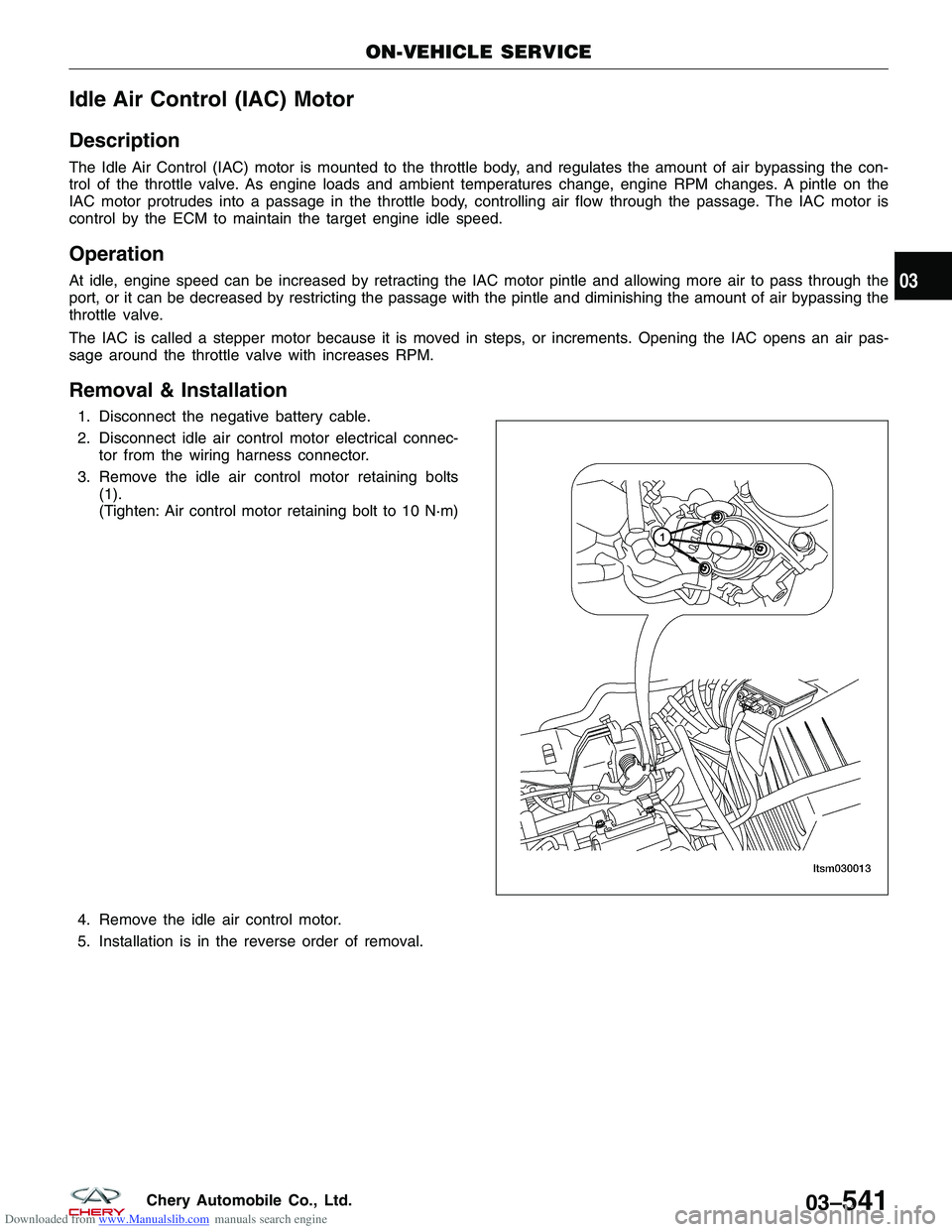
The Idle Air Control (IAC) motor is mounted to the throttle body, and regulates the amount of air bypassing the con-
trol of the throttle valve. As engine loads and ambient temperatures change, engine RPM changes. A pintle on the
IAC motor protrudes into a passage in the throttle body, controlling air flow through the passage. The IAC motor is
control by the ECM to maintain the target engine idle speed.
Operation
At idle, engine speed can be increased by retracting the IAC motor pintle and allowing more air to pass through the
port, or it can be decreased by restricting the passage with the pintle and diminishing the amount of air bypassing the
throttle valve.
The IAC is called a stepper motor because it is moved in steps, or increments. Opening the IAC opens an air pas-
sage around the throttle valve with increases RPM.
Removal & Installation
1. Disconnect the negative battery cable.
2. Disconnect idle air control motor electrical connec-tor from the wiring harness connector.
3. Remove the idle air control motor retaining bolts (1).
(Tighten: Air control motor retaining bolt to 10 N·m)
4. Remove the idle air control motor.
5. Installation is in the reverse order of removal.
ON-VEHICLE SERVICE
LTSM030013
03
03–541Chery Automobile Co., Ltd.
Page 826 of 1903
Downloaded from www.Manualslib.com manuals search engine Crankshaft Position (CKP) Sensor
Description
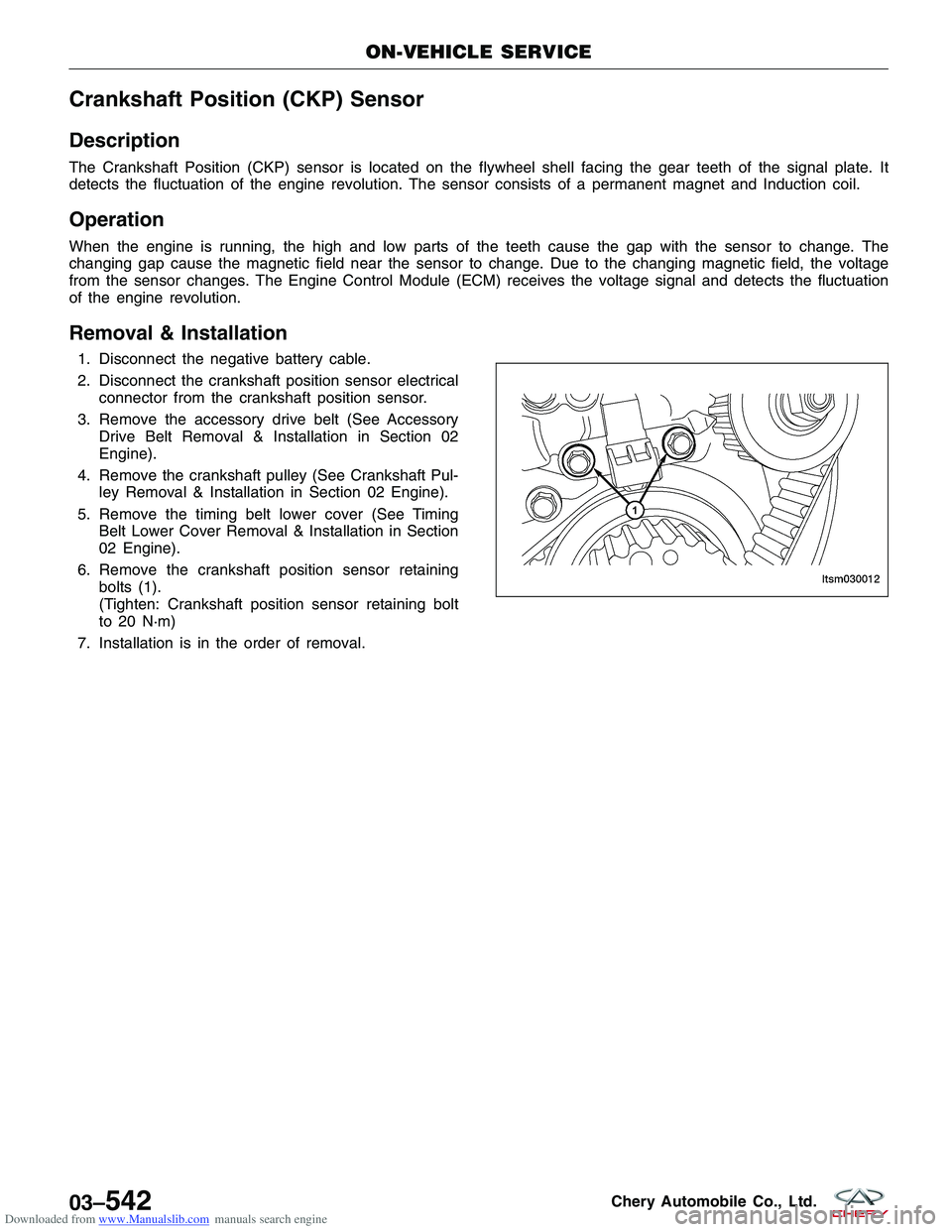
The Crankshaft Position (CKP) sensor is located on the flywheel shell facing the gear teeth of the signal plate. It
detects the fluctuation of the engine revolution. The sensor consists of a permanent magnet and Induction coil.
Operation
When the engine is running, the high and low parts of the teeth cause the gap with the sensor to change. The
changing gap cause the magnetic field near the sensor to change. Due to the changing magnetic field, the voltage
from the sensor changes. The Engine Control Module (ECM) receives the voltage signal and detects the fluctuation
of the engine revolution.
Removal & Installation
1. Disconnect the negative battery cable.
2. Disconnect the crankshaft position sensor electricalconnector from the crankshaft position sensor.
3. Remove the accessory drive belt (See Accessory Drive Belt Removal & Installation in Section 02
Engine).
4. Remove the crankshaft pulley (See Crankshaft Pul- ley Removal & Installation in Section 02 Engine).
5. Remove the timing belt lower cover (See Timing Belt Lower Cover Removal & Installation in Section
02 Engine).
6. Remove the crankshaft position sensor retaining bolts (1).
(Tighten: Crankshaft position sensor retaining bolt
to 20 N·m)
7. Installation is in the order of removal.
ON-VEHICLE SERVICE
LTSM030012
03–542Chery Automobile Co., Ltd.
Page 828 of 1903

Downloaded from www.Manualslib.com manuals search engine Symptom Diagnostic Tests
General Troubleshooting Checks
•Confirm the engine trouble light is working properly.
• Confirm that there are no DTCs recorded with the X-431 Scan Tool.
• Confirm that the customer’s complaint is current, and the conditions that are causing the failure are present.
Visual Inspection
•Check the fuel system for any fuel leakage.
• Check the vacuum system for any broken, kinked or incorrectly linked vacuum pipes or hoses.
• Check the intake air pipe for being jammed, leaking, or damaged.
• Check the ignition system for any broken or aging spark plug wires and verify the engine firing order is correct.
• Check the engine ground cable and verify a clean and tight connection.
• Check the sensors and actuators electrical connectors and verify good contact and tight connection.
NOTE :
Repair any of the above conditions first before continuing with symptom diagnostics.
Diagnostic Help
• Confirm there are no current engine DTCs.
• Confirm that the failure exists and the customer complaint can be verified.
• Inspect the engine following the above steps and verify all engine features are operating properly.
• While servicing the vehicle, verify the service record, vehicle maintenance, engine compression pressures,
mechanical ignition timing and fuel conditions.
• If replacing the Engine Control Module (ECM), carry out the validation test. If the failure no longer exists, the
failure is in the ECM; if the failure still exists, reinstall the original ECM and repeat the diagnostic test.
Symptom Diagnostic Test List
SYMPTOM DEFINITION
Engine Cranks Normal But Will Not Start
Engine Will Not Crank
Hard Start / Long Crank Time
Fast Idle
Lack / Loss Of Power
Back Fires
Engine Poor Driveability
Low Idle / Stalls During Deceleration
Idle Speed Slow Return To Normal Idle
ELECTRONIC ENGINE CONTROLS - 2.4L ENGINE SYMPTOM DIAGNOSIS
03–544Chery Automobile Co., Ltd.
Page 849 of 1903
Downloaded from www.Manualslib.com manuals search engine IGNITION CONTROL
GENERAL INFORMATION03-566
Description 03-566
Operation 03-566
Specifications 03-566
Special Tools 03-567
Electrical Schematics 03-568
ON-VEHICLE SERVICE03-571
Ignition Coil 1.6L & 1.8L & 2.0L 03-571
Description 03-571
Operation 03-571
Removal & Installation 03-571Ignition Coil 2.4L
03-572
Description 03-572
Operation 03-572
Removal & Installation 03-572
Spark Plug Wire 1.6L & 1.8L & 2.0L 03-573
Removal & Installation 03-573
Spark Plug Wire 2.4L 03-574
Removal & Installation 03-574
Spark Plug 1.6L & 1.8L & 2.0L 03-574
Removal & Installation 03-574
Spark Plug 2.4L 03-575
Removal & Installation 03-575
03
03–565Chery Automobile Co., Ltd.
Page 855 of 1903
Downloaded from www.Manualslib.com manuals search engine ON-VEHICLE SERVICE
Ignition Coil 1.6L & 1.8L & 2.0L
Description
The ignition coil consists of primary and secondary groups of wire. The primary wire is located on one end of the coil.
One end of the wire is connected to power and the other end is connected to the Engine Control Module (ECM). The
secondary coil connects two spark plugs. They form a loop and provide high-voltage output.
Operation
When the primary wire is connected to power, current will flow causing a strong magnetic field to form. When the
primary wire is disconnected, the magnetic field will collapse into the secondary wire causing very high voltage out-
put.
Removal & Installation
1. Remove the engine cover.
2. Disconnect the negative battery cable.
3. Disconnect the ignition coil electrical connector.
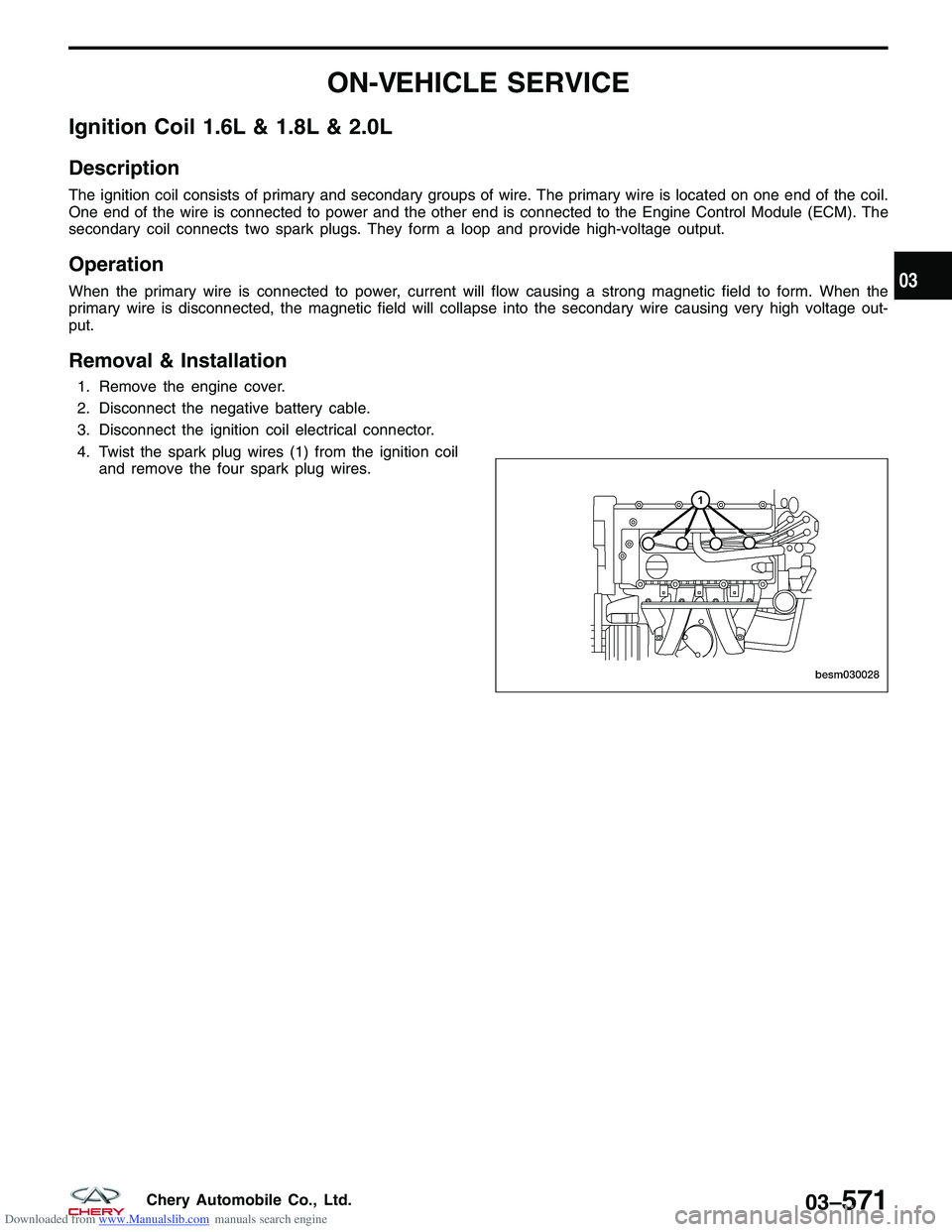
4. Twist the spark plug wires (1) from the ignition coiland remove the four spark plug wires.
BESM030028
03
03–571Chery Automobile Co., Ltd.