heating CHEVROLET ASTRO 1996 User Guide
[x] Cancel search | Manufacturer: CHEVROLET, Model Year: 1996, Model line: ASTRO, Model: CHEVROLET ASTRO 1996Pages: 372, PDF Size: 21.51 MB
Page 187 of 372
Trailer Brakes
If your trailer weighs more than 1,000 lbs. (450 kg)
loaded, then it needs its own brakes
-- and they must be
adequate. Be sure
to read and follow the instructions for
the trailer brakes
so you’ll be able to install, adjust and
maintain them properly.
Your trailer brake system can tap into your vehicle’s
hydraulic brake system, except:
a
a
a
Don’t tap into your vehicle’s brake system if
the trailer’s brake system will use more than
0.02 cubic inch (0.3 cc) of fluid from your vehicle’s
master cylinder. If
it does, both braking systems
won’t work well.
You could even lose your brakes.
Will the trailer parts take
3,000 psi (20 650 kPa) of
pressure? If not, the trailer brake system must
not be
used with your vehicle.
If everything checks out this far, then make the brake
fluid tap at the port
on the master cylinder that sends ’
fluid to the rear brakes. But don’t use copper tubing
for this. If
you do, it will bend and finally break off.
Use steel brake tubing.
Driving with a Trailer
A CAUTION:
If you have a rear-most window open and you
pull
a trailer with your vehicle, carbon monoxide
(CO) could come into your vehicle. You can’t see
or smell CO. It can cause unconsciousness or
death. (See “Engine Exhaust” in the Index.)
To
maximize your safety when towing a trailer:
Have your exhaust system inspected for
leaks, and make necessary repairs before
starting on your trip.
Keep the rear-most windows closed.
If exhaust does come into your vehicle
through
a window in the rear or another
opening,
drive with your front, main
heating or cooling system
on and with the
fan on any speed. This will bring fresh,
outside air into your vehicle.
Do not use
MAX A/C because it only recirculates the
air inside your vehicle. (See “Comfort
Controls” in the Index.)
4-33
Page 189 of 372
Making Turns
NOTICE:
Making very sharp turns while trailering could
cause the trailer to come in contact with the
vehicle. Your vehicle could
be damaged. Avoid
making very sharp turns while trailering.
When you’re turning with a trailer, make wider turns than
normal.
Do this so your trailer won’t strike soft shoulders,
curbs, road signs, trees or other objects. Avoid jerky or
sudden maneuvers. Signal well in advance.
Tbrn Signals When Towing a Trailer
When you tow a trailer, your vehicle has to have extra
wiring and a heavy-duty turn signal flasher (included
in
the optional trailering package).
The green arrows on your instrument panel will flash
whenever you signal a turn or lane change. Properly
hooked up, the trailer lamps will also flash, telling other
drivers you’re about to turn, change lanes or stop. When
towing
a trailer, the green arrows on your
instrument panel will flash for turns even if the bulbs
on
the trailer are burned out. Thus, you may think drivers
behind you are seeing your signal when they are not. It’s
important
to check occasionally to be sure the trailer
bulbs are still working.
Driving On Grades
Reduce speed and shift to a lower gear before you start
down a long or steep downgrade. If
you don’t shift
down, you might have to use your brakes
so much that
they would get hot and
no longer work well.
On a long uphill grade, shift down and reduce your
speed to around
45 mph (70 km/h) to reduce the
possibility
of engine and transmission overheating.
When towing at high altitude on steep uphill grades,
consider the following: Engine coolant will boil at a
lower temperature than at normal altitudes. If you turn
your engine off immediately after towing at high altitude
on steep uphill grades, your vehicle may show signs
similar to engine overheating.
To avoid this, let the
engine run while parked (preferably on level ground)
with the automatic transmission in
PARK (P) for a few
minutes before turning
the engine off. If you do get the
overheat warning, see “Engine Overheating” in
the Index.
4-35
Page 205 of 372
Engine Overheating
You will find a temperature gage on your vehicle’s
instrument panel.
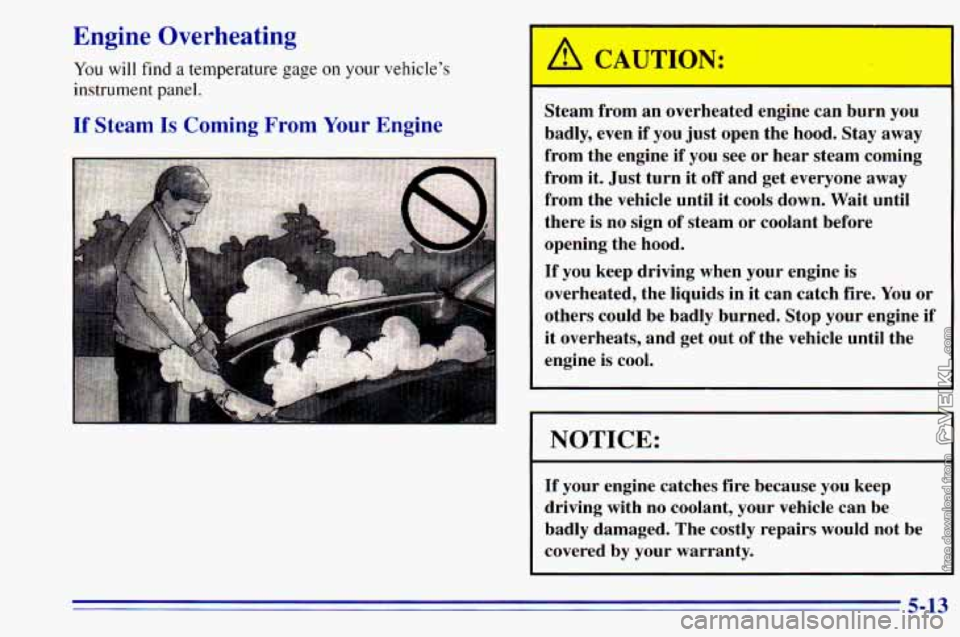
If Steam Is Coming From Your Engine
Steam from an overheated engine can burn you
badly, even if you just open the hood.
Stay away
from the engine if you see or hear steam coming
from it. Just turn it off and get everyone away
from the vehicle until it cools down. Wait until
there is no sign of steam or coolant before
opening the hood.
If you keep driving when your engine is
overheated, the liquids in it can catch fire. You or
others could be badly burned. Stop your engine if
it overheats, and get out of the vehicle until the
engine is cool.
I NOTICE:
If your engine catches fire because you keep
driving with no coolant, your vehicle can be
badly damaged. The costly repairs would not be
covered by your warranty.
5-13
Page 255 of 372
What to Use Rear Axle
When to Check and Change Lubricant
Refer to the Maintenance Schedule to determine how
often to check the lubricant and when
to change it. See
“Scheduled Maintenance Services” in the Index.
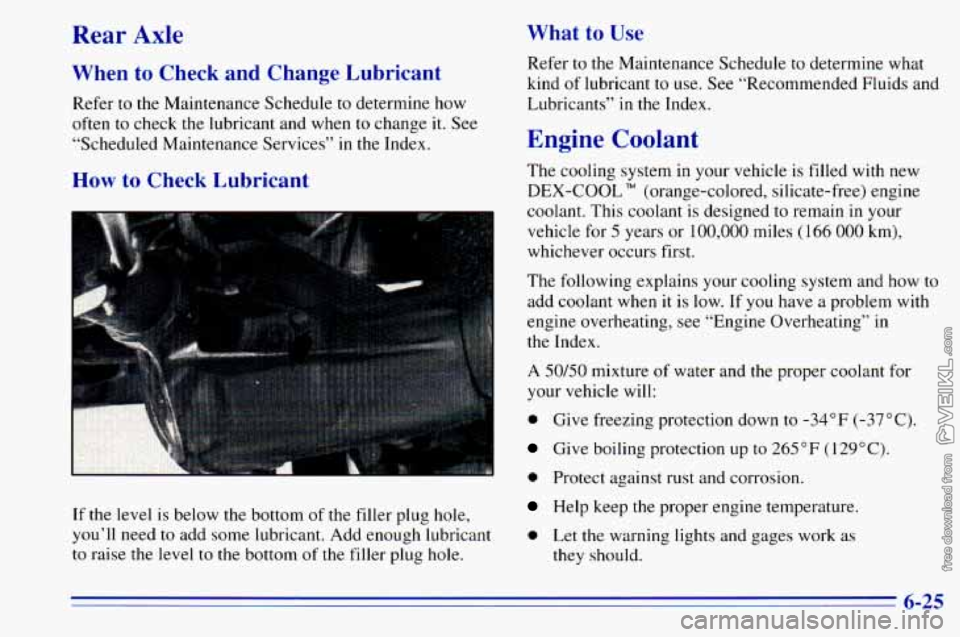
How to Check Lubricant
If the level is below the bottom of the filler plug hole,
you’ll need to add some lubricant. Add enough lubricant
to raise the level to the bottom of the filler plug hole. Refer
to the Maintenance Schedule to determine what
kind of lubricant
to use. See “Recommended Fluids and
Lubricants” in the Index.
Engine Coolant
The cooling system in your vehicle is filled with new
DEX-COOL (orange-colored, silicate-free) engine
coolant. This coolant is designed to remain in your
vehicle for
5 years or 100,000 miles (166 000 km),
whichever occurs first.
The following explains your cooling system and how to
add coolant when it is low. If
you have a problem with
engine overheating, see “Engine Overheating’’ in
the Index.
A 50/50 mixture of water and the proper coolant for
your vehicle will:
0 Give freezing protection down to -34°F (-37°C).
Give boiling protection up to 265 “F (1 29°C).
0 Protect against rust and corrosion.
Help keep the proper engine temperature.
0 Let the warning lights and gages work as
they should.
6-25
Page 259 of 372
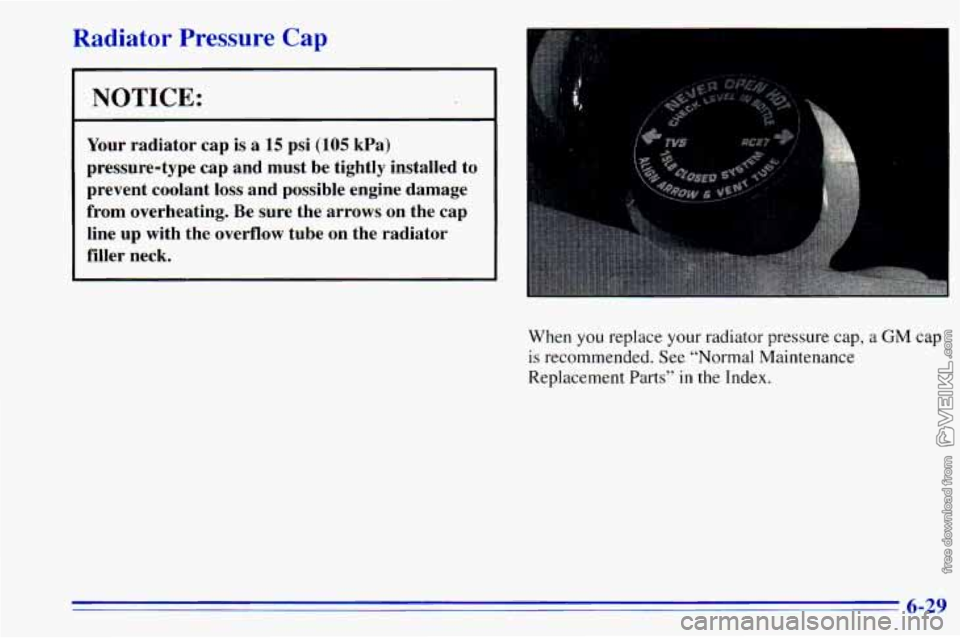
Radiator Pressure Cap
NOTICE:
Your radiator cap is a 15 psi (105 kPa)
pressure-type cap and must be tightly installed to
prevent coolant loss and possible engine damage
from overheating. Be sure the arrows on the cap
line
up with the overflow tube on the radiator
filler neck.
When you replace your radiator pressure cap, a GM cap
is recommended. See “Normal Maintenance
Replacement Parts” in the Index.
6-29
Page 272 of 372
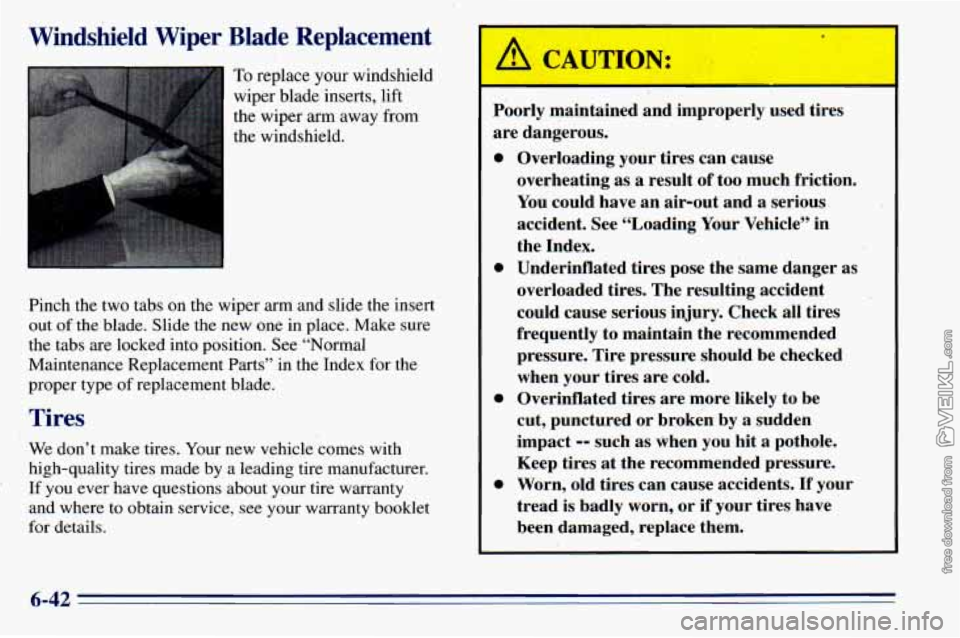
Windshield Wiper Blade Replacement
To replace your windshield
wiper blade ‘inserts, lift
the wiper arm away‘from
the windshield.
Pinch the two tabs on the wiper arm and slide
the ins1 ert
out of the blade. Slide the new one in place. Make sure
the tabs are locked into position. See “Normal
Maintenance Replacement
Parts” in the Index for the
proper type of replacement blade.
Tires
We don’t make tires. Your new vehicle comes with
high-quality tires made by a leading tire manufacturer.
‘ If you ever have questions about your tire warranty
and where to obtain service,
see your wai-ranty booklet
for details.
A CAUTION:
0
0
0
0
I
Poorly maintained and improperly used tires
are dangerous.
Overloading your tires can cause
overheating as a result of too much friction.’
You could have an air-out and a serious
accident. See “Loading Your Vehicle” in
the Index.
Underinflated tires pose the same danger as
overloaded tires. The resulting accident could cause serious injury. Check all tires
frequently to maintain the recommended
pressure. Tire pressure should be checked
when your tires are cold.
Overinflated tires are more likely to be
cut, punctured or broken by a sudden
impact
-- such as When you hit a pothole.
Keep tires
at the recommended pressure.
Worn, old tires can cause accidents.
If your
tread
is badly worn, or if your tires have
been damaged, replace them.
6-42
Page 363 of 372
Damage. Finish ........................ . . 6-56
Damage. Sheet Metal
............................ 6-56
Daytime Running Lamps
......................... 2-36
Daytime Running Lamps Indicator Light
............ 2-62
Dead Battery
................................... 5-2
Defects. Reporting Safety
......................... 8-8
Defensive Driving ............................... 4- 1
Defogger. Rear Window .......................... 3-7
Defrosting
..................................... 3-6
Dimensions. Vehicle
............................ 6-69
Dome Lamps
.................................. 2-37
Door Locks
....................................... 2-5
Sliding ...................................... 2-9
DrivePosition
................................. 2-20
DriverPosition
................................. 1-16
Driving City
........................................ 4-17
Defensive
.................................... 4-1
Drunken ..................................... 4-2
Freeway
.................................... 4-18
InaBlizzard ................................. 4-24
In Foreign Countries ........................... 6-4
In the Rain .................................. 4-14
Night
...................................... 4-13
OnCurves
................................... 4-8
On Grades While Towing
a Trailer ............... 4-35
On Hill and Mountain Roads
.................... 4-20
On Snow and Ice
............................. 4-22
Through Water
................... ....... 4-16
WetRoads
.................................. 4-14
Winter ...................................... 4-22
With a Trailer ................................ 4-33
Drunken Driving
................................ 4-2 Electrical
Equipment. Adding
........ 2- 16. 3.26. 6-60
Electrical System
............................... 6-60
Engine ........................................ 4-9
Coolant
..................................... 6-25
Coolant Heater
............................... 2-16
Coolant Level Check
.......................... 7-41
Cooling System Capacity
....................... 6-67
Cover
...................................... 6-15
Exhaust
..................................... 2-26
FuseBlocks
............................ 6-61. 6-64
Identification
................................ 6-59
OilLevelCheck
.............................. 7-41
Overheating
................................. 5-13
Running While Parked
......................... 2-26
Specifications
................................ 6-67
Starting
..................................... 2-15
Temperature Gage
............................ 2-62
Engineoil
.................................... 6-11
Adding
..................................... 6-12
Additives
................................... 6-14
Checking
................................... 6-12
Pressure Gage
........................... .... 2-60
Used
....................................... 6-15
Whentochange .............................. 6-14
Exhaust. Engine
................................ 2-26
Express-Down Window
........................ 2-28
Fabric Cleaning
............................... 6-50
Fiberglass Springs
.............................. 6-57
Filling Your Tank
................................ 6-5
Filter. Air
..................................... 6-69
Filter. Engine Oil
............................... 6-69
Finish Care
.................................... 6-54
9-3
Page 364 of 372
Finish Damage ................................. 6-56
First Gear
..................................... 2-20
Flashers. Hazard Warning
......................... 5-1
Flat Tire. Changing ............................. 5-23
Fluid Capacities
................................ 6-67
Fluids and Lubricants
............................ 7-47
Foreign Countries. Fuel
........................... 6-4
French Language Manual
11
Front Axle .................................... 6-24
Front Storage Area
.............................. 2-40
Front Towing
.............................. 5-9. 5- 10
Front Turn Signal Lamp Bulb Replacement .......... 6-40
Fuel
.......................................... 6-3
Canada
...................................... 6-3
Filling Your Tank
.............................. 6-5
Gage
....................................... 2-63
In Foreign Countries
........................... 6-4
Regulator
................................... 2-16
Fuses
and Circuit Breakers ....................... 6-61
Gages
.. ...........................
Engine Coolant Temperature .................... 2-62
Engine Oil Pressure
........................... 2-60
Fuel
....................................... 2-63
Garage Door Opener
............................ 2-43
Gear Positions. Automatic Transmission
............. 2- 18
GloveBox .................................... 2-40
Gross Axle Weight Rating
........................ 4-26
Gross Vehicle Weight Rating
...................... 4-26
Guide en FranGais
11
GVWR ....................................... 4-26
GAWR
....................................... 4-26
.. .................................
Halogen
Bulbs ................................ 6-36
Hatch Release
.................................. 2-11
Hazard Warning Flashers .......................... 5-1
Head Restraints ................................. 1-5
Headlamps .................................... 2-35
Bulb Replacement
............................ 6-36
Highkow Beam Changer
...................... 2-30
OnReminder
................................ 2-36
Wiring
..................................... 6-60
Hearing Impaired. Customer Assistance
.............. 8-3
Heating ........................................ 3-5
High-Beam Headlamps
.......................... 2-30
Highway Hypnosis
.............................. 4-20
Hill and Mountain Roads
......................... 4-20
Hitches. Trailer
................................. 4-32
Hood Checking Things Under
......................... 6-7
Prop
....................................... 6-10
Release
...................................... 6-8
Horn
......................................... 2-29
Hydroplaning
.................................. 4-16
Ignition Positions
.............................. 2-14
Inflation. Tire
.................................. 6-43
Inside Daymight Rearview Mirror
................. 2-38
Inspections
.................................... 7-45
Brakesystem
................................ 7-46
Drive Axle
.................................. 7-46
Exhaust Systems
............................. 7-45
Radiator and Heater Hose
...................... 7-45
Steering
.................................... 7-45
Suspension
.................................. 7-45
Throttle Linkage
.............................. 7-45
9-4
Page 366 of 372
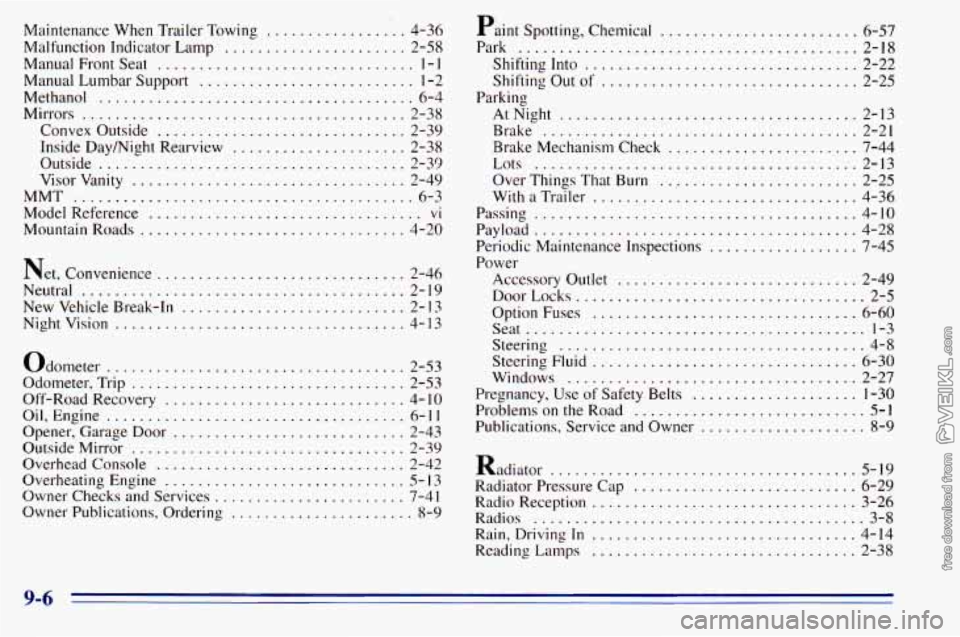
Maintenance When Trailer Towing ............... 4-36
Malfunction Indicator Lamp
...................... 2-58
ManualFrontSeat
............................... 1-1
Manual Lumbar Support .......................... 1-2
Methanol
...................................... 6-4
Mirrors
....................................... 2-38
Convex Outside
.............................. 2-39
Inside Day/Night Rearview
..................... 2-38
Outside
..................................... 2-39
Visor Vanity ................................. 2-49
MMT
......................................... 6-3
ModelReference
................................. vi
Mountain Roads ........ ................ 4-20
Net. Convenience
.............................. 2-46
Neutral
....................................... 2-19
New Vehicle Break-In
........................... 2- I3
Nightvision
................................... 4-13
Odometer
.................................... 2-53
Odometer. Trip
................................. 2-53
Off-Road Recovery
............................. 4- IO
Oil. Engine .................................... 6-11
Opener. Garage Door ............................ 2-43
Outside Mirror
................................. 2-39
Overhead Console
.............................. 2-42
Overheating Engine
............................. 5- I3
Owner Checks and Services
....................... 7-41
Owner Publications. Ordering ...................... 8-9
Paint Spotting. Chemical ........................ 6-57
Park
......................................... 2-18
Shifting Into
................................. 2-22
Shifting Out
of ............................... 2-25
AtNight
.................................... 2-13
Brake ...................................... 2-21
Brake Mechanism Check
....................... 7-44
Lots
....................................... 2-13
Over Things That Burn
......................... 2-25
With
a Trailer ................................ 4-36
Passing
....................................... 4-10
Payload
....................................... 4-28
Periodic Maintenance Inspections
.................. 7-45
Power Accessory Outlet
............................. 2-49
DoorLocks
................................... 2-5
Option Fuses
................................ 6-60
Seat ......................................... 1-3
Steering ..................................... 4-8
Steering Fluid
................................ 6-30
Windows
.................................... 2-27
Pregnancy, Use of Safety Belts
.................... 1-30
Problems on the Road
............................ 5-1
Publications, Service and Owner .................... 8-9
Parking
Radiator
..................................... 5-19
Radiator Pressure Cap ........................... 6-29
Radio Reception
................................ 3-26
Radios
........................................ 3-8
Rain. Driving In ................................ 4-14
Reading
Lamps ................................ 2-38
9-6
Page 367 of 372
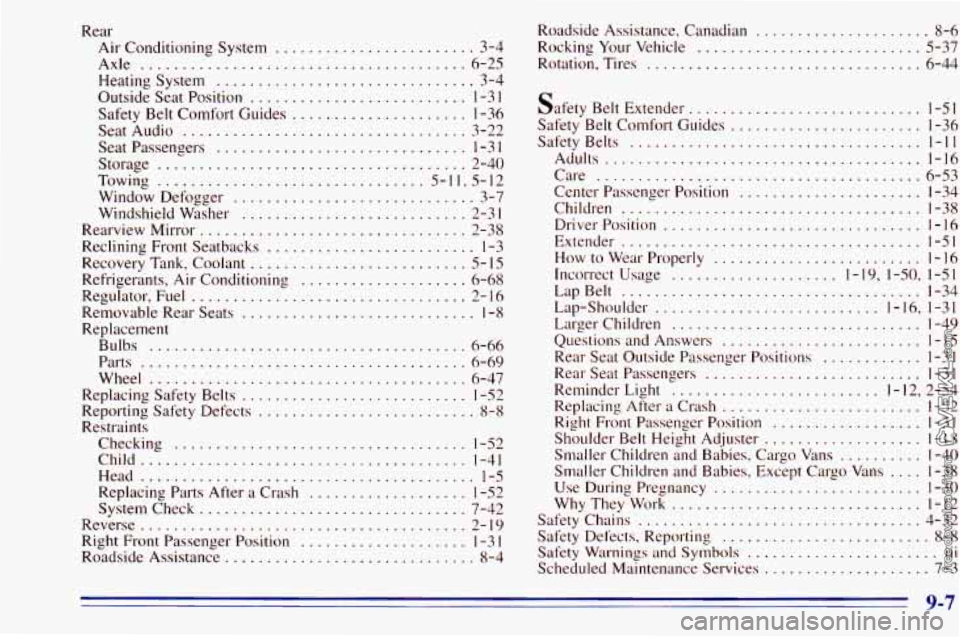
Rear Air Conditioning System
.................... 3-4
Axle
....................................... 6-25
Heating System
............................... 3-4
Outside Seat Position
.......................... 1-3 I
Safety Belt Comfort Guides ..................... 1-36
SeatAudio
.................................. 3-22
Seatpassengers
.............................. 1-31
Storage
..................................... 2-40
Towing
................................ 5.11. 5.12
Window Defogger
............................. 3-7
Windshield Washer
........................... 2-3 I
Rearview Mirror ................................ 2-38
Reclining Front Seatbacks
......................... 1-3
Recovery Tank, Coolant
.......................... 5- 15
Refrigerants. Air Conditioning
.................... 6-68
Regulator.
Fuel ................................. 2- 16
Removable Rear Seats ............................ 1-8
Replacement Bulbs
...................................... 6-66
Parts
....................................... 6-69
Wheel
...................................... 6-47
Replacing Safety Belts
........................... 1-52
Reporting Safety Defects
.......................... 8-8
Restraints Checking
................................... 1-52
Child ....................................... 1-41
Head
........................................ 1-5
Replacing Parts After
a Crash ................... 1-52
Systemcheck
................................ 7-42
Reverse
....................................... 2-19
Right Front Passenger Position
.................... 1-3 I
Roadside Assistance .............................. 8-4 Roadside Assistance. Canadian
......... ....... 8-6
Rocking Your Vehicle
........................... 5-37
Rotation. Tires
...................... ...... 6-44
Safety Belt Extender
............................ 1-51
Safety Belt Comfort Guides
....................... 1-36
Safety Belts
................................... 1 . 11
Adults ...................................... 1-16
Care
....................................... 6-53
Center Passenger Position
...................... 1-34
Children
.................................... 1-38
Driver Position
............................... 1-16
Extender
.................................... 1-51
How
to Wear Properly ......................... 1-16
Incorrect Usage
.................... 1.19. 1-50, 1-51
LapBelt
.................................... 1-34
Lap-Shoulder
........................... 1 . 16, 1-3 1
Questions and Answers ........................ 1 . 15
Rear Seat Outside Passenger Positions
............ 1-31
Rear Seat Passengers
.......................... 1-31
Reminder Light
......................... 1 - 12. 2-54
Replacing Atter
a Crash ........................ 1-52
Right Front Passenger Position .................. 1-31
Shoulder Belt Height Adjuster
................... 1 . 18
Smaller Children and Babies. Cargo Vans .......... 1-40
Smaller Children and Babies. Except Cargo Vans
.... 1-38
Use During Pregnancy
......................... 1-30
WhyThey Work
.............................. 1-12
Safety Defects. Reporting ......................... 8-8
Safety Warnings and Symbols
....................... 111
Scheduled Maintenance Services .................... 7-3
Larger Children
.............................. 1-49
Safety Chains
.................................. 4-32
...
9-7