oil CHEVROLET ASTRO 1996 Owner's Manual
[x] Cancel search | Manufacturer: CHEVROLET, Model Year: 1996, Model line: ASTRO, Model: CHEVROLET ASTRO 1996Pages: 372, PDF Size: 21.51 MB
Page 255 of 372
What to Use Rear Axle
When to Check and Change Lubricant
Refer to the Maintenance Schedule to determine how
often to check the lubricant and when
to change it. See
“Scheduled Maintenance Services” in the Index.
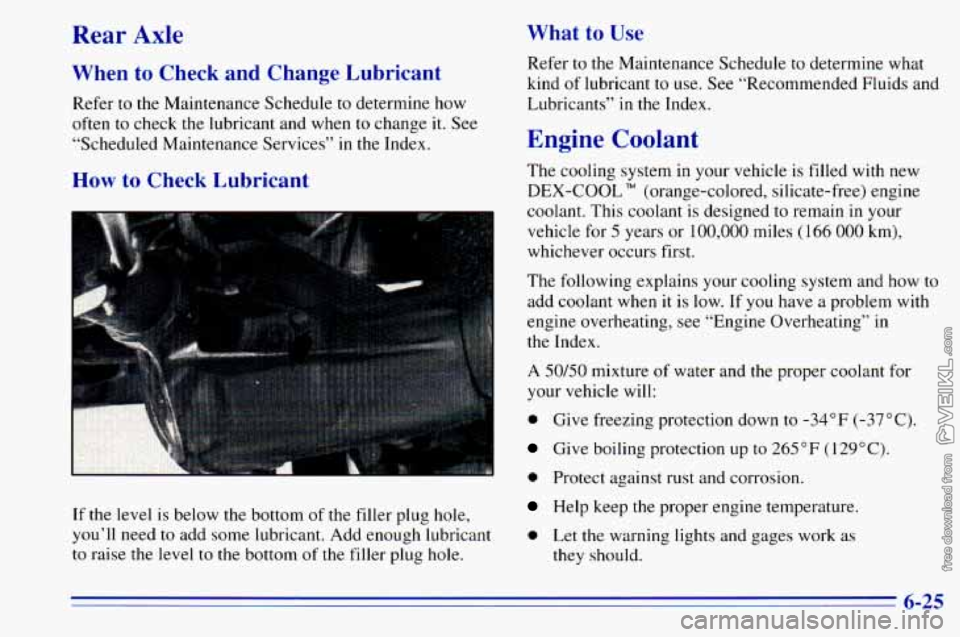
How to Check Lubricant
If the level is below the bottom of the filler plug hole,
you’ll need to add some lubricant. Add enough lubricant
to raise the level to the bottom of the filler plug hole. Refer
to the Maintenance Schedule to determine what
kind of lubricant
to use. See “Recommended Fluids and
Lubricants” in the Index.
Engine Coolant
The cooling system in your vehicle is filled with new
DEX-COOL (orange-colored, silicate-free) engine
coolant. This coolant is designed to remain in your
vehicle for
5 years or 100,000 miles (166 000 km),
whichever occurs first.
The following explains your cooling system and how to
add coolant when it is low. If
you have a problem with
engine overheating, see “Engine Overheating’’ in
the Index.
A 50/50 mixture of water and the proper coolant for
your vehicle will:
0 Give freezing protection down to -34°F (-37°C).
Give boiling protection up to 265 “F (1 29°C).
0 Protect against rust and corrosion.
Help keep the proper engine temperature.
0 Let the warning lights and gages work as
they should.
6-25
Page 256 of 372
NOTICE:
When adding coolant it is important that you use
DEX-COOL
TM (orange-colored, silicate-free)
coolant meeting
GM Specification 6277M.
If silicated coolant is added to the system,
premature engine, heater core or radiator
corrosion may result. In addition, the engine
coolant will require change sooner
-- at
30,000 miles (50 000 km) or 24 months,
whichever occurs first.
What to Use
Use a mixture
of one-half clean water (preferably
distilled) and one-half
DEX-COOL (orange-colored,
silicate-free) antifreeze that meets GM Specification
6277M, which won’t damage aluminum parts. Use GM
Engine Coolant Supplement (sealer)
(GM Part
No. 3634621) with any complete coolant change. If you
use this mixture, you don’t need to add anything else.
A CAUTION:
I
Adding only plain water to your cooling system
can be dangerous. Plain water, or some other
liquid like alcohol, can boil before the proper
coolant mix will. Your vehicle’s coolant warning
system is set for the proper coolant mix. With
plain water or the wrong mix, your engine could
get too hot but
you wouldn’t get the overheat
warning. Your engine could catch fire and you or
others could be burned. Use
a 50/50 mix of clean
water and DEX-COOL (orange-colored,
silicate-free) antifreeze.
6-26
Page 264 of 372
Using the wrong fluid can badly damage
brake system parts. For example, just
a few
drops of mineral-based oil, such as engine
oil, in your brake system can damage brake
system parts
so badly that they’ll have to be
replaced. Don’t let someone put in the
wrong kind of fluid.
If you spill brake fluid on your vehicle’s
painted surfaces, the paint finish can be
damaged. Be careful not to spill brake fluid
on your vehicle.
If you do, wash it off
immediately. See “Appearance Care” in
the Index.
I A CAUTION:
The brake wear warning sound means that
sooner or later your brakes won’t work well.
That could lead to an accident. When you hear
the brake wear warning sound, have your vehicle serviced.
NOTICE:
Continuing to drive with worn-out brake pads
could result
in costly brake repair.
Brake Wear
Your vehicle has front disc brakes and rear drum brakes.
Disc brake pads have built-in wear indicators that make
a high-pitched warning sound when the brake pads are
worn and new pads are needed.
The sound may come and
go or be heard all the time your vehicle
is moving (except
when you are pushing
on the brake pedal firmly). Some driving conditions or climates may cause a brake
squeal when the brakes are first applied or lightly applied.
This does not mean something
is wrong with your brakes.
Free movement
of brake calipers and properly torqued
wheel nuts are necessary to help prevent brake
pulsation. When tires are rotated, inspect brake calipers
for movement, brake pads for wear, and evenly torque
wheel nuts
in the proper sequence to GM specifications.
6-34
Page 281 of 372
Using Solvent-Type Cleaner on Fabric
First, see if you have to use solvent-type cleaner at all.
Some spots and stains will clean off better with just
water and mild soap.
-. If you need to use a solvent:
0 Gently scrape excess soil from the trim material with a
clean, dd1 knife or scraper. Use very little cleaner, light
pressure and clean cloths (preferably cheesecloth). Cleaning should start at the outside of the stain,
“feathering”’ toward
the center. Keep changing
to a clean section of the cloth.
0 When you clean a stain from fabric, immediately
dry the area with a blow dryer
to help prevent a
cleaning ring.
Fabric Protection
Your vehicle has upholstery and carpet that has been .
treated with Scotchgard“ Fabric Protector, a 3M
product.
It protects fabrics by repelling oil and water,
which are the carriers of most stains. Even
with this
protection, you still need to clean your upholstery and
carpet often to keep
it looking new.
Further information on cleaning is available by calling
1-800-433-3296
(in Minnesota, 1-800-642-61 67).
Special Cleaning Problems
Greasy or Oily Stains
Stains caused by grease, oil, butter, margarine, shoe
polish, coffee with cream, chewing gum, cosmetic
creams, vegetable oils, wax crayon,
tar and asphalt can
be removed as follows:
1. Carefully scrape off excess stain.
2. Follow the solvent-type instructions
described earlier.
3. Shoe polish, wax crayon, tar and asphalt will stain
if left on a vehicle’s seat fabric. They should be
removed as soon as possible.
Be careful, because
the cleaner will dissolve them and may cause them
to spread.
6-5 1
Page 282 of 372
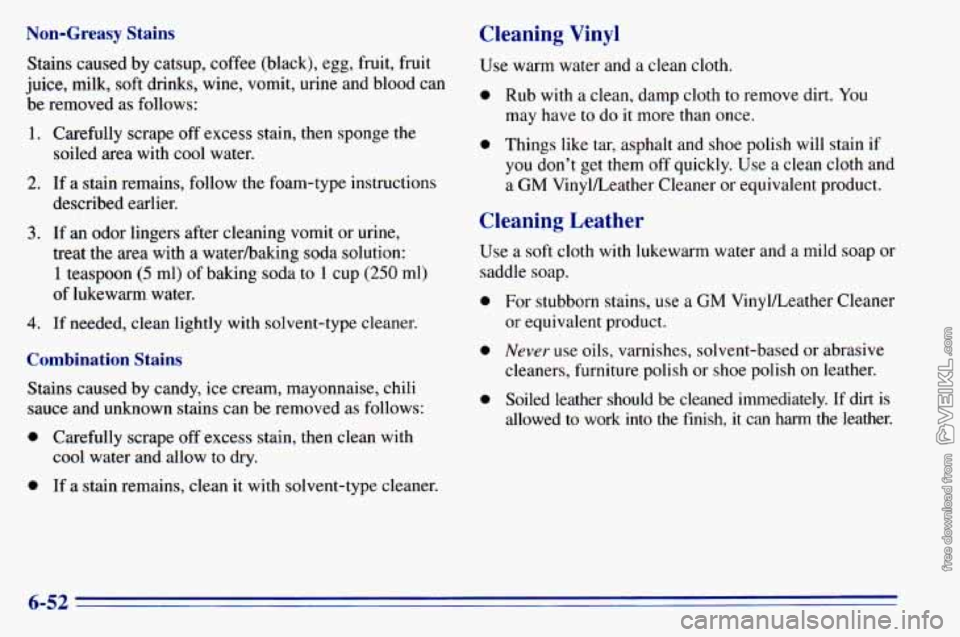
Non-Greasy Stains
Stains caused by catsup, coffee (black), egg, fruit, fruit
juice, milk, soft drinks, wine, vomit, urine and blood can
be removed as follows:
1.
2.
3.
4.
Carefully scrape off excess stain, then sponge the
soiled area with cool water.
If a stain remains, follow the foam-type instructions
described earlier.
If an odor lingers after cleaning vomit or urine,
treat the area with
a waterhaking soda solution:
1 teaspoon (5 ml) of baking soda to 1 cup (250 ml)
of lukewarm water.
If needed, clean lightly with solvent-type cleaner.
Combination Stains
Stains caused by candy, ice cream, mayonnaise, chili
sauce and unknown stains can be removed as follows:
0 Carefully scrape off excess stain, then clean with
0 If a stain remains, clean it with solvent-type cleaner.
cool
water and allow to dry.
Cleaning Vinyl
Use warm water and a clean cloth.
0 Rub with a clean, damp cloth to remove dirt. You
may have to do
it more than once.
0 Things like tar, asphalt and shoe polish will stain if
you don’t get them off quickly. Use a clean cloth and
a GM VinylLeather Cleaner or equivalent product.
Cleaning Leather
Use a soft cloth with lukewarm water and a mild soap or
saddle soap.
0 For stubborn stains, use a GM Vinylkeather Cleaner
0 Never use oils, varnishes, solvent-based or abrasive
or equivalent product.
cleaners, furniture polish or shoe polish on leather.
0 Soiled leather should be cleaned immediately. If dirt is
allowed to work into the finish, it can
harm the leather.
6-52
Page 285 of 372
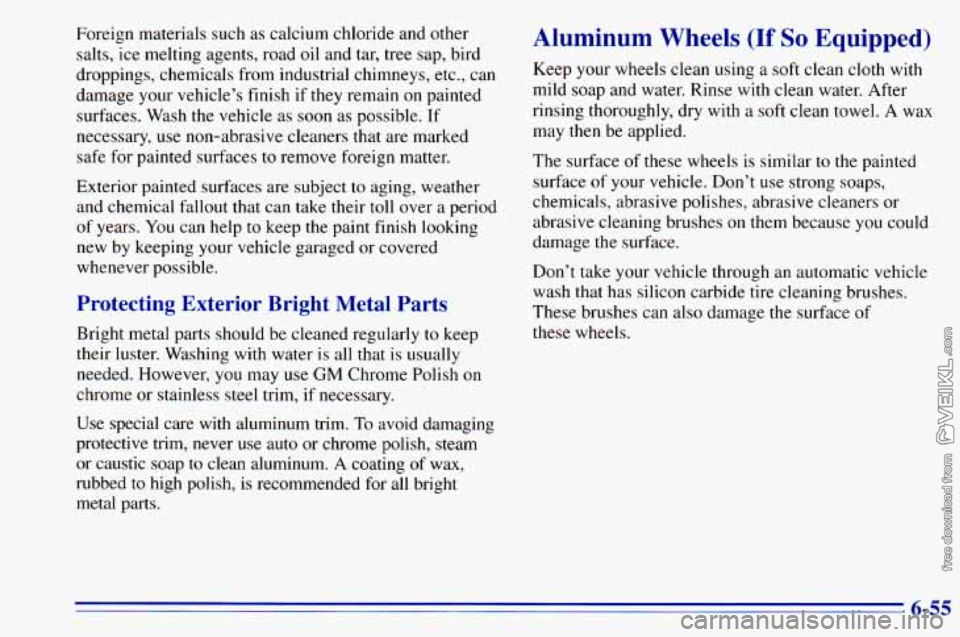
Foreign materials such as calcium chloride and other
salts, ice melting agents, road oil and tar, tree sap, bird
droppings, chemicals from industrial chimneys, etc., can
damage your vehicle’s finish if they remain on painted
surfaces. Wash the vehicle as soon as possible. If
necessary,
use non-abrasive cleaners that are marked
safe for painted surfaces
to remove foreign matter.
Exterior painted surfaces are subject to aging, weather
and chemical fallout that can take their toll over a period
of years. You can help to keep the paint finish looking
new by keeping your vehicle garaged or covered
whenever possible.
Protecting Exterior Bright Metal Parts
Bright metal parts should be cleaned regularly to keep
their luster. Washing with water is all that is usually
needed. However, you may use
GM Chrome Polish on
chrome or stainless steel trim,
if necessary.
Use special care with aluminum trim. To avoid damaging
protective trim, never use auto or chrome polish, steam
or caustic soap
to clean aluminum. A coating of wax,
rubbed to high polish, is recommended for all bright
metal parts.
Aluminum Wheels (If So Equipped)
Keep your wheels clean using a soft clean cloth with
mild soap and water. Rinse with
clean water. After
rinsing thoroughly, dry with
a soft clean towel. A wax
may
then be applied.
The surface of these wheels is similar
to the painted
surface of your vehicle. Don’t use strong soaps,
chemicals, abrasive polishes, abrasive cleaners or
abrasive cleaning brushes
on them because you could
damage the surface.
Don’t take your vehicle through an automatic vehicle
wash that has silicon carbide tire cleaning brushes.
These brushes can also damage the surface of
these wheels.
6-55
Page 288 of 372
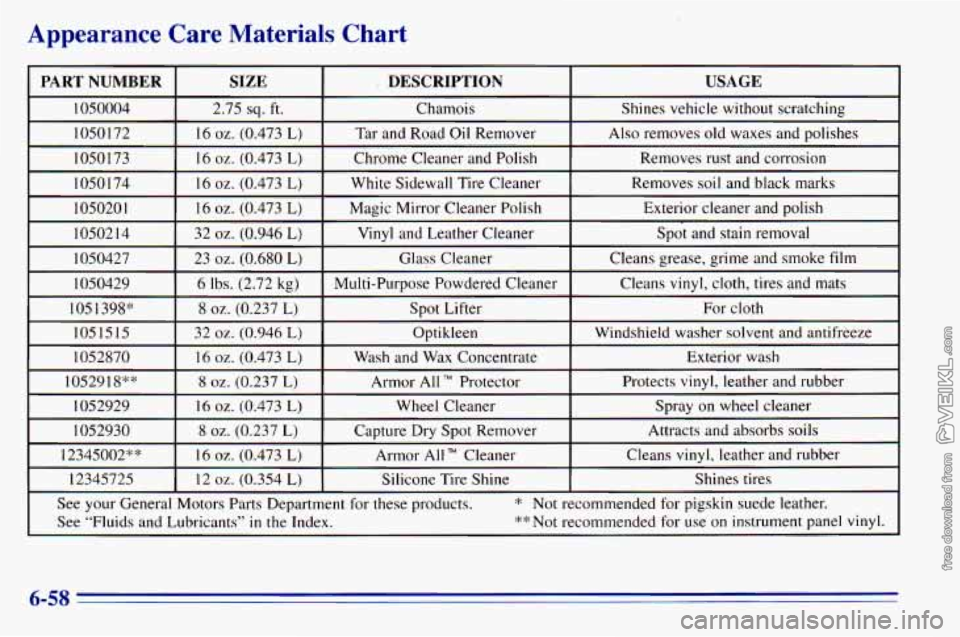
Appearance Care Materials Chart
PART NUMBER USAGE DESCRIPTION
SIZE
1050004
Exterior cleaner and polish
Magic Mirror Cleaner Polish
16
oz. (0.473 L) I05020 1
Removes soil and black marks White Sidewall Tire Cleaner 16 oz. (0.473 L) 10501 74 Removes rust and corrosion
Chrome Cleaner and Polish 16
oz. (0.473 L)
1050173 Also removes old waxes and polishes
Tar and Road Oil Remover 16
oz. (0.473 L)
1050172 Shines vehicle without scratching
Chamois
2.75
sq. ft.
~ ~~
1050214
1050427 Spot and stain removal Vinyl and Leather Cleaner
32 oz. (0.946 L)
Exterior wash
Wash and
Wax Concentrate
16 oz. (0.473 L) 1052870 Windshield washer solvent and
antifreeze
Optikleen
32
oz. (0.946 L) 1051515 For cloth
Spot Lifter
8 oz. (0.237 L) 105 1398” Cleans
vinyl, cloth, tires and mats
Multi-Purpose Powdered Cleaner 6 lbs. (2.72 kg) 1050429 Cleans
grease, grime and smoke
film Glass Cleaner 23
oz. (0.680 L)
I I I
I 1052918** I 8 oz. (0.237 L) I Armor All TM Protector I Protects vinyl, leather and rubber 1
1052929
Cleans
vinyl, leather and rubber
Armor All Cleaner
16 oz. (0.473 L) 12345002** Attracts and absorbs
soils
Capture Dry Spot Remover
8 oz. (0.237 L) 1052930 Spray on wheel cleaner Wheel Cleaner 16
oz. (0.473 L)
12345725 Shines tires
Silicone Tire Shine
12 oz. (0.354 L)
See
your General Motors Parts Department for these products. * Not recommended for pigskin suede leather.
See “Fluids and Lubricants’’
in the Index. **Not
recommended for use on instrument panel vinyl.
6-58
Page 292 of 372
12 18 24
c57 c7 E7 c7 11 17 23
4
c7 c7 E7 E7 10 16 22
3 9 15 21 C7 E7 E7 C7
2
c7 c87 c7 c3 14 20
i
c7 1 7 13 19 c7 c7 c7
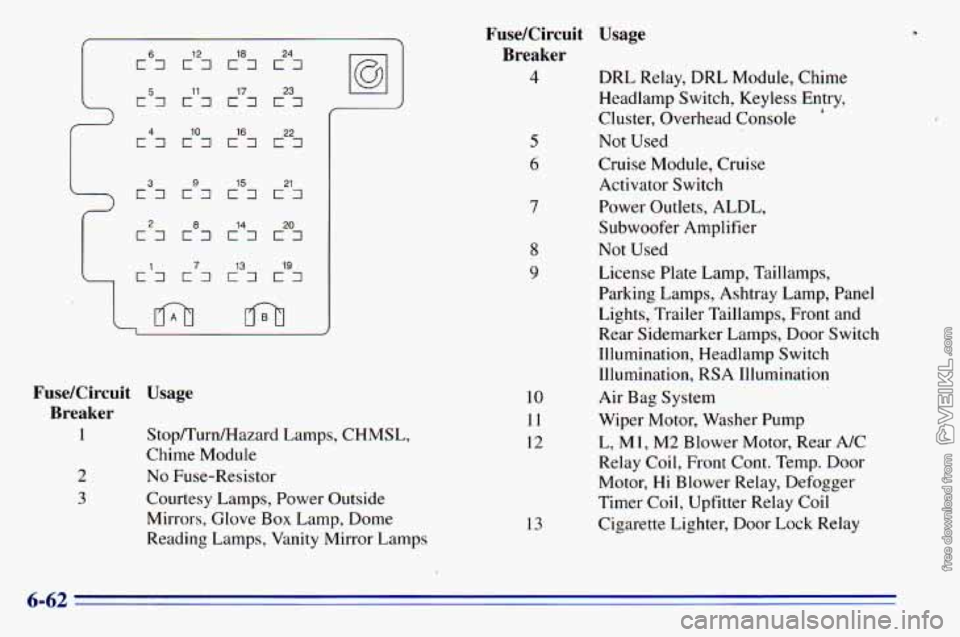
FuseKircuit Usage
Breaker
1
2
3
Stop/Turn/Hazard Lamps, CHMSL,
Chime Module
No Fuse-Resistor
Courtesy Lamps, Power Outside Mirrors, Glove Box Lamp, Dome
Reading Lamps, Vanity Mirror Lamps
10
11
12
13
FuseKircuit Usage
Breaker
4 DRL Relay, DRL Module, Chime
Headlamp Switch, Keyless Entry,
Cluster, Overhead Console
Not Used
Cruise Module, Cruise
Activator Switch
Power Outlets, ALDL,
Subwoofer Amplifier
Not Used
License Plate Lamp, Taillamps,
Parking Lamps, Ashtray Lamp, Panel
Lights, Trailer Taillamps, Front and Rear Sidemarker Lamps, Door Switch
Illumination, Headlamp Switch
Illumination, RSA Illumination
Air Bag System
Wiper Motor, Washer Pump
L, M 1, M2 Blower Motor, Rear A/C
Relay Coil, Front Cont, Temp. Door
Motor, Hi Blower Relay, Defogger
Timer Coil, Upfitter Relay Coil
Cigarette Lighter, Door Lock Relay
i
5
6
7
8
9
6-62
Page 295 of 372
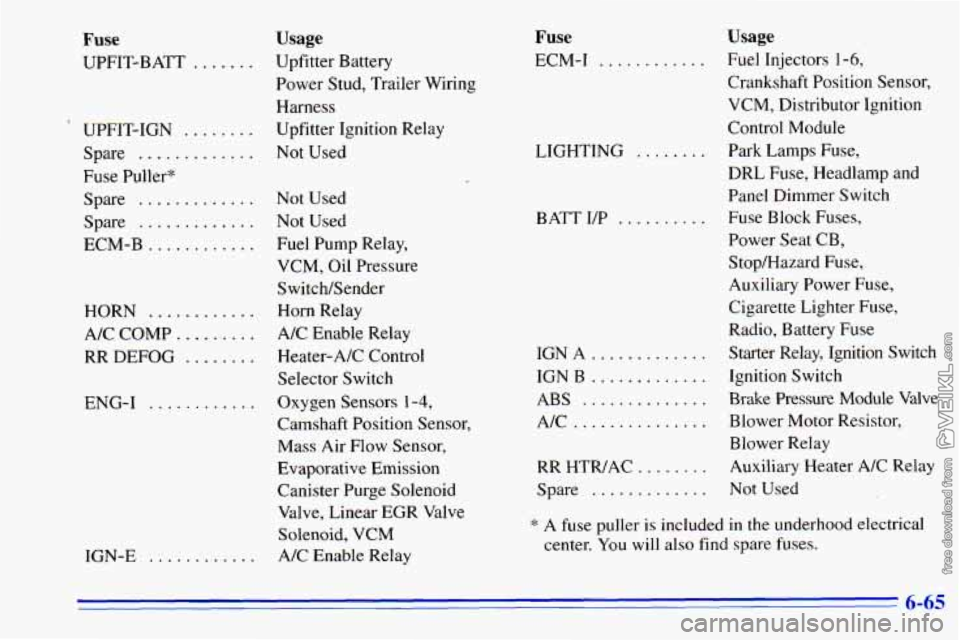
Fuse
UPFIT-BATT .......
UPFIT-IGN . .
Spare .....
Fuse Puller*
Spare
.............
Spare .............
ECM-B ............
..
..
HORN ......
A/C COMP ...
RR DEFOG .......
ENG-I ......
IGN-E
..
..
Usage
Upfitter Battery
Power Stud, Trailer Wiring
Harness Upfitter Ignition Relay
Not Used
Not Used Not Used
Fuel Pump Relay,
VCM, Oil Pressure
Switch/Sender
Horn Relay
A/C Enable Relay
Heater-A/C Control Selector Switch
Oxygen Sensors 1-4,
Camshaft Position Sensor,
Mass Air Flow Sensor,
Evaporative Emission
Canister Purge Solenoid
Valve, Linear EGR Valve
Solenoid, VCM
A/C Enable Relay
Fuse
ECM-I ..... .....
LIGHTING .....
BATT I/P .......
IGN A .............
IGN B .............
ABS ..............
AIC ...............
RR HTR/AC ........
Spare .............
Usage
Fuel Injectors 1-6,
Crankshaft Position Sensor,
VCM, Distributor Ignition
Control Module Park Lamps Fuse,
DRL Fuse, Headlamp and
Panel Dimmer Switch
Fuse Block Fuses,
Power Seat CB,
Stop/Hazard Fuse,
Auxiliary Power Fuse,
Cigarette Lighter Fuse,
Radio, Battery Fuse
Starter Relay, Ignition Switch
Ignition Switch
Brake Pressure Module Valve Blower Motor Resistor,
Blower Relay
Auxiliary Heater A/C Relay
Not Used
* A fuse puller is included in the underhood electrical
center. You
will also find spare fuses.
6-65
Page 298 of 372
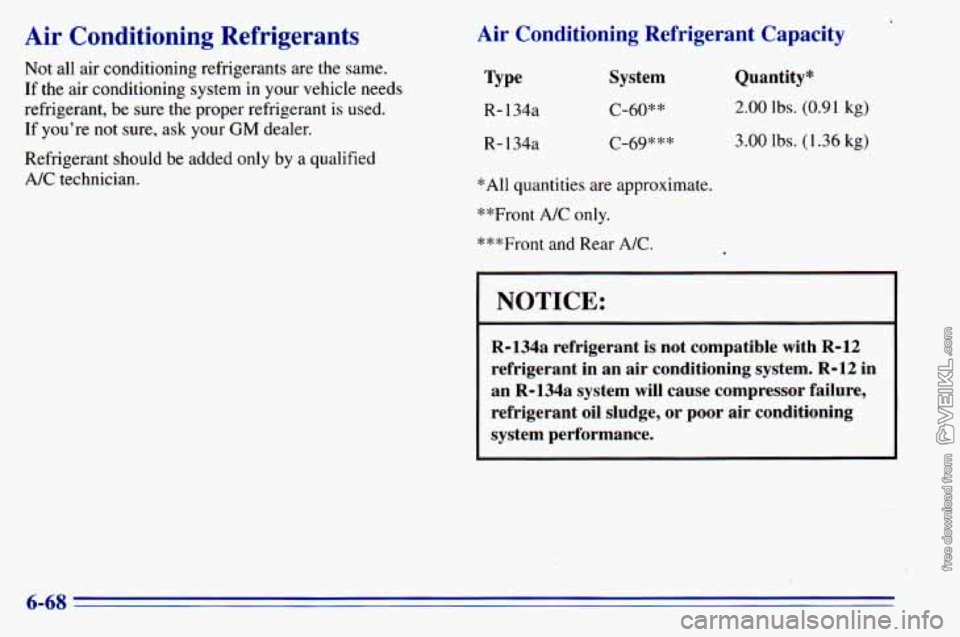
Air Conditioning Refrigerants
Not all air conditioning refrigerants are the same.
If the air conditioning system in your vehicle needs
refrigerant, be
sure the proper refrigerant is used.
If you’re not sure, ask your GM dealer.
Refrigerant should be added only by a qualified
A/C technician.
Air Conditioning Refrigerant Capacity
VPe
R- 134a
R- 134a
System
C-60**
C-69***
*All quantities are approximate.
**Front
A/C only.
***Front and Rear
A/C.
Quantity*
2.00 Ibs. (0.91 kg)
3.00 lbs. (1.36 kg)
NOTICE:
R-134a refrigerant is not compatible with R-12
refrigerant in an air conditioning system. R-12 in
an R-134a system
will cause compressor failure,
refrigerant
oil sludge, or poor air conditioning
system performance.
6-68