light CHEVROLET ASTRO 1996 Workshop Manual
[x] Cancel search | Manufacturer: CHEVROLET, Model Year: 1996, Model line: ASTRO, Model: CHEVROLET ASTRO 1996Pages: 372, PDF Size: 21.51 MB
Page 196 of 372
I A CAUTION:
Using a match near a battery can cause battery
gas to explode. People have been hurt doing this,
and some have been blinded. Use
a flashlight if
you need more light.
Be sure the battery has enough water. You’don’t
need to add water to the Delco Freedom’ battery
installed in every new
GM vehicle. But if a
battery
has filler caps, be sure the right amount
of fluid is there. If it is low, add water to take
care
of that first. If you don’t, explosive gas could
be present.
Battery fluid contains acid that can burn you.
Don’t get it on you.
If you accidentally get it in
your eyes or on your skin, flush the place with
water and get medical help immediately.
5. Check that the jumper cables don’t have loose or
missing insulation.
If they do, you could get a shock.
The vehicles could be damaged too.
Before you connect the cables, here are some basic
things you should
know. Positive (+) will go
to positive (+) and negative (-) will go to
negative (-) or a metal engine part. Don’t connect
positive
(+) to negative (-) or you’ll get a short that
would damage the battery
and maybe other
parts too.
Fans or other moving engine pa, can injure you
badly. Keep your hands
away from moving parts
once the engines are running.
5-4
Page 229 of 372
If You’re Stuck: In Sand, Mud, Ice
or Snow
What you don’t want to do when your vehicle is stuck is
to spin your wheels too fast. The method known as
“rocking” can help
you get out when you’re stuck, but
you must use caution.
A CAUTION:’
I
If you let your tires spin at high speed, they can
explode, and you or others could be injured.
And, the transmission or other parts of the
vehicle can overheat. That could cause an engine
compartment fire or other damage. When you’re
stuck, spin the wheels
as little as possible. Don’t
~ spin the wheels above 35 mph (55 km/h) as shown
~ on the speedometer.
I
NOTICE:
Spinning your wheels can destroy parts of your
vehicle
as well as the tires. If you spin the wheels
too fast while shifting your transmission back
and forth, you can destroy your transmission.
For information about using tire chains
on your vehicle,
see “Tire Chains” in
the Index.
Rocking your vehicle to get it out:
First, turn your steering wheel left and right. That will
clear the area around your front wheels. Then shift back
and forth between REVERSE
(R) and a forward gear,
spinning the wheels as little as possible. Release the
accelerator pedal while you shift, and press lightly
on
the accelerator pedal when the transmission is in gear. If
that doesn’t get
you out after a few tries, you may need
to be towed out. If you do need to be towed out, see
“Towing Your Vehicle’’’ in the Index.
5-37
Page 241 of 372
Engine Oil
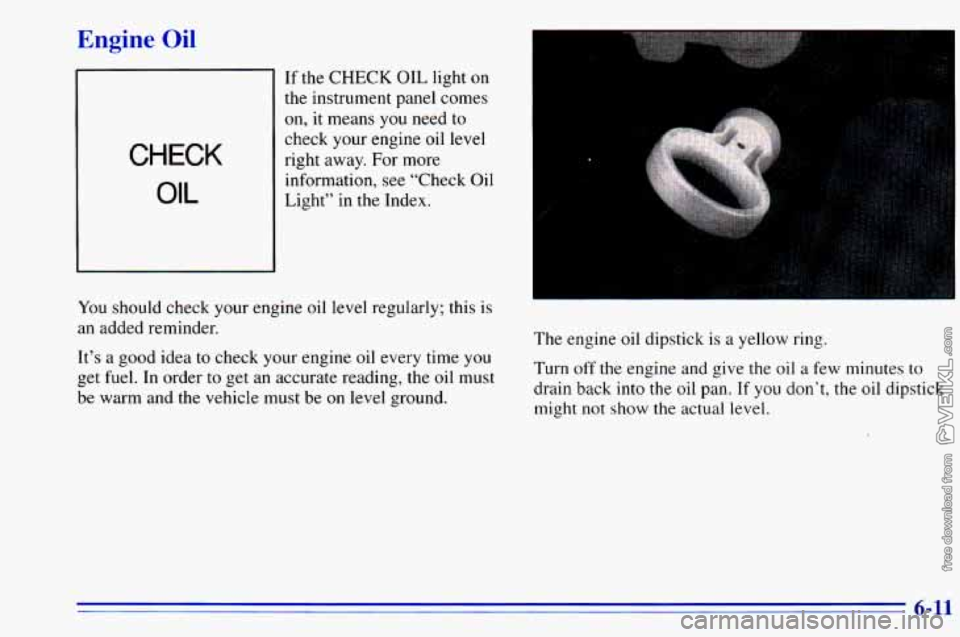
CHECK
OIL
If the CHECK OIL light on
the instrument panel comes
on, it means you need to
check your engine oil level
right away. For more information, see “Check Oil
Light” in the Index.
You should check your engine oil level regularly; this is
an added reminder.
It’s a good idea to check your engine oil every time
you
get fuel. In order to get an accurate reading, the oil must
be warm and the vehicle must be
on level ground. The
engine oil dipstick
is a yellow ring.
Turn
off the engine and give the oil a few minutes to
drain back into the oil pan. If you don’t, the oil dipstick
might not show the actual
level.
6-11
Page 255 of 372
What to Use Rear Axle
When to Check and Change Lubricant
Refer to the Maintenance Schedule to determine how
often to check the lubricant and when
to change it. See
“Scheduled Maintenance Services” in the Index.
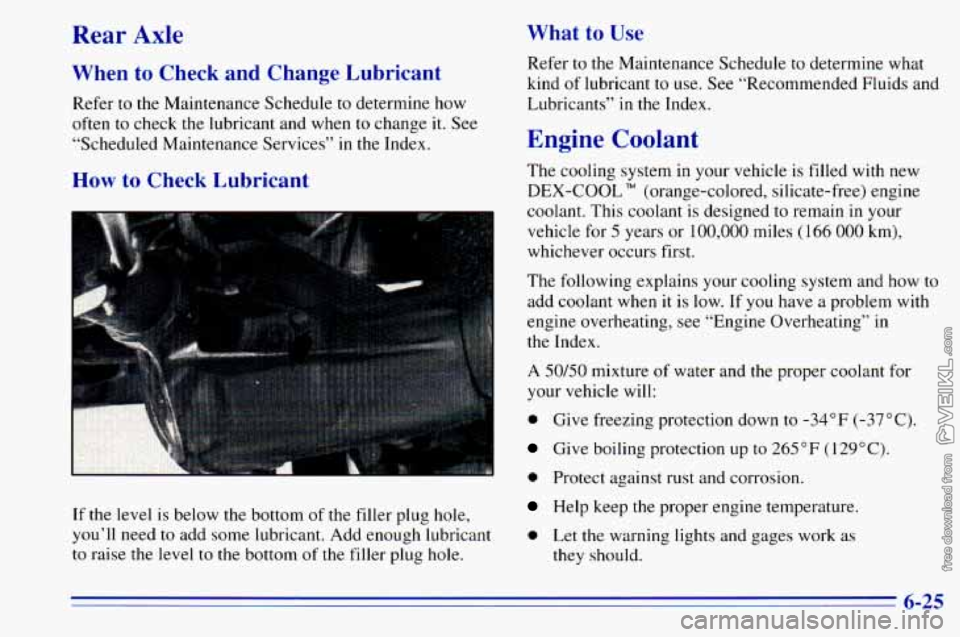
How to Check Lubricant
If the level is below the bottom of the filler plug hole,
you’ll need to add some lubricant. Add enough lubricant
to raise the level to the bottom of the filler plug hole. Refer
to the Maintenance Schedule to determine what
kind of lubricant
to use. See “Recommended Fluids and
Lubricants” in the Index.
Engine Coolant
The cooling system in your vehicle is filled with new
DEX-COOL (orange-colored, silicate-free) engine
coolant. This coolant is designed to remain in your
vehicle for
5 years or 100,000 miles (166 000 km),
whichever occurs first.
The following explains your cooling system and how to
add coolant when it is low. If
you have a problem with
engine overheating, see “Engine Overheating’’ in
the Index.
A 50/50 mixture of water and the proper coolant for
your vehicle will:
0 Give freezing protection down to -34°F (-37°C).
Give boiling protection up to 265 “F (1 29°C).
0 Protect against rust and corrosion.
Help keep the proper engine temperature.
0 Let the warning lights and gages work as
they should.
6-25
Page 264 of 372
Using the wrong fluid can badly damage
brake system parts. For example, just
a few
drops of mineral-based oil, such as engine
oil, in your brake system can damage brake
system parts
so badly that they’ll have to be
replaced. Don’t let someone put in the
wrong kind of fluid.
If you spill brake fluid on your vehicle’s
painted surfaces, the paint finish can be
damaged. Be careful not to spill brake fluid
on your vehicle.
If you do, wash it off
immediately. See “Appearance Care” in
the Index.
I A CAUTION:
The brake wear warning sound means that
sooner or later your brakes won’t work well.
That could lead to an accident. When you hear
the brake wear warning sound, have your vehicle serviced.
NOTICE:
Continuing to drive with worn-out brake pads
could result
in costly brake repair.
Brake Wear
Your vehicle has front disc brakes and rear drum brakes.
Disc brake pads have built-in wear indicators that make
a high-pitched warning sound when the brake pads are
worn and new pads are needed.
The sound may come and
go or be heard all the time your vehicle
is moving (except
when you are pushing
on the brake pedal firmly). Some driving conditions or climates may cause a brake
squeal when the brakes are first applied or lightly applied.
This does not mean something
is wrong with your brakes.
Free movement
of brake calipers and properly torqued
wheel nuts are necessary to help prevent brake
pulsation. When tires are rotated, inspect brake calipers
for movement, brake pads for wear, and evenly torque
wheel nuts
in the proper sequence to GM specifications.
6-34
Page 276 of 372
I
ng tires could cause you to lose control while
driving. If you mix tires of different sizes or types
(radial and bias-belted tires), the vehicle may not
handle properly, and you could have
a crash.
Using tires of different sizes may also cause
damage to your vehicle. Be sure to use the same
size and type tires on all wheels.
It’s all right to drive with your compact spare,
though. It was developed
for use on your vehicle.
Uniform Tire Quality Grading
The following information relates to the system
developed by
the United States National Highway
Traffic Safety Administration, which grades tires by
treadwear, traction and temperature performance. (This
applies
only to vehicles sold in the United States.) The
grades are molded on the sidewalls of most passenger
car tires. The Uniform Tire Quality Grading system does not apply to
deep tread, winter-type snow tires,
space-saver or temporary use spare tires, tires with
nominal rim diameters
of 10 to 12 inches (25 to 30 cm),
or to some limited-production tires.
While
the tires available on General Motors passenger
cars and light trucks may vary with respect to
these
grades, they must also conform to Federal safety
requirements and additional General Motors Tire
Performance Criteria (TPC) standards.
Treadwear
The treadwear grade is a comparative rating based on
the wear rate of the tire when tested under controlled
conditions on
a specified government test course. For
example, a tire graded
150 would wear one and a half
(1 1/2) times as well on the government course as a tire
graded
100. The relative performance of tires depends
upon the actual conditions of their use, however, and may depart significantly from the norm due to variations
in driving habits, service practices and differences Jn
road characteristics and climate.
6-46
d
Page 280 of 372
Don’t use any of these unless this manual says you can.
In many uses, these will damage your vehicle:
Alcohol
Laundry Soap
Bleach
Reducing Agents
Cleaning the Inside of Your Vehicle
Use a vacuum cleaner often to get rid of dust and loose
dirt. Wipe vinyl or leather with a clean, damp cloth.
Your
GM dealer has two GM cleaners, a solvent-type
spot lifter and a foam-type powdered cleaner. They will
clean normal spots and stains very well. Do
not use
them
on vinyl or leather.
Here are some cleaning tips:
Always read the instructions on the cleaner label.
Clean up stains as soon as you can -- before they set.
Use a clean cloth or sponge, and change to a
clean area often. A soft brush may be used if stains
are stubborn.
0 Use solvent-type cleaners in a well-ventilated area
only.
If you use them, don’t saturate the stained area.
0 If a ring forms after spot cleaning, clean the entire
area immediately or
it will set.
Using Foam-Type Cleaner on Fabric
1.
2.
3.
4.
5.
6.
7.
8.
9.
10.
11.
Vacuum and brush the area to remove any loose dirt.
Always clean a whole trim panel or section. Mask
surrounding trim along stitch or welt lines.
Mix Multi-Purpose Powdered Cleaner following
the directions
on the container label.
Use suds only and apply with
a clean sponge.
Don’t saturate the material.
Don’t rub
it roughly.
As soon as you’ve cleaned the section, use
a sponge
to remove
the suds.
Rinse the section with a clean, wet sponge.
Wipe off what’s
left with a slightly damp paper
towel or cloth.
Then dry it immediately with a blow dryer.
Wipe
with a clean cloth.
6-50
Page 281 of 372
Using Solvent-Type Cleaner on Fabric
First, see if you have to use solvent-type cleaner at all.
Some spots and stains will clean off better with just
water and mild soap.
-. If you need to use a solvent:
0 Gently scrape excess soil from the trim material with a
clean, dd1 knife or scraper. Use very little cleaner, light
pressure and clean cloths (preferably cheesecloth). Cleaning should start at the outside of the stain,
“feathering”’ toward
the center. Keep changing
to a clean section of the cloth.
0 When you clean a stain from fabric, immediately
dry the area with a blow dryer
to help prevent a
cleaning ring.
Fabric Protection
Your vehicle has upholstery and carpet that has been .
treated with Scotchgard“ Fabric Protector, a 3M
product.
It protects fabrics by repelling oil and water,
which are the carriers of most stains. Even
with this
protection, you still need to clean your upholstery and
carpet often to keep
it looking new.
Further information on cleaning is available by calling
1-800-433-3296
(in Minnesota, 1-800-642-61 67).
Special Cleaning Problems
Greasy or Oily Stains
Stains caused by grease, oil, butter, margarine, shoe
polish, coffee with cream, chewing gum, cosmetic
creams, vegetable oils, wax crayon,
tar and asphalt can
be removed as follows:
1. Carefully scrape off excess stain.
2. Follow the solvent-type instructions
described earlier.
3. Shoe polish, wax crayon, tar and asphalt will stain
if left on a vehicle’s seat fabric. They should be
removed as soon as possible.
Be careful, because
the cleaner will dissolve them and may cause them
to spread.
6-5 1
Page 282 of 372
Non-Greasy Stains
Stains caused by catsup, coffee (black), egg, fruit, fruit
juice, milk, soft drinks, wine, vomit, urine and blood can
be removed as follows:
1.
2.
3.
4.
Carefully scrape off excess stain, then sponge the
soiled area with cool water.
If a stain remains, follow the foam-type instructions
described earlier.
If an odor lingers after cleaning vomit or urine,
treat the area with
a waterhaking soda solution:
1 teaspoon (5 ml) of baking soda to 1 cup (250 ml)
of lukewarm water.
If needed, clean lightly with solvent-type cleaner.
Combination Stains
Stains caused by candy, ice cream, mayonnaise, chili
sauce and unknown stains can be removed as follows:
0 Carefully scrape off excess stain, then clean with
0 If a stain remains, clean it with solvent-type cleaner.
cool
water and allow to dry.
Cleaning Vinyl
Use warm water and a clean cloth.
0 Rub with a clean, damp cloth to remove dirt. You
may have to do
it more than once.
0 Things like tar, asphalt and shoe polish will stain if
you don’t get them off quickly. Use a clean cloth and
a GM VinylLeather Cleaner or equivalent product.
Cleaning Leather
Use a soft cloth with lukewarm water and a mild soap or
saddle soap.
0 For stubborn stains, use a GM Vinylkeather Cleaner
0 Never use oils, varnishes, solvent-based or abrasive
or equivalent product.
cleaners, furniture polish or shoe polish on leather.
0 Soiled leather should be cleaned immediately. If dirt is
allowed to work into the finish, it can
harm the leather.
6-52
Page 291 of 372
Fuses and Circuit Breakers
The wiring circuits in your vehicle are protected from
short circuits by a combination
of fuses, circuit breakers
and fusible thermal links. This greatly reduces the
chance of fires caused by electrical problems.
Look at the silver-colored band inside the fuse. If the
band is broken or melted, replace the fuse. Be sure you
replace a bad fuse with a new one
of the identical size
and rating.
If you ever have a problem
on the road and don’t have a
spare fuse,
you can borrow one that has the same
amperage. Just pick some feature of your vehicle that
you can get along without -- like the radio or cigarette
lighter
-- and use its fuse, if it is the correct amperage.
Replace it
as soon as you can.
There are two fuse blocks in your vehicle: one
is inside
the vehicle and one
is in the engine compartment.
Instrument Panel Fuse Block
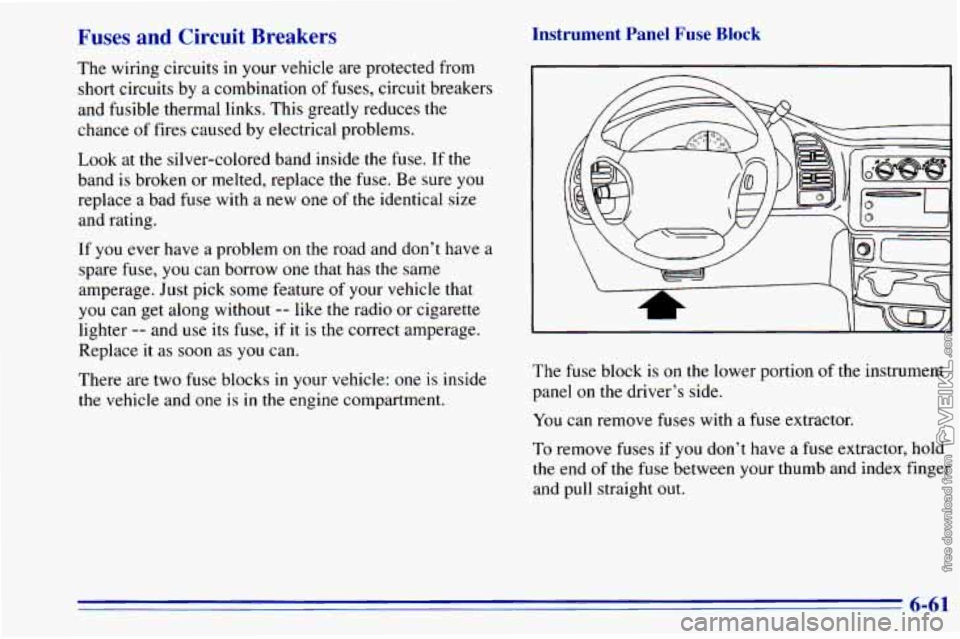
The fuse block is on the lower portion of the instrument
panel on the driver’s side.
You can remove fuses with a fuse extractor.
To remove fuses if you don’t have a fuse extractor, hold
the end of the fuse between your thumb and index finger
and pull straight out.
6-61