load capacity CHEVROLET ASTRO 1996 Owners Manual
[x] Cancel search | Manufacturer: CHEVROLET, Model Year: 1996, Model line: ASTRO, Model: CHEVROLET ASTRO 1996Pages: 372, PDF Size: 21.51 MB
Page 107 of 372
Luggage Carrier (Option)
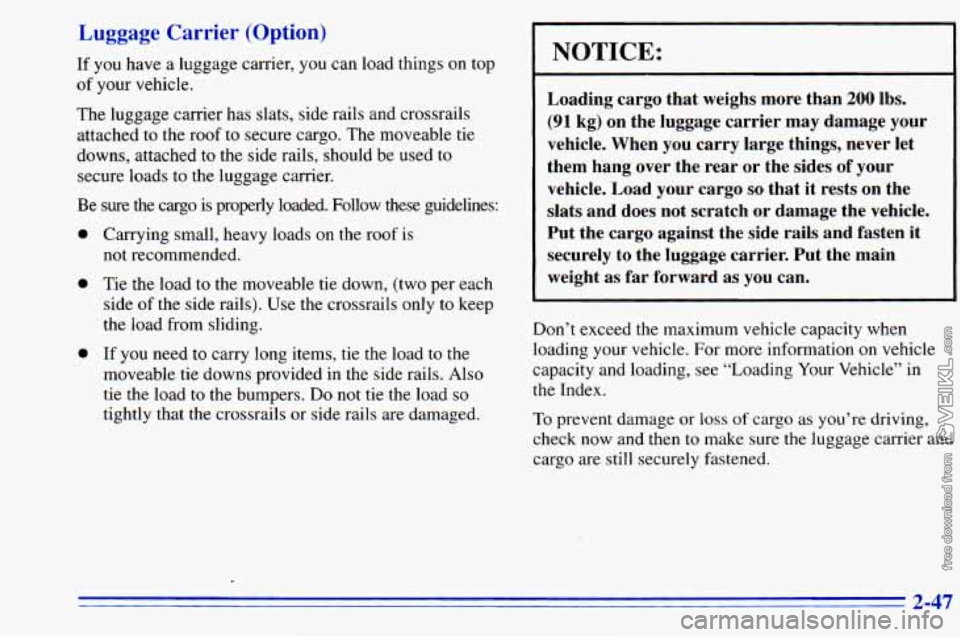
If you have a luggage carrier, you can load things on top
of your vehicle.
The luggage carrier has slats, side rails and crossrails
attached to the roof to secure cargo. The moveable tie
downs, attached to the side rails, should be used to
secure loads to the luggage carrier.
Be sure the cargo
is properly loaded. Follow these guidelines:
a
a
a
Carrying small, heavy loads on the roof is
not recommended.
Tie the load to the moveable tie down,
(two per each
side of the side rails). Use the crossrails only to keep
the load from sliding.
If you need to carry long items, tie the load
to the
moveable tie downs provided in the side rails. Also
tie the load to the bumpers.
Do not tie the load so
tightly that the crossrails or side rails are damaged.
NOTICE:
Loading cargo that weighs more than 200 lbs.
(91 kg) on the luggage carrier may damage your
vehicle. When you carry large things, never let
them hang over the rear or the sides
of your
vehicle. Load your cargo
so that it rests on the
slats and does not scratch or damage the vehicle.
Put the cargo against the side rails and fasten it
securely to the luggage carrier. Put the main
weight
as far forward as you can.
Don’t exceed the maximum vehicle capacity when
loading your vehicle. For more information on vehicle
capacity and loading, see “Loading Your Vehicle” in
the Index.
To prevent damage or loss of cargo as you’re driving,
check now and then to make sure the luggage carrier and
cargo are still securely fastened.
2-47
Page 180 of 372
Loading Your Vehicle
7
_I r7 , 1 u-- SEE OWNER'S MANUAL FOR ADDITIONAL INFORMATION 1 U
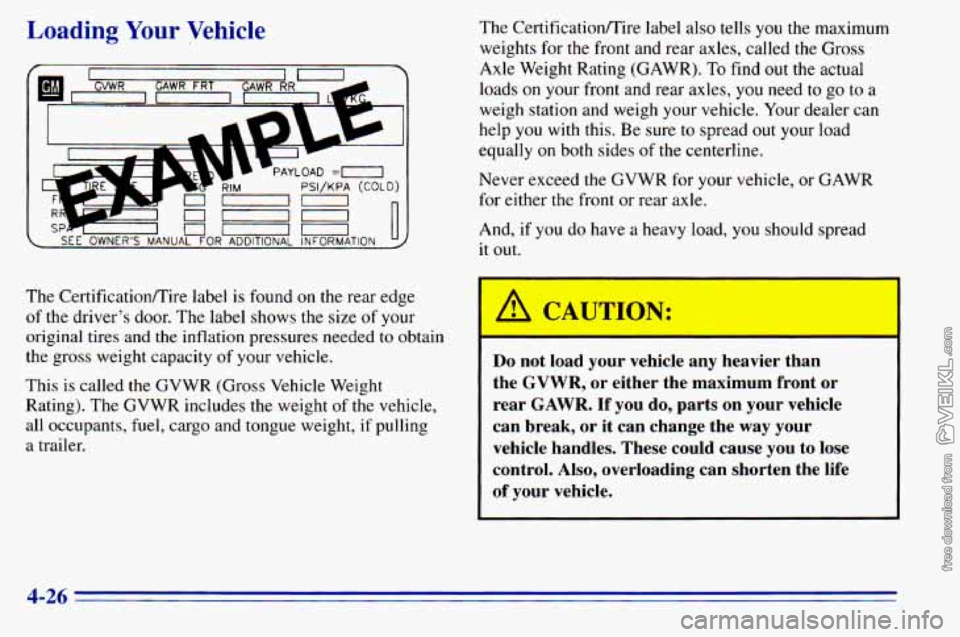
The CertificatiodTire label is found on the rear edge
of the driver's door. The label shows the size of your
original tires and
the inflation pressures needed to obtain
the gross weight capacity
of your vehicle.
This
is called the GVWR (Gross Vehicle Weight
Rating). The GVWR includes
the weight of the vehicle,
all occupants,
fuel, cargo and tongue weight, if pulling
a trailer. The Certificationmire
label also tells you the maximum
weights for the front and rear axles, called the Gross
Axle Weight Rating (GAWR). To find out the actual
loads
on your front and rear axles, you need to go to a
weigh station and weigh your vehicle. Your dealer can
help
you with this. Be sure to spread out your load
equally
on both sides of the centerline.
Never exceed
the GVWR for your vehicle, or GAWR
for either
the front or rear axle.
And, if you do have a heavy load,
you should spread
it out.
I
A CAUTION: I
I---
Do not load your vehicle any Ldvier than
the
GVWR, or either the maximum front or
rear
GAWR. If you do, parts on your vehicle
can break, or it can change the way your
vehicle handles. These could cause you to lose
control.
Also, overloading can shorten the life
of your vehicle.
4-26
Page 182 of 372
Payload
The Payload Capacity is shown on the Certificationflire
label. This is the maximum load capacity that your
vehicle can carry. Be sure
to include the weight of the
people inside as part of your load.
If you added any
accessories or equipment after your vehicle
left the
factory, remember to subtract the weight of
these things
from
the payload. Your dealer can help you with this.
Trailering Package
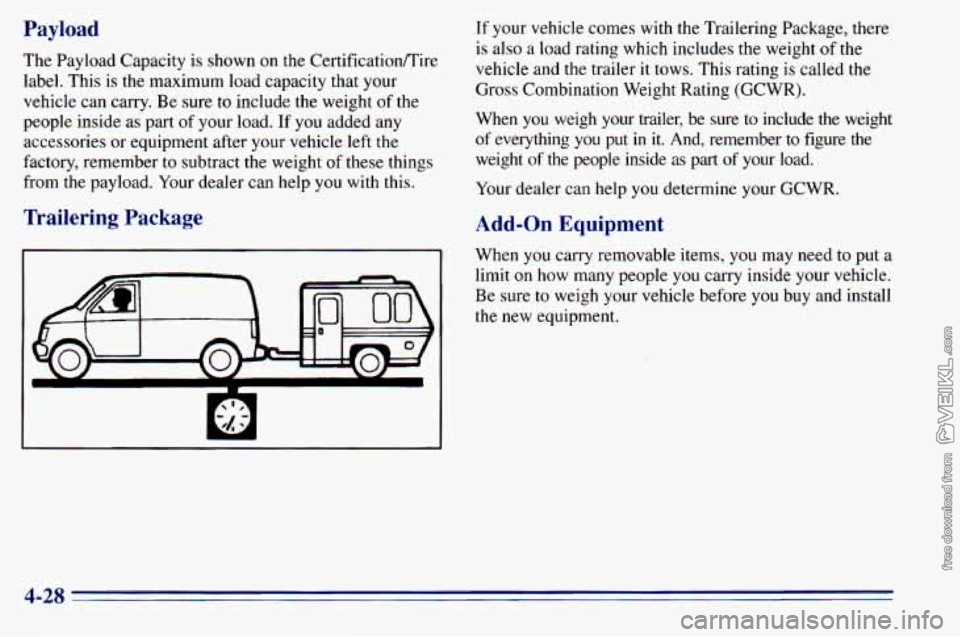
If your vehicle comes with the Trailering Package, there
is also a load rating which includes the weight of the
vehicle and
the trailer it tows. This rating is called the
Gross Combination Weight Rating (GCWR).
When
you weigh your trailer, be sure to include the weight
of everything you put in it. And, remember to figure the
weight
of the people inside as part of your load.
Your dealer can help
you determine your GCWR.
Add-on Equipment
When you carry removable items, you may need to put a
limit
on how many people you carry inside your vehicle.
Be sure to weigh your vehicle before you buy and install
the new equipment.
A 34
Page 185 of 372
Maximum trailer weight is calculated assuming the
driver and one passenger are in the tow vehicle and it
has all the required trailering equipment. The weight of
additional optional equipment, passengers and cargo in
the tow vehicle must be subtracted from the maximum
trailer weight.
You
can ask your dealer for our trailering information or
advice, or
you can write us at the address listed in your
Warranty and Owner Assistance Information Booklet.
In Canada, write to:
General Motors
of Canada Limited
Customer Assistance Center
1908 Colonel Sam Drive
Oshawa, Ontario LlH
8P7
Weight of the Trailer Tongue
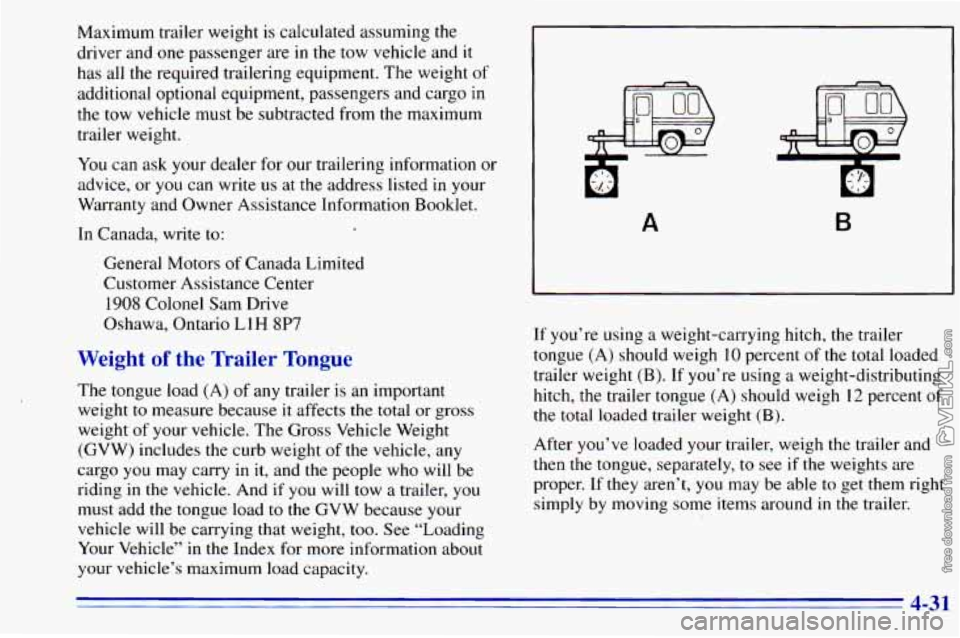
The tongue load (A) of any trailer is an important
weight to measure because it affects the total or gross
weight
of your vehicle. The Gross Vehicle Weight
(GVW) includes the curb weight of the vehicle, any
cargo
you may carry in it, and the people who will be
riding in the vehicle. And if
you will tow a trailer, you
must add the tongue load to the GVW because your
vehicle will be carrying that weight, too. See “Loading
Your Vehicle” in the Index for more information about
your vehicle’s maximum load capacity.
A B
If you’re using a weight-carrying hitch, the trailer
tongue (A) should weigh 10 percent of the total loaded
trailer weight (B). If you’re using a weight-distributing
hitch,
the trailer tongue (A) should weigh 12 percent of
the total loaded trailer weight (B).
After you’ve loaded your trailer, weigh the trailer and
then the tongue, separately,
to see if the weights are
proper. If they aren’t, you may be able to get them right
simply by moving some items around in
the trailer.
4-31
Page 277 of 372
Traction -- A, B, C
The traction grades, from highest to lowest, are A, B,
and C, and they represent the tire’s ability to stop on wet
pavement as measured under controlled conditions on specified government test surfaces of asphalt and concrete.
A tire marked C may have poor traction performance.
Warning: The traction grade assigned to this tire is based
on braking (straightahead) traction tests and does not
include cornering (turning) traction.
Temperature -- A, B, C
The temperature grades are A (the highest), B, and C,
representing
the tire’s resistance to the generation of
heat and its ability
to dissipate heat when tested under
controlled conditions
on a specified indoor laboratory
test wheel. Sustained high temperature can cause
the
material of the tire to degenerate and reduce tire life, and
excessive temperature can lead
to sudden tire failure.
The grade
C corresponds to a level of performance
which all passenger car tires must meet under the
Federal Motor Vehicle Safety Standard
No. 109. Grades
B and A represent higher levels of performance on the
laboratory test wheel than the minimum required by law.
Warning: The temperature grade for this tire is
established for a tire that
is properly inflated and not
overloaded. Excessive speed, underinflation, or excessive loading, either
separately or in combination.
can cause heat buildup and possible tire failure.
Wheel Alignment and Tire Balance
The wheels on your vehicle were aligned and balanced
carefully at the factory
to give you the longest tire life
and best overall performance.
In most cases, you will
not need to have your wheels
aligned again. However, if
you notice unusual tire
wear or your vehicle pulling one way or the other, the
alignment may need to be reset.
If you notice your
vehicle vibrating when driving
on a smooth road, your
wheels may need to be rebalanced.
Wheel Replacement
Replace any wheel that is bent, cracked, or badly rusted
or corroded. If wheel nuts keep coming loose,
the wheel,
wheel bolts and wheel
nuts should be replaced. If the
wheel leaks air, replace
it (except some aluminum
wheels, which can sometimes be repaired). See your
GM dealer if any of these conditions exist.
Your dealer will know
the kind of wheel you need.
Each new wheel should have the same load-carrying
capacity, diameter, width, offset and be mounted the
same way as
the one it replaces.
6-47
Page 297 of 372
Capacities and Specifications
Engine Specifications
Engine ............... “VORTEC” 4300 V6 SFI‘k
RPO ................................... L35
Firing Order
...................... 1-6-5-4-3-2
Horsepower
................... 190 at 4,400 rpm
Thermostat Specification
......... 195 “F (9 1 O C)
“Sequential Fuel Injection
Wheel Nut Torque
Base or Optional Wheel ....... 100 lb-ft (140 Nem)
Tire Pressures ......... .... See “Loading
Your Vehicle” in
the Index.
Cooling System Capacity
Quantity*
Without Rear Heater
13.5 quarts (12.8 L)
Quantity*
with Rear Heater
16.5 quarts (15.5 L)
*All quantities are approximate. After refill, the level must
be checked.
Crankcase Capacity
Quantity*
with Filter
................... 4.5 quarts (4.3 L)
*All quantities are approximate. After refill, the level
must be checked. Do not overfill.
Fuel Tank Capacity
Standard Tank* ...........
*All quantities are approximate,
Transmission Capacity
Automatic Transmission
(Drain and Refill)“
.........
*All quantities are approximate.
Rear Axle Capacity
Standard Rear Axle* . .
Locking Rear Axle” ..........
*All quantities are approximate.
. . 27 gallons (102 L)
. . 5.0 quarts (4.7 L)
. . 3.5 pint (1.7 L)
3.5 pint (1.7 L)
6-67